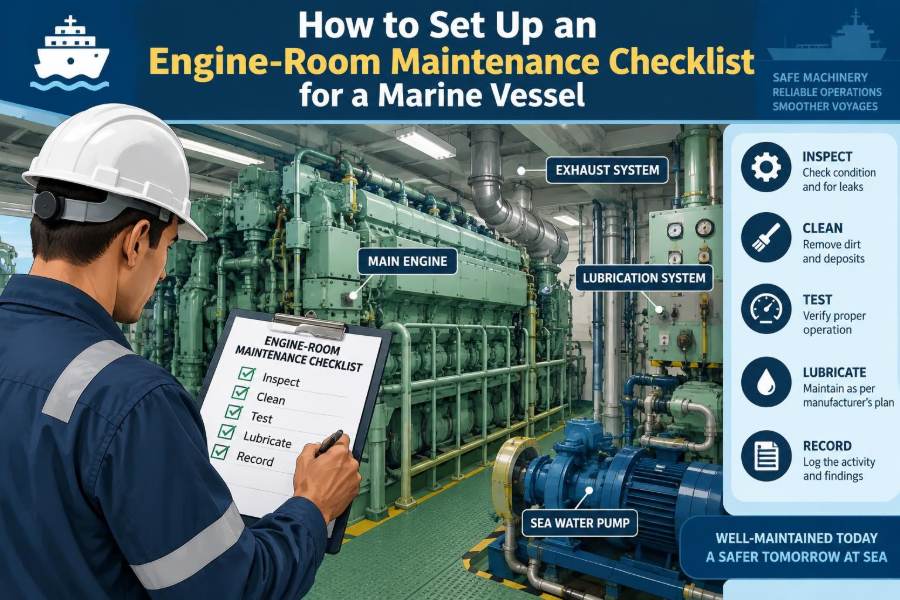

A chief engineer is called to the engine room after a routine round reveals a small pool of oil beneath an auxiliary engine. The engine is still running normally, temperatures look acceptable, and the vessel is on schedule. Yet the finding matters: a minor leak can become a fire hazard, an environmental issue, or the first visible sign of a developing machinery fault.
Situations like this explain why engine-room maintenance cannot depend on memory, habit, or whoever happens to be on watch. A well-built checklist turns many separate observations—levels, pressures, leaks, alarms, vibration, cleanliness, and records—into a repeatable system.
For students, a checklist shows how theoretical machinery knowledge becomes shipboard practice. For working engineers, it provides a practical control against missed tasks during busy watches, crew changes, port operations, and unexpected repairs.
The goal is not to create a long form that people tick without thinking. It is to build a living maintenance checklist that helps the crew identify abnormal conditions early, complete work safely, and preserve a reliable record of what was found and done.
⚙️ Start with the purpose of the checklist
Before listing tasks, decide what the checklist must achieve. Most engine-room maintenance checklists serve four connected purposes: maintaining reliability, protecting people, meeting operational and statutory requirements, and creating traceable records.
A task belongs on the checklist when it controls a known failure mode or confirms that a safety-critical condition remains acceptable. “Inspect pump” is too vague. “Check bilge pump suction strainer for debris and verify automatic start arrangement, where fitted” gives the user a meaningful action and a reason for it.
🧭 Separate operation from maintenance
Daily watchkeeping and planned maintenance overlap, but they are not identical. A watchkeeper records running parameters and responds to immediate abnormalities. Planned maintenance includes work due by time, running hours, condition, or manufacturer guidance.
Keep these streams clear. A daily round may detect a noisy bearing; a planned-maintenance task may require lubrication, vibration monitoring, or bearing replacement. The first identifies a condition, while the second controls the underlying equipment life cycle.
📚 Collect the documents before drafting
The checklist should be built from the vessel’s actual machinery and approved operating arrangements, not copied blindly from another ship. Gather manufacturer manuals, machinery drawings, piping diagrams, alarm lists, maintenance history, class or flag requirements where applicable, and the vessel’s safety management procedures.
Also review previous defect reports. Repeated issues—such as clogged purifier filters, leaking valve glands, or unreliable level switches—often deserve focused inspection points or clearer acceptance criteria.
🗺️ Map the engine room by system
Organizing by system makes a checklist easier to follow during rounds and easier to assign in a maintenance plan. It also helps engineers understand how one fault affects other equipment.
- Main propulsion machinery and shafting
- Diesel generators and electrical distribution
- Fuel oil, lubricating oil, cooling-water, and compressed-air systems
- Bilge, ballast, fire, and general-service systems
- Boilers, thermal-oil equipment, or exhaust-gas systems where installed
- Steering gear, deck machinery support systems, and emergency equipment
A physical route through the engine room can support this system structure. It reduces backtracking and makes it less likely that equipment in remote corners is forgotten.
🔍 Build every task around a failure mode
A strong checklist asks what can go wrong, how it becomes visible, and what action is needed. For a seawater cooling pump, possible failure modes include low suction pressure from a blocked strainer, seal leakage, bearing wear, or reduced flow.
The task should then target observable signs: check strainer differential condition, inspect for leakage, listen for abnormal bearing noise, and confirm pressure or temperature trends. This approach is more useful than generic wording such as “check pump condition.”
⏱️ Assign sensible maintenance intervals
Not every item needs attention every day. Set intervals using equipment criticality, operating hours, manufacturer instructions, environmental exposure, and the vessel’s own operating history.
Some checks are shift-based because failure can escalate quickly, such as bilge level, machinery leaks, and running temperatures. Other tasks may be weekly, monthly, after a stated number of operating hours, or triggered by condition-monitoring results.
| Interval | Typical focus | Example |
|---|---|---|
| Each watch or daily | Visible condition and operating parameters | Leaks, tank levels, temperatures, pressures, alarms |
| Weekly | Functional condition and housekeeping | Emergency generator space inspection, strainer checks |
| Monthly or periodic | Tests and detailed inspection | Alarm tests, battery condition, safety-device checks |
| Running-hour based | Manufacturer-specified servicing | Oil changes, filter renewal, valve-clearance checks |
Intervals should be reviewed when actual operating evidence shows they are unsuitable. Extending or shortening an interval should follow the vessel’s approved maintenance-control process.
🚨 Identify safety-critical equipment first
Give special prominence to equipment whose failure could directly threaten propulsion, steering, fire response, flooding control, electrical power, or emergency evacuation. These systems deserve unambiguous task wording, defined intervals, and clear escalation routes.
Examples may include emergency generators, fire pumps, bilge alarms, quick-closing valves, steering gear, emergency air compressors, and remote shutdown arrangements. Exact testing requirements vary by vessel design and applicable rules, so the checklist must match approved procedures rather than assume one universal method.
🛢️ Create a main-engine inspection block
The main engine section should combine operating observation with planned tasks. Include lube-oil pressure and temperature, cooling-water temperatures, fuel-system leakage, exhaust-temperature balance, crankcase condition where safe and permitted, and unusual noise or vibration.
Use trends rather than isolated numbers whenever possible. A temperature still inside its normal operating range may nevertheless require investigation if it has drifted steadily away from the cylinder-to-cylinder pattern.
⚡ Cover auxiliary engines and generators
Generator reliability is especially important when vessels operate cargo equipment, thrusters, reefers, or hotel loads. Checklist points should cover fluid levels, leaks, belt condition where fitted, cooling performance, exhaust condition, electrical load sharing, and panel indications.
For standby sets, include readiness checks. A generator that appears clean but cannot start automatically when called is not genuinely available. Record test results, starting-air or battery condition, and any defect that could prevent emergency use.
🔌 Include switchboards and electrical condition
Electrical inspection is not limited to reading voltage and frequency. Look for abnormal heat, loose covers, moisture, dust accumulation, damaged cable insulation, signs of arcing, and unexplained alarm indications.
Only authorized personnel should enter switchboards or carry out internal inspection. The checklist should direct the user to follow isolation and electrical-safety procedures, not encourage live work merely to complete a routine tick box.
🔥 Treat fuel systems as fire-prevention systems
Fuel oil is essential to propulsion, but leaked fuel near hot surfaces creates a serious engine-room hazard. Include checks for leaks at filters, pumps, injectors, pipe joints, flexible hoses, and drain arrangements.
Also inspect shielding and insulation around hot surfaces. A checklist should ask whether spray shields are secure and whether lagging is intact, dry, and free from oil contamination. Cleaning alone is not a repair; the leak source must be identified and controlled.
💧 Check cooling systems for flow and corrosion
Cooling failures often develop through restricted flow, air locks, fouling, corrosion, leaking seals, or poor treatment of the cooling medium. The checklist should cover expansion-tank level, pump condition, pressure trends, cooler performance, and seawater strainer condition.
For closed freshwater systems, record treatment results according to the vessel’s approved chemical program. Adding chemicals without testing or understanding compatibility can damage equipment or create misleading readings.
🛢️ Manage lubricating oil by condition
Oil levels matter, but oil condition matters too. Look for water contamination, unusual colour, burnt smell, excessive foaming, leakage, abnormal filter differential pressure, and unexplained consumption.
Oil analysis, where used, can help reveal wear metals, contamination, or declining lubricant quality. It should support—not replace—physical inspection and trend review. A sample is only useful when it is taken correctly, labelled accurately, and compared with meaningful past results.
🌬️ Inspect compressed-air systems
Starting air, control air, and service air may have different reliability consequences, but all require clean, dry, adequately pressurized supply. Include compressor oil level, discharge temperature, drains, air-receiver condition, leaks, and dryer or filter status.
Water accumulation in air systems can promote corrosion and interfere with pneumatic controls. Drain routines must follow the vessel’s approved procedure because hot condensate, pressurized equipment, and oily residues require care.
🧯 Make fire systems visible in the routine
Fixed firefighting systems, portable extinguishers, fire pumps, fire doors, dampers, and emergency stops should appear in maintenance planning at appropriate intervals. A checklist can confirm accessibility, seal condition, clear identification, and absence of obstruction.
Do not turn these checks into unplanned discharge or activation tests. Functional testing of fixed systems must follow approved instructions, since accidental release can endanger personnel and disable machinery.
🌊 Include bilge and pollution-prevention controls
Bilges reveal the health of the engine room. Increasing water, oil, or sludge may indicate a leaking cooler, failed seal, drain issue, or poor housekeeping. Record unusual bilge content and investigate the source rather than repeatedly pumping it away.
Checklist items should cover bilge alarms, wells, suction strainers, bilge-pump readiness, drip trays, sludge arrangements, and oil-record procedures where relevant. Disposal and transfer operations must comply with vessel procedures and applicable environmental rules.
🧰 Inspect pumps, valves, and strainers systematically
Small components create many operational failures. A seized valve, blocked strainer, worn mechanical seal, or incorrectly lined-up suction can stop an otherwise healthy system.
For each important pump, list its duty, standby arrangement, normal suction and discharge source, and key signs of poor performance. For valves, focus on leakage, accessibility, identification, correct securing, and operability when scheduled for testing.
🧪 Plan boiler and thermal-system checks carefully
Where fitted, boilers and thermal-oil systems require dedicated checklist sections because they involve heat, pressure, combustion, and water or oil quality. Typical observations include burner condition, flame indication, feedwater level, pressure, leakage, insulation, and combustion abnormalities.
Safety valves, low-water protections, and combustion safeguards must be maintained and tested only under approved procedures. These are not suitable areas for improvisation, especially during port turnarounds or reduced manning.
🛞 Do not overlook steering gear
Steering gear must remain reliable under normal and emergency conditions. Maintenance tasks may include checking hydraulic-fluid level, leaks, pipe condition, reservoir cleanliness, alarms, pumps, local controls, and communication arrangements.
Tests must be coordinated with the bridge and conducted according to the vessel’s procedures. A good checklist records not only that a test occurred, but also the operating mode used, the result, and any limitation found.
🧹 Make housekeeping an engineering task
Cleanliness is a practical control, not cosmetic work. Clean deck plates make leaks visible; clear escape routes improve emergency response; properly stowed tools reduce trip hazards and prevent damage to rotating machinery.
Include checks for oily rags, blocked access, unsecured stores, poor lighting, missing labels, slippery surfaces, and combustible material near hot equipment. Housekeeping tasks should name the condition to achieve, not simply say “clean engine room.”
📏 Define acceptance criteria
A tick box is weak if no one knows what “acceptable” means. Add limits, references, or observable standards where practical: no visible fuel leakage; bilge level below alarm point; correct lube-oil level within marked range; no abnormal vibration compared with normal operating condition.
Do not overload the sheet with every technical limit. For complex equipment, reference the manual, alarm set-point list, or planned-maintenance instruction. The checklist should guide action without becoming an unreadable technical manual.
✍️ Record findings, not just completion
Maintenance records need enough detail for the next engineer to understand what happened. “Checked OK” may be sufficient for a simple, routine visual check, but abnormal findings need location, symptom, measurement where relevant, action taken, and follow-up requirement.
A useful entry might state: “No. 2 generator seawater pump gland weeping; drip rate increased during run; spare seal kit requested; monitored each watch.” This creates continuity and helps the team judge whether the condition is stable or worsening.
🧾 Use a clear defect and escalation path
A checklist must never become a place where defects disappear into paperwork. Define what the user should do when a task fails: make safe, inform the responsible engineer, enter the defect, assess operational impact, arrange repair, and verify closure.
Different findings require different urgency. A loose label can be planned for correction, while fuel spray near an unprotected hot surface demands immediate control measures and prompt reporting. The checklist should direct escalation without asking watchkeepers to make unsupported risk decisions alone.
🦺 Put safety controls beside hazardous tasks
Some maintenance activities involve pressure, heat, rotating machinery, electricity, chemicals, or confined spaces. Put a brief safety prompt next to the task or reference the applicable permit and isolation procedure.
- Isolate, lock, tag, and prove dead before relevant work.
- Depressurize and drain systems before opening them.
- Allow hot components to cool where possible.
- Use suitable personal protective equipment.
- Confirm that standby equipment is available before taking duty machinery out of service.
These prompts reinforce safe sequencing, but they do not replace formal risk assessment or the vessel’s safety-management system.
👥 Assign ownership without losing teamwork
Every task needs a responsible role, such as motorman, engineer officer, electrician, or chief engineer. Ownership reduces ambiguity, especially during busy periods. However, responsibility should not prevent cross-checking or reporting by any crew member.
For critical checks, consider independent verification or a supervisor sign-off. This is useful when a task restores a safety barrier, returns equipment to service, or involves a configuration that could affect propulsion or emergency response.
💻 Choose paper, digital, or hybrid records
Paper checklists are simple, resilient, and often convenient in machinery spaces. Digital planned-maintenance systems can schedule running-hour tasks, retain history, generate reports, and link defects to spare parts. Many vessels use both.
The best format is the one crew can use accurately under real conditions. A digital system with poor onboard access, confusing screens, or no practical work flow may encourage delayed entries. A paper system without review can make trends hard to find.
🔄 Link tasks to spares and tools
A maintenance task is only partly planned if the required gasket, filter, test instrument, lifting gear, or special tool is unavailable. For recurring jobs, note essential consumables and confirm stock before the maintenance window.
Critical spares should be controlled through the vessel’s inventory process. The checklist can flag a low-stock condition, but it should not substitute for proper spare-parts planning or approved purchasing controls.
📈 Review trends during handovers
A checklist becomes more valuable when its records are reviewed rather than filed away. During handover, discuss defects, recurring alarms, fluid consumption, changing temperatures, overdue jobs, and equipment placed under monitoring.
Trend review often reveals slow deterioration. For example, repeated cleaning of the same seawater strainer may point to seasonal debris, an intake problem, or an unsuitable inspection interval—not merely a routine cleaning task.
🚫 Avoid the tick-and-forget trap
The most common checklist failure is superficial completion. This can happen when forms are too long, task wording is vague, schedules do not reflect workload, or crew members believe reporting defects will only create blame.
Counter this by removing low-value duplication, training crew on the purpose of each critical task, and treating accurate defect reporting as professional evidence. A documented abnormality is not a failure of the checklist; ignoring it is.
🧠 Train people to recognize abnormal conditions
Checklists support judgement; they do not replace it. Junior engineers should learn what normal machinery sounds, smells, feels, and looks like, while always following safe boundaries around running equipment.
Use toolbox talks, handovers, and supervised rounds to explain why a particular check exists. A person who understands that a rising pump temperature can indicate poor lubrication or bearing damage is more likely to report it early.
📝 Build a practical checklist template
Each line should be short enough to use during work but specific enough to produce consistent results. A practical format commonly includes the system, task, interval or trigger, acceptance criterion, responsible role, record location, and action for abnormal findings.
For example: “Daily: inspect fuel-transfer pump and surrounding tray for leakage; no active leak or oil accumulation permitted; report and contain any leakage immediately.” The wording tells the engineer what to inspect, what acceptable looks like, and what happens next.
🔧 Test the checklist on real rounds
Drafting at a desk is only the first stage. Ask the engineers and ratings who perform the rounds to use the draft in the engine room. Note unclear terms, missing locations, duplicate tasks, impractical intervals, and checks that require tools not readily available.
Revise the document after this trial. A checklist should reflect the vessel’s layout, operating profile, manning, and equipment condition—not an idealized engine room.
✅ Keep the checklist controlled and current
Machinery modifications, new equipment, altered operating patterns, recurring defects, and revised procedures can all make an old checklist inaccurate. Use document control so the crew knows which version is current and why changes were made.
Review the checklist after significant failures or near misses as well as on a planned basis. The aim is learning: determine whether the task, interval, acceptance criterion, training, or escalation process needs improvement.
🌟 The core principle: make maintenance observable
An effective engine-room maintenance checklist translates reliability into observable actions. It tells people what to look at, what normal condition means, when work is due, who owns it, and what to do when something is wrong.
Its real value is not the completed form. Value comes from earlier detection, safer maintenance decisions, better handovers, and records that allow the engineering team to learn from the vessel’s actual condition.
A checklist works when it helps people notice, understand, act on, and learn from changing machinery condition before a small defect becomes an operational problem. Built carefully and used honestly, it becomes one of the most dependable tools in the engine room. 🚢🔧🦺