
A container ship arriving at a busy terminal can look like a single, enormous machine: steel hull, stacked boxes, cranes working ashore, and a crew preparing for the next voyage. Behind that apparently simple scene is a chain of decisions that began years earlier, long before the vessel first touched water.
Someone had to decide what cargo it would carry, where it would trade, how fast it should sail, which engine and fuel system it needed, and how much uncertainty its owner was willing to accept. Each decision changes both the price of building the ship and the cost of keeping it commercially useful.
For a shipowner, the purchase price is only the opening commitment. For a charterer, operator, engineer, cargo customer, or student, the more revealing question is often the lifetime cost: what must be paid every day the ship is available, sailing, waiting, repairing, or complying with new rules?
A cargo ship is therefore best understood not as a product with one price tag, but as a long-lived transport system. Its economics connect naval architecture, machinery, finance, ports, fuel markets, maintenance planning, and the practical work of people at sea.
⚓ Start with the difference between capital and operating cost
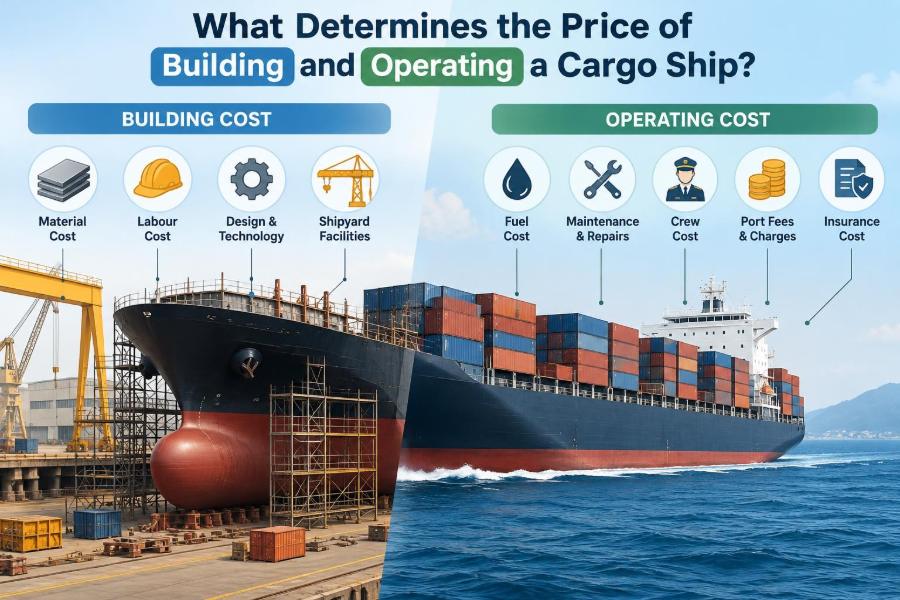
Ship costs are commonly divided into capital expenditure and operating expenditure. Capital expenditure is the money required to acquire the asset: design, construction, equipment, financing arrangements, and delivery preparation.
Operating expenditure covers the continuing cost of running it. This includes crew, maintenance, insurance, stores, repairs, administration, and often fuel, although fuel is sometimes accounted for separately because it can dominate voyage economics.
This distinction matters because a cheaper ship can be more expensive over its useful life. A design that saves money at the shipyard may consume more fuel, require more maintenance, or lose earning time later.
📦 The ship type sets the economic starting point
There is no meaningful single “cargo ship price.” A small coastal general cargo vessel, a feeder container ship, a bulk carrier, a chemical tanker, and an LNG carrier perform different jobs and require very different systems.
Bulk carriers often use large, relatively open cargo holds for unpackaged dry cargo such as grain or ore. Container ships need cell guides, lashing arrangements, high electrical capacity for refrigerated containers, and hull forms suited to scheduled liner service.
Tankers introduce pumps, piping, segregated tanks, cargo control systems, and, depending on cargo, coatings or stainless-steel tanks. Specialized capability tends to increase initial cost because it adds equipment, testing, engineering, and compliance obligations.
📏 Size changes more than the amount of steel
A larger vessel generally needs more steel, more powerful machinery, larger tanks, stronger structure, and more extensive outfitting. Those requirements raise construction cost. Yet capacity does not always rise in direct proportion to cost.
This is the principle of economies of scale. If a larger bulk carrier carries substantially more cargo without requiring twice the crew or twice the fuel, its transport cost per tonne may fall.
Scale has limits. A larger ship may be unable to use shallow ports, narrow channels, smaller repair docks, or terminals with limited crane outreach. A vessel that cannot call at profitable ports may lose the commercial advantage that justified its size.
🏗️ Shipyard location and production capability matter
Shipyards differ in labour cost, supplier networks, dry-dock dimensions, automation, experience, available berths, and production workload. A yard that repeatedly builds a particular ship type can reduce rework and manage interfaces more efficiently than a yard starting from scratch.
Building in a lower-cost region does not automatically mean a lower total cost. Owners also assess build quality, supervision, delivery reliability, warranty support, access to approved equipment, and the practicality of resolving defects after delivery.
When yard capacity is tight, prices can rise even if the physical design has changed little. Shipbuilding is a project-based industry, so orderbook demand and available slots strongly influence quoted prices.
🧱 Steel is essential, but it is not the whole bill
Hull steel is a major material input, and changes in steel prices can affect newbuilding quotations. The hull, however, is only one part of the vessel.
Outfitting includes pipes, valves, cables, insulation, accommodation spaces, deck machinery, paint systems, navigation equipment, automation, pumps, ventilation, and thousands of smaller components. On a complex ship, outfitting can represent a very large share of the build effort.
Steel also has a quality dimension. Different structural areas require specified grades, thicknesses, welding procedures, and corrosion allowances. Choosing material is not simply a matter of buying the cheapest available plate.
🔩 Design complexity drives engineering hours
A standard design can be adapted from an existing vessel with modest changes. A highly customized design may require detailed analysis of structure, stability, cargo systems, electrical load, machinery integration, and operational risks.
For example, an owner may request a particular cargo-handling arrangement, unusual hatch dimensions, ice strengthening, a shallow draft, or enhanced accommodation. Each request can affect multiple systems rather than one isolated feature.
Customization can create real commercial value, but it should solve a defined operational problem. Features added without a clear revenue, safety, or compliance benefit can make construction and later maintenance unnecessarily difficult.
🛠️ The main engine is a lifecycle decision
The propulsion plant affects newbuilding cost, fuel consumption, machinery-space layout, maintenance workload, spare-part needs, and emissions performance. It is not merely a component selected from a catalogue.
Slow-speed two-stroke diesel engines are common on large ocean-going cargo ships because they can propel a fixed-pitch propeller efficiently at low rotational speed. Other vessel types may use medium-speed engines, diesel-electric arrangements, or more specialized plants.
A larger engine may allow higher speed or reserve power in difficult conditions, but it can cost more to buy and operate. Underpowered machinery, on the other hand, can restrict schedule recovery and safe manoeuvring margins.
⛽ Fuel choice reshapes both price and risk
Conventional marine fuels remain widely used, but fuel selection is increasingly connected to emissions rules, fuel availability, charterer expectations, and a vessel’s anticipated trading pattern. Systems for LNG, methanol, LPG, batteries, shore-power connection, or other alternatives can change the capital budget substantially.
These systems may require larger or differently shaped tanks, fuel preparation equipment, additional safety arrangements, crew training, and revised machinery layouts. The space taken by fuel storage can also reduce cargo capacity or alter the ship’s design compromise.
There is no universal “future-proof” fuel solution. A sensible choice depends on expected routes, bunkering access, regulatory exposure, asset life, and the owner’s tolerance for technology and fuel-supply uncertainty.
🌬️ Energy-efficiency features cost money before they save it
Modern cargo ships may include optimized hull lines, efficient propellers, ducts, fins, air-lubrication systems, waste-heat recovery, shaft generators, improved coatings, and advanced performance-monitoring tools. Some measures are modest additions; others require significant integration.
The business case depends on the vessel’s duty cycle. A device that saves fuel on long, steady ocean passages may be less valuable on a ship that spends much of its time maneuvering, waiting, or making short coastal calls.
Owners should evaluate expected savings against installation cost, maintenance needs, reliability, and off-hire risk. Efficiency is a system property: hull, propeller, engine loading, weather routing, trim, and operating speed interact.
🧭 Regulatory compliance is built into the design
International and flag-state requirements influence fire safety, lifesaving appliances, pollution prevention, stability, navigation, radio communications, crew accommodation, and machinery arrangements. Classification societies verify that designs and construction meet applicable class rules and standards.
Compliance is not an optional add-on after the ship has been built. It shapes layouts, equipment specifications, documentation, inspections, and tests throughout construction.
Rules evolve. A design may therefore include reserve space, electrical capacity, or structural provisions for equipment that could be fitted later. Such foresight costs money, but retrofitting a crowded machinery space can be far more disruptive.
🧪 Cargo containment can dominate specialized vessel cost
For many ships, the cargo system is the defining cost driver. A product tanker needs safe segregation and efficient pumping; a chemical tanker may require specialized coatings or stainless steel; a gas carrier needs insulated pressure or cryogenic containment systems.
These vessels also rely on instrumentation, alarms, ventilation, cargo heating or cooling, and carefully designed emergency arrangements. The cargo itself determines much of the engineering challenge.
A useful comparison is a delivery van and a refrigerated pharmaceutical vehicle. Both move goods, but the second must control temperature, monitor conditions, protect a sensitive product, and document performance. Ships face the same principle at a much larger scale.
⚡ Electrical demand is no longer a minor detail
Electrical systems support pumps, reefers, deck machinery, accommodation, automation, navigation, lighting, cargo handling, and sometimes hybrid propulsion or shore-power operation. A container ship carrying many refrigerated units may need especially high generating capacity.
Redundancy is also important. Critical services may need backup generators, separated switchboards, emergency power, and protection systems designed to prevent one failure from disabling the ship.
More electrical capability increases equipment cost and installation complexity, but inadequate capacity can constrain cargo intake, operational flexibility, and safety.
👷 Labour and supervision shape quality as well as cost
Building a ship requires welders, pipefitters, electricians, painters, riggers, commissioning engineers, surveyors, designers, and production planners. Their availability and skill affect both schedule and workmanship.
Owner supervision teams monitor whether the ship is being built to contract, drawings, and agreed standards. They inspect hidden work before spaces are closed, witness tests, record deficiencies, and follow corrective actions.
Reducing supervision may appear to save money during construction, but it can shift defects into the operating period, when access is harder and repairs may cause costly off-hire.
🧾 Contract terms change the real newbuilding price
A shipbuilding contract defines far more than the headline price. It addresses technical specifications, payment milestones, delivery window, permissible delays, tests, guarantees, warranty terms, change orders, and the responsibilities of yard and owner.
Currency exposure also matters. If revenues, loans, yard payments, and equipment purchases are denominated in different currencies, exchange-rate movements can affect the effective cost.
Comparing quotations requires a like-for-like scope. One offer may include owner-furnished equipment, training, spares, or commissioning support that another excludes. The lowest quoted figure is not always the lowest completed cost.
💳 Financing turns a ship price into a cash-flow commitment
Few vessels are paid for entirely from immediately available cash. Financing may involve bank debt, leasing, export credit support, equity, or other arrangements. Interest, repayment schedules, covenants, fees, and collateral requirements affect the owner’s financial burden.
Debt service continues even when freight markets weaken or the vessel is idle. This is why capital structure can be as important as technical efficiency during a downturn.
Financial analysis should test several scenarios rather than relying on one optimistic freight-rate forecast. A ship can be technically excellent and still become financially stressed if earnings fall below fixed obligations.
👥 Crewing is a daily operating cost and a safety system
Crew expense includes wages, benefits, travel, training, insurance, recruitment, relief planning, and management support. The required number and competence of seafarers depend on the vessel, flag, trade, automation level, and applicable minimum safe-manning decisions.
Trying to minimize crew cost without considering workload can create fatigue, deferred maintenance, paperwork overload, and safety risk. Automation may reduce some routine tasks, but it also requires people who can diagnose complex systems.
Good crewing is not merely an expense line. Competent crews protect machinery, cargo, schedules, and the vessel’s condition.
🛢️ Fuel cost depends heavily on speed and route
Fuel is often the most variable and influential voyage cost. Resistance rises sharply with speed, so the power required to gain a relatively small increase in speed can be substantial. The exact relationship depends on hull form, displacement, sea state, fouling, trim, and loading condition.
Slow steaming—operating below a vessel’s maximum commercial speed—can reduce fuel use significantly on suitable routes. It may also require more ships to maintain a fixed weekly service, so the system-level result needs careful assessment.
Weather, currents, congestion, and port readiness matter too. Burning fuel to arrive early only to wait at anchorage is poor operational coordination.
🧽 Hull condition quietly affects the fuel bill
Marine growth, rough coatings, damaged propeller surfaces, and hull fouling increase resistance through the water. The vessel must then use more power to maintain the same speed.
Coating selection, hull cleaning, propeller polishing, and performance monitoring are therefore commercial decisions as well as maintenance tasks. Their value depends on trading waters, idle time, coating condition, cleaning restrictions, and the vessel’s operating profile.
A practical lesson is to establish a performance baseline after delivery or dry docking. Without reliable speed, power, draft, weather, and fuel data, it is difficult to distinguish a genuine efficiency loss from normal voyage variation.
🔧 Maintenance prevents small defects becoming off-hire events
Maintenance expenditure includes planned servicing, condition monitoring, lubricants, consumables, spare parts, riding squads, and repairs. Some work is predictable, such as routine overhauls; other work follows an unexpected failure.
Off-hire is time when a chartered vessel is not earning hire because it cannot perform as required under the charter terms. A failed pump, crane, generator, or main-engine component can therefore create both repair cost and lost revenue.
Deferring maintenance may conserve cash temporarily, but it can increase failure probability and shorten component life. The goal is not maximum maintenance spending; it is timely, evidence-based maintenance that protects availability.
🛁 Dry docking is a planned but expensive interruption
Ships periodically enter dry dock for underwater inspection, hull coating work, rudder and propeller attention, sea-valve servicing, structural repairs, and class-related surveys. The vessel earns little or nothing from trading while it is out of service.
A dry-dock budget includes yard fees, dock services, coatings, steel renewal, machinery work, survey attendance, logistics, and contingency. The final amount can rise if inspection reveals corrosion, cracking, worn equipment, or previously hidden damage.
Strong preparation reduces surprises: inspect known problem areas, order long-lead spares early, define the scope, and coordinate class requirements before the vessel enters dock.
🛡️ Insurance transfers risk but does not remove it
Hull and machinery insurance addresses physical damage to the vessel within policy terms. Protection and indemnity cover is associated with third-party liabilities, including areas such as crew claims, pollution liabilities, and cargo-related exposures, again subject to rules and conditions.
Premiums reflect vessel characteristics, claims history, trading areas, insurer appetite, deductibles, and market conditions. Insurance is a significant operating cost, but uninsured or poorly understood exposures can be much more damaging.
Operators should also recognize that good risk management affects more than premiums. It reduces accidents, delays, detentions, cargo claims, and damage to commercial relationships.
⚓ Port charges and canal tolls shape route economics
A ship pays for more than fuel while moving cargo. Typical voyage-related expenses can include port dues, pilotage, towage, mooring, agency services, berth charges, cargo-handling costs, freshwater, waste services, and canal transit charges where relevant.
These charges vary with vessel size, port rules, cargo, duration of stay, and local service needs. A route that appears shorter on a chart may not be cheaper after tolls, fuel, time, draft restrictions, and port costs are considered.
Port efficiency matters as well. Faster, predictable turnarounds allow a vessel to complete more productive voyages each year, provided the schedule does not compromise safe operations.
📄 Administration, certification, and digital systems add up
Shore-based technical management, crewing administration, accounting, legal support, communications, software, cyber-risk controls, audits, certificates, and inspections are all part of operating a commercial ship.
Individually, many are less visible than fuel or dry docking. Together, they enable the vessel to trade legally, document cargo operations, maintain records, communicate with ports, and respond to incidents.
Digital tools can improve reporting and performance analysis, but they also require reliable data, crew acceptance, training, support contracts, and cyber security. Buying software without fitting it into working routines rarely produces the promised benefit.
⏳ Reliability has a direct economic value
A vessel’s availability is a core commercial asset. A reliable ship meets loading windows, completes charter commitments, avoids emergency repair bills, and gives operators confidence when planning fleets and cargo flows.
Reliability comes from design margins, quality construction, competent operation, spare-parts strategy, disciplined maintenance, and prompt investigation of recurring faults. It cannot be purchased through one decision alone.
Consider two hypothetical sister ships with similar fuel consumption. If one suffers repeated generator failures that delay cargo operations, its total economics may be worse despite having the same basic design.
📉 Freight markets influence whether costs can be recovered
Freight revenue is shaped by supply and demand for shipping capacity, cargo volumes, trade routes, seasonal patterns, port disruptions, and broader economic conditions. Owners cannot simply raise rates whenever their own costs increase.
This creates a central shipping risk: many costs are fixed or difficult to reduce quickly, while earnings can move sharply. A vessel may be profitable in one market period and struggle in another without changing physically.
Long-term contracts can provide income visibility, while spot-market exposure can capture stronger rates. Neither approach is universally superior; the right balance depends on the company, fleet, cargo relationships, and risk strategy.
🧮 A simple way to think about daily ship economics
Operators often convert different expenses into a daily figure so alternatives can be compared. A simplified conceptual model is:
Daily cost = capital cost + operating cost + maintenance allowance + insurance + voyage-related cost
The actual calculation is more detailed. Some costs are fixed per day, some vary by voyage, and some occur irregularly but should be accrued over time, such as major surveys or dry docking.
For a hypothetical vessel, saving fuel by reducing speed may lower the daily fuel bill but lengthen the voyage. The useful comparison is not only cost per day; it may also include cost per tonne carried, cost per container moved, annual voyages completed, and contractual schedule performance.
📊 Compare costs across the vessel’s whole life
Lifecycle costing asks what the vessel will cost from design through disposal or recycling, rather than focusing only on delivery price. It includes expected fuel, maintenance, surveys, upgrades, financing, downtime, and residual value.
This approach is especially valuable when comparing a conventional design with a more efficient or alternative-fuel design. The higher-priced option may earn its premium only under certain fuel prices, utilization levels, routes, or regulatory conditions.
| Decision | Possible short-term effect | Potential lifecycle consequence |
|---|---|---|
| Lower initial equipment specification | Reduced newbuilding cost | Higher maintenance, lower reliability, or earlier replacement |
| Larger cargo capacity | Higher capital and port cost | Lower unit transport cost if ports and demand support it |
| Efficiency technology | Higher installation and integration cost | Lower fuel use if suited to the operating profile |
| Deferred maintenance | Lower immediate cash outlay | Greater failure and off-hire exposure |
🚫 Common mistakes in ship cost comparisons
A frequent mistake is comparing vessels by deadweight tonnage or container capacity alone. Two ships with similar capacity can have very different cargo systems, speed, ice class, fuel arrangements, electrical loads, port limitations, and maintenance requirements.
Another mistake is assuming the design consumption figure will occur on every voyage. Actual consumption depends on draft, weather, hull condition, speed, engine condition, and auxiliary loads.
It is also risky to ignore downtime. A low-cost maintenance plan that produces more breakdowns may look attractive in a spreadsheet that counts repair invoices but not missed charter income or disruption to customers.
🧠 Better decisions use scenarios, not one forecast
Because fuel prices, freight rates, interest rates, regulations, and technology availability can change, ship investment decisions should be tested against several credible conditions. This is often called sensitivity analysis.
Useful questions include:
- What happens if the vessel spends more time at low speed?
- What if a preferred fuel is unavailable on part of the route?
- Can the ship still trade profitably with lower utilization?
- Which failures would create the longest off-hire period?
- What upgrades may be needed before the vessel reaches mid-life?
Scenario planning does not predict the future perfectly. It reveals which assumptions have the greatest influence and where flexibility is worth paying for.
🌍 Environmental performance is becoming a commercial variable
Fuel efficiency and emissions performance can affect charter attractiveness, access to certain trades, reporting requirements, and future upgrade needs. Environmental equipment should therefore be assessed as part of commercial capability, not treated solely as a compliance burden.
However, technology choices involve trade-offs. A system that lowers one type of emission may add energy demand, maintenance complexity, or supply-chain dependency. Engineers and operators need to examine the entire operating context.
Clear performance data, realistic operating assumptions, and provision for maintenance are more valuable than vague claims of sustainability.
🤝 Collaboration between departments prevents expensive surprises
Naval architects, marine engineers, superintendents, masters, crews, chartering teams, finance staff, insurers, and port specialists see different parts of the same economic system. A technically elegant solution can fail commercially, while a financially attractive plan can create an unmanageable workload at sea.
Early communication is particularly valuable during design and dry-dock planning. Crew experience can reveal maintenance access problems; commercial teams can identify port restrictions; engineers can explain machinery consequences before a contractual promise is made.
The strongest decisions connect these perspectives rather than letting each department optimize its own narrow cost line.
🧭 The core principle: cost follows the mission
The price of building and operating a cargo ship is determined by the mission the vessel must perform: cargo type, route, ports, speed, environmental requirements, expected utilization, and required reliability. Steel, engines, fuel, crew, finance, and regulation are all consequences of that mission.
A sound ship investment is not necessarily the cheapest vessel, the largest vessel, or the one with the most advanced technology. It is the vessel whose design and operating model match a realistic trade well enough to earn safely and reliably over time.
For students and professionals alike, the key habit is to ask what each cost buys: capacity, efficiency, compliance, flexibility, safety, or availability. That question turns a list of expenses into an engineering and commercial decision.
A cargo ship succeeds economically when its whole-life cost is aligned with the work it is genuinely able to do. That alignment is built through careful design, disciplined operation, and realistic assumptions—not by chasing the lowest number on the first quotation. 🚢⚓📈