
A chief engineer reviewing a fuel changeover does not begin with an abstract question about which fuel is “safe.” They think about tank pressures, ventilation fans, detector readings, transfer procedures, crew competence, and what could happen if one barrier fails at sea.
For a cadet, an alternative-fuel engine room can look familiar: pumps, pipework, valves, control panels, and machinery spaces. But the hazard can be fundamentally different. A small diesel leak is usually a liquid fuel and fire-management problem; an ammonia release can become an immediate toxic-exposure problem even when there is no fire.
Fuel choices are changing because ships must reduce air pollution and greenhouse-gas emissions. LNG, methanol, and ammonia can each play a role, but they shift the safety case rather than removing it.
So, which is safer? The useful engineering answer is: safer for which operation, in which ship, with which safeguards, and with what level of crew preparedness? This comparison explains the hazards behind that answer.
⚖️ Safety Is Not a Single Fuel Property
Fuel safety has several dimensions. A fuel may be hard to ignite but highly toxic. Another may burn readily but be easy to see, smell, contain, and manage using well-established shipboard practices.
A sound comparison considers the whole chain: bunkering, storage, transfer, conditioning, engine use, maintenance, emergency response, and disposal or venting arrangements. It also considers people outside the ship, including bunker personnel, pilots, terminal workers, and nearby vessels.
Calling one fuel universally safest hides these trade-offs. Marine engineers instead build a safety case: a structured argument showing that hazards have been identified and reduced through design, procedures, training, and verification.
🧭 The Four Fuels at a Glance
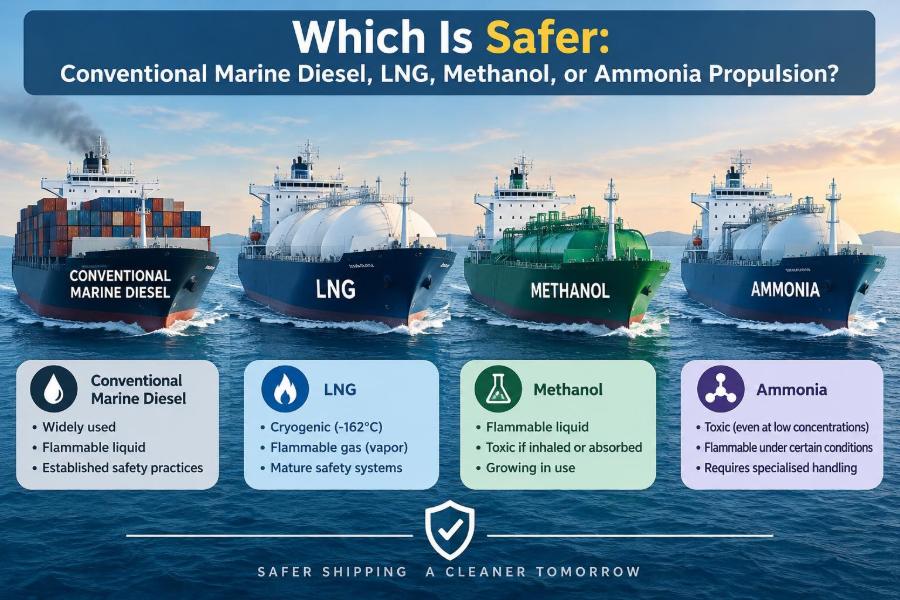
| Fuel | Dominant safety concern | Useful safety characteristic | Typical design focus |
|---|---|---|---|
| Marine diesel | Fire, hot-surface ignition, spills | Extensive operational experience | Leak containment and fire protection |
| LNG | Cryogenic release, flammable gas cloud, pressure | Non-toxic methane vapour in the usual acute-exposure sense | Gas detection, ventilation, double barriers |
| Methanol | Toxic exposure, low-flashpoint liquid fire | Liquid at ambient conditions | Leak detection, drainage, personal protection |
| Ammonia | Severe toxicity and corrosive exposure | Difficult to ignite compared with conventional fuels | Containment, detection, evacuation, treatment systems |
This table is a starting point, not a ranking. The same fuel can be handled differently on a small coastal vessel, a tanker, a container ship, or an offshore support vessel.
🔥 Conventional Diesel: Familiar Does Not Mean Harmless
Conventional marine diesel, including distillate and residual fuel systems, has decades of design rules, operating routines, spare-part familiarity, and crew experience behind it. That maturity is a real safety advantage.
However, diesel is combustible. Leaks from high-pressure injection lines, defective pipe joints, fuel heaters, or poorly maintained valves can reach hot exhaust components and ignite. Engine-room fire prevention is therefore based on shielding, lagging, leak detection, drainage, quick-closing valves, and disciplined maintenance.
Diesel also presents spill and pollution risks. Its hazard profile is familiar, but it remains serious because fuel systems operate close to ignition sources.
🛢️ Why Diesel Usually Has a High Flash Point
Flash point is the lowest temperature at which a liquid produces enough vapour above its surface to ignite briefly when exposed to an ignition source. Marine diesel generally has a much higher flash point than methanol, which means it does not normally form ignitable vapour at ordinary engine-room ambient temperatures.
That characteristic helps during handling and storage. It does not make a spray leak safe. Fine droplets from pressurised fuel can ignite readily, particularly when they strike a hot surface. Engineers must distinguish between a calm pool of liquid and an atomised leak under pressure.
❄️ LNG: A Different Type of Fuel System
Liquefied natural gas is natural gas cooled to a cryogenic liquid state for transport and storage. In practical marine systems, it is mainly methane. Its storage temperature is extremely low, and its volume expands greatly when it vaporises.
Unlike diesel, LNG systems must manage both a cold liquid and a pressurised or ventilated gas phase. Tanks, piping, valves, insulation, vapour handling, and emergency shutdown arrangements are all designed around this reality.
LNG is not simply “gasoline for ships” or “cleaner diesel.” It is a distinct fuel-system discipline with cryogenic and gaseous-fuel hazards.
🥶 The Cryogenic Hazard of LNG Releases
An LNG leak can cause severe cold burns and can make ordinary structural materials brittle if they are not suitable for cryogenic exposure. A release may also create a visible vapour cloud because moisture in the air condenses, though the visible cloud does not always precisely show the flammable boundary.
Cold liquid can damage coatings, cable insulation, equipment supports, and deck structures if the design does not provide spill protection. This is why LNG installations use carefully selected materials, drip trays or spill containment where appropriate, protected routing, and separation from critical equipment.
💨 Gas Clouds and Ignition Control
As LNG warms, it vaporises into methane. Methane is flammable when mixed with air within a certain concentration range. If gas accumulates in an enclosed or poorly ventilated space, ignition can produce a flash fire or explosion.
The central strategy is to prevent a flammable mixture from forming and to eliminate ignition sources where it might form. Typical barriers include double-wall piping, ventilated ducts, gas-tight boundaries, automatic shutdown valves, hazardous-area electrical equipment, and fixed gas detection.
Ventilation is not a substitute for containment. It is one layer in a system intended to keep leaked gas from reaching hazardous concentrations.
📈 LNG Tank Pressure and Boil-Off Gas
Heat slowly enters even well-insulated LNG tanks. This causes part of the liquid to vaporise, creating boil-off gas and increasing tank pressure unless the gas is managed.
Ships may use boil-off gas as fuel, return it during bunkering where facilities allow, or manage it through controlled systems designed for the vessel. The exact arrangement depends on tank type, machinery, voyage pattern, and regulations.
Pressure relief is essential, but treating relief as a routine operating tool is poor practice. The safer approach is to maintain pressure within normal limits through planned fuel management and reliable control systems.
🧊 LNG Bunkering Requires a Controlled Interface
LNG bunkering brings together two transfer systems, often in a port environment with changing weather, traffic, communication challenges, and time pressure. The operation requires clear responsibility between ship and supplier.
- Confirm the transfer plan, tank capacity, pressure limits, and emergency signals.
- Establish exclusion zones and control ignition sources.
- Verify communication, emergency shutdown links, bonding or isolation arrangements as applicable, and hose or loading-arm status.
- Monitor temperature, pressure, transfer rate, and alarm response throughout the operation.
A recurring mistake is treating bunker checklists as paperwork. In reality, they are a last deliberate pause before energy, pressure, and flammable material are connected across two organisations.
🧪 Methanol Is a Liquid, but Not a Diesel-Like Liquid
Methanol is an alcohol that can be stored and transferred as a liquid at ambient temperature and pressure. This simplifies some tank and bunkering issues compared with cryogenic LNG, especially for ships that benefit from liquid-fuel logistics.
Its hazards are different. Methanol has a low flash point, evaporates readily, burns with a flame that can be difficult to see in daylight, and is toxic if swallowed, inhaled in sufficient concentration, or absorbed through the skin.
The fact that it is a liquid can make methanol feel familiar. That familiarity must not lead crews to apply diesel assumptions to a low-flashpoint, toxic chemical.
👁️ Methanol Fires Can Be Hard to See
Methanol flames may be pale or nearly invisible under bright conditions. Personnel may not immediately recognise the boundary of a fire, especially during a daylight deck incident.
Detection and response plans should therefore not rely on visual observation alone. Heat detection, flame detection suitable for the hazard, isolation, water spray for cooling where designed, and appropriate firefighting media all need to be considered as part of the vessel-specific fire strategy.
Training should include the practical message: an apparently clear area near a methanol release is not automatically safe to approach.
☠️ Methanol Toxicity Changes Routine Work
Methanol exposure can cause serious health effects. The route of exposure matters: splashes, vapour in confined spaces, contaminated gloves, and poor hygiene can all defeat an otherwise sound system.
Safe design includes closed transfer where possible, segregated drainage, leak collection, ventilation, eyewash and safety-shower arrangements, and clearly selected personal protective equipment. Safe operation includes knowing when PPE is a final barrier rather than permission to work in a leak.
For maintenance, isolation, draining, purging, and line breaking demand particularly careful planning. A task that would be routine on a diesel line may require a higher level of chemical-exposure control on methanol equipment.
🧯 Containing Methanol Spills
Methanol mixes with water, so response planning differs from response to an oil spill. It can spread through drainage systems and may create flammable vapour above a spill.
Drains, coamings, collection tanks, and segregation arrangements must be designed to prevent the fuel reaching unsafe spaces or the marine environment. Crews need to understand where a spill will flow before it occurs, not while trying to control it.
Good housekeeping matters. Unidentified liquid around fuel equipment should never be treated casually simply because it is clear and does not look like heavy fuel oil.
🌫️ Ammonia Brings a Toxicity-First Hazard Profile
Ammonia is receiving attention as a potential low-carbon fuel, but its main acute safety challenge is toxicity. It is corrosive to eyes, skin, and respiratory tissue, and a release can rapidly make an area unsafe for unprotected people.
Ammonia also has a strong, pungent odour that can provide an early warning at low concentrations. Smell is not a protective measure, however. Exposure can overwhelm a person, and no one should use their nose to judge whether an atmosphere is safe.
For ammonia-fuelled ships, life safety begins with preventing release and ensuring that people can detect, isolate, escape, and account for a release quickly.
🫁 Why Ammonia Exposure Is So Serious
Ammonia gas dissolves readily in moisture, including the moist surfaces of the eyes and airways. This creates an irritating and corrosive effect. Liquid ammonia can also cause cold injury as it evaporates, alongside chemical burns.
The response priorities can differ from a fuel fire scenario. Wind direction, escape routes, muster location, remote isolation, and the availability of suitable respiratory protection become central. Sending personnel toward a leak to “check it” without proper protection can create additional casualties.
Emergency planning must consider that a toxic cloud may affect spaces beyond the immediate machinery area.
🔥 Ammonia Is Not Non-Flammable
Ammonia is harder to ignite than methane, methanol vapour, or many conventional fuel vapours, and its flammable range in air is relatively narrow. Those properties can reduce some ignition scenarios, but they do not eliminate fire and explosion concerns.
Under particular concentrations, temperatures, confinement conditions, or in the presence of ignition sources, ammonia can burn. It can also form hazardous mixtures with other substances in certain circumstances.
The correct shorthand is not “ammonia does not burn.” It is ammonia’s toxic hazard usually dominates its safety design, while flammability still requires engineering control.
⚙️ Materials Compatibility Matters for Every Fuel
Fuel safety is not only about the fuel itself; it is also about what touches it. Seals, gaskets, coatings, valves, pipe materials, instruments, insulation, and elastomers must be compatible with the expected temperature, pressure, and chemical environment.
For LNG, cryogenic performance is critical. For methanol, material selection must account for chemical compatibility and possible degradation. For ammonia, compatibility is especially important because some materials can be unsuitable in ammonia service.
A small component substitution during repair can undermine a carefully engineered system. Procurement control and approved spare parts are therefore part of process safety, not merely administration.
🧱 Containment Is the First Safety Barrier
The first aim is to keep fuel inside its intended tank and piping. Double-wall pipes, enclosed ducts, tank-room boundaries, leak-tight joints, protected routing, drip trays, cofferdams, and secondary enclosures are examples of containment barriers.
The best containment choice depends on fuel behaviour. A diesel system may prioritise spray shielding and hot-surface protection. A gas system may require ventilated secondary containment. An ammonia system may require tightly controlled enclosed spaces and arrangements to deal with contaminated ventilation or releases.
Strong containment reduces dependence on rapid human reaction, which is valuable because leaks often develop before anyone is standing nearby.
📟 Detection Must Match the Hazard
Detectors provide warning, not immunity. Their placement, calibration, alarm settings, maintenance, and connection to shutdown logic determine whether they are useful.
Gas detection should be located based on how a released substance behaves and how ventilation moves air. Methane tends to rise in open conditions, while ammonia behaviour can vary with temperature, release conditions, and interaction with moisture. Methanol vapour and liquid leaks need their own assessment.
Detection systems should trigger a defined response: alarm, machinery shutdown, valve closure, ventilation action, access restriction, or escalation. An alarm with no practised action is only noise.
🌬️ Ventilation Can Protect or Spread a Hazard
Ventilation dilutes vapour and prevents accumulation in many designs, but airflow must be deliberate. Poorly arranged ventilation can move flammable or toxic material into occupied areas, ignition zones, or spaces thought to be safe.
Engineers examine air inlets, extraction points, dead zones, fan reliability, backflow prevention, and the effect of opening doors or access hatches. Ventilation alarms and failure modes also matter; a fuel system may need to stop automatically if required ventilation is lost.
Never assume that opening a door solves a gas problem. It changes the airflow pattern and may expose another space.
🔒 Isolation and Emergency Shutdown Limit Escalation
Emergency shutdown systems are designed to stop transfer or fuel supply quickly when abnormal conditions occur. They may close remotely operated valves, stop pumps, shut down machinery, and isolate sections of the system.
Speed matters, but so does reliability. Valves must fail to a safe position where appropriate, remain accessible for testing, and be protected from the very fire, cold exposure, or gas cloud that may require their operation.
During design review, ask a simple question: if power is lost or the local area becomes inaccessible, can the fuel source still be isolated?
🧑🚒 Firefighting Strategy Depends on the Fuel
All fuel fires require scene assessment, isolation, cooling of exposed equipment, and protection of personnel. Yet the tactical details differ. Diesel fires often involve spray, pool, and hot-surface ignition risks. LNG incidents may involve gas jets, cold exposure, and vapour-cloud control. Methanol fires can be difficult to see. Ammonia releases may require toxic-gas protection before firefighting becomes possible.
Shipboard teams should not improvise media selection from memory. The vessel’s approved fire plan, fixed systems, portable extinguishing arrangements, and training must reflect the installed fuel.
Water can be valuable for cooling exposures and controlling vapours in some designed applications, but it can also spread a liquid spill or create contaminated runoff. Context governs the response.
🧑✈️ Human Factors Decide Whether Barriers Work
Many incidents begin with ordinary pressures: a late berth, a confusing handover, an alarm that has become familiar, a procedure skipped because the job “only takes five minutes,” or unclear authority between ship and bunker supplier.
Fuel systems need interfaces that make correct action easy. Labelling, colour coding where appropriate, physical segregation, clear control-room displays, alarm prioritisation, and simple emergency instructions reduce the chance of error under stress.
Fatigue, language differences, contractor involvement, and unfamiliar technology should be addressed openly in risk assessments. Safety is not improved by assuming every operator will perform perfectly.
🎓 Competence Is More Than a Certificate
Alternative-fuel competence includes understanding normal operations, but it also includes recognising abnormal conditions. Crew members should know what a rising tank pressure means, why a ventilation alarm matters, how to identify a detector fault, and when to stop work.
Practical drills should cover realistic scenarios: a hose leak during bunkering, a gas detector alarm in an enclosed space, a methanol splash, loss of ventilation, or an ammonia release affecting an escape route. Drills reveal unclear roles before an emergency does.
Training must include engineers, deck officers, ratings, and personnel who may be involved indirectly. A safe response can fail if one watchkeeper does not understand the alarm or muster instruction.
🛠️ Maintenance Has New Failure Modes
Alternative-fuel systems add equipment such as gas valves, vapourisers, double-wall piping, nitrogen purging connections, gas detection, ventilation interlocks, and specialised sealing systems. These devices require planned maintenance and competent troubleshooting.
Bypassing an alarm or interlock to keep equipment running is particularly dangerous. A bypass may be necessary under a controlled permit for testing, but it must be authorised, time-limited, recorded, and removed after the work.
Maintenance planning should also include calibration gases, compatible lubricants, spare sensors, seal kits, and test equipment. A detector that cannot be function-tested is not a dependable barrier.
📋 Regulations Set a Baseline, Not the Finish Line
International and flag-state requirements, class rules, port requirements, and company procedures shape alternative-fuel ship design and operation. The International Code of Safety for Ships using Gases or other Low-flashpoint Fuels, commonly called the IGF Code, is a key framework for relevant low-flashpoint fuel arrangements.
Rules evolve as technology and operational experience develop. Ammonia-specific requirements, in particular, continue to mature alongside projects and risk assessments. Designers and operators should use the current applicable requirements rather than relying on old guidance or assumptions from another fuel.
Compliance is essential, but it does not replace thinking about a vessel’s actual operating profile.
🚢 Ship Type Changes the Safety Answer
A fuel’s practical safety performance depends on ship layout and service. A short-sea ferry with frequent bunkering has different exposure points from an ocean-going bulk carrier that fuels infrequently. A passenger vessel also has a different tolerance for hazardous zones near accommodation and evacuation routes.
Tank location, machinery-space arrangement, redundancy needs, port access, crew numbers, weather exposure, and rescue support all influence the design. There is no meaningful “safest fuel” ranking without this context.
For example, a fuel with manageable onboard storage may still be unsuitable if the available bunkering arrangement cannot provide reliable transfer control and emergency separation.
🧮 Risk Assessment Should Examine Credible Scenarios
A good risk assessment asks what can leak, where it can go, who can be exposed, how it could ignite or spread, and which barriers prevent escalation. It also considers equipment failure, human error, external impact, and simultaneous operations.
Useful scenarios include a fractured bunker hose, a valve failing open, loss of power during transfer, ventilation failure, a collision affecting a fuel tank, a line break during maintenance, and an alarm occurring during a night watch.
The purpose is not to predict every event. It is to identify credible paths to harm and ensure that more than one independent safeguard interrupts each path.
🚫 Common Comparison Mistakes
- “LNG is safe because it evaporates.” Vapourisation can create cold hazards, gas clouds, pressure issues, and flammable mixtures.
- “Methanol is easy because it is liquid.” Its low flash point, toxicity, and difficult-to-see flame require specialised controls.
- “Ammonia is safe because it is hard to ignite.” Toxicity and corrosive exposure can dominate the emergency.
- “Diesel is safest because crews know it.” Familiar systems still cause serious fires when leaks meet hot surfaces.
- “A detector solves the problem.” Detection only helps when it is maintained and linked to prompt, practised action.
✅ So Which Fuel Is Safer in Practice?
Conventional marine diesel generally has the most mature operational knowledge and infrastructure. Its principal hazards are well understood, and ships have long-established protections against leaks, fires, and spills. For many existing operations, that maturity makes diesel the lower-complexity safety choice.
LNG can be operated safely with robust cryogenic containment, gas management, ventilation, detection, and bunkering discipline. Its main challenge is controlling flammable gas and cold releases. Methanol avoids cryogenic storage but demands strong low-flashpoint fire protection and toxic-exposure control.
Ammonia presents the most demanding acute toxicity challenge of the four. It may be a viable marine fuel where purpose-built design, procedures, emergency arrangements, and specialised competence are fully developed, but it should not be approached as a simple fuel substitution.
🏁 The Core Principle: Safety Comes From the System
No fuel is safe merely because of its chemistry, and no fuel is unsafe merely because it is unfamiliar. The real question is whether the ship’s complete system can control the fuel’s specific hazards through sound design, reliable equipment, trained people, and disciplined operation.
Diesel relies on mature fire prevention. LNG relies on cryogenic and gas-control barriers. Methanol relies on low-flashpoint liquid handling and exposure protection. Ammonia relies above all on stringent toxic-release prevention and emergency response.
For students and professionals alike, the lasting lesson is to avoid fuel labels and study hazard pathways. Ask what can be released, where it can travel, how it can harm people or equipment, and which barriers will still work when conditions are abnormal.
The safest marine propulsion fuel is the one whose hazards are fully understood, engineered, operated, and maintained for the vessel’s real service—not the one that sounds safest in isolation. 🚢⚓🧯