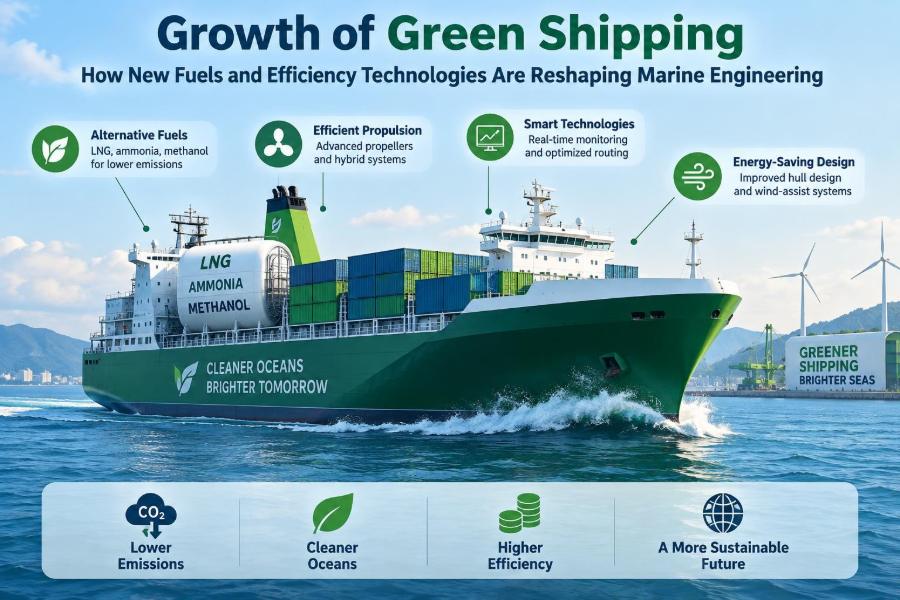

A container vessel leaving port can appear unchanged from the quay: the same steel hull, cranes, wake, and steady exhaust plume. Yet below deck, its engineers may be managing a fuel system, power plant, and set of operating decisions that would have been unfamiliar on many ships only a few years ago.
For a cadet, this shift changes what must be learned. For a chief engineer, it changes maintenance planning, risk assessment, training, and daily watchkeeping. For shipowners and charterers, it affects design choices that can remain in service for decades.
Shipping carries the majority of global traded goods by volume, but it also consumes large quantities of fuel over long voyages. Reducing its climate impact cannot come from one device or one fuel alone; it requires a connected change in energy, machinery, operations, and infrastructure.
Green shipping is therefore less about a single “perfect” vessel and more about making sound engineering choices under real constraints. The most useful question is not simply which technology is cleanest, but which combination can safely reduce emissions on a particular route, vessel, and operating profile.
🌍 What Green Shipping Actually Means
Green shipping describes efforts to reduce the environmental burden of ships across their life cycle. Carbon dioxide emissions from fuel use are a central concern, but the term can also include air pollutants, methane emissions, underwater noise, waste, ballast-water impacts, and resource use during construction and recycling.
In marine engineering, the immediate focus is often energy efficiency and fuel transition. These are related but different tasks: efficiency reduces the energy needed to move the ship, while a new fuel changes the emissions associated with supplying that energy.
⚓ Why Marine Engineers Are at the Centre
The engine department turns environmental targets into physical reality. Engineers operate machinery safely, monitor fuel consumption, maintain pumps and heat exchangers, manage electrical loads, and identify performance losses before they become expensive failures.
A fuel choice also changes the engineering system around it. Tanks, piping, ventilation, gas detection, emergency shutdown arrangements, bunkering procedures, and crew competence may all need revision. Green shipping is consequently a practical machinery challenge, not only a policy discussion.
📉 The Case for Lower Energy Demand
The cheapest unit of energy is often the one a vessel does not need to use. A ship with lower resistance and better propulsion efficiency requires less fuel regardless of whether it runs on conventional fuel, biofuel, methanol, or another option.
This is why efficiency measures remain valuable during fuel uncertainty. They reduce operating cost, extend range for a given tank volume, and can make expensive low-carbon fuels more manageable. In many retrofit projects, several modest improvements together are more realistic than a single dramatic alteration.
🧭 Understanding the Energy Chain
Engineers should assess more than exhaust emissions. A fuel’s full impact depends on its well-to-wake energy chain: production or extraction, processing, transport, bunkering, and use on board.
For example, a fuel may produce little or no carbon dioxide at the funnel while requiring substantial energy or emitting greenhouse gases during production. Conversely, a fuel with carbon in its molecule may offer a lower life-cycle footprint if it is made from appropriate renewable feedstocks. The answer depends on how and where the fuel is produced.
🛢️ Conventional Fuel Is Not a Single Baseline
Marine fuels vary in composition, handling properties, and emissions. Residual fuels, distillates, and blends do not behave identically in storage or combustion. A vessel’s existing fuel-treatment plant, engine configuration, and trading area influence what can be used reliably.
Comparisons with alternatives need a clear baseline. Saying that a technology is “cleaner” without identifying whether the comparison concerns carbon, sulphur oxides, nitrogen oxides, particulates, or life-cycle emissions can lead to poor decisions.
🌿 Biofuels and Renewable Drop-In Blends
Some biofuels and renewable fuel blends can be used in existing engines with limited modification, which makes them attractive for early adoption. Their compatibility depends on fuel specification, blend ratio, storage stability, lubricity, microbial growth risk, and the equipment manufacturer’s guidance.
The main engineering appeal is that a drop-in fuel may use much of the existing bunker and fuel-supply arrangement. The main limitation is supply: sustainable feedstocks are not unlimited, and environmental performance depends strongly on origin, processing, and land-use effects.
🧪 Methanol as a Marine Fuel
Methanol is a liquid at ambient conditions, simplifying storage compared with cryogenic fuels. Dual-fuel engines can use it alongside a pilot fuel or a conventional fuel arrangement, depending on engine type and design.
Its lower energy density means a vessel needs more tank volume for the same voyage energy. Methanol is also toxic and flammable, so double-wall piping, leak detection, ventilation, safe draining, and carefully designed bunkering procedures matter. Its climate value depends on whether it is produced from fossil, biogenic, or renewable pathways.
❄️ LNG and the Methane Question
Liquefied natural gas has been adopted on some ships because it can reduce certain air pollutants and can support compliance with local emission requirements. It is stored at very low temperature, requiring insulated tanks, specialized valves, boil-off gas management, and strict procedures.
Its climate assessment is more complicated. Methane is a potent greenhouse gas, and unburned methane escaping from engines or handling systems is often called methane slip. Engine type, operating condition, fuel pathway, and control technology all affect the overall result.
🌬️ Hydrogen’s Promise and Practical Limits
Hydrogen can be used in fuel cells or combustion systems without carbon dioxide emissions at the point of use. It is especially relevant to concepts for shorter routes, smaller vessels, or applications where frequent refuelling is possible.
However, hydrogen has low volumetric energy density. Storage requires either high pressure or cryogenic liquid conditions, both of which impose space, cost, insulation, and safety demands. Its wider benefit also depends on production methods and the availability of low-carbon electricity.
🧊 Ammonia and New Safety Boundaries
Ammonia contains no carbon, so its use does not create carbon dioxide from the fuel itself. It can be stored as a liquid under moderate pressure or refrigeration, making it a prominent candidate for deep-sea shipping concepts.
Its challenge is toxicity. Even small releases can be hazardous to personnel, requiring robust containment, ventilation, detection, protective equipment, escape planning, and drills. Combustion may also require careful control of nitrogen-based emissions. Adoption depends on machinery maturity, rules, fuel availability, and a safety culture equal to the risk.
🔋 Batteries and Hybrid Power Systems
Batteries are highly effective where a vessel has short, predictable routes, access to charging, and opportunities to eliminate idling of diesel generators. Ferries, harbour craft, and offshore support operations can use them for propulsion, peak shaving, or hotel loads.
A hybrid system combines batteries with engines, generators, or fuel cells. The energy-management system decides when to charge, discharge, start generators, and share load. Battery installation is not merely “adding storage”; it requires thermal management, fire detection, segregation, ventilation strategy, and lifecycle monitoring.
⚡ Fuel Cells for Quiet Efficient Power
Fuel cells convert chemical energy into electricity electrochemically rather than through combustion. They can offer quiet operation and high efficiency at suitable steady loads, particularly when integrated with batteries and electric propulsion.
The complete plant still needs fuel conditioning, cooling, power electronics, redundancy, and maintenance planning. Their usefulness varies with fuel, vessel duty cycle, installation space, and the reliability expected from the electrical network. They are an option within a system design, not a universal replacement for main engines.
🌀 Wind Assistance Is Returning Differently
Modern wind-assist devices include rotor sails, rigid wings, suction wings, and towing kites. They do not usually make a commercial vessel dependent on wind; instead, they provide supplementary thrust when conditions are favourable.
The engineering task is integration. Devices affect structural loads, stability, deck layout, visibility, cargo operations, maintenance access, and bridge procedures. Their output changes with route, season, wind direction, and speed, so voyage planning and performance analysis are essential.
🛶 Hull Form and Resistance Reduction
A hull must move water aside, create waves, and overcome friction along its wetted surface. Small roughness, fouling, or damage can increase resistance enough to affect daily fuel use over time.
Newbuild designs may optimize bulbous bows, stern forms, appendages, and hull lines for a narrower range of realistic speeds. A ship designed for slower service may not have the same optimum shape as one designed for high-speed operation. This is why design speed assumptions deserve close scrutiny.
🎨 Hull Coatings and Fouling Control
Marine organisms attached to a hull increase drag. Coatings help limit attachment or make it easier for water flow to remove organisms, but no coating eliminates the need for inspection and maintenance.
Coating selection involves more than fuel savings. Engineers and operators must consider coating condition, trading pattern, idle periods, cleaning methods, local environmental requirements, and the risk of transferring invasive species. Cleaning a badly fouled hull can improve performance, but it should be planned rather than treated as an emergency response.
🔩 Propellers, Ducts, and Wake Management
Propeller efficiency depends on matching the propeller to hull wake, engine speed, and operating condition. Devices such as pre-swirl fins, ducts, rudder bulbs, and optimized propeller geometries aim to recover losses in the flow around the stern.
These technologies need credible analysis for the actual vessel. A device successful on one hull may not deliver the same result on another. Installation quality, vibration behaviour, cavitation characteristics, and dry-dock access deserve attention alongside projected fuel savings.
🌡️ Recovering Waste Heat
Large marine engines reject considerable heat through exhaust gas, cooling water, lubricating oil, and charge-air systems. Waste-heat recovery uses part of that energy to produce steam, generate electricity, heat fuel, or support onboard services.
The opportunity depends on engine loading. At lower loads, exhaust temperatures and available heat may fall, while the added system still requires pumps, controls, cleaning, and maintenance. A recovery plant should be evaluated over the vessel’s real load profile, not just at a favourable design point.
💡 Smarter Auxiliary Power
Auxiliary generators support pumps, refrigeration, ventilation, accommodation, cargo systems, and many other loads. Running a generator far below its efficient load range wastes fuel and can worsen maintenance issues.
Load sharing, variable-speed drives, LED lighting, efficient pumps, and demand-based ventilation can reduce this burden. The key is to understand the load profile. A pump throttled by a valve, for instance, may be using excess energy that a variable-speed drive could avoid.
📊 Digital Monitoring That Engineers Can Use
Fuel-flow meters, shaft-power meters, weather data, engine sensors, and noon reports can reveal where energy is being lost. A performance system is useful when it turns data into questions: Has hull resistance changed? Is a generator carrying an unusual load? Has a fuel change affected combustion?
Data is not automatically truth. Sensors drift, manual entries vary, and weather correction introduces assumptions. Good practice includes calibration, data validation, and comparison with known operating conditions before making costly decisions.
🗺️ Weather Routing and Just-in-Time Arrival
A voyage can consume more energy than necessary when a ship races toward a berth that is not ready. Better communication among vessel, port, terminal, and chartering parties can allow a ship to adjust speed and arrive when a berth or service window is genuinely available.
Weather routing adds another layer by balancing safety, schedule, fuel use, and cargo constraints. A longer route may sometimes be safer or more efficient than the shortest track. These operational measures often require no new engine, but they do require coordination and realistic commercial planning.
🐢 Slow Steaming and Engine Health
Reducing speed can significantly reduce propulsion demand because resistance rises sharply as speed increases. It is one of the most powerful operational levers available, but it is not simply a command to run the main engine slowly.
Extended low-load operation can affect combustion quality, turbocharger performance, cylinder condition, exhaust temperatures, and fouling. Engineers may need revised maintenance routines or operating guidance. Schedule reliability, cargo requirements, and machinery limits must be considered alongside fuel savings.
🏗️ Newbuild Decisions versus Retrofits
A newbuild can integrate tanks, machinery spaces, electrical architecture, and safety systems from the beginning. This gives designers more freedom but also creates uncertainty when future fuel supply is unclear.
Retrofits work within fixed space, structure, stability margins, and dry-dock windows. An owner may choose efficiency upgrades now while keeping future fuel options open. The most sensible pathway is often staged: improve energy demand first, then select fuel and propulsion changes as routes and supply mature.
🧰 Fuel Readiness Is Not Fuel Capability
Terms such as “ready,” “prepared,” and “capable” are used loosely. A vessel described as ready for a future fuel may only have reserved space, strengthened foundations, or preliminary design allowances; it may not be able to bunker or burn that fuel without major work.
Students and professionals should ask precise questions: Which systems are installed now? Which approvals are in place? What equipment remains to be added? What changes are required to tanks, ventilation, control systems, and crew procedures? Clear language prevents expensive misunderstandings.
🧯 Safety Engineering Must Lead the Transition
Alternative fuels introduce unfamiliar hazards alongside familiar marine risks. Flammability, cryogenic temperatures, toxicity, pressure release, invisible flames, material compatibility, and confined-space exposure can alter emergency scenarios.
A sound safety approach starts with hazard identification during design and continues through operating procedures, drills, maintenance, and learning from near misses. Safety barriers include physical design, alarms, shutdowns, ventilation, training, permits, and communication. No single barrier should be assumed sufficient.
👩🏭 Training for the Changing Engine Room
Engine-room competence increasingly includes automation, electrical systems, data interpretation, and fuel-specific safety knowledge. Familiarity with a conventional diesel plant does not automatically transfer to a vessel carrying toxic, cryogenic, or low-flashpoint fuel.
Effective training combines theory with practical scenarios. Crews should understand normal operation, but also what a leak alarm means, how isolation is achieved, which spaces are hazardous, and when to stop a transfer. Clear handovers are especially important when systems are new or rarely used.
📜 Rules, Class, and Verification
International and regional requirements influence ship design and operation, while flag administrations, classification societies, ports, insurers, manufacturers, and charterers may impose additional expectations. Requirements evolve as technology develops.
Engineers do not need to memorize every rule to work effectively, but they must know when a modification needs formal review. Changes to fuel systems, automation, emissions equipment, or safety-critical machinery should never be treated as informal workshop projects.
💰 Looking Beyond the Purchase Price
A greener technology may cost more to install while reducing fuel use, exposure to future emissions costs, or maintenance in a particular application. Another option may look economical initially but create costly fuel, space, training, or infrastructure obligations later.
Life-cycle thinking considers capital cost, fuel availability, energy efficiency, maintenance, downtime, crew training, residual value, and compliance risk. The best option is rarely the device with the most impressive brochure figure; it is the option that performs reliably within the vessel’s full operating context.
🔍 Common Mistakes in Decarbonization Projects
Several mistakes recur when environmental goals are separated from engineering reality:
- Comparing fuels only by funnel emissions rather than their full energy pathway.
- Assuming a technology proven on one trade will suit every route.
- Ignoring tank volume, payload loss, and port infrastructure.
- Estimating savings without reliable baseline data.
- Treating crew training as a final administrative step.
- Installing efficiency devices without planning inspection and maintenance.
These errors are avoidable when feasibility work includes operations, safety, machinery, commercial teams, and crew experience from the outset.
🧩 Choosing Technology by Vessel and Voyage
There is no universal green-ship configuration. A battery-supported ferry with frequent charging opportunities faces a different problem from a bulk carrier crossing oceans, and a tanker may have different safety and cargo constraints from a cruise vessel.
| Operating context | Often relevant options | Key engineering question |
|---|---|---|
| Short, regular route | Batteries, shore power, hybrid systems | Can charging fit the turnaround schedule? |
| Coastal or regional trade | Hybrid power, biofuels, methanol, wind assistance | Which fuels are reliably available along the route? |
| Long deep-sea voyage | Hull and propeller upgrades, waste heat recovery, wind assistance, emerging fuels | How do fuel volume and global bunkering affect range? |
🤝 Collaboration Beyond the Ship
A vessel cannot decarbonize in isolation. Ports need bunkering and charging capability, fuel producers need predictable demand, shipyards need design expertise, and cargo interests influence schedule and speed.
For this reason, pilot projects and corridor-based approaches can be valuable. They allow a limited group of ports, operators, and fuel suppliers to test practical arrangements before wider deployment. Lessons from these projects should be assessed carefully rather than assumed to transfer unchanged to every trade.
🎯 The Core Principle: Reduce Demand, Then Decarbonize Supply
The strongest green-shipping strategy usually follows a sequence. First, reduce the energy the vessel needs through design, maintenance, and operations. Next, optimize how that energy is generated and managed. Then select lower-emission energy sources that are safe, available, and credible across their life cycle.
This sequence does not delay fuel transition; it makes it more achievable. A more efficient vessel needs smaller tanks, fewer bunkering resources, and less low-carbon fuel for the same service. It also gives marine engineers a clearer basis for comparing options as technologies and rules continue to evolve.
Green shipping will be shaped not by one miracle fuel, but by disciplined engineering that connects efficiency, safe fuel systems, informed operations, and life-cycle thinking. For the next generation of marine professionals, that connection is becoming a core part of the job. 🚢⚙️🌱