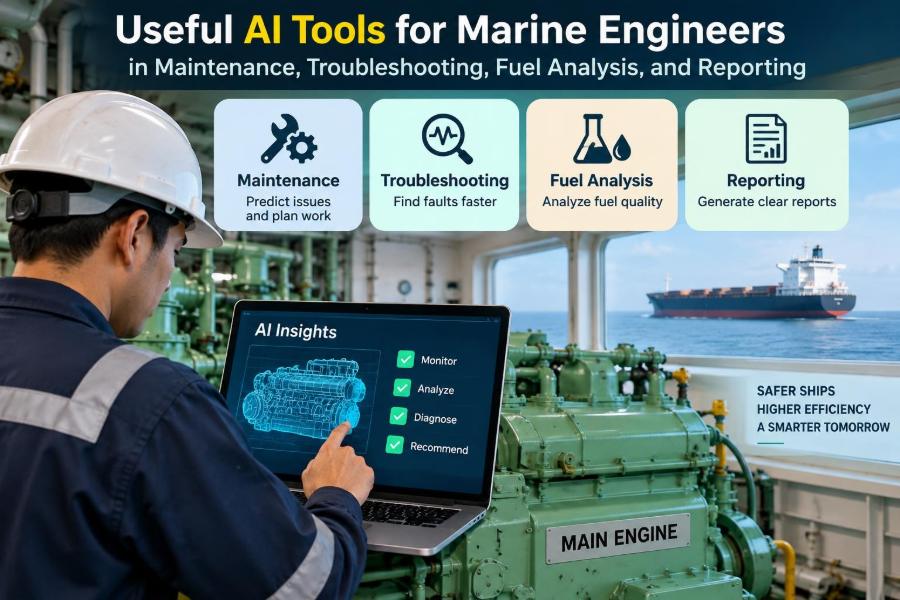

The alarm comes in during a busy watch: an auxiliary pump is running warmer than usual, the vibration trend looks different, and the last maintenance note is buried somewhere in a long chain of reports. The engineer still has to make the decision. Is this a monitoring issue, an operating issue, or a fault that needs immediate action?
Marine engineers already work with automation, sensors, planned-maintenance systems, laboratory reports, and technical manuals. Artificial intelligence can help bring those sources together faster, particularly when time, connectivity, and crew availability are limited.
But an AI tool does not inspect a bearing, smell overheating insulation, or accept responsibility for a safety-critical decision. Its value lies in helping engineers find information, spot patterns, structure observations, and produce clearer records.
Used with engineering judgment and the vessel’s established procedures, AI can reduce administrative friction without weakening professional control. The useful question is not whether AI replaces the engineer. It is where it can make the engineer’s next action more informed.
🧭 Start With the Real Job, Not the Tool
AI is most useful when it is connected to a defined engineering task. “Use AI for maintenance” is too vague; “compare this purifier’s operating data with its normal baseline and list possible checks” is actionable.
Begin by identifying the decision that is difficult, repetitive, or slowed by scattered information. Common examples include writing defect reports, reviewing fuel laboratory results, preparing a troubleshooting sequence, and converting watchkeeper notes into a usable handover.
A tool should shorten the path from evidence to a safe next step. If it creates extra data entry, produces unverifiable advice, or distracts from the machinery space, it is not helping.
🤖 What AI Can and Cannot Do on Board
Most AI tools used by engineers fall into two broad groups. Generative AI works with language: it summarizes documents, drafts reports, translates technical text, and helps formulate questions. Analytical AI works with data: it detects unusual patterns, forecasts trends, or classifies images and signals.
Neither type possesses practical awareness of the vessel. It may generate a plausible answer from incomplete data, confuse equipment variants, or miss a critical context such as a recent overhaul, load change, or temporary bypass.
For that reason, treat output as a draft, prompt, or analytical lead, not as an instruction. The engineer must verify it against drawings, manuals, maker guidance, operating limits, risk assessments, and onboard procedures.
🔐 Protect Vessel Data Before Uploading Anything
Machinery logs, incident reports, voyage details, photographs, and equipment serial numbers may be commercially sensitive or subject to company control. Public AI services may not be an approved place to paste them.
Before using any external service, follow the operator’s cyber-security and data-handling policy. Ask what data can leave the vessel, whether the service retains prompts, and whether an approved enterprise system is available.
- Remove names, vessel identifiers, port details, and commercially sensitive quantities where possible.
- Do not upload controlled manuals, proprietary drawings, or screenshots unless permission is clear.
- Keep operational technology systems separated from unapproved software and cloud services.
- Record AI use where company policy requires traceability.
Good data discipline is not bureaucracy. It prevents a time-saving experiment from becoming a security or compliance problem.
🗂️ Turn Manuals Into Searchable Working Knowledge
Engine-room manuals are often technically complete but difficult to navigate during a fault. An approved document-search system can index manuals, service bulletins, checklists, and previous job reports so that an engineer can ask a targeted question in ordinary language.
For example, instead of manually searching several documents, an engineer might ask: “List the maker’s stated checks before restarting this model of fresh-water generator after a high-salinity trip.” The system should return the relevant passages and document location, not merely an unsupported summary.
The best arrangement is a controlled internal library with version management. An obsolete manual can be more dangerous than no answer at all.
🔎 Ask Better Troubleshooting Questions
The quality of an AI response depends heavily on the details supplied. A vague request such as “Why is my purifier vibrating?” produces a vague fault list. A structured prompt produces a more useful diagnostic framework.
Include the equipment type, operating condition, recent work, observed symptoms, alarm history, trend direction, and checks already completed. State what you need: likely causes, safe inspection priorities, required measurements, or a draft report.
Equipment: auxiliary engine cooling-water pump
Symptom: discharge pressure slowly reduced over two days
Condition: same engine load, suction strainer cleaned yesterday
Observed: no unusual motor current; minor mechanical-seal leakage
Request: provide a ranked inspection checklist and distinguish checks possible while stopped from those requiring dismantling.
This does not make the output correct automatically. It makes the reasoning easier to examine and challenge.
🧩 Use Fault Trees Instead of One-Answer Diagnoses
Machinery faults rarely have one obvious cause. A low-pressure alarm can arise from a defective transmitter, blocked suction, air ingress, worn impeller, poor tank level, incorrect valve position, or a process change elsewhere in the system.
AI can help create a fault tree: a structured set of possible causes, grouped by mechanism and linked to observations that would confirm or rule them out. This is more valuable than a confident single diagnosis.
A useful fault tree separates immediate safety checks from routine investigation. For example, loss of lubricating-oil pressure requires protective action first; identifying whether the root cause is a sensor or a pump comes after the machinery is protected.
📈 Detect Abnormal Trends Before Alarms Operate
Alarms are usually threshold-based. They tell the crew when a value has crossed a set point, but a slowly changing value may be meaningful well before that point. Trend analysis is therefore one of the strongest uses of data-driven tools.
An analytical system can compare present readings with a machine’s own historical operating pattern while accounting for load, ambient conditions, and operating mode. A gradual increase in jacket-water temperature difference or purifier bowl vibration may deserve attention even when still inside limits.
Trend tools need stable, trustworthy input. A drifting sensor, inconsistent manual readings, or missing load data can create false patterns. Always investigate the measurement chain before assuming the machinery has changed.
📊 Establish a Baseline for Each Equipment Condition
There is no single “normal” exhaust temperature, pump pressure, or compressor running current for every vessel. Normal values vary with equipment condition, load, seawater temperature, fuel, maintenance state, and control settings.
A baseline is a record of what normal operation looks like under comparable conditions. It may include pressures, temperatures, vibration readings, flows, running hours, and operator observations.
AI can organize and compare this information, but the crew must label important events. If an air cooler was cleaned, a valve changed, or a sensor replaced, that context should sit beside the trend. Otherwise, the model may treat a justified step change as a fault.
⚙️ Support Condition-Based Maintenance Decisions
Planned maintenance remains necessary for many statutory, maker-recommended, and safety-related tasks. However, condition information can help decide where additional attention is needed between scheduled jobs.
Condition-based maintenance uses evidence such as oil condition, vibration, thermography, performance trends, and inspection results to assess deterioration. AI can combine these sources into a prioritized list of equipment that warrants review.
That list is not permission to defer mandatory maintenance. It is a way to focus troubleshooting hours, spares planning, and inspection effort where the evidence indicates growing risk.
🛢️ Read Fuel Analysis Reports More Systematically
Fuel laboratory reports contain valuable information, but their terminology can make rapid interpretation difficult. AI can convert a report into a structured briefing that highlights parameters outside the contractual or operational expectation and explains what each may imply.
For residual fuel, useful areas to review may include viscosity, density, water, sediment, aluminium plus silicon, catalytic-fine indicators, ash, sodium, vanadium, and calculated carbon aromaticity index where reported. For distillates, water, flash point, lubricity, cold-flow properties, and contamination indicators may matter.
The tool should not declare a fuel “safe” or “unsafe” from a report alone. Compatibility, storage history, treatment capability, machinery type, and the laboratory’s comments all affect the operational decision.
🧪 Connect Fuel Results to Treatment Actions
The operational value comes from translating a laboratory result into controlled questions. High water content, for instance, may lead the engineer to review settling time, drain routines, separator setup, heating, and the possibility of ingress or contamination.
Elevated catalytic-fine indicators may justify careful attention to separator efficiency, filter condition, purifier throughput, and wear monitoring. It does not prove that wear is occurring, and it does not justify changing settings beyond maker guidance.
| Reported concern | Useful engineering question | Potential follow-up |
|---|---|---|
| Water or sediment | Was settling and drainage adequate before transfer? | Review tank drains, transfer records, and separator operation. |
| High aluminium plus silicon | Is fuel treatment operating within maker limits? | Check throughput, temperature, gravity disc or configuration, and filters. |
| Off-spec viscosity or density | Can the system achieve correct injection viscosity safely? | Review heating capacity, changeover plan, and operating instructions. |
This approach keeps AI in its appropriate role: translating data into a checklist for human review.
🌡️ Use AI to Compare Cylinder and Exhaust Patterns
Engine data becomes more revealing when values are compared across cylinders and over time. Differences in exhaust temperature, peak pressure where measured, fuel index, scavenge condition, or cooling-water temperature can indicate uneven combustion or measurement problems.
A useful analytical tool can flag combinations rather than isolated readings. For example, an exhaust-temperature rise alongside reduced turbocharger performance and increased exhaust back pressure suggests a different investigation path than an isolated temperature rise with an erratic sensor signal.
Interpretation requires caution. Cylinder balance is influenced by load changes, fuel quality, sensor accuracy, ambient conditions, and recent adjustment. Never adjust fuel equipment solely because an algorithm labels one cylinder an outlier.
📳 Make Vibration Data Easier to Triage
Vibration monitoring can reveal developing issues in rotating machinery, including imbalance, misalignment, looseness, bearing damage, and hydraulic effects. The raw signal, however, can be difficult to interpret without suitable training and equipment-specific reference data.
AI-supported tools can classify signal features and identify departures from previous measurements. Their greatest practical benefit may be triage: showing which pump, fan, motor, or compressor deserves a closer measurement and inspection.
Measurement consistency matters. Use comparable sensor position, direction, machine state, speed, and load. A reading taken from a different location after a structural modification is not automatically comparable with an earlier trend.
📷 Use Images Carefully for Visual Inspections
Image-recognition tools can help sort inspection photographs of corrosion, leaks, insulation damage, loose fasteners, gauge readings, or filter contamination. They are especially useful for cataloguing repeated inspections and creating a visual history.
Lighting, angle, oil film, paint colour, and image quality can mislead a model. A photograph also lacks tactile clues: temperature, vibration, smell, hardness, and the sound of a running machine.
Use image tools to label, organize, and prompt closer inspection. For a suspected crack, hot surface, pressure-boundary defect, or electrical hazard, rely on qualified inspection methods and the vessel’s safety controls—not a camera classification.
🧾 Draft Better Defect and Maintenance Reports
A clear report preserves engineering knowledge across watches, crew changes, superintendent review, and future maintenance. AI can turn rough notes into a consistent draft while retaining the engineer’s actual findings.
The report should distinguish observations from conclusions. “Oil mist observed around coupling guard” is an observation. “Mechanical seal failure confirmed” is a conclusion that needs supporting evidence.
- Equipment identification and operating state
- Time and nature of the defect or abnormality
- Measurements, alarms, photographs, and checks completed
- Immediate actions taken and any operational limitation
- Parts used, work performed, test result, and outstanding actions
Review every generated sentence. A polished report that contains one wrong component name can misdirect the next watch.
🗣️ Improve Watch Handovers Without Losing Detail
Watch handovers fail when notes are either too brief to be useful or so long that urgent items disappear. An AI summarizer can help format entries into priorities: active alarms, equipment in manual mode, temporary repairs, work permits, tank status, pending tests, and restrictions.
It should never replace the face-to-face handover required by good practice and company procedure. The receiving engineer needs a chance to ask what changed, what was tried, and what concerns remain.
A practical habit is to ask the tool for a short “next watch actions” list, then compare it with the actual log and machinery state. The human check is quick and catches invented or omitted detail.
📝 Convert Voice Notes Into Useful Job Records
After a dirty or time-critical task, an engineer may remember key details better by speaking them than by immediately typing a formal report. Approved speech-to-text tools can turn a voice note into a draft job record.
Technical vocabulary is a limitation. Model names, valve tags, chemical names, and numbers are commonly misheard, particularly with machinery noise or accents. Verify transcribed values against gauges, labels, and handwritten notes.
Voice capture works best as a memory aid, not as the sole record. It can preserve the sequence of events while the engineer later adds measurements, actions, and verification results.
🌍 Translate Technical Information With Context
Multinational crews often work with documents, labels, and supplier communications in different languages. AI translation can assist with routine comprehension and the preparation of plain-language explanations.
Safety-critical instructions deserve extra care. A mistranslated negative, unit, warning, or conditional statement can change the meaning completely. Use the original approved manual as the authority, and obtain competent support when an exact interpretation is needed.
For everyday communication, ask for simple wording rather than just direct translation. “Explain this isolation sequence in clear shipboard English” may be more useful than a literal sentence-by-sentence output.
🧮 Help Plan Spares and Consumables
Maintenance delays are often caused by missing gaskets, filters, seals, or overhaul kits rather than by the main component itself. AI can analyze past consumption, running hours, outstanding jobs, and lead-time notes to help create a planning list.
It can also identify inconsistent part descriptions in old records. A filter element listed under several informal names may look like separate stock items until the part number is checked.
Do not allow automatic recommendations to replace stock control. Confirm maker part numbers, approved alternatives, shelf life, storage requirements, and criticality. A suggested purchase quantity is an input to planning, not a purchase authorization.
🧠 Preserve Lessons From Repeat Failures
Every vessel accumulates local knowledge: a recurring level-switch issue, a valve that sticks after long standby periods, or a particular symptom that appears before a known problem. This knowledge is easily lost when it remains only in individual memory.
An internal AI search tool can retrieve similar defects from previous reports and group recurring themes. The goal is not to assume every repeat symptom has the same cause, but to avoid starting from zero.
Good records should capture the eventual confirmed cause, not merely the first suspicion. This distinction makes future searches much more valuable.
🛡️ Keep Safety Decisions Outside the Automation Loop
AI must not dilute the safeguards that govern engine-room work. Isolation, lockout and tagout, enclosed-space entry, hot work, electrical work, lifting, and work on pressurized systems require formal controls regardless of how persuasive a digital recommendation appears.
A useful prompt can ask for likely hazards and verification points before a task. It cannot certify that energy has been isolated, that atmosphere testing is valid, or that a worksite is safe.
Where an AI suggestion conflicts with a permit, risk assessment, maker instruction, or senior engineer’s direction, the approved safety system takes precedence.
⚠️ Watch for Hallucinations and False Confidence
Language models can produce convincing but incorrect statements, sometimes called hallucinations. They may cite a procedure that does not exist, invent a parameter, or blend advice from a different equipment model.
Warning signs include exact-looking limits with no source, unrequested certainty, unfamiliar terminology, or recommendations that contradict the machine manual. Ask the tool to state assumptions, identify missing information, and separate facts supplied by the user from general possibilities.
For technical questions, prefer systems that can show the source passage from an approved document. Even then, check that the passage applies to the installed equipment and current configuration.
🧹 Improve Data Quality Before Seeking Smart Analysis
“Garbage in, garbage out” applies strongly to machinery analytics. If temperature readings are manually entered with inconsistent units, tags are ambiguous, and maintenance dates are incomplete, an AI system will detect noise as readily as it detects deterioration.
Start with a small number of high-value data points. Define standard equipment tags, units, reading intervals, and acceptable notes. Record whether a machine was on standby, at low load, undergoing a test, or recently maintained.
Better data collection often delivers benefits before any advanced AI is introduced. A clean trend and disciplined log are powerful engineering tools on their own.
🧑🔧 Maintain Human Skill and Situational Awareness
There is a risk that convenient summaries can weaken fundamental troubleshooting habits. Engineers still need to understand flow paths, thermodynamics, electrical protection, lubrication, combustion, control loops, and the physical meaning of a changing parameter.
Use AI as a training partner rather than a shortcut around understanding. Ask it to generate practice fault scenarios, explain a system at different experience levels, or quiz you on the consequence of a failed sensor versus a failed actuator.
Then verify the lesson with drawings, manuals, and experienced colleagues. Practical competence grows through observation and supervised work, not through text alone.
👥 Create a Clear Review and Escalation Path
Not every AI-assisted finding deserves the same response. A minor report-formatting suggestion can be reviewed by the author. A predicted bearing issue may need a second engineer’s assessment. A safety-critical anomaly requires immediate escalation through the established chain.
Define who reviews outputs, which decisions require independent verification, and where the final record is stored. This avoids an unclear situation in which a tool influences maintenance priorities without anyone owning the decision.
Clear accountability also makes lessons easier to capture. When a prediction was wrong or useful, the team can identify why and improve the process.
📶 Design for Limited Connectivity at Sea
Cloud-based AI is not always available or fast enough at sea. Satellite bandwidth may be constrained, connection quality may vary, and company cyber rules may limit access.
For practical onboard use, favor workflows that can continue offline: locally stored manuals, exportable trend data, standard report templates, and checklists that do not depend on a live service. Cloud analysis can be used when available, but it should not become a single point of failure.
Test tools in realistic conditions before relying on them during a demanding operation. A system that works well ashore may be frustrating in a machinery space with poor connectivity and limited time.
🧰 Build a Small, Useful AI Toolkit
A sensible starting toolkit does not need to be complex. It might contain an approved document search function, a spreadsheet or condition-monitoring tool for trends, an approved writing assistant for reports, and a controlled method for organizing inspection photographs.
Choose tools around recurring tasks rather than novelty. If the crew spends significant time interpreting laboratory reports, begin there. If watch handovers are inconsistent, improve that workflow first.
Integration matters more than the number of applications. A few trusted tools with clear inputs, review steps, and records are more useful than a collection of disconnected experiments.
🪜 Introduce AI Through Low-Risk Pilots
Start with tasks where an error is easily noticed and human review is already routine. Drafting a maintenance summary, standardizing defect descriptions, or extracting action items from a non-sensitive report are good initial candidates.
Set a simple success measure: less time spent formatting, fewer missing fields, clearer handovers, or faster retrieval of an approved manual section. Do not judge a pilot by whether the output sounds impressive.
As confidence and governance improve, the team can explore data analysis for trends and maintenance prioritization. Safety-critical control decisions should remain outside the pilot scope.
📚 Know When Conventional Methods Are Better
AI is not automatically the fastest solution. A laminated emergency checklist, a maker’s troubleshooting chart, a direct call to technical support, or an experienced fitter’s observation may be better in the moment.
Use conventional methods when the procedure is clear, the task is safety-critical, data is missing, or the AI result cannot be verified quickly. Technology should reduce cognitive load, not create a new layer of uncertainty.
The strongest practice combines disciplined routines with selective digital assistance. Good engineering remains grounded in evidence, communication, and physical verification.
✅ The Core Principle: AI Assists, Engineers Decide
Useful marine-engineering AI is not a black box that tells a crew what to do. It is a structured assistant that helps locate approved information, organize evidence, recognize changes, and communicate work clearly.
Its output becomes valuable only after it is checked against the actual machinery, the vessel’s procedures, and professional judgment. That is especially true for fuel decisions, fault diagnosis, maintenance deferral, and anything that affects safety or environmental compliance.
The best question to ask of any tool is simple: does it help the crew see the condition of the plant more clearly and act more reliably? If the answer is yes, with proper controls, it has a legitimate place in the engine room.
AI can make marine engineers faster and better informed, but safe operation still depends on competent people verifying the evidence and owning the decision. 🚢🛠️📈