
A ship can carry fuel that looks perfectly ordinary in a tank, yet that same fuel may contain water, abrasive particles, rust, catalytic fines, and unstable residues. If it reaches an engine untreated, the result may be poor combustion, worn fuel pumps, damaged injectors, or a loss of propulsion at the worst possible time.
For engineers, the fuel purifier is therefore not an optional auxiliary machine quietly operating in the background. It is one of the barriers between stored fuel and the precision components that meter, pressurize, and inject it.
The challenge is especially familiar after bunkering. New fuel can bring a different density, viscosity, water content, and contaminant load than the previous batch. The engine department must make that fuel usable without assuming that a supplier’s documentation tells the whole story.
Marine fuel purification turns a difficult mixture into a controlled engine supply. Understanding what happens inside the bowl explains not only how the equipment works, but also why correct temperature, flow, sealing water, and routine cleaning matter so much.
⚓ The Fuel’s Journey Before the Engine
Fuel normally passes through several stages: receiving and storage tanks, settling tanks, service tanks, booster equipment, fine filters, and finally the engine. A centrifugal purifier usually operates between settling and service storage.
This position gives the machine time to remove separated water and solids before the fuel enters the day tank. Filters downstream still have a job, but they should not be asked to handle the bulk contamination that a separator is designed to remove.
🛢️ Why Marine Fuel Needs Treatment
Marine fuels are handled through tanks, hoses, barges, and shore systems before reaching a vessel. Water can enter through condensation, tank leakage, poor handling, or contaminated deliveries. Solids may include corrosion products, sand, sludge, and residues from blending.
Residual fuels can also contain contaminants associated with refinery processes, including catalytic fines: hard aluminium- and silicon-containing particles that can cause severe abrasive wear if they reach engine components.
🔍 What a Fuel Purifier Actually Removes
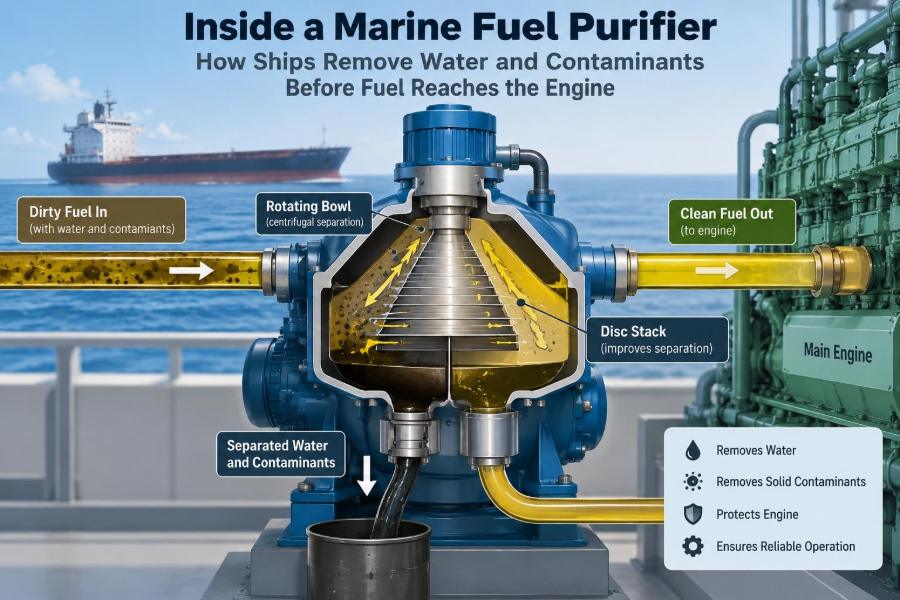
A purifier separates materials according to density under high centrifugal force. In a conventional fuel application, the desired product is cleaned oil, while water and solids are removed or retained separately.
It does not make unsuitable fuel magically safe, nor does it correct every chemical problem. Its main strengths are removing free water and density-different contaminants; performance against very fine particles or stable emulsions depends heavily on operating conditions.
🌀 Centrifugal Force in Simple Terms
Imagine shaking a jar of muddy oil and water: gravity will eventually pull the denser material down, but the process is slow. Inside a separator bowl rotating at high speed, the effective separating force is vastly greater than gravity.
Under this force, denser water and solids move outward toward the bowl wall. The less-dense oil moves inward toward the centre. This basic movement is the foundation of marine fuel purification.
🥣 The Rotating Bowl: The Machine’s Core
The bowl is the precision-built rotating assembly inside the purifier. Fuel enters near the centre and travels through a stack of conical discs before clean oil exits through its designated outlet.
The bowl also contains spaces for the separated phases. In a self-cleaning separator, accumulated solids can be discharged periodically through ports in the lower part of the bowl while it remains in operation.
📚 Why the Disc Stack Makes Separation Faster
A disc stack contains many closely spaced conical discs. Rather than asking droplets and particles to cross one large open chamber, it divides the flow into many thin layers.
This sharply reduces the distance that water droplets and particles need to travel before reaching a separating surface. The result is a more compact and effective machine than a simple spinning tank.
💧 Purifier Mode and Clarifier Mode
The terms are often used loosely, but they describe different arrangements. A purifier is set up to separate oil, water, and solids. A clarifier is arranged mainly to remove solids from oil, without a deliberate water outlet.
| Operating arrangement | Main purpose | Water handling |
|---|---|---|
| Purifier | Clean fuel while separating free water and solids | Water has a controlled outlet/interface |
| Clarifier | Remove fine solids after prior water separation | Water is not continuously discharged as a separate phase |
Many fuel systems use purifiers as the primary treatment stage. Some installations use separators in series, with one operating as a purifier and another as a clarifier, where fuel quality and machinery design justify it.
⚖️ Density Determines the Separation Boundary
Oil and water do not occupy fixed positions in the bowl by accident. Their location depends on density, temperature, flow conditions, and the hydraulic arrangement of the machine.
If the fuel density approaches that of water, separation becomes more difficult. Heating helps by reducing fuel viscosity and can alter the density relationship, but the separator must still be configured and operated within the manufacturer’s limits.
🔧 The Gravity Disc and Interface Control
Traditional purifier designs use a gravity disc, sometimes called a dam ring, to control where the oil-water interface sits inside the bowl. Choosing the correct size is essential.
If the interface moves too far inward, water can escape with the clean oil. If it moves too far outward, oil may be lost through the water outlet. Modern systems may use automated interface control instead, but the same physical principle remains.
🌡️ Why Fuel Is Heated First
Heavy fuel oil is usually heated before separation because warm fuel flows more readily. Lower viscosity lets water droplets and solid particles migrate through the disc stack more easily.
Too little heat reduces separation efficiency and can overload the purifier. Too much heat can create other handling issues and must never exceed the fuel supplier’s guidance or the equipment maker’s operating limits.
📏 Viscosity Is as Important as Temperature
Temperature is not the real target by itself; viscosity at the separator inlet is what matters. Two fuels may need different temperatures to reach a suitable viscosity because their compositions differ.
This is why engineers check fuel data and follow the purifier maker’s guidance rather than relying on one memorized temperature. The practical question is whether the fuel has the flow characteristics needed for effective separation.
🚰 Feed Rate Sets the Time Available
Every purifier has a rated throughput, but maximum throughput is not always the best operating point. A high flow rate gives fuel less residence time in the bowl and can reduce the opportunity for small droplets or particles to separate.
When handling difficult fuel, reducing throughput may improve cleaning. The trade-off is capacity: the system must still maintain an adequate supply of treated fuel to the service tank.
🧪 Water Sealing and the Hydraulic Seal
Before oil is admitted, many purifier arrangements establish a water seal inside the bowl. This creates the liquid boundary needed for purifier operation and helps position the interface correctly.
If the seal is absent or disturbed, oil may discharge through the wrong outlet. Engineers often recognize this as an abnormal oil loss, unstable outlet condition, or poor separation rather than a mysterious mechanical failure.
🚪 How Self-Cleaning Bowls Discharge Sludge
Solid contamination gradually collects at the bowl periphery. A self-cleaning bowl opens briefly at programmed intervals, using operating water to move internal parts and uncover discharge ports.
The discharge sends concentrated sludge to a sludge tank or collection system. During the short cycle, there may be a small loss of oil, so discharge timing should balance cleanliness against unnecessary fuel loss.
🧱 What Sludge Really Contains
Separator sludge is not simply “dirt.” It can contain water, rust, mineral particles, fuel residues, asphaltenic material, and traces of oil. Its appearance can reveal useful clues about tank condition and fuel compatibility.
An unusually large amount of water may point to a bunkering issue or tank ingress. Hard, gritty deposits deserve particular attention because they may indicate abrasive contamination. Sludge handling also requires safe, compliant disposal procedures.
🧫 Emulsions: When Water Will Not Let Go
An emulsion is a mixture in which very small water droplets remain suspended in oil. Agitation during transfer, certain fuel characteristics, detergents, or incompatible products can make emulsions more stable.
A purifier can struggle with a persistent emulsion because the droplets do not readily coalesce into a separate water phase. Correct heating, lower flow, adequate settling time, and investigation of the source are usually more sensible responses than simply increasing purifier speed.
🪨 Catalytic Fines and Abrasive Wear
Catalytic fines are among the most concerning solid contaminants in residual fuel. They are hard enough to wear fuel-system components and engine parts when not adequately removed.
Purification is one layer of defence, not the only layer. Good bunkering practice, settling, controlled transfer, service-tank management, and properly maintained downstream filters all contribute to reducing the amount that reaches the engine.
🧯 Why Settling Tanks Still Matter
A settling tank gives fuel time for free water and heavier solids to fall out before the purifier receives it. Heat can assist this process by lowering viscosity, though it does not replace centrifugal treatment.
The tank drain should be checked and used carefully. Sending heavily contaminated bottom water straight toward the purifier creates an avoidable workload and can disturb stable operation.
🔁 One Separator or Two in Series?
Using separators in series can improve resilience when handling difficult fuel. A common concept is to use the first machine for water and bulk-solid removal, then use the second for additional clarification.
This arrangement is not automatically superior on every ship. It adds energy use, maintenance, complexity, and possible flow restrictions. The right setup depends on vessel design, fuel type, equipment capacity, and the operating profile.
🧭 The Service Tank Is a Quality Checkpoint
The service tank is the last major storage point before fuel enters the booster system. It should receive cleaned fuel, not become a second settling tank for untreated bunkers.
Regular sounding, draining of any collected water, and attention to tank temperature help preserve the purifier’s work. If water repeatedly appears in a service tank, the investigation should include separator settings, tank vent integrity, and transfer practices.
🔎 Reading the Signs of Poor Separation
Poor purifier performance is often visible indirectly. More frequent filter blockage, water alarms, unstable engine fuel pressure, abnormal sludge discharge, or unexpected oil losses can all be warning signs.
These symptoms do not prove a single cause. They should trigger a structured check of fuel temperature, inlet pressure, feed rate, sealing water, gravity-disc selection or interface control, discharge operation, and recent fuel changeovers.
🛠️ A Practical Start-Up Sequence
Exact procedures vary by manufacturer, so the operating manual always controls. However, a sound sequence commonly includes confirming that the bowl is assembled correctly, allowing it to reach speed, establishing operating water, heating fuel to the required condition, and introducing feed gradually.
- Verify drains, valves, sludge paths, and operating-water supply.
- Confirm the bowl has reached its specified running condition.
- Establish the water seal or automatic control sequence.
- Check fuel temperature, viscosity condition, and inlet pressure.
- Open feed progressively and monitor outlets, vibration, and alarms.
Starting slowly is useful because it lets the operator detect an incorrect interface or abnormal discharge before a large quantity of fuel is misdirected.
📉 Common Operating Mistakes
Many purifier problems begin with understandable shortcuts: running cold fuel to save heating time, maintaining maximum throughput for every fuel, or leaving settings unchanged after a new bunker delivery.
- Ignoring water drains in storage and settling tanks.
- Using an unsuitable gravity disc on equipment that requires manual selection.
- Extending cleaning intervals despite rising sludge load.
- Treating repeated alarms as nuisance signals rather than diagnostic information.
- Assuming downstream filters can compensate for poor purification.
Each shortcut can shift contamination further down the system, where its effects are harder and more expensive to manage.
🧼 Bowl Cleaning Is Precision Maintenance
Even self-cleaning separators need periodic opening, inspection, and manual cleaning. Deposits can form on discs, sludge spaces, operating components, and seals; these deposits reduce capacity and can interfere with reliable bowl movement.
Disc stacks require careful handling. Damaged, incorrectly stacked, or improperly cleaned discs affect flow paths and separation performance. Cleanliness during reassembly matters as much as cleanliness during operation.
🧩 Seals, O-Rings, and Small Parts Matter
A separator depends on correctly fitted seals, gaskets, springs, sliding parts, and water passages. A small damaged O-ring or blocked pilot passage can cause failure to close, poor sealing, unwanted discharge, or water loss.
Using approved spares and following the maker’s assembly instructions is not administrative caution. It protects the bowl’s hydraulic functions and helps prevent unsafe mechanical behaviour at high rotational speed.
⚠️ Safety Around High-Speed Machinery
A running purifier contains a rapidly rotating bowl and hot fuel. Covers, interlocks, and procedures are essential. Never attempt to open, loosen, or defeat safeguards while the machine is operating or coasting down.
Maintenance also involves hot surfaces, pressurized operating water, slippery oil, and sludge exposure. Isolation, lockout arrangements, protective equipment, and adequate cooling time should be part of the job plan.
📊 Monitoring Data Without Overtrusting It
Modern separator systems may display flow, temperature, vibration, operating-water pressure, discharge count, and alarms. These readings are valuable because trends often reveal a developing issue before a trip occurs.
But a normal display does not prove the fuel is clean. A downstream filter differential-pressure trend, service-tank water check, fuel analysis results where available, and direct observation of sludge all add context.
🔄 Fuel Changeover Brings New Variables
Switching between fuel batches or grades can change density, viscosity, compatibility, and contaminant behaviour. Settings that worked well for one fuel may not deliver the same result for the next.
During changeover, operators should pay close attention to temperature control, interface behaviour, sludge load, and filters. Where fuels may be incompatible, controlled segregation and gradual changeover procedures reduce the chance of excessive sludge formation.
🌱 Cleaner Fuel Handling Also Reduces Waste
Good purification protects machinery, but it also reduces avoidable waste. Stable operation limits unnecessary oil discharge with water or sludge and reduces the need to replace blocked filter elements prematurely.
There is a balance to maintain. Running a separator, heating fuel, and operating pumps consume energy, while poor treatment can create much larger losses through damaged equipment, off-spec waste, and unplanned maintenance.
👨🔧 Troubleshooting with Cause and Effect
Effective troubleshooting begins by describing the symptom precisely: oil in the water outlet, water in clean fuel, excessive sludge, vibration, failure to discharge, or frequent filter blockage. Each points toward a different group of likely causes.
Change one controlled condition at a time where safe and permitted. For example, if separation is weak after a fuel change, verify fuel condition and interface settings before assuming that the bowl itself is damaged. A systematic approach prevents random adjustments from hiding the real fault.
🧠 The Core Principle to Remember
A marine fuel purifier works because it gives density differences a powerful mechanical advantage. Heat makes fuel easier to separate, the disc stack shortens separation distances, the hydraulic arrangement controls where phases go, and periodic discharge removes accumulated solids.
Its performance is never isolated from the rest of the fuel system. Tank housekeeping, correct feed preparation, sensible throughput, maintenance discipline, and downstream checks determine whether the engine receives fuel that is genuinely fit for service.
The purifier is most effective when it is treated as part of a complete fuel-management system, not as a machine expected to correct every problem on its own.
A clean service tank begins with thoughtful fuel handling long before the engine’s injection equipment sees a drop of fuel. Learn the flow, watch the trends, respect the operating limits, and the purifier becomes one of the engine room’s most dependable protectors. ⚙️🚢💧