
A ship’s engine room is designed to keep the vessel moving, generating power, pumping water, and supporting almost every service on board. It is also a place where oil and water inevitably meet: a leaking seal, a drain from maintenance, condensation, purifier sludge, or a small spill during machinery work can all find their way into bilges.
The mixture collected in a bilge well may look like dirty water, but its composition can change from hour to hour. It can contain fuel oil, lubricating oil, detergents, rust particles, soot, chemicals, and seawater or freshwater. Sending that mixture overboard untreated would turn routine machinery-space housekeeping into marine pollution.
This is why the oily water separator, usually called an OWS, is a critical piece of environmental protection equipment. It is not simply a filter that makes oily water disappear. It is a controlled treatment system, supported by monitoring, alarms, piping arrangements, records, maintenance, and professional judgment.
For marine engineers, understanding the OWS means understanding both its physical separation process and the operating discipline around it. A separator can only protect the sea when it is correctly supplied, correctly operated, and never bypassed.
🌊 Why machinery-space bilges become polluted
Bilges are the lowest spaces in a machinery compartment, so liquid naturally drains toward them. Small losses that are unavoidable or quickly noticed in isolation can accumulate there over time.
Typical sources include leakage from pumps and valves, dripping gland seals, overflow from maintenance trays, drain water from equipment, and contaminated cleaning water. A well-run engine room reduces these sources, but it cannot assume that bilge water is clean.
Bilge water is therefore treated as a waste stream. The engineer’s first task is to control the contamination at source; the OWS is the next barrier, not a substitute for good housekeeping.
🛢️ What an oily water separator actually does
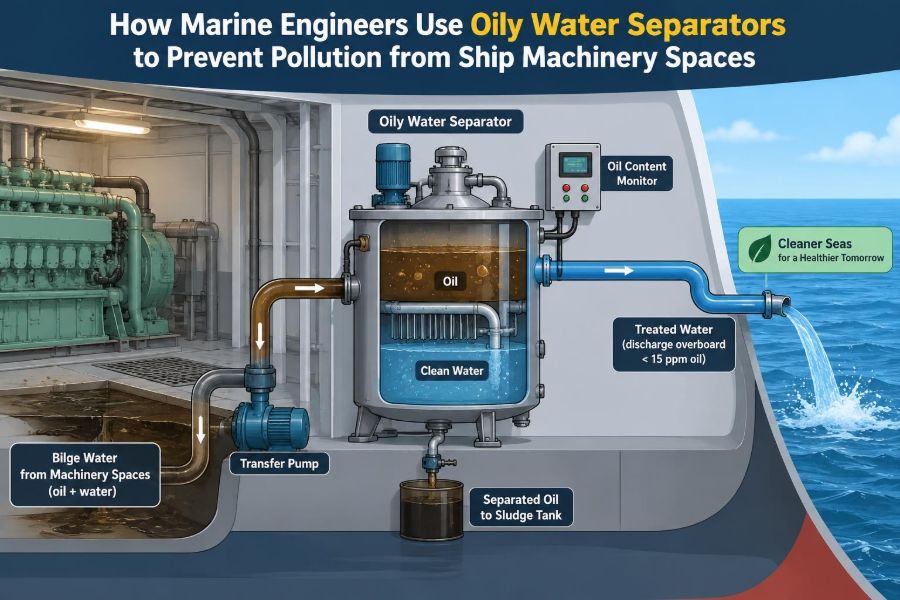
An OWS separates free oil and some dispersed oil from water before any permitted discharge. Most shipboard units combine physical processes such as gravity separation, coalescence, and filtration, although the exact design differs by manufacturer.
Oil is generally less dense than water, so droplets have a natural tendency to rise when flow is slow enough. The separator creates conditions in which droplets can join together, become larger, and rise more readily to an oil-collection space.
The treated water then passes through an oil-content monitoring arrangement before it can be discharged. Oil removed by the system is retained for transfer to a sludge or waste-oil tank; it is not sent to sea.
⚙️ The basic flow path through an OWS
Although pipe layouts vary, the process usually begins with bilge water being drawn from a bilge holding tank or bilge well into the separator. A feed pump moves it at a controlled rate, because excessive flow reduces separation time.
Inside the unit, larger droplets and solids are removed or directed toward collection areas. Water may then pass through a coalescer, where fine oil droplets meet a structured medium and combine into larger droplets.
After final treatment, an oil content monitor checks the effluent. If the reading is acceptable and all interlocks are satisfied, the system may allow discharge; otherwise, it automatically diverts the flow back to a holding tank or stops discharge.
🧪 Why oil and water do not separate equally well
A simple mixture of water and diesel may separate relatively easily after it stands. Real bilge water is more difficult because machinery action and pumping can break oil into tiny droplets dispersed throughout the water.
Some mixtures form an emulsion: a stable blend in which very small oil droplets remain suspended. Detergents, cleaning chemicals, vibration, heat, and high-shear pumps can make emulsions harder for a conventional OWS to treat.
This limitation matters operationally. A separator that works properly on normal oily bilge water may not be able to handle a tank containing strong detergent wash water, chemical residues, or emulsified fuel oil.
🧲 Gravity separation: the first treatment stage
In a gravity separation chamber, flow is slowed so denser water moves downward while free oil rises. Internal plates or baffles may reduce turbulence and lengthen the path through the chamber.
This stage is especially useful for larger, free oil droplets. It also prevents the later treatment stages from being overloaded by a sudden quantity of oil.
Gravity separation has limits. If the feed is violently mixed, too warm, chemically emulsified, or pumped too quickly, droplets may remain suspended and leave the chamber with the water.
🧩 Coalescers and why they improve separation
A coalescer contains material with a large surface area, often arranged as plates, media, or cartridges. As oily water moves gently through it, small droplets contact surfaces and one another.
The droplets merge, or coalesce, into larger drops. Larger drops rise more easily than fine droplets, allowing the oil to separate from the water in a following chamber or collection space.
Coalescers are effective only when they are clean and compatible with the liquid being processed. Sludge, solids, detergent residues, or certain chemicals can foul the media and prevent the system from performing as intended.
🧼 Why detergents can defeat a normal operating plan
Cleaning chemicals can be necessary in an engine room, but they require careful selection and use. A surfactant lowers the tendency of oil and water to separate, which is useful for cleaning surfaces but troublesome for an OWS.
For example, a crew member might wash a heavily oily deck with a powerful degreaser and hose the wash water into the bilge. The resulting emulsion may pass poorly through the separator and repeatedly trigger a high-oil alarm.
The practical response is not to keep restarting the OWS. Engineers should follow the vessel’s waste-management procedures, contain chemical wash water where required, and use products approved for the ship’s treatment arrangements.
🔍 The 15 ppm oil content monitor
Ships operating under the applicable international pollution-prevention framework commonly use a 15 parts per million (ppm) bilge alarm and automatic stopping device as part of their oily-water discharge arrangement. The monitor continuously assesses the treated effluent.
When the oil content exceeds the permitted setting, the arrangement must prevent non-compliant discharge, typically by stopping the discharge pump or diverting the flow back to a tank. The exact behavior depends on the approved system design.
The monitor is a safeguard, not proof that every upstream practice is sound. A contaminated measuring cell, incorrect calibration procedure, damaged sample line, or unapproved alteration can undermine its reliability.
📟 How the monitor makes a discharge decision
The monitor usually receives a representative sample from the treated-water outlet. Its sensor estimates oil content using an approved measurement method, while a control unit compares the result with the alarm threshold.
A three-way valve or similar arrangement provides the physical response. In normal approved operation, flow can go to the overboard line; when the reading is high, flow is redirected to a bilge holding tank or the discharge route is shut.
Engineers should understand the whole chain: sample flow, sensor, controller, alarm, valve, return line, and record function. A correct number on a display is of limited value if the diversion valve does not actually move.
🚫 Why bypassing the OWS is never an operational shortcut
An OWS bypass defeats the system’s environmental purpose and may violate pollution-prevention requirements. A hose, temporary pipe, altered valve lineup, or concealed connection that allows oily water to reach an overboard line is not a harmless workaround.
Bypasses also remove the safeguards that detect poor treatment. The crew loses the monitor’s warning, waste oil can enter the sea, and inaccurate records can conceal a serious operational failure.
When the separator cannot process a waste stream, the correct decision is to retain it, segregate it, treat it by an approved alternative, or discharge it to a reception facility. Capacity and schedule pressure do not change the nature of the risk.
📜 The regulatory principle behind OWS operation
International rules on prevention of pollution by oil establish conditions for machinery-space bilge discharge from ships. The details depend on the vessel, its trading area, equipment approval, flag-state implementation, and applicable special-area restrictions.
At the working level, the principle is clear: oily mixtures must not be discharged unless the approved equipment and operating conditions permit it. The vessel’s approved manuals, certificates, procedures, and company safety-management system guide the exact actions.
Engineers should avoid relying on memory for legal interpretation. When conditions are unusual, consult the vessel’s documentation and responsible officers rather than assuming that a familiar practice is allowed everywhere.
🗺️ Special areas and stricter operational caution
Some sea areas have enhanced environmental protection requirements, and discharge restrictions can be more stringent there. Voyage planning therefore affects waste management long before the ship reaches a sensitive area.
Before entering a restricted area, engineers need sufficient tank capacity for bilge water, sludge, and other residues that cannot be discharged. This calls for communication between the engine department, deck department, and shipboard management.
A common planning mistake is waiting until waste tanks are nearly full. Good practice is to estimate generation rates, confirm reception-facility opportunities, and preserve a realistic operating margin.
🪣 Bilge holding tanks provide operational control
A bilge holding tank gives the engineering team time to manage oily water properly. Rather than sending water straight from a dirty bilge well to the OWS, the tank allows collection, settling, and more controlled treatment.
Settling can reduce the amount of free oil entering the separator. It also lets the crew inspect the nature of the waste and avoid feeding a clearly unsuitable mixture into the unit.
Tank management still requires attention. Level alarms, sounding arrangements, heating where fitted, transfer routes, and contamination control all affect whether the system remains ready for use.
🧯 Source control starts before the separator
The least difficult litre of oily water to manage is the litre that never enters the bilge. Engineers reduce load on the OWS through leak prevention, drip trays, prompt repair, and disciplined maintenance practices.
- Keep fuel, lube-oil, and hydraulic leaks under repair rather than accepting them as normal.
- Use absorbent materials for small spills and dispose of them through the appropriate waste route.
- Segregate clean drains from oily drains where the vessel’s design permits.
- Prevent chemical wash water from entering bilges unless the procedure specifically permits it.
These measures improve safety as well as pollution control. Oil on deck plates is a slip and fire risk before it ever becomes an OWS problem.
🔧 Preparing the system before starting
Starting an OWS should be a deliberate operation, not a quick valve-opening exercise. The engineer checks that the intended tank has adequate capacity, that the correct suction and return paths are lined up, and that no unauthorized route exists to overboard.
The discharge side also needs verification. The monitor should be powered, sample flow established where applicable, alarms functional, and the automatic stopping or recirculation arrangement available.
A useful habit is to trace the flow mentally and physically: from source tank, through pump and separator, past the monitor, to either return or overboard. This reduces errors caused by confusing valve positions in a crowded machinery space.
▶️ A disciplined operating sequence
Manufacturers’ instructions and vessel procedures always take priority, but normal operation follows a recognizable pattern. The aim is to introduce waste slowly, observe the separator’s response, and retain control over where every stream goes.
- Confirm the approved valve lineup and tank levels.
- Start the system as instructed, usually with recirculation or a controlled initial flow.
- Allow the separator to stabilize and check for leaks, abnormal pressure, vibration, or alarms.
- Observe oil-content readings and verify that the return or discharge path responds correctly.
- Record the operation accurately when required, including transfers and discharge details.
Rushing this process can disturb separation, send a slug of oil toward the monitor, or conceal a faulty automatic valve.
⏱️ Why flow rate matters so much
Every separator has a designed capacity. Capacity is not a promise that all oily liquids can be processed at the maximum pump rate under any conditions; it assumes a particular type of feed and adequate residence time.
If flow is too high, oil droplets have less time to rise or coalesce. Turbulence can also break larger droplets into smaller ones, making separation more difficult.
When readings rise toward the alarm point, reducing flow may help only if the mixture is otherwise treatable. It will not solve a stable chemical emulsion or compensate for damaged media, which need separate corrective action.
🧱 Filters, cartridges, and their limitations
Some OWS designs use replaceable filter elements or polishing stages to capture remaining contamination. These components can improve effluent quality, but they are not an invitation to process unsuitable waste.
A blocked cartridge may create high differential pressure, reduced flow, bypass risk within the equipment, or repeated alarms. Replacing it without investigating the cause may lead to the same failure shortly afterward.
Engineers should inspect removed elements for clues: heavy sludge can suggest poor upstream settling, while oily detergent residue may indicate incompatible wash water. Condition-based observation is often more useful than treating replacement as a routine chore alone.
🧹 Removing separated oil and sludge
The oil collected within an OWS must be transferred to the designated sludge, waste-oil, or dirty-oil tank according to the vessel’s arrangement. If it is allowed to accumulate excessively, separation spaces can lose effectiveness or oil can be carried forward.
Sludge is not just “old oil.” It may contain water, solids, soot, chemical residues, and degraded lubricants. Its handling requires compatible tanking, pumping, heating where necessary, and accurate records.
Regular draining prevents the separator from becoming its own contamination source. It also helps reveal abnormal oil quantities that may point to a worsening machinery leak.
🛠️ Routine maintenance protects treatment performance
OWS maintenance should follow the maker’s manual and planned-maintenance system. Typical work includes cleaning chambers, checking coalescer condition, renewing seals, testing alarms, inspecting valves, and confirming sample-line cleanliness.
The oil-content monitor deserves particular care. Sampling points can foul, optical or sensing surfaces can become contaminated, and calibration or functional checks may be specified at defined intervals.
Maintenance records matter because they show whether the equipment has been kept in a serviceable condition. More importantly, they give the next engineer a reliable history of recurring faults and previous corrective actions.
🧾 Accurate records make operations traceable
Oil Record Book entries, tank soundings, transfer logs, and monitor records should tell one coherent story. They document what was collected, transferred, treated, retained, or delivered ashore.
Accuracy means recording the actual operation, at the appropriate time, using the vessel’s required format. It does not mean reconstructing a plausible entry later from memory.
Inconsistent records can expose genuine procedural weaknesses, even if no pollution occurred. For example, a large reduction in a bilge tank level without a corresponding transfer or treatment entry deserves explanation.
👥 Roles on a well-managed engine-room team
Pollution prevention is not assigned to one rank alone. The chief engineer sets standards and ensures the system is maintained; watchkeeping engineers operate equipment responsibly; motormen and oilers report leaks and maintain cleanliness; junior engineers learn the reasons behind each step.
Clear handovers are especially important. If an OWS run is underway, the relieving watch needs to know the source tank, valve position, current monitor trend, remaining capacity, and any abnormal behavior.
A team culture that welcomes early reporting is valuable. Reporting “the monitor is unstable” or “this cleaning chemical may be unsuitable” gives the ship time to make a compliant decision.
⚠️ Common mistakes and what they reveal
Repeated high-oil alarms are sometimes treated as an equipment nuisance. In reality, they may reveal a poor feed mixture, excess flow, fouled coalescer media, incorrect valve configuration, or defective monitoring equipment.
- Feeding the separator too fast: reduces residence time and can carry oil through.
- Mixing all drains together: turns manageable waste into a complex emulsion.
- Ignoring small machinery leaks: steadily overloads tanks and treatment equipment.
- Cleaning the monitor but not investigating contamination: treats a symptom, not the source.
- Assuming an alarm is false: can lead to a non-compliant discharge decision.
The best troubleshooting begins with the question: what changed in the waste stream, equipment condition, or valve lineup?
🧭 Troubleshooting a high oil-content alarm
When a high reading occurs, the safe response is to follow the approved procedure: stop or divert discharge as designed, retain the mixture, and investigate. Continuing overboard discharge while hoping the reading will fall is not an acceptable diagnostic method.
Check whether the feed is emulsified, whether the flow rate is excessive, whether the separator is contaminated, and whether the monitor’s sampling system is clean and functioning. Confirm the return line is open and that the automatic valve has moved to the safe position.
If the cause cannot be confidently resolved, isolate the equipment as appropriate, notify the responsible engineer, and manage the waste through approved retention or shore-disposal arrangements.
🏗️ Design features that improve real-world reliability
Modern OWS installations may include automated recirculation, data logging, self-cleaning features, improved coalescing materials, and more sophisticated monitor diagnostics. These features can reduce routine workload and improve fault detection.
Automation does not remove the need for oversight. Sensors still need clean samples, valves still need periodic testing, and an automatic system can only respond correctly if its inputs and mechanical components remain healthy.
When evaluating equipment, engineers should consider maintainability as well as nominal performance: access for cleaning, availability of spares, clarity of alarms, and ease of verifying the actual flow path all affect reliable use at sea.
♻️ OWS operation within a wider waste-management system
The separator is one part of an integrated shipboard waste system. Sludge tanks, bilge tanks, incineration arrangements where permitted and fitted, shore reception facilities, garbage controls, sewage systems, and chemical inventories all influence pollution prevention.
Segregation is a recurring theme. Keeping waste streams separate preserves options: clean drainage may need little treatment, conventional oily bilge water may suit the OWS, and chemical or highly emulsified waste may need retention for shore disposal.
This wider perspective helps engineers avoid using the OWS as a universal drain. It is a specialized system with a defined duty, not a solution for every liquid generated in an engine room.
🎓 Training turns procedures into sound judgment
New engineers often learn OWS operation as a sequence of valves, switches, and logbook entries. That sequence matters, but competent operation requires understanding why each safeguard exists.
Training should include practical recognition of oil-water interfaces, sample-line issues, emulsions, alarm response, tank-capacity planning, and the consequences of incorrect waste segregation. Drills and supervised operation are useful when they reflect the vessel’s actual equipment.
Good judgment is most visible in unusual situations: a damaged monitor, a contaminated bilge after maintenance, or an approaching restricted area with limited tank capacity. Procedures provide the framework; understanding helps the engineer apply it safely.
🧠 A practical scenario: after a purifier maintenance job
Consider a hypothetical case in which fuel-purifier maintenance produces oily rags, a small quantity of drain liquid, and deck washings. The poor approach would be to hose everything toward the bilge and assume the OWS will manage it later.
A better approach is to use drip trays, collect free oil and contaminated absorbents separately, minimize wash water, and identify whether any cleaning agent is compatible with the ship’s waste procedures. The remaining bilge water can then be transferred to the holding tank for controlled treatment.
The difference is not extra bureaucracy. It protects separator capacity, avoids creating a stable emulsion, and gives the crew a clear record of where the waste went.
🌍 Why preventing discharge protects more than compliance
Oil can affect marine organisms, shorelines, fisheries, and the appearance of the sea, even when a release is not dramatic enough to make headlines. Machinery-space pollution also damages the trust placed in professional seafarers and ship operators.
Compliance is therefore not merely about avoiding detention, penalties, or an investigation. It is the formal expression of a practical duty: machinery spaces generate wastes, and those wastes must be managed without transferring harm to the marine environment.
For an engineer, this duty is exercised through ordinary actions—repairing a leak, checking a valve, segregating a drain, challenging a doubtful instruction, and making an honest record.
✅ The core principle: treat, verify, retain when uncertain
Effective OWS use rests on three connected actions. First, reduce contamination and treat only waste the approved system can handle. Second, verify that the separator, monitor, alarm, and automatic diversion arrangement are functioning as a complete system.
Third, when the waste is unsuitable or equipment performance is uncertain, retain the mixture rather than discharging it. This principle is more dependable than any single alarm, valve, or checklist item.
An oily water separator protects the sea only when engineering knowledge is paired with careful operation, maintenance, records, and the willingness to stop when conditions are not right.
Marine pollution prevention begins in the engine room, where every litre of bilge water must be understood, controlled, and handled through an approved path. 🚢🌊⚙️