
A crew member making a routine engine-room round notices water shimmering in the bilge below a main engine. There may be only a small amount, but its appearance matters: clear water, dark oil, rusty sediment, or a rising level can each point to a very different condition.
On a ship, liquid does not always stay where it is meant to be. Condensation forms on cool surfaces, cooling-water systems can seep, drains collect wash water, and machinery may release small quantities of oil. Gravity carries much of it to the lowest spaces in the hull: the bilges.
Bilge management is therefore not simply a housekeeping task. It protects machinery, helps crews detect faults early, preserves stability, and prevents oil pollution. The system has to collect unwanted liquid reliably while ensuring that oil-contaminated water is never discharged unlawfully.
Understanding the bilge system means following the path of that liquid—from its source, through wells and pumps, into treatment equipment, records, and finally an approved disposal route.
⚓ What “Bilge” Means on a Ship
The bilge is the lowest internal area of a ship’s hull, especially along the turn of the bilge where the bottom plating curves toward the ship’s side. It is also used more broadly to describe low spaces where drainage gathers.
Ships are divided into watertight compartments, so there is not one single bilge for the entire vessel. Engine rooms, pump rooms, cargo spaces, steering gear rooms, and accommodation service spaces may each have their own drainage arrangements.
💧 Why Water Collects Below Deck
Some bilge water is expected during normal operation. Sources include machinery leakage, pipe-joint seepage, condensation, deck washings that reach internal drains, and water carried in on boots or equipment.
Other sources require prompt investigation. A leaking seawater cooling line, failed seal, fractured drain pipe, or hull ingress can raise a bilge level quickly. The system removes liquid, but it must never become an excuse to ignore the cause.
🛢️ Why Engine-Room Bilge Water Often Contains Oil
Engine rooms contain fuel systems, lubricating oil systems, hydraulic equipment, compressors, pumps, and oily machinery surfaces. Small drips can combine with water and cleaning residues in the bilge.
The result is usually an oily-water mixture, not a neat layer of oil floating on clear water. Detergents, heat, agitation, and fine droplets can create emulsions that are harder to separate. This is why an ordinary drain pump alone is not an acceptable answer.
🧭 The Bilge System’s Four Core Jobs
A well-designed bilge arrangement performs four connected functions: collection, monitoring, pumping, and controlled disposal. Each function supports the others.
- Collection: guide liquids to accessible low points.
- Monitoring: reveal abnormal levels and contamination.
- Pumping: remove liquid from compartments safely.
- Control: treat, retain, transfer, or discharge it through approved means.
A fault in any one stage can turn a manageable leak into a machinery, flooding, or pollution problem.
📍 Bilge Wells: Purpose-Built Collection Points
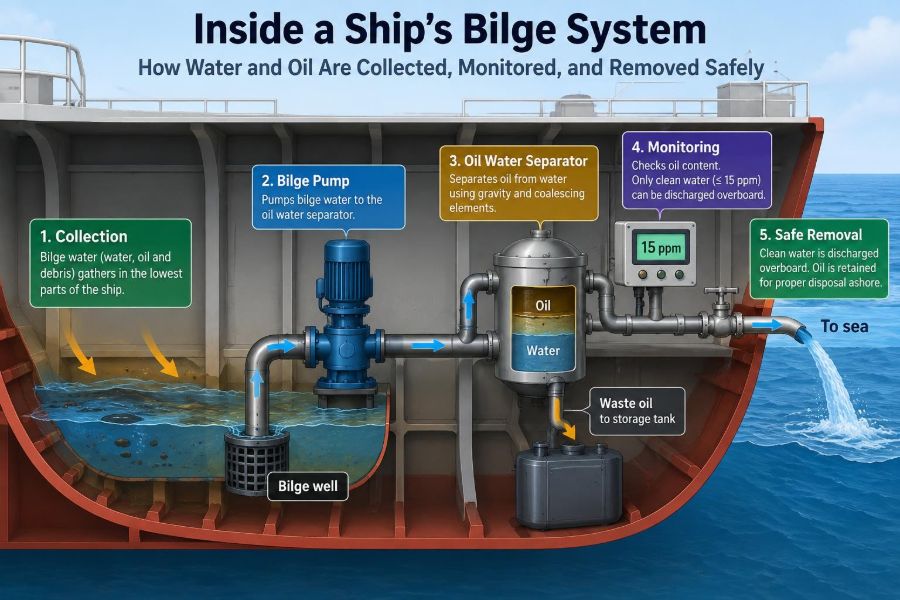
A bilge well is a small recessed pocket at a low point in a compartment. It concentrates collected liquid where a suction pipe, sounding device, or level sensor can reach it effectively.
Wells commonly include strainers or mud boxes to stop rags, scale, bolts, and other debris entering suction lines. They are practical collection points, but they also require cleaning; a blocked strainer can prevent a pump from removing water when it is needed most.
🧱 Why Ships Use Several Wells Instead of One
A vessel trims and heels as fuel is used, cargo changes, seas act on the hull, or a turn is made. Liquid moves toward the lowest point under those changing conditions.
For that reason, machinery spaces often have wells at more than one location, such as forward and aft or port and starboard. Crews can select the appropriate suction and avoid leaving a pocket of water trapped on the “high” side of a heeled ship.
🔧 Suction Lines, Valves, and the Bilge Manifold
Each bilge well connects through piping and isolating valves to a common bilge manifold or pumping arrangement. The manifold lets operators choose which compartment is being pumped and where the liquid is sent.
Valve line-ups demand discipline. An incorrect line-up can send liquid to the wrong tank, defeat segregation between systems, or leave the intended suction isolated. Clear labeling, updated piping diagrams, and deliberate verification are essential controls.
🚰 The Main Bilge Pump and Backup Arrangements
Ships need sufficient pumping capacity to manage foreseeable water accumulation. Depending on vessel design, dedicated bilge pumps, general-service pumps, ballast pumps with approved arrangements, or ejectors may be used.
Redundancy matters because one pump can lose prime, suffer an electrical fault, or be unavailable during maintenance. Emergency arrangements are not substitutes for normal housekeeping, but they provide another layer of protection if flooding develops.
🌊 Emergency Bilge Suction: A Last-Resort Tool
Many machinery installations include an emergency bilge suction connected so that a large-capacity pump, often a main cooling-water pump, can draw directly from the engine-room bilge in an emergency.
This arrangement is intended for serious flooding, not routine drainage. Using it casually can introduce debris into a critical pump, disrupt cooling flow, or make control of contaminated water more difficult. Crew members must know its location, operating limitations, and valve sequence.
🧹 Strainers and Mud Boxes Protect the System
Bilges are messy by nature. Paint chips, insulation fragments, gasket material, welding debris, and cleaning cloths can all find their way into a well. Strainers protect pumps and narrow piping from this debris.
However, a strainer is only effective when inspected and cleaned. A recurring amount of debris is also diagnostic: it may indicate poor engine-room housekeeping, deteriorating insulation, or work practices that allow foreign material into drains.
📏 Sounding Pipes and Electronic Level Alarms
Traditional sounding pipes allow a crew member to measure liquid level manually using a sounding tape and bob. The method is simple, independent of electrical power, and useful for confirming an instrument reading.
Electronic sensors and high-level alarms add continuous warning. Their value depends on correct testing: a float switch stuck by sludge or a sensor with a failed connection can create false confidence. Good practice combines reliable automation with physical verification.
🚨 What a Rising Bilge Level Can Tell You
A rising level is a symptom, not a diagnosis. The rate of rise, liquid appearance, recent machinery work, and associated alarms help identify the likely source.
| Observation | Possible meaning | Initial response |
|---|---|---|
| Clear water rising steadily | Cooling-water, freshwater, drain, or hull leak | Check nearby systems and isolate the source if safe |
| Dark oily water | Lubricating oil, fuel oil, or hydraulic leakage | Identify equipment, stop leakage, contain and transfer correctly |
| Sudden rapid rise | Major pipe failure or seawater ingress | Raise alarm, begin emergency response, assess stability |
| Unusual foam or milky liquid | Detergent contamination or emulsified oil | Segregate for treatment and avoid unsuitable discharge |
These are investigative clues, not conclusive diagnoses. The ship’s procedures and the responsible engineer’s assessment govern the response.
🛑 Finding and Stopping the Source First
Pumping down a bilge without controlling the leak can hide an escalating problem. A crew should first assess whether the liquid is safe to approach, then trace likely sources systematically.
For example, a freshwater leak may be found by checking tank levels, pressure loss, and nearby pipework. A suspected fuel leak calls for ignition control, spill containment, ventilation awareness, and immediate reporting under the vessel’s emergency procedures.
🧪 Why Oil and Water Do Not Always Separate Easily
Free oil generally rises because it is less dense than water. In a quiet settling tank, that difference can be used to separate much of the oil.
But pumps, turbulence, heat, and detergents can break oil into tiny droplets dispersed through water. This emulsion may look cloudy or milky and can overwhelm equipment designed mainly for free-oil separation. Chemical cleaning agents should therefore be selected and used carefully.
🛢️ The Bilge Holding Tank’s Role
Oily bilge water is commonly collected in a bilge holding tank before processing. This gives the vessel time to manage the liquid, allows some settling, and prevents immediate reliance on the oily-water separator.
Holding capacity is finite. If an underlying leak is not corrected, the tank can fill faster than it can be processed or landed ashore. Regular tank-level monitoring turns a capacity issue into an early warning rather than a late emergency.
⚙️ How an Oily-Water Separator Works
An oily-water separator, often called an OWS, treats bilge water before any permitted overboard discharge. Designs vary, but they typically use stages that slow the flow, encourage larger oil droplets to coalesce, and separate oil from water.
Separated oil is directed to a sludge or waste-oil tank. The water outlet passes to monitoring equipment. The OWS is effective only within its operating conditions; heavily emulsified mixtures, excessive solids, or unsuitable cleaning chemicals may require retention and shore disposal instead.
📊 The 15 ppm Monitor and Automatic Safeguards
International pollution-prevention requirements generally restrict discharge of machinery-space bilge water to a very low oil content, commonly expressed as 15 parts per million under applicable operating conditions. Ships use an oil-content monitor to assess the treated outlet.
If the measured oil content exceeds the permitted setting, approved arrangements should stop or divert the overboard flow, usually back to a holding tank. The monitor, alarm, and automatic stopping device are safeguards—not permission to bypass maintenance or operational controls.
🌍 Discharge Rules Depend on Location and Vessel Status
Whether discharge is allowed depends on the vessel’s certification, equipment approval, operating condition, location, and applicable international, flag-state, port-state, and company requirements. Some areas and operating situations impose stricter controls or effectively require retention.
For that reason, no article can replace the ship’s current pollution-prevention manual, certificates, and voyage-specific instructions. When there is uncertainty about discharge legality or equipment performance, retaining the liquid and seeking an approved disposal route is the safer decision.
📒 Recordkeeping Makes the Process Accountable
Transfers, treatment operations, discharge, and disposal of oily residues are recorded in the appropriate oil record book as required by the vessel’s regime. Entries must accurately reflect what happened, including quantities, tanks, dates, and operational method.
Records matter because they connect tank levels, machinery operation, and environmental compliance. Inconsistent entries are not a paperwork nuisance; they can indicate poor control, create legal exposure, and make it harder for the crew to reconstruct an incident.
🚫 Why Bypass Arrangements Are Dangerous and Prohibited
Any unauthorized piping, hose, valve arrangement, or manipulation that defeats the OWS and monitoring safeguards is commonly called a magic pipe or bypass. It can allow untreated oily water to reach the sea.
Such arrangements create environmental harm and serious consequences for individuals and companies. More fundamentally, they undermine the engineering culture required aboard ship: systems must be operated as designed, faults reported, and waste managed through lawful routes.
🏗️ Separating Clean Drains from Oily Drains
Good ship design and operation keep streams separate where practical. Clean condensate or uncontaminated drainage may be managed differently from engine-room bilge water, while oily drains should be routed to suitable containment and treatment.
Mixing everything into one bilge creates unnecessary waste volume and makes treatment harder. During maintenance, crews should protect drains from oil, chemicals, and solids rather than assuming that downstream equipment can solve every contamination problem.
🧯 Fire, Slip, and Machinery Risks in Bilges
Oil in a hot machinery space is not only a pollution concern. Sprayed or pooled oil can contribute to fire risk if it contacts hot surfaces, while wet gratings and oily plates create slip hazards.
Standing water also accelerates corrosion and can conceal damaged fittings, sharp edges, or loose material. Keeping bilges clean and reasonably dry improves inspection access and makes abnormal leakage easier to see early.
⚖️ Bilges, Free Surface Effect, and Stability
Large quantities of loose liquid can reduce stability through the free surface effect. As a ship heels, liquid shifts across the compartment, moving its center of gravity and reducing the vessel’s ability to return upright.
Normal bilge quantities are usually small, but uncontrolled flooding is a stability emergency. Watertight boundaries, prompt pumping, correct isolation, and communication with the bridge are all part of managing the wider consequences of water ingress.
🔍 Routine Rounds Are an Early-Warning System
A proper engine-room round is active observation, not merely checking boxes. Engineers look at bilge level, color, sheen, smell, temperature nearby, pump status, tank levels, and the condition of strainers and drains.
Trend awareness is especially useful. A small daily increase in oily-water generation may reveal a seal deteriorating long before it becomes a major leak. Notes that describe changes clearly help the next watch continue the investigation.
🧰 Planned Maintenance Prevents Hidden Failures
Bilge valves, non-return valves, suction strainers, pumps, high-level alarms, OWS components, and oil-content monitors need planned inspection and testing. A component that works only on paper is not a safety barrier.
Maintenance should include verification of valve freedom, leak-tightness where relevant, alarm function, pump priming ability, and calibration or functional checks required by the equipment maker and vessel procedures. Defects should be reported rather than compensated for with improvised operating habits.
👥 Clear Roles During a Bilge Incident
During abnormal flooding or a significant oil leak, everyone should understand who investigates, who operates pumps, who manages valves, who informs the bridge, and who records actions. Unclear roles waste time and can create conflicting valve movements.
Training scenarios are valuable when they include realistic complications: a blocked strainer, a pump that loses suction, an alarm that needs confirmation, or an oily mixture unsuitable for discharge. The aim is calm, controlled decision-making rather than memorizing a single sequence.
🧼 Housekeeping Is a Technical Control, Not Cosmetics
Clean bilges allow leaks to stand out. A fresh oil trail from a pump seal is far easier to trace on a clean plate than in an old mixture of sludge and wash water.
Good housekeeping also means storing absorbents correctly, removing waste promptly, securing tools, and preventing rags from entering wells. It reduces both the likelihood of blockage and the effort needed to investigate an alarm.
🧠 Common Mistakes That Undermine Bilge Management
- Pumping a bilge repeatedly without identifying why it refills.
- Leaving suction valves in an unverified position after maintenance.
- Using detergents that create difficult emulsions without considering disposal.
- Assuming an electronic alarm is correct without periodic physical checks.
- Allowing solids, rags, or oily absorbents into bilge wells.
- Treating OWS operation as a routine button-push rather than a controlled process.
Most of these mistakes begin as small shortcuts. Their consequences grow when poor housekeeping, weak records, and unreported equipment defects occur together.
🧑🏫 What Students Should Learn From the Bilge System
The bilge system is an excellent example of marine engineering as an interconnected discipline. It combines fluid flow, pumps, pipe systems, automation, pollution prevention, fire safety, ship stability, maintenance, and human factors.
When studying a piping diagram, do not only memorize line names. Ask where liquid originates, what prevents backflow, how an operator confirms the path, what happens if a pump fails, and where contaminated liquid ultimately goes. Those questions build operational understanding.
✅ The Core Principle: Control the Liquid, Then Control the Risk
Safe bilge management follows a simple but demanding sequence: collect liquid at low points, detect abnormal changes, identify and stop the source, pump through the correct route, treat or retain contamination, and document the operation accurately.
The most reliable bilge system is not defined solely by sophisticated equipment. It depends on clean wells, maintained pumps and alarms, correct valve management, trained people, and a culture that refuses shortcuts when environmental protection is inconvenient.
A ship’s bilge system protects the vessel and the sea only when every drop is treated as both a technical signal and a responsibility. 🚢🌊🛠️