
A large ship approaches a berth slowly, with tugs standing by and mooring lines ready on shore. The bridge team may need the bow to move a few metres sideways while keeping the vessel nearly still ahead. From the quay, that movement can look almost effortless.
It is not. A ship has enormous mass, inertia, windage, and underwater resistance. Its main propeller is designed primarily to drive it forward or astern, while its rudder needs water flow to generate a useful turning force. At very low speed, precise sideways control becomes difficult.
This is where the bow thruster earns its place. It gives the operator a controlled sideways force near the forward end of the ship, helping with docking, undocking, lock transits, and close-quarters manoeuvring.
Bow thrusters do not let a ship slide sideways like a car in a parking bay, and they do not replace professional shiphandling. But when used with the rudder, propeller, tugs, and good planning, they can make slow-speed manoeuvres safer and more predictable.
🧭 The sideways-control problem
Ships are naturally efficient at moving lengthwise. Their hulls are long, their propulsion is aligned fore and aft, and their steering systems are built to change heading while the ship has forward motion.
Moving bodily sideways is different. It is called transverse motion, and a vessel has relatively little natural ability to create it. Near a berth, even a small sideways drift can decide whether fenders are contacted gently or a landing becomes difficult.
🚢 What a bow thruster is
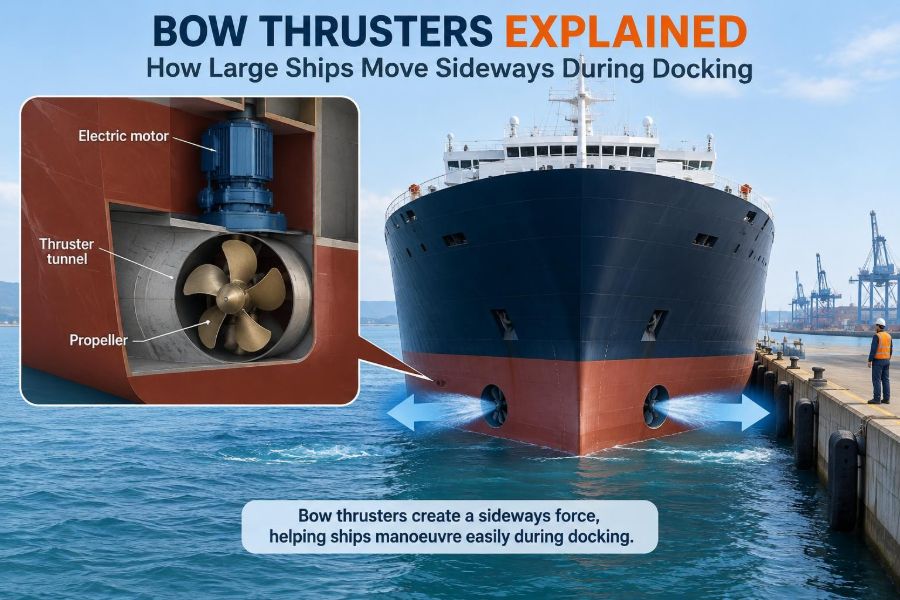
A bow thruster is a manoeuvring device installed low in the forward part of a vessel. It produces thrust to port or starboard, allowing the bow to be pushed sideways without relying on forward speed.
On many ships, the equipment consists of a transverse tunnel through the hull, a propeller inside that tunnel, and an electric or hydraulic drive system. Selecting one direction sends a water jet out one side and draws water in from the other.
📍 Why the unit sits near the bow
Location matters because force creates a turning effect as well as a sideways push. A force applied far from the vessel’s centre of rotation produces a large yaw moment: it tends to swing the ship’s heading.
Putting a thruster well forward means a modest side force can move the bow decisively. The stern will commonly swing in the opposite direction, especially if the ship is free to rotate.
🔄 How a tunnel thruster creates force
In a conventional tunnel thruster, a propeller accelerates water through a cylindrical passage across the hull. Newton’s third law provides the useful result: as water is pushed out to one side, the vessel is pushed toward the other.
The flow is not perfectly simple. The tunnel shape, grille, propeller design, hull boundary layer, and nearby structures all affect efficiency. Still, the operating idea is straightforward: accelerate a mass of water sideways to generate an equal and opposite reaction on the ship.
🌀 The propeller inside the tunnel
Most tunnel thrusters use either a fixed-pitch or controllable-pitch propeller. A fixed-pitch unit reverses thrust by reversing motor or hydraulic-drive direction. A controllable-pitch unit can keep the shaft turning one way and reverse thrust by changing blade pitch.
Controllable-pitch designs can provide rapid response, but they add mechanical complexity. The best arrangement depends on vessel type, power system, operating profile, maintenance support, and redundancy requirements.
⚡ Electric, hydraulic, and diesel-driven systems
The propeller needs substantial power for short periods. On many modern ships, an electric motor drives the thruster, supplied by generators and a distribution system designed to handle the high demand.
Hydraulic thrusters are also used, particularly where an existing hydraulic system suits the vessel. Some smaller craft use a dedicated diesel engine. Each arrangement must be assessed not only for installed power, but for response time, heat generation, maintenance needs, and available electrical capacity.
🎛️ The controls on the bridge
Bow-thruster control is commonly provided by a small lever, joystick, or rotary controller at the manoeuvring position. Moving the control to port requests a force toward port; moving it to starboard requests force the other way.
The apparent simplicity can be misleading. The operator must interpret wind, current, ship speed, tug forces, mooring constraints, and the vessel’s delayed response. A brief input may be enough; holding maximum thrust can create excessive swing or waste power.
🛳️ Bow movement is not whole-ship translation
A common misconception is that a bow thruster moves the entire ship cleanly sideways. Usually, it first moves the bow and rotates the vessel. The stern response depends on the ship’s inertia, pivot point, water depth, other forces, and whether the stern is restrained.
Imagine pushing one end of a long floating plank. Unless the other end is controlled, the plank turns. A ship behaves similarly, although water resistance and momentum make the real motion slower and more complex.
⚓ The role of the pivot point
The pivot point is the point around which a ship appears to rotate during a manoeuvre. Its position changes with speed, propulsion, hull form, and external forces; it is not a fixed physical pin in the hull.
When making headway, it often lies forward of midships. When moving astern, it can shift aft. This changing geometry affects how a thruster input influences the bow and stern, which is why shiphandlers think in terms of the whole vessel rather than a single control.
🌬️ Wind can overwhelm a thruster
Wind acts on everything above the waterline: accommodation blocks, container stacks, vehicle decks, cranes, and exposed hull surfaces. This projected area is known as windage.
A strong crosswind may create more sideways force than the bow thruster can overcome, particularly on a lightly loaded ship sitting high in the water. The thruster may still help with heading control, but it cannot be assumed to guarantee a berth approach.
🌊 Current, tide, and water movement
Current affects the underwater hull and may vary across a harbour, near river mouths, around lock entrances, or close to structures. Tidal streams can also change direction and strength during the operation.
A bow thruster supplies force relative to the surrounding water, while the ship’s actual track is judged relative to the berth or shore. This distinction matters: a vessel can have controlled heading through the water while still being set sideways by current.
🏗️ Why docking is the classic use case
During docking, the aim is normally to approach at a carefully controlled angle and rate, then bring the hull alongside without excessive contact force. The bow thruster is useful for fine adjustments to bow alignment as lines are passed and tugs work.
It is particularly valuable where berth space is limited, another vessel is nearby, or a marina, terminal, or lock gives little room for error. Its value comes from precision at low speed, not from raw power alone.
↔️ Bow thruster versus stern thruster
A stern thruster performs the same basic function at the aft end. A vessel fitted with both can generate more direct transverse control and, under suitable conditions, can move laterally with less unwanted rotation.
| Equipment | Primary effect | Typical manoeuvring use |
|---|---|---|
| Bow thruster | Moves bow sideways; creates yaw | Bow alignment and close-quarters turns |
| Stern thruster | Moves stern sideways; creates opposite yaw | Stern clearance and final alignment |
| Bow and stern thrusters | Can balance yaw for lateral movement | Precise berthing in sheltered conditions |
| Tugs | Apply external force at chosen points | High-wind, confined, or high-risk manoeuvres |
Even with both thrusters, environmental conditions and vessel momentum still govern what is possible.
🧰 Other thruster designs
Not every bow thruster is a fixed tunnel. Retractable units lower from the hull when needed, reducing drag when underway. Swing-out or azimuthing units can direct thrust through a range of angles, offering more flexible control.
Waterjets and podded propulsion systems can also contribute to low-speed manoeuvrability. These arrangements should not be casually treated as identical to a tunnel thruster; their flow paths, response characteristics, and failure modes differ.
📐 Thrust rating is not the whole story
Thrusters are often described by their static thrust, frequently expressed in kilonewtons or tonnes-force equivalents. That rating is useful for comparison, but it represents performance under defined conditions rather than a promise of identical real-world force.
Hull immersion, tunnel losses, vessel speed, waves, fouling, voltage or hydraulic pressure, and wind can all change the practical result. Shiphandling decisions should be based on vessel-specific experience, approved operating information, and prevailing conditions.
💨 Why performance falls as speed rises
A tunnel thruster works best when the vessel is nearly stopped. As forward speed increases, water flows across the tunnel openings and can disrupt the transverse jet. The effective side force drops, sometimes sharply.
Higher speed also increases the main hull’s directional forces, making a small transverse input less influential. Operators therefore use bow thrusters mainly for low-speed work and follow the vessel manufacturer’s specified speed limits.
🕳️ Tunnel interaction and recirculation
At certain speeds or in restricted water, water expelled from one tunnel opening may circulate around the hull and return toward the intake. This recirculation reduces the useful change in water momentum and lowers thrust efficiency.
Harbour walls, seabed proximity, and adjacent vessels may alter local flow further. A thruster that feels strong in open, still water may respond differently beside a solid quay or in a narrow lock.
🧱 Shallow water and bank effects
Shallow water changes pressure distribution around the hull and increases resistance. In narrow channels, water constrained between the ship, bank, and bottom can create attraction or repulsion effects that complicate steering.
These effects are not corrected automatically by pressing harder on the thruster control. A prudent manoeuvre uses lower speed, adequate under-keel clearance, local knowledge, tugs where required, and allowances for the vessel’s particular behaviour.
🔌 The electrical load challenge
Large electric bow thrusters can demand a major share of the ship’s available electrical power. Starting or loading the unit may cause voltage dips if generators and power-management systems are not properly matched to the demand.
Bridge teams and engineering teams must understand operational restrictions. In some cases, cargo equipment, reefer loads, or other high-demand consumers may need management before intensive manoeuvring begins.
🌡️ Duty cycle and overheating
Thrusters are usually designed for intermittent service, not continuous operation. Motors, hydraulic oil, gearboxes, and power electronics generate heat during heavy use, and their allowable running time may be limited.
The duty cycle stated in the vessel documentation matters. Repeated long bursts can trigger thermal protection or damage equipment, leaving less manoeuvring capability when it is most needed.
🧽 Marine growth and blocked tunnels
Thruster tunnels are exposed to seawater at all times. Marine growth, debris, ice in relevant waters, damaged grilles, or accumulated sediment can restrict flow or create imbalance.
Planned hull cleaning and inspection help maintain performance. A noticeable change in vibration, noise, current draw, or response should be investigated rather than dismissed as normal harbour conditions.
🔧 Maintenance priorities below the waterline
Reliable operation depends on more than the propeller. Maintenance programmes commonly address seals, bearings, gear oil, lubrication, hydraulic hoses where fitted, electrical insulation, cooling arrangements, alarms, control circuits, and structural condition of the tunnel.
Seal integrity deserves particular attention because a fault can allow seawater into machinery spaces or lubricants out into the environment. Exact inspection intervals depend on the manufacturer, classification requirements, and the ship’s maintenance system.
🚨 Failure modes during manoeuvring
A thruster can fail through loss of electrical supply, overload trips, hydraulic faults, control failure, mechanical damage, overheating, or protection-system action. It may also be available but ineffective against conditions beyond its capability.
The operational consequence depends on the stage of the manoeuvre. Losing bow control close to a berth may require stopping the approach, using tugs, or aborting and trying again when safe. The safe response is planned before the vessel enters confined water.
📋 Pre-arrival checks that matter
Before a manoeuvring operation, the relevant systems should be tested and confirmed in accordance with procedures. The bridge needs clear status information, and the engine room needs to know the expected timing and likely electrical demand.
- Confirm the thruster is available and controls respond in both directions.
- Check alarms, cooling, lubrication or hydraulic status as applicable.
- Discuss power limitations and generator configuration.
- Review wind, tide, current, berth geometry, tug plan, and abort points.
- Record or communicate any restriction honestly before the approach begins.
👥 Bridge teamwork and clear language
Thruster use is part of bridge resource management, not a solitary action. The master, pilot where carried, officers, helmsman, engine-room team, tug masters, and mooring parties need a shared understanding of the intended plan.
Instructions should state direction, amount, and duration clearly. Closed-loop communication—where a command is repeated back and acknowledged—helps catch misunderstandings, especially when noise, accents, workload, or simultaneous radio traffic increase pressure.
🧠 A practical hypothetical docking sequence
Consider a cargo ship approaching a berth in light crosswind. The vessel reduces to very low speed, uses a tug to control the stern, and keeps the bow slightly clear while lines are prepared.
A short bow-thruster input brings the bow toward the fenders while the tug checks the opposing swing. As the vessel comes alongside, the operator uses small corrections rather than continuous maximum thrust. This is a hypothetical example; the actual sequence must match the ship, port rules, tug plan, and conditions.
❌ Mistake: treating the thruster as an emergency cure
A bow thruster is most effective when it supports a controlled plan. Waiting until the bow is already being blown rapidly away, or toward an obstruction, may demand more force than the unit can deliver.
Good shiphandling protects options: approach slowly, leave room to stop or turn away, anticipate environmental forces, and request tug assistance early when margins are shrinking.
❌ Mistake: using maximum thrust for too long
Maximum thrust may be appropriate briefly, but it is not automatically the safest setting. Prolonged use can overheat equipment, consume electrical reserve, and cause an unexpectedly large rotational response once the ship begins moving.
Small, observed inputs are often more effective in calm conditions. The key is to allow enough time to assess the vessel’s response without allowing momentum to build unchecked.
❌ Mistake: forgetting people and lines ashore
Thruster wash can disturb water around a berth, small craft, workboats, and mooring lines. The ship’s sideways movement can also tighten, slacken, or lead lines in changing directions.
Bridge commands must be coordinated with mooring operations. No manoeuvring aid removes the need to keep people clear of snap-back zones and to treat tensioned lines as hazardous equipment.
⚖️ Thrusters, tugs, and pilotage work together
A powerful bow thruster may reduce tug use in benign conditions, but it does not make tugs unnecessary in every port. Tugs offer force at selected locations, can assist with braking and escort duties, and provide redundancy if onboard equipment fails.
Pilots contribute local experience with currents, berth geometry, traffic, and port practices. The sensible question is not whether a thruster is better than a tug, but what combination provides adequate control and safety margin for that operation.
🌱 Efficiency, noise, and environmental considerations
Thrusters consume energy and may produce underwater noise, vibration, and local turbulence. Frequent high-power use can increase fuel consumption indirectly by raising generator load.
Efficient manoeuvring starts with planning: arrive at a suitable speed, avoid unnecessary correction cycles, maintain the equipment well, and use the least force that safely achieves the required movement. Local restrictions may also apply near sensitive waters or small craft.
🎓 What students should learn from a bow thruster
The bow thruster is a useful engineering lesson because it connects propulsion, fluid mechanics, electrical systems, controls, structural design, and human decision-making. Its visible sideways jet is only the end result of many systems working together.
For engineering students, the question is not simply “How much thrust does it make?” Ask what power is available, how heat is removed, how the control fails safely, what degrades performance, and how the crew knows the equipment is healthy.
🧭 The core principle of controlled docking
Bow thrusters give large ships a valuable lateral force where conventional propulsion is weakest: at very low speed near the berth. They are especially effective for positioning the bow and creating a controlled turning moment.
Yet their real value depends on context. Wind, current, speed, hull form, water depth, power availability, maintenance condition, tug support, and crew coordination all determine whether the force is sufficient and how it should be used.
A bow thruster is not a sideways-driving shortcut; it is a precisely applied manoeuvring tool that works best within a well-planned, whole-ship handling strategy. 🚢⚓🌊