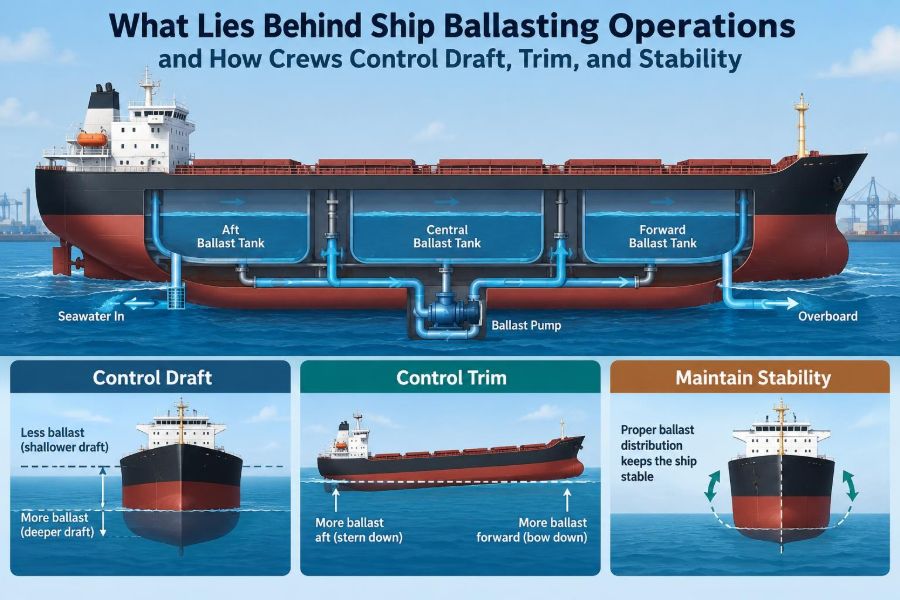

A cargo vessel can arrive in port heavily loaded, discharge thousands of tonnes of cargo, and leave with its holds nearly empty. Yet it cannot simply sail away “light.” Without the right weight low in the hull, the ship may ride too high, respond sharply to waves, lose propeller immersion, or develop unsafe stresses.
The weight that replaces cargo is usually seawater. Moving that water into, between, and out of dedicated tanks is called ballasting. It sounds straightforward, but every transfer changes the vessel’s draft, trim, stability, structural loading, and sometimes its environmental obligations.
For officers on watch and engine-room personnel, ballasting is therefore not a background utility task. It is a controlled ship-handling operation conducted with plans, calculations, communication, and continuous checks.
Understanding what happens behind the valves helps explain why ships can safely adapt to changing cargo, fuel consumption, weather, port limits, and loading conditions.
⚓ What Ballast Water Actually Does
Ballast water is water intentionally taken into tanks within a ship to improve its operating condition. It provides weight where the vessel needs it, generally low down and often spread across the hull.
Its main purposes are to achieve a suitable draft, control trim, maintain adequate stability, and keep hull stresses within approved limits. On some vessels, ballast also helps meet propeller and rudder immersion requirements.
Ballast is not cargo, even though it has weight and affects the ship in similar ways. Its movement is governed by the vessel’s approved stability information, operating procedures, and applicable pollution-prevention requirements.
🧭 Why an Empty Ship Still Needs Weight
A lightly loaded ship can sit unusually high in the water. This reduces the underwater area of the hull and can make the vessel more sensitive to wind, waves, and rapid rolling.
Aft draft may become too small to keep the propeller fully immersed. If the propeller draws air near the surface, thrust can become erratic and vibration may increase. Reduced rudder immersion can also weaken steering response.
Ballast restores a controlled displacement—the total weight of water displaced by the hull—without requiring unnecessary cargo or fuel to remain onboard.
📏 Draft: The Ship’s Vertical Position in Water
Draft is the vertical distance from the keel to the waterline. Draft marks painted near the bow, midship, and stern let crews observe how deeply the ship is floating.
Draft determines whether the vessel has enough under-keel clearance for a channel, berth, lock, or shallow anchorage. It also influences squat, the tendency of a moving vessel to sink deeper and alter trim in restricted or shallow water.
Ballasting increases draft; deballasting reduces it. But the location of the water matters just as much as the total amount.
↔️ Trim: Bow Down, Stern Down, or Even Keel
Trim describes the difference between forward and aft draft. A vessel drawing more aft than forward is trimmed by the stern; the opposite condition is trimmed by the head.
Many ships operate best with a modest stern trim, but the desirable condition depends on hull form, propeller immersion, cargo arrangement, sea conditions, and company guidance. An extreme trim can impair visibility, steering, machinery performance, or structural loading.
Transferring ballast forward tends to lower the bow relative to the stern. Transferring it aft tends to lower the stern. This simple principle becomes more complicated when several tanks are used at once.
⚖️ Stability: The Ship’s Ability to Return Upright
Stability concerns a ship’s ability to resist heeling and return toward upright after wind, waves, turns, cargo shifts, or other forces act on it. Ballast strongly affects stability because it changes both the ship’s weight and where that weight acts.
Water placed low in double-bottom tanks normally lowers the ship’s center of gravity and improves initial stability. Water placed high in a wing tank may have the opposite effect, depending on the full loading condition.
Too much stiffness is not automatically desirable. A very stiff ship can roll quickly and violently, increasing loads on cargo, equipment, and people. Safe stability is a calculated operating range, not simply “as much as possible.”
🧮 The Key Centers Crews Consider
Stability calculations use several reference points. The center of gravity, commonly called G, is the point through which the ship’s total weight is considered to act. Adding or removing weight shifts G.
The center of buoyancy, B, is the center of the underwater volume that supports the ship. As the hull heels, B shifts toward the lower side. The relationship among these centers and the metacenter determines the righting tendency at small angles of heel.
Officers do not estimate this only by eye. Approved loading computers, stability booklets, and tank data provide the necessary values, subject to verification and proper use.
🪣 Free Surface Effect: Why Half-Full Tanks Matter
A partially filled tank has a free liquid surface. When the ship heels, water runs to the lower side, shifting its effective center of gravity and reducing stability. This is called the free surface effect.
A wide, slack tank can create a significant correction to stability. The danger is not that the water is “moving around” in a vague sense; it is the predictable rise in the vessel’s effective center of gravity caused by that movement.
For this reason, crews generally avoid carrying unnecessary slack tanks. During transfers, temporary slack tanks may be unavoidable, but their effect must be considered in the loading plan.
🏗️ Where Ballast Tanks Are Located
Tank arrangement varies by ship type, but common ballast spaces include double-bottom tanks, peak tanks at the bow or stern, hopper tanks, topside tanks, and wing tanks. Some cargo ships use segregated ballast tanks that are permanently separated from cargo and fuel systems.
Double-bottom tanks are especially useful because their low position supports stability. Peak tanks are effective for changing trim because they are far from the vessel’s longitudinal center.
| Tank type | Typical location | Common operating effect |
|---|---|---|
| Double-bottom | Low across the hull | Adds low weight and supports stability |
| Forepeak | Near the bow | Adjusts forward draft and bow trim |
| Afterpeak | Near the stern | Adjusts stern draft and propeller immersion |
| Wing or topside | Outboard or high in hull | Can control list and loading condition, with stability limits |
🔧 The Pumps, Pipes, Valves, and Eductors
The ballast system connects tanks through pipelines, remotely operated or manually operated valves, strainers, pumps, overboard discharges, and often a ballast water treatment system. The exact arrangement is shown on piping diagrams and tank plans.
Ballast pumps normally move water at high volume, but capacity does not remove the need for control. A mistaken valve lineup can flood the wrong tank, transfer water unexpectedly, or create an unintended overboard discharge.
Some ships use eductors—devices that use a high-velocity water flow to create suction—for stripping residual water from tanks. Their performance depends on correct pressure, valve alignment, and discharge arrangements.
🖥️ Planning Starts Before a Valve Moves
A proper ballast operation begins with a plan that identifies the initial condition, intended final condition, sequence of transfers, expected drafts, tank levels, and key limits. On a cargo ship, it is normally coordinated with the cargo plan.
The plan should account for changes occurring at the same time: cargo loading or discharge, fuel transfer, fresh-water use, crane operations, and tidal restrictions. A ballast sequence that is safe by itself may become unsafe when combined with another weight movement.
- Confirm the tanks available and their sounding or level status.
- Check draft, trim, list, stability, and hull-strength limits.
- Define valve lineups, pump assignments, and overflow precautions.
- Agree communication between deck, cargo control room, bridge, and engine room.
- Set checkpoints at which the operation will be reviewed or paused.
📋 The Loading Computer Is a Decision Tool
Modern vessels commonly use an approved loading computer to evaluate stability, longitudinal strength, shear force, bending moment, draft, and trim. It allows operators to model the planned condition before and during an operation.
The computer is not a substitute for understanding the ship. Incorrect tank inputs, unrealistic cargo distribution, or a failure to recognize a sensor problem can produce a misleading result.
Good practice is to compare computed conditions with physical observations: drafts, tank soundings, list, cargo quantities, and the expected trend of the operation.
📐 Longitudinal Strength: The Hull Is Not a Simple Beam
A ship floats because buoyancy supports it along its length, while cargo, machinery, fuel, and ballast apply weight at particular locations. When weight and buoyancy distribution differ, the hull girder experiences shear forces and bending moments.
Too much weight concentrated amidships can contribute to hogging, where the middle is supported more strongly than the ends. Excess weight toward the ends can contribute to sagging, where the middle tends to bend downward relative to the ends.
Ballast transfers can change these forces rapidly. A condition may have acceptable draft and stability but still be unacceptable if longitudinal strength limits are exceeded.
🌊 Transverse Balance and List Control
List is a persistent lean to port or starboard caused by unequal weight distribution. It differs from temporary heel caused by a turn, gust, or wave.
Ballast in port and starboard wing tanks can correct a small list, but “pumping until the ship looks level” is not a safe method. The cause must be understood: uneven cargo, a flooded space, unequal fuel, a suspended load, or an inaccurate level indication may require different action.
Correcting one visible symptom can hide a more serious fault. If unexplained list develops, the operation should be reassessed rather than automatically counter-ballasted.
🚢 A Typical Deballasting Sequence During Loading
Consider a hypothetical bulk carrier loading cargo at a terminal. As cargo enters central holds, the ship’s displacement rises and its stress pattern changes. The crew deballasts according to a sequence designed to maintain safe drafts, stability, and bending moments.
Early in loading, some ballast may remain to keep the vessel stable and to control its position alongside. As cargo distribution develops, selected tanks are emptied in steps rather than all at once.
Near completion, final tank adjustments bring the vessel to its departure draft and trim. Draft surveys, cargo figures, and tank soundings are checked because small discrepancies can matter in a tightly planned condition.
⛴️ Ballasting During Cargo Discharge
During discharge, cargo weight leaves the ship and ballast often replaces it. The sequence is equally critical because removing cargo from one area without adding suitable ballast can create high local or longitudinal stresses.
On tankers, container ships, and bulk carriers, the permissible sequence depends on the vessel’s approved loading manual and terminal procedures. Some ships have special restrictions for alternate-hold loading or discharge because hull stresses can rise sharply.
Ballast is therefore a partner to cargo handling, not a final adjustment made after cargo work is complete.
🌬️ Weather, Wind, and the Need for Operational Margin
Conditions that appear acceptable in sheltered water may be unsuitable at sea. Windage on a lightly loaded vessel can be substantial, especially on ships with large deck structures or container stacks.
Heavy weather also introduces rolling, pitching, slamming, and green water on deck. Adequate draft forward, reasonable trim, secure tank closures, and an approved stability condition all matter.
There is no universal “best ballast condition” for every voyage. The safe condition is the one evaluated for that vessel, cargo, expected environment, and operating constraints.
🛟 Minimum Draft and Propeller Immersion
The stern must normally be deep enough to keep the propeller working efficiently and the rudder effective. In rough seas, intermittent emergence of the propeller can cause racing, vibration, and reduced propulsion.
Forward draft also matters. If the bow is too light, the vessel may pitch more severely, experience slamming, or have poor directional behavior in waves.
Approved minimum draft requirements are vessel-specific. They should be treated as operational limits, not targets to be approached casually for a slight reduction in ballast time.
🧪 Ballast Water Treatment and Environmental Control
Ballast water can contain organisms, sediments, and microbes from the place where it was taken onboard. If discharged elsewhere, those organisms may be introduced into a different marine environment.
Many ships therefore operate ballast water management systems that treat water during uptake, discharge, or both, depending on the system design. Treatment may involve filtration and a disinfection process, but its use must follow the maker’s instructions and regulatory requirements.
Operational limitations matter. Water quality, temperature, salinity, flow rate, power availability, and equipment condition can affect how a system is run. Crews need to plan treatment alongside the hydraulic transfer itself.
🗺️ Ballast Records Are Operational Evidence
Ballast operations are documented in the ship’s required records and operating logs. Entries commonly cover uptake, internal transfer, treatment, discharge, tank quantities, location, and time.
Accurate records help demonstrate compliance, but they also help the crew reconstruct what happened if an unexpected list, draft change, alarm, or equipment issue occurs later.
A record entered from memory after a busy operation is more likely to contain errors. Timely, factual entries support both safe operation and accountability.
📡 Measuring Tank Levels Without Blind Trust
Tank contents may be checked by sounding pipes, ullage measurements, pressure sensors, radar gauges, or remote monitoring systems. Each method has limitations: sensor calibration, blocked sounding pipes, density assumptions, and communication faults can affect the reading.
Where practical, crews cross-check unexpected values. A tank that appears full unusually quickly, or a draft change that does not match the calculated transfer, deserves investigation.
Physical verification is especially valuable after maintenance, before a critical operation, or when automatic indications disagree with each other.
🚨 Overflow, Flooding, and Cross-Connection Hazards
Overfilling a ballast tank can send water through air vents, overflow arrangements, or spaces not intended to receive it. Besides pollution risk, this can damage equipment, create corrosion, and obscure the true source of water.
Cross-connections between systems are another hazard. A valve lineup error may allow ballast water to enter a bilge, cargo, or other system, depending on design. Isolation procedures and clear valve identification reduce this risk.
During high-rate operations, someone must actively monitor tank levels and alarms. Remote control is useful, but it does not eliminate the need for watchkeeping.
🗣️ Communication Makes the Sequence Work
Ballasting often involves personnel in separated locations: deck rounds, cargo control, bridge, engine room, and shore terminal. Clear communication prevents one team from starting a transfer while another assumes a line is isolated.
Commands should identify the tank, valve, pump, intended direction, and expected completion point. Closed-loop communication—repeating back a critical instruction—helps catch ambiguity.
A short pre-operation briefing is especially useful when the plan changes because of a delayed cargo stream, weather, pump failure, or berth instruction.
🧰 Common Equipment Problems and Their Effects
Ballast pumps can lose suction, valves can stick, strainers can clog, level transmitters can fail, and treatment systems can alarm or trip. These are operational problems, not merely maintenance inconveniences.
A failed pump may leave a tank slack longer than planned. A leaking valve can slowly alter a carefully balanced condition. A blocked vent can interfere with filling or emptying and may damage the tank structure.
Preventive maintenance, functional tests, spare parts, and familiarity with manual backup arrangements give crews more options when the planned sequence is interrupted.
⚠️ Common Ballasting Mistakes
Many failures begin with an assumption: that the tank is empty, the valve is shut, the plan still matches reality, or the displayed level is correct. Disciplined verification is the practical defense.
- Starting transfers before confirming the actual initial condition.
- Ignoring free surface effects from multiple slack tanks.
- Focusing on draft while overlooking shear force and bending moment.
- Counter-ballasting an unexplained list without investigating its cause.
- Running pumps unattended near a planned stop level.
- Making late changes without updating calculations and informing all stations.
These mistakes are preventable not by a single rule, but by combining planning, independent checks, and the willingness to stop when results do not match expectations.
🧑🏫 Training Turns Procedures Into Judgment
New personnel may learn tank names and valve numbers first, but competent ballasting requires a wider mental model. They need to understand why a transfer affects trim, why a slack tank matters, and why cargo and ballast cannot be planned separately.
Drills, supervised operations, simulator training, and post-operation reviews help turn written procedures into practical judgment. Experienced crew members can explain not only the normal sequence, but the signs that indicate it is no longer behaving normally.
Every ship has its own hydraulic behavior, tank geometry, and operating limits. Familiarity with the specific vessel remains essential.
🔍 A Practical Pre-Transfer Check
Before beginning a routine transfer, the responsible officer should pause long enough to establish a reliable baseline. This is often the moment that prevents a minor discrepancy from becoming an operational problem.
- Review the approved loading or ballast plan and intended final condition.
- Confirm current drafts, list, tank levels, and relevant cargo or fuel activity.
- Verify the valve lineup and the destination tank’s available capacity.
- Check pump, treatment-system, vent, alarm, and communication readiness.
- Calculate or confirm the expected effect on stability, trim, and hull strength.
- Monitor progress against planned checkpoints and stop if the trend differs.
The exact checklist varies by vessel and company system, but the principle is constant: know the starting condition, intended movement, and safe limits before transferring water.
🧠 Why Ballasting Is a Constant Balancing Act
Ballast operations involve competing requirements. More low ballast can improve stability, yet increase draft. A trim adjustment may improve propeller immersion, yet affect under-keel clearance or hull stress. Rapid transfer may suit a terminal schedule, yet leave less time for verification.
The correct decision is rarely based on one number. Crews balance approved criteria while considering the immediate operation, the next stage of cargo work, the voyage ahead, and the reliability of the equipment available.
This is why ballasting is best understood as controlled weight management rather than simply pumping seawater.
✅ The Core Principle Behind Safe Ballasting
Safe ballasting keeps the ship within its approved limits for stability, draft, trim, strength, and environmental operation at every stage—not only at departure or arrival. The transition between two safe-looking conditions can itself be unsafe if tanks are slack, loads are concentrated, or calculations are ignored.
The strongest routine combines a realistic plan, accurate tank information, sound engineering knowledge, direct monitoring, and clear communication. When observations differ from the plan, the right response is to investigate and recalculate rather than force the sequence to continue.
Ballast water is not just weight in a tank; it is a precisely managed part of the ship’s safety, performance, and environmental responsibility.
When crews treat every transfer as a change to the whole vessel, they can control draft, trim, stability, and structural loading with the care that safe marine operations demand. ⚓🌊🚢