
A vessel leaves berth with the same main engine, the same hull, and almost the same displacement it had on the previous voyage. Yet its speed through the water is lower, the fuel figures are worse, and the helmsman notices that it does not feel quite as responsive.
Often, the explanation is not a mechanical failure. It is the way the ship is sitting in the water: a little deeper by the bow, a little too high at the stern, or simply at a trim that creates more resistance than the voyage plan assumed.
Hull trim is one of the most practical links between cargo planning, ballast operations, navigation, propulsion, and stability. Small changes in draft distribution can alter the flow of water around the hull, the loading on the propeller, and the vessel’s handling characteristics.
Understanding trim does not mean chasing one “perfect” number. It means recognizing that the best condition depends on hull form, draft, speed, sea state, loading condition, structural limits, and the ship’s operating instructions.
⚓ What Hull Trim Means
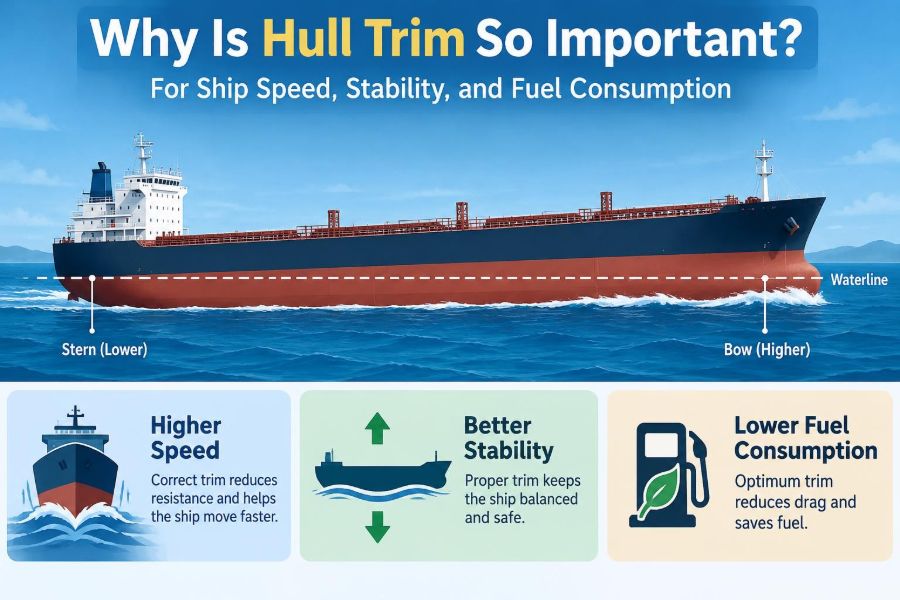
Trim is the difference between a ship’s draft aft and its draft forward. Draft is the vertical distance from the keel reference to the waterline, measured at designated draft marks.
If the aft draft is greater than the forward draft, the vessel is trimmed by the stern. If the forward draft is greater, it is trimmed by the bow. When both drafts are equal, the ship is said to be on an even keel.
Trim describes the ship’s longitudinal attitude. It is different from list, which is a transverse heel to port or starboard.
📏 Reading the Basic Trim Calculation
The usual onboard calculation is straightforward:
Trim = aft draft − forward draft
For example, a ship with an aft draft of 9.20 m and a forward draft of 8.80 m has 0.40 m trim by the stern. The sign convention used in software or documentation should always be checked, because some systems record bow trim as positive and others do not.
Drafts should be read carefully and corrected where required under the vessel’s established procedures. A rough draft reading can lead to a misleading trim calculation, especially when the difference itself is small.
🧭 Trim Is Not the Same as Mean Draft
Mean draft expresses how deeply the ship is immersed overall, while trim describes how that immersion is distributed between bow and stern. Two ships may have the same mean draft but very different resistance and handling because their waterlines are not shaped the same way.
For a simple estimate, the mean of forward and aft drafts is often useful. Hydrostatic calculations may also require a correction for trim, particularly when using displacement tables referenced to an even-keel condition.
That distinction matters in cargo work: total weight determines displacement, but the longitudinal position of that weight determines trim.
🌊 Why Water Resistance Changes with Trim
A moving hull must push water aside, guide it along the shell, and allow it to close behind the vessel. Trim changes the underwater geometry doing that work. It changes which parts of the bow and stern are immersed, the wetted surface area, and the pressure distribution around the hull.
At service speed, resistance is not one single force. Frictional resistance arises from water rubbing over the hull; wave-making resistance comes from generating waves; and viscous pressure effects reflect flow separation and hull shape. A different trim can influence all three.
The effect may be modest in some conditions and substantial in others. It cannot be inferred reliably from a general rule alone.
🏹 The Bow’s Role in Wave-Making Resistance
The bow is where the hull first divides the water. If the ship is too deep forward, a larger immersed bow volume may create a less favorable wave pattern and increase pressure resistance. If it is too shallow forward, the bow may emerge excessively in waves, creating slamming and operational problems.
Fine, slender ships and fuller merchant hulls respond differently. A condition that reduces resistance for one design may increase it for another because the waterline shape, bulbous bow geometry, and operating speed are different.
This is why “trim by the stern is always efficient” is an unsafe shortcut.
🔧 The Stern, Propeller, and Wake Field
Water approaching the propeller is called the wake field. Its velocity and uniformity affect propeller loading, vibration, cavitation risk, and efficiency. Trim alters the stern immersion and can change this inflow pattern.
Too little stern draft may reduce propeller submergence. In rough conditions, the propeller can draw air from the surface, a phenomenon known as ventilation. The engine may race, thrust falls, and repeated loading changes can be harmful.
More stern immersion is not automatically better either. It may increase hull resistance or place the propeller in a less favorable wake, depending on the vessel.
⚙️ Trim and Propulsive Efficiency
Propulsive efficiency is about more than the propeller itself. It includes how effectively engine power becomes useful thrust and how effectively that thrust moves the hull. Since trim affects both hull resistance and propeller inflow, it affects the power needed for a given speed.
A useful operating question is not merely, “What trim gives the lowest resistance?” It is, “What trim gives the best overall performance while maintaining safe drafts, stability, visibility, structural margins, and propulsion reliability?”
The answer may vary between ballast and loaded voyages, and even between calm water and a rough-weather passage.
⛽ Why Fuel Consumption Responds So Quickly
Fuel consumption rises when the engine must deliver more power to maintain the same speed. If an unfavorable trim increases resistance, the vessel may need additional shaft power even though nothing has changed in the machinery condition.
Conversely, a favorable trim may allow the same speed at lower power, or slightly better speed at a fixed power setting. The exact saving depends on the vessel and condition; it should be measured rather than assumed.
For ships trading over long distances, a small daily difference can accumulate. That makes trim optimization a legitimate operational task, not a cosmetic adjustment to draft marks.
📈 Speed–Power Curves Explain the Trade-Off
Ship resistance generally rises rapidly as speed increases. This means a relatively small resistance penalty may demand a noticeable power increase near higher operating speeds. The relationship is not perfectly fixed because wind, waves, fouling, current, displacement, and machinery condition also change.
When comparing trim conditions, crews and shore teams should compare like with like: similar displacement, draft, speed range, weather, and engine condition. A faster ground speed caused by favorable current is not evidence of an efficient trim.
Speed through water, shaft power, and fuel flow provide a much more meaningful operating picture.
📊 A Practical Trim Comparison
| Condition | Likely operational concern | Useful check |
|---|---|---|
| Excessive trim by stern | Higher resistance, deep stern restrictions, altered steering response | Compare power at equal speed through water |
| Excessive trim by bow | Poor visibility, bow slamming, increased forward resistance | Check forecastle clearance and bridge sight line |
| Near even keel | May be practical, but not always the lowest-fuel condition | Review vessel-specific performance guidance |
| Moderate vessel-specific optimum trim | Can reduce power demand under matching conditions | Confirm stability, strength, and draft limits |
This table gives operating prompts, not universal predictions. The approved loading computer, stability booklet, trim tables, and company procedures remain the controlling sources for a specific vessel.
⚖️ Trim and Longitudinal Stability
Adding, removing, or shifting weight longitudinally moves the ship’s longitudinal center of gravity. The hull then settles at a new trim until buoyancy and weight are in equilibrium.
A weight placed aft tends to increase stern draft; a weight placed forward tends to increase forward draft. The amount of trim change depends on the ship’s hydrostatic characteristics, especially its moment to change trim, commonly abbreviated MCT.
Longitudinal stability is normally strong compared with transverse stability, but its consequences are highly visible in draft distribution, propeller immersion, air draft, and bottom clearance.
📦 Cargo Distribution Creates Trim
Cargo planners control trim partly through the order and location of loading. A concentrated heavy cargo in aft holds has a different effect from the same total mass distributed around midships.
Tankers, bulk carriers, container ships, and offshore vessels each have distinct constraints. A cargo arrangement that looks efficient from a stowage perspective may create an undesirable trim or exceed local strength limits.
- Heavy lifts can cause major local trim changes during loading or discharge.
- Partly filled cargo tanks may create free-surface effects as well as trim changes.
- Container weight distribution affects both longitudinal and transverse stability.
- Sequential loading plans must consider intermediate conditions, not only the final departure state.
💧 Ballast Water Is a Trim-Control Tool
Ballast tanks allow crews to adjust draft, trim, stability, propeller immersion, and hull stresses. Moving ballast longitudinally is often the most direct way to correct a departure condition without disturbing cargo.
But ballast is not free performance. Pumping consumes time and energy, and ballast operations introduce risks of overflow, incorrect tank identification, pollution, excessive stress, and stability errors. Ballast water management requirements may also limit what can be taken on or discharged and where.
Every transfer should follow the approved ballast plan and be verified against current tank soundings and loading-computer results.
🧮 Hydrostatics Behind Trim Correction
For a first-order calculation, trim change can be estimated from the trimming moment divided by the vessel’s MCT value for the relevant draft. A trimming moment is weight multiplied by its longitudinal distance from the vessel’s longitudinal center of flotation.
The center of flotation is the point about which the ship approximately trims for small changes. It is not necessarily at midships. Its position shifts with hull form and draft.
These calculations are useful planning tools, but large changes, complex tank geometry, and nonstandard conditions should be checked in approved stability software rather than managed with simplified arithmetic alone.
🖥️ Why the Loading Computer Matters
A modern loading computer can integrate tank contents, cargo weights, drafts, stability, shear forces, bending moments, and sometimes strength limitations in one model. It helps users see the consequences of a ballast transfer before valves are opened.
Its output is only as sound as its input. Incorrect density, unrecorded consumption, inaccurate tank levels, or an outdated cargo entry can create false confidence.
Good practice is to reconcile the model with observed drafts, tank measurements, and the vessel’s actual operation. When they disagree, investigate the reason instead of selecting whichever number seems more convenient.
🧱 Hull Girder Strength Limits the Options
A ship behaves structurally like a long beam supported by buoyancy and loaded by weight. Changing trim by moving cargo or ballast also changes the longitudinal distribution of weight and buoyancy. This affects shear force and bending moment.
In sagging, buoyancy is relatively greater toward the ends; in hogging, it is relatively greater near midships. Real conditions are more complex, especially in waves, but the basic principle explains why an apparently sensible trim correction can be structurally unacceptable.
Never use ballast casually to chase fuel performance if it brings the vessel near approved strength limits.
🛟 Trim Influences Safety and Seakeeping
Trim affects how a ship meets waves. A bow-down condition can increase the chance of shipping green water or slamming when the vessel pitches into head seas. An overly stern-down condition may alter the stern’s response and can affect steering or propulsion in following seas.
There is no single safe trim for every wave direction and speed. Masters must account for weather routing, expected sea state, freeboard, vessel behavior, and the guidance in the ship’s operating manuals.
Fuel efficiency is valuable, but it should never override safe navigation and seakeeping judgment.
👀 Bridge Visibility and Regulatory Draft Conditions
Excessive trim by the bow can reduce the view ahead from the bridge. This is not just an inconvenience when navigating confined waters, approaching a pilot station, or monitoring traffic and small craft.
Applicable navigation requirements and the vessel’s approved visibility criteria must be satisfied. The bridge team may need to use radar, cameras, lookouts, or course alterations in some circumstances, but these measures do not make an unsuitable loading condition automatically acceptable.
Trim decisions must also preserve required freeboard, load line compliance, and safe under-keel clearance.
🛞 Steering, Rudder Bite, and Maneuvering
The rudder needs adequate water flow and immersion to generate steering force. Trim changes both. A deeply immersed stern may improve rudder submergence but can also alter turning behavior because the hull’s underwater lateral area has changed.
A bow-down condition may make a vessel feel directionally different from a stern-down condition, particularly at low speed. Windage, current, propeller rotation, thruster capability, and hull type can be equally influential.
Before critical port maneuvers, crews should consider the actual loading condition rather than relying only on memories of how the vessel handled on a previous voyage.
🌫️ Shallow Water Changes the Picture
In shallow water, the flow beneath the hull is restricted. Resistance may rise, sinkage can increase, and trim can change dynamically as speed rises. This is part of the broader shallow-water and squat problem.
Squat is the bodily sinkage and trim change experienced by a moving vessel in restricted water. A ship that is safely trimmed in deep water can develop a more hazardous effective draft when traveling fast in a channel.
Static draft figures alone are therefore insufficient. Speed, channel geometry, tidal height, bottom conditions, and the vessel’s squat characteristics all deserve attention.
🌬️ Wind, Waves, and Current Can Mislead Performance Checks
Sea trials and onboard performance monitoring aim to separate trim effects from environmental noise. That is difficult at sea because wind resistance, wave added resistance, current, water temperature, and density can all influence speed and power.
A useful comparison requires repeated observations under reasonably similar conditions. Data should record at least draft and trim, displacement, speed through water where available, shaft power or engine load, fuel consumption, weather, and hull condition.
One favorable afternoon does not establish an optimum trim curve.
🧪 Building a Vessel-Specific Trim Trial
A controlled trim trial is usually more informative than relying on generic advice. Within safe operational limits, the vessel can operate at selected trim conditions while maintaining comparable displacement and target speed ranges.
- Confirm stability, strength, draft, and propeller-immersion limits for each condition.
- Use calibrated or consistently recorded power and fuel data.
- Repeat runs where practical and account for current and weather.
- Compare power demand at equal speed through water rather than equal speed over ground.
- Document limitations, such as calm-water-only results or a narrow draft range.
The resulting guidance should be treated as operational decision support, not as permission to disregard the master’s judgment or approved loading limits.
📚 Trim Optimization Software: Helpful, Not Automatic
Digital trim optimization tools may use hull-model data, historical voyages, and measured operating data to recommend a target condition. They can make complex trade-offs more visible and help crews test whether a predicted benefit appears in service.
However, software predictions depend on assumptions. Hull fouling, propeller damage, cargo constraints, weather, engine limits, and sensor quality may make the recommendation less applicable than it appears on screen.
The best use of such a tool is as part of disciplined voyage planning: validate the recommendation, apply constraints, then monitor the actual result.
🐚 Hull Fouling Can Hide the Trim Effect
Marine growth and roughness increase frictional resistance. A fouled hull can consume more power at a given speed regardless of trim, making it harder to identify whether ballast adjustments are helping.
Propeller surface condition matters too. Damage, roughness, or fouling can reduce propulsive performance and change vibration behavior. A trim correction may improve the operating point without solving the underlying maintenance issue.
Performance analysis should therefore consider hull and propeller condition alongside trim. These factors interact; they are not competing explanations.
🚢 Ballast Voyages Need Their Own Strategy
Ballast condition often presents different priorities from loaded condition. The ship may ride high, exposing more of the bow, reducing propeller immersion, and increasing sensitivity to wind and waves.
Additional ballast aft can improve propeller submergence and steering, while forward ballast may be necessary for draft, visibility, structural, or seakeeping reasons. The appropriate arrangement is vessel-specific and weather-dependent.
A ballast voyage plan should address more than minimum drafts. It should consider expected weather, tank free surfaces, navigation restrictions, fuel use, and the practicality of ballast exchange or management requirements.
🏗️ Loaded Voyages Bring Different Constraints
In loaded condition, available ballast capacity may be limited, and cargo distribution often dominates the trim. Deep drafts narrow the margin for ports, canals, rivers, and under-keel clearance, especially if the stern is already heavily immersed.
Some vessels may achieve favorable resistance with a modest stern trim at certain loaded drafts. Others may need closer-to-even trim because of bow form, draft limitations, or structural concerns. There is no substitute for the ship’s own verified performance data.
Intermediate conditions during discharge deserve the same care as the departure condition. Trim can change significantly as holds or tanks are emptied in sequence.
⚠️ Common Trim Management Mistakes
The most persistent error is treating trim as a single fuel-saving setting. A target that worked on one passage may be unsuitable after a change in displacement, weather, route depth, or cargo arrangement.
- Using speed over ground as the only performance indicator.
- Correcting trim without checking shear force and bending moment.
- Ignoring bridge visibility and propeller-immersion limits.
- Making ballast transfers from estimates rather than verified tank data.
- Assuming even keel is always safest or always most efficient.
- Optimizing for calm-water fuel use before a forecast rough-weather passage.
Each mistake comes from overlooking the fact that trim is part of a whole-ship operating condition.
🔍 A Sensible Pre-Departure Trim Check
Before sailing, the bridge, deck, engine, and cargo functions benefit from a common picture of the condition. The exact division of responsibility varies by ship, but the questions are widely applicable.
- What are the observed forward, aft, and, where used, midship drafts?
- Are stability and longitudinal strength within approved limits?
- Is propeller and rudder immersion adequate for expected conditions?
- Are visibility, freeboard, air draft, and under-keel requirements satisfied?
- Does the planned trim match forecast weather, route restrictions, and cargo operations?
- Have planned fuel consumption and ballast transfers been entered correctly?
A short, structured review catches conflicts early, when changes are still manageable at berth.
📝 Monitoring Trim During the Voyage
Trim is not fixed after departure. Fuel consumption, freshwater use, cargo heating or transfer operations, ballast work, and changing sea conditions can alter the vessel’s condition. On some ships, these changes are small; on others, they are operationally significant.
Regular tank records and draft observations help the crew recognize trends. If power demand rises unexpectedly, check trim alongside weather, speed, hull condition, engine parameters, and propeller performance.
Any underway ballast adjustment should be planned with the same care as a port operation, particularly in heavy weather or when tanks are close to limits.
🎓 What Engineers and Deck Officers Should Learn from Each Other
Deck officers often see trim first through drafts, stability, navigation, and cargo constraints. Marine engineers see its effects through propeller behavior, shaft power, fuel rate, vibration, cooling-water conditions, and engine response.
Neither perspective is complete in isolation. A condition that looks satisfactory in the loading computer may produce poor propeller behavior, while an engine-room preference for deeper stern immersion may conflict with draft restrictions or hull strength.
Sharing daily performance observations builds a more useful vessel-specific understanding than relying on departmental assumptions.
🧠 The Core Principle: Balance the Whole Operating Condition
Hull trim matters because it changes the shape of the ship presented to the water. That influences resistance, wave-making, propeller inflow, power demand, maneuvering, visibility, structural loading, and behavior in waves.
The best trim is therefore not a universal angle or a fixed amount by the stern. It is the condition that meets safety and statutory requirements, respects stability and structural limits, supports reliable propulsion, and delivers acceptable performance for the actual voyage.
Measured vessel data, careful loading calculations, and sound seamanship turn trim from a rough rule of thumb into a controllable operating variable.
Good trim management is the practical art of making cargo, ballast, hull, propeller, and voyage conditions work together rather than optimizing one at the expense of the others. 🚢⚓🌊