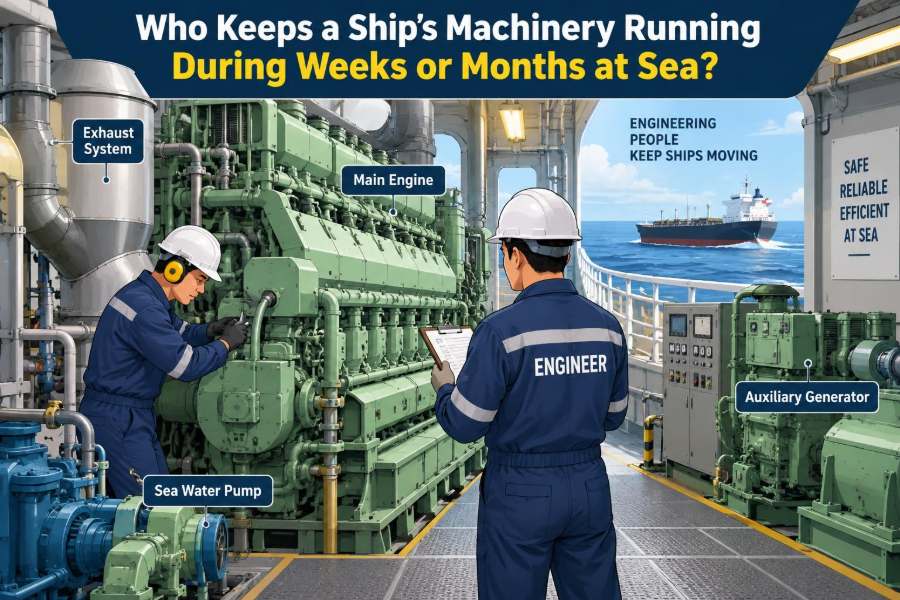

A cargo ship is several days from the nearest port. Below deck, the main engine has been turning continuously, generators are supplying electricity, pumps are moving fuel and cooling water, and steering gear must remain ready for the next course alteration.
Most passengers never see this work. Yet a vessel does not operate on engines alone; it operates because trained people inspect, adjust, maintain, test, and repair those systems every day.
The people responsible are the ship’s engineering department, led by the chief engineer. Their workplace is not a quiet repair shop but a moving industrial plant exposed to vibration, heat, salt air, changing loads, and limited outside assistance.
Understanding who keeps machinery running at sea reveals why marine engineering combines technical knowledge, disciplined routines, teamwork, and sound judgment.
⚙️ The Engineering Department Below Deck
The engineering department is the crew responsible for propulsion machinery and most of the ship’s technical services. On a conventional merchant ship, its work includes the main engine, electrical generation, boilers where fitted, pumps, compressors, fuel systems, freshwater systems, and many safety-critical auxiliaries.
Its purpose is broader than “fixing breakdowns.” The department aims to keep equipment reliable enough that failures are prevented, contained, or managed safely before they interrupt the voyage.
👨🔧 The Chief Engineer’s Overall Responsibility
The chief engineer is the senior engineer officer and the head of the engineering department. They are responsible for the condition, operation, maintenance planning, stores, spare parts, fuel use, pollution-prevention equipment, and engineering records.
On many ships, the chief engineer has substantial authority over technical decisions, while working closely with the master, who has overall command of the vessel. A major engineering issue can affect route planning, port operations, cargo handling, and safety, so this relationship matters.
🧭 How the Chief Engineer Plans the Work
The chief engineer does not personally turn every valve or dismantle every pump. Instead, they organize the people, priorities, and resources needed to keep the plant dependable.
A typical planning cycle includes reviewing defects, checking maintenance due dates, assessing critical spares, assigning jobs, verifying completed work, and deciding when a repair can safely be deferred until port. These decisions require technical knowledge and an accurate sense of operational risk.
🥈 The Second Engineer as Daily Operations Leader
The second engineer is commonly the officer who manages much of the engine room’s daily operation and planned maintenance. Exact duties vary by ship and company, but this role often involves supervising junior engineers and ratings, coordinating routine jobs, and following up defects.
If the chief engineer sets the overall technical direction, the second engineer often turns it into a workable day-by-day schedule. That includes making sure equipment is available for maintenance without compromising propulsion or essential services.
🛠️ Junior Engineer Officers and Assigned Systems
Third, fourth, and sometimes additional engineer officers normally hold responsibility for particular machinery groups. One may look after generators and electrical equipment; another may oversee purifiers, compressors, pumps, or boilers.
Assigned responsibility does not mean working alone. It means knowing the condition of that system, carrying out inspections, raising defects, and ensuring maintenance is completed correctly. During a fault, officers support one another according to the urgency and complexity of the task.
🔩 Ratings Who Turn Plans Into Physical Work
Engine ratings, such as motormen, oilers, fitters, and wipers, provide essential practical support. They assist with rounds, cleaning, lubrication, maintenance, repairs, stores handling, and machinery watchkeeping according to their training and assigned duties.
A fitter may fabricate a simple bracket, repair a pipe support, or assist with welding where authorized. An oiler’s observation of an unusual sound, leak, or temperature can provide the first warning of a developing problem.
🏫 Cadets Learning the Working Plant
Engineer cadets are trainees completing sea service under supervision. Their work can include taking readings, assisting with maintenance, learning safety procedures, tracing piping systems, and keeping training records.
A cadet should never be treated merely as extra labor. Proper supervision helps them connect classroom principles—pressure, lubrication, combustion, heat transfer, electrical protection—to real machinery and real consequences.
📋 Responsibilities Differ by Vessel
There is no single staffing pattern for every ship. A large ocean-going container vessel, a tanker, an offshore support vessel, a ferry, and a small coastal ship can have very different engine-room arrangements and crew numbers.
| Role | Typical focus | Examples of decisions |
|---|---|---|
| Chief engineer | Technical leadership and compliance | Repair priorities, spare strategy, operating limits |
| Second engineer | Daily maintenance coordination | Work allocation, isolation plans, defect follow-up |
| Junior engineer | System ownership and watchkeeping | Fault diagnosis, routine tests, local repairs |
| Engine rating | Practical operation and maintenance support | Rounds, cleaning, assistance, early reporting |
Automation, vessel design, flag requirements, company procedures, and trade all influence the final arrangement.
🔥 The Main Engine Is Only One Part of the Job
The main engine may be the most visible piece of machinery, but it depends on supporting systems. It needs correctly treated fuel, lubricating oil, cooling water, starting air, exhaust handling, controls, and a shaft line that transfers power to the propeller.
A failure in an apparently modest auxiliary system can reduce or stop propulsion. For example, a cooling-water pump problem may force the main engine to slow down even when the engine itself is mechanically sound.
⚡ Keeping Electrical Power Available
Ships generate their own electrical power, usually with diesel generators and, on some vessels, shaft generators, batteries, or other arrangements. Electricity supports navigation equipment, lighting, pumps, refrigeration, communications, cargo equipment, accommodation, and control systems.
Engineers manage generator loading, monitor voltage and frequency, and maintain protective devices. A blackout is serious because many services can stop simultaneously, so redundancy and recovery procedures are central parts of plant design and operation.
💧 Pumps, Piping, and the Hidden Circulation Network
A ship’s engine room contains many pumps moving seawater, freshwater, fuel, lubricating oil, bilge water, ballast water, and hydraulic fluid. Piping systems can be thought of as the vessel’s circulation network, but each fluid has different contamination, pressure, and safety requirements.
Engineers must understand valve line-ups: which valves should be open, shut, locked, or tagged for a particular operation. A wrong line-up can contaminate a tank, starve a pump, cause overflow, or send a fluid to the wrong destination.
🛢️ Fuel Treatment Before Combustion
Marine fuel must be stored, transferred, heated when necessary, filtered, and often centrifuged in purifiers before it reaches an engine. Water and solid contaminants can damage fuel-injection equipment and interfere with reliable combustion.
Fuel changeover requires particular care when moving between fuel types or meeting local emissions requirements. Temperature, viscosity, compatibility, and the timing of the change all affect whether the engine receives suitable fuel.
🧴 Lubrication Protects Moving Surfaces
Lubricating oil forms a protective film between moving parts, carries heat away, and transports contaminants toward filters or separators. On large engines, different oils may serve the crankcase, cylinder lubrication, gears, or hydraulic controls.
Engineers monitor oil level, pressure, temperature, and condition. Changes in these readings can point to wear, leakage, water ingress, overheating, or a restriction in the system; they are clues rather than automatic proof of one specific fault.
🌡️ Cooling Systems Control Heat
Combustion creates far more heat than a marine engine can use as useful power. Cooling circuits manage temperatures in jackets, pistons, lubricating oil coolers, charge-air coolers, and other equipment.
Too little cooling risks overheating and material damage. Too much cooling can reduce efficiency and contribute to poor combustion conditions. The objective is controlled temperature, not simply the lowest possible temperature.
💨 Starting Air and Compressed-Air Services
Large diesel engines are commonly started with compressed air. Air compressors and receivers must therefore remain available, along with their drains, safety valves, control lines, and starting-air components.
Compressed air may also serve control systems, tools, and other equipment. Moisture management matters because water in air systems can cause corrosion, freeze in some conditions, or interfere with valves and instruments.
🔍 Machinery Rounds Catch Small Changes Early
Routine rounds are among the most valuable habits in marine engineering. An engineer or rating walks through assigned spaces and compares what they see, hear, smell, and feel with normal operation.
They check for leaks, unusual vibration, hot bearings, loose guards, abnormal readings, low tank levels, poor housekeeping, and alarms. A faint knocking sound or a fresh oil stain may be more informative than a screen full of apparently normal data.
📈 Trend Monitoring Makes Data Useful
A single temperature or pressure reading has limited meaning without context. Engineers record and compare operating data over time to identify gradual change.
For example, rising exhaust temperatures on one cylinder could prompt checks of fuel injection, air supply, valve condition, or sensor accuracy. The point is not to guess immediately, but to investigate before a minor deviation develops into a restriction on engine power.
🗓️ Planned Maintenance Is Not a Calendar Exercise
A planned maintenance system schedules inspections, renewals, tests, and overhauls based on running hours, time intervals, condition data, manufacturer guidance, and company procedures. It gives structure to work that might otherwise be postponed during busy voyages.
However, blindly following a schedule is not enough. Engineers must consider the actual condition of equipment, operating history, available spares, and whether a job can be done safely with the machinery isolated.
🧰 Corrective Maintenance When Something Fails
Corrective maintenance restores equipment after a defect is found. It can range from tightening a leaking fitting to rebuilding a pump or replacing an electrical component.
At sea, the team first stabilizes the situation. They may start standby equipment, reduce load, isolate the faulty unit, or change operating mode. Only then can they diagnose the root cause without rushing into an unsafe repair.
🧪 Condition Monitoring Extends the Engineer’s Senses
Some defects are easier to detect through condition monitoring than through visual inspection alone. Oil analysis, vibration monitoring, thermal imaging, performance measurements, and electrical tests can reveal signs of deterioration.
These methods are decision aids, not crystal balls. A test result must be interpreted alongside operating conditions, maintenance history, and physical inspection. Good engineering combines data with practical observation.
🚨 Alarms Demand Understanding, Not Panic
Modern ships use alarms to warn of high temperature, low pressure, tank level problems, generator faults, fire-related signals, and many other conditions. An alarm tells the crew that a measured condition has crossed a set point; it does not necessarily identify the true cause.
Responding well means verifying the condition, protecting people and equipment, checking related systems, and communicating clearly. Repeatedly acknowledging an alarm without resolving its cause is a dangerous habit because it normalizes abnormal operation.
🧯 Safety Comes Before a Quick Repair
Engine-room work involves hot surfaces, rotating machinery, pressurized fluids, electricity, confined spaces, chemicals, noise, and fire hazards. Before maintenance begins, the team should identify energy sources and isolate them using the vessel’s established procedures.
Typical controls may include permits, lockout or tagout arrangements, ventilation, gas testing, protective equipment, communication with the bridge, and a clear handover between watchkeepers. A repair that saves minutes but bypasses these safeguards can create much larger consequences.
🌊 Rough Weather Changes Engineering Priorities
Heavy weather can affect fuel transfer, bilge levels, cooling-water suction, tank soundings, and the physical safety of personnel moving around the engine room. Vibration and ship motion also increase the chance that unsecured tools or stores become hazards.
Before severe weather, engineers may secure loose equipment, check tank levels, confirm standby machinery, and postpone nonessential maintenance. The aim is to preserve propulsion and essential services while reducing exposure to avoidable risks.
🧑✈️ Communication With the Bridge Is Operationally Critical
The bridge controls navigation, but it needs accurate information about machinery capability. Engineers must report limits such as reduced speed, unavailable thrusters, generator restrictions, or maintenance that could affect maneuvering.
During arrivals, departures, canal transits, and other maneuvering operations, engine orders can change quickly. Clear communication prevents misunderstandings about readiness, direction changes, and the time needed to place machinery on standby.
⚓ Port Calls Create Their Own Workload
A port call is often the busiest period for the engine department. While the vessel is preparing to berth, engineers may be supporting maneuvering, running additional generators, operating ballast systems, preparing cargo equipment, receiving stores, taking fuel, and dealing with inspections.
Maintenance planning must account for this workload. Beginning a major overhaul immediately before a demanding port operation can leave too little redundancy if another piece of equipment develops a problem.
🌱 Environmental Equipment Needs Continuous Attention
Engineers operate systems that limit pollution, including oily-water separation equipment, sewage systems, fuel-transfer safeguards, and, depending on the vessel, exhaust-gas cleaning or ballast-water treatment equipment.
These systems must be operated and recorded correctly, not simply carried onboard. Environmental compliance depends on proper procedures, accurate records, trained operators, and equipment that is maintained well enough to perform as intended.
📦 Spare Parts and Stores Are a Reliability Strategy
At sea, a replacement part may be days or weeks away. The engineering department therefore tracks critical spares: items whose failure could stop propulsion, remove redundancy, or compromise a safety system.
Stocking every conceivable part is unrealistic because storage, cost, shelf life, and ship design impose limits. The better approach is risk-based planning—knowing what is fitted, what fails most consequentially, what can be repaired onboard, and what must be ordered early.
🧠 Fault-Finding Requires a Method
Effective troubleshooting starts by defining the symptom precisely: what changed, when it began, under what load, and which alarms or readings are involved. Engineers then check the simplest and safest possibilities before dismantling complex machinery.
- Confirm the reported condition with reliable readings or inspection.
- Compare the affected unit with a similar healthy unit where possible.
- Trace the system logically: supply, control, mechanical function, and discharge.
- Change one condition at a time when safe, then observe the result.
- Record the defect and repair so the next watch understands the history.
This disciplined approach reduces wasted work and helps avoid introducing new faults during diagnosis.
🤝 Teamwork Prevents Knowledge Gaps
No engineer can hold every detail in memory, particularly on complex ships with evolving automation. Toolbox talks, handovers, job briefings, and accurate log entries help the department share information.
A useful handover includes machinery status, ongoing work, isolations, alarms, unusual trends, and what the next watch needs to monitor. “Everything normal” is not enough if a standby pump has been dismantled or a temporary repair is in service.
🖥️ Automation Changes Work Rather Than Removing It
Unattended or periodically unattended machinery spaces use sensors, alarms, remote controls, and automated sequences to reduce routine watchkeeping demands. This can improve monitoring and allow engineers to focus on maintenance and analysis.
But automation creates new responsibilities: validating sensors, understanding control logic, maintaining electrical and electronic components, and recognizing when a displayed value does not match the physical equipment. A failed sensor can be as operationally significant as a worn mechanical part.
📚 Competence Is Built Over a Career
Marine engineers develop competence through formal education, certification pathways, supervised sea service, manufacturer guidance, drills, and repeated exposure to real operating conditions. The technical foundation includes thermodynamics, mechanics, electrical systems, fluid systems, materials, controls, and safety management.
Experience adds pattern recognition: knowing which noise is ordinary, which temperature trend deserves attention, and when a small defect should change the plan for the day. Still, experience should support procedures and evidence, not replace them.
⚠️ Common Mistakes That Undermine Reliability
Many machinery problems become worse through ordinary-looking mistakes: poor housekeeping that hides leaks, skipped checks during busy periods, incomplete handovers, incorrect valve line-ups, and repairs made without confirming the root cause.
Another risk is treating standby equipment as permanently idle. A standby pump or generator is only useful if it is tested, maintained, and ready to start when the primary unit fails.
✅ The Core Principle of Reliable Ship Machinery
Ships remain operational at sea because a structured engineering team combines people, procedures, equipment knowledge, and careful observation. The chief engineer leads the department, but reliability is created by every person who notices, reports, maintains, tests, and communicates.
The strongest engine room is not necessarily the one with the newest machinery. It is the one where crews understand their systems, preserve redundancy, plan work realistically, and respond to abnormal conditions before they become emergencies.
Keeping a ship’s machinery running for weeks or months at sea is a shared professional discipline: detect early, communicate clearly, maintain safely, and never assume a critical system will look after itself. 🚢⚙️🌊