
A vessel may leave port with clean hull paint, healthy main-engine readings, and a carefully planned passage—yet still fail to achieve the expected speed. The explanation is not always in the engine room. Often, it is turning beneath the stern.
Propeller pitch is one of the most influential, and commonly misunderstood, features of a ship’s propulsion system. A small change in blade angle can alter engine load, fuel use, acceleration, manoeuvring response, and the vessel’s ability to perform in heavy weather.
For an engineer, pitch is not simply a number stamped on a drawing. It is part of the relationship between the engine, shaft, propeller, hull, and the water arriving at the propeller plane.
Understanding that relationship helps crews diagnose poor performance, operate controllable-pitch systems safely, and recognize why the “best” pitch depends on the job the ship is doing.
⚙️ What Propeller Pitch Means
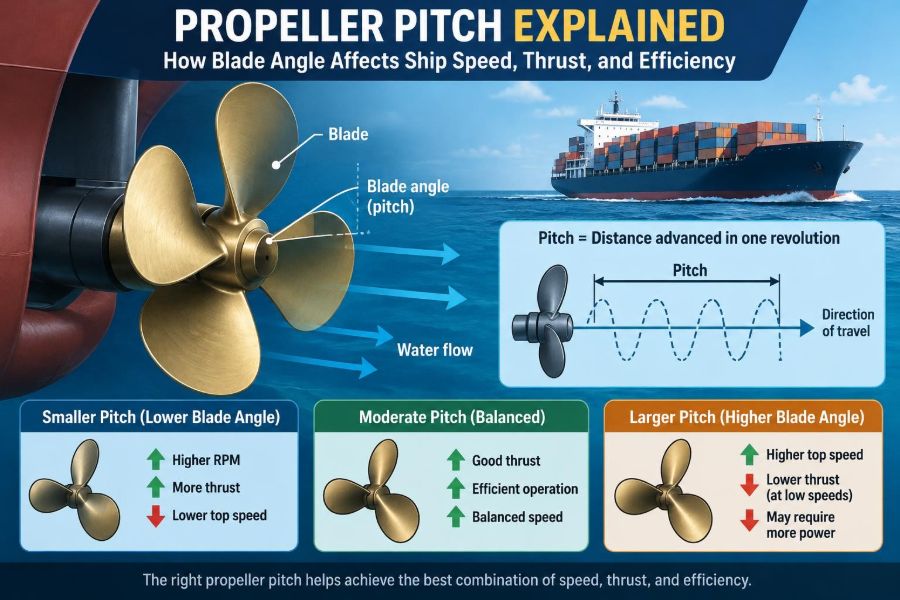
Propeller pitch is the theoretical forward distance a propeller would travel in one complete revolution if it moved through a solid material without slipping. It is similar to the lead of a screw: turn the screw once, and it advances by one thread distance.
In water, a propeller cannot achieve that theoretical distance exactly. Water yields, accelerates, and flows around the blades. Pitch therefore provides a useful geometric reference, not a guaranteed distance travelled per revolution.
🌀 Blade Angle Is the Physical Basis of Pitch
Pitch comes from the blade’s angle relative to the plane of rotation. A blade with a greater angle takes a larger “bite” of water during each revolution, producing a higher pitch.
Because the blade moves in a circular path, its speed is lower near the hub and higher near the tip. Blade sections are therefore twisted from root to tip so that each section can meet the local flow at a workable angle.
📏 The Screw Analogy—and Its Limits
The screw analogy is useful because it shows why changing pitch changes theoretical advance. A coarse-thread screw advances farther per turn than a fine-thread screw.
However, a propeller operates in a fluid, not a solid. Its performance depends on water density, hull wake, vessel speed, rotation rate, cavitation, blade condition, and the engine’s available torque. The analogy explains geometry, but not the full hydrodynamics.
🚤 Fine Pitch and Coarse Pitch
Fine pitch means a smaller blade angle and less theoretical advance per revolution. It is broadly comparable to a low gear in a vehicle: the propeller can turn readily and develop useful thrust at low speed, but it may not be efficient for sustained fast running.
Coarse pitch means a larger blade angle and greater theoretical advance per revolution. It resembles a high gear: it can suit higher vessel speed, but demands more torque and can overload the engine if selected too early or used in unsuitable conditions.
| Pitch condition | General effect | Typical operational use |
|---|---|---|
| Fine pitch | Lower load per revolution; strong low-speed response | Starting, manoeuvring, towing, restricted waters |
| Medium pitch | Balanced loading and forward thrust | Normal transit at moderate speed |
| Coarse pitch | Higher load and greater theoretical advance | Higher-speed service when power and conditions allow |
📐 Geometric Pitch and Effective Pitch
Geometric pitch is the pitch defined by blade geometry. It can be measured or specified on the propeller drawing and is normally expressed as a distance or as a pitch-to-diameter ratio.
Effective pitch describes how the propeller behaves in real operating water. Hull wake, blade deflection, surface roughness, cavitation, and non-uniform inflow can make effective performance differ from the ideal geometric value.
🔄 Why Propellers Have Blade Twist
At a given shaft speed, the blade tip travels much faster than the blade root. If every blade section had the same angle, some sections would meet the water at an inefficient angle while others could stall or cavitate.
Twist allows designers to manage the local angle of attack: the angle between a blade section and the water flow approaching it. Keeping that angle within a useful range is central to efficient thrust generation.
🌊 The Water Does Not Arrive Straight
A propeller behind a ship works in the vessel’s wake, not in undisturbed open water. The hull slows and redirects water as it passes aft, creating a non-uniform velocity field at the propeller disc.
As each blade rotates, it may pass through water with different speed and direction. This changes blade loading through every revolution and can contribute to vibration, pressure pulses, noise, and uneven cavitation.
💨 Thrust Comes From Changing Water Momentum
A propeller produces thrust by accelerating water aft. The reaction to that change in momentum pushes the vessel forward. Blade pressure differences provide the local force that makes this acceleration possible.
More pitch can increase the blade’s loading and its ability to accelerate water, but only while the flow remains well behaved and the engine can supply the required torque. Excessive loading does not create unlimited useful thrust.
🏃 Pitch, Revolutions, and Ship Speed
A simplified theoretical relation is:
theoretical advance per minute = pitch × propeller revolutions per minute
Dividing by the appropriate time and distance units gives theoretical vessel speed. This is useful for understanding trends: for a given rpm, a higher pitch has a higher theoretical advance.
Actual ship speed will be lower because of slip and hull resistance. It also changes with displacement, trim, wind, waves, current, fouling, and water depth. Never treat the simple relation as a sea-trial prediction by itself.
📉 Understanding Propeller Slip
Slip is the difference between a propeller’s theoretical advance and the vessel’s actual advance through the water. It is not automatically a fault; some slip is inherent in propeller operation because water must be accelerated to produce thrust.
Unusually high apparent slip may indicate increased resistance, hull or propeller fouling, heavy weather, an incorrect operating point, damaged blades, or inaccurate speed data. A current can also confuse the picture, which is why speed through water and speed over ground must be distinguished.
🧭 Advance, Wake, and the Real Operating Point
Propeller designers use concepts such as advance speed and advance coefficient to describe the water flow reaching the propeller in relation to rotation rate and diameter. These values help compare propeller behaviour across different sizes and operating conditions.
Behind a hull, the propeller’s inflow is affected by the wake fraction. In practical terms, the propeller often sees water moving forward more slowly than the ship’s speed through water. This is one reason a propeller cannot be selected using vessel speed alone.
🔥 Why Coarse Pitch Raises Engine Load
When pitch is increased at the same rpm, the blades try to move a larger mass of water farther aft each revolution. The propeller absorbs more torque, so the engine must provide more torque to maintain shaft speed.
If fuel input and air supply cannot support that demand, rpm may fall. On a fixed-pitch, direct-drive installation, this can push the engine toward an unfavourable operating condition. On a controllable-pitch installation, pitch must be coordinated with permissible engine load.
🧰 The Engine–Propeller Matching Problem
An engine is designed to operate within limits for speed, torque, firing pressure, exhaust temperature, and turbocharger performance. A propeller must absorb power in a way that lets the engine remain within those limits across expected service conditions.
Too much propeller demand is often described as a heavy propeller. Too little demand is a light propeller. These terms refer to the load curve seen by the engine, not merely to the propeller’s physical mass.
📈 The Propeller Law in Practical Terms
For a conventional displacement vessel operating under roughly similar conditions, propeller power demand changes approximately with the cube of rpm. This is commonly called the propeller law.
It explains why a modest rpm increase can require a much larger power increase. The relationship is an operational approximation, not a universal rule: changes in pitch, hull condition, weather, shallow water, and cavitation can move the vessel away from the assumed curve.
⚓ Fixed-Pitch Propellers
A fixed-pitch propeller, or FPP, has blades locked at one geometric pitch. Ahead and astern operation normally requires reversing the shaft rotation or using another arrangement that reverses thrust.
FPP systems are mechanically straightforward at the hub and can be highly efficient near their intended design condition. Their limitation is flexibility: the same pitch must serve acceleration, manoeuvring, loaded passage, ballast passage, and varying weather.
🎛️ Controllable-Pitch Propellers
A controllable-pitch propeller, or CPP, changes blade angle while the shaft continues to rotate in the same direction. Hydraulic mechanisms inside the hub move the blades through a pitch range that may include ahead, zero-thrust, and astern positions.
This allows propulsion thrust to be adjusted without continuously changing shaft rpm. CPP systems are especially useful where rapid manoeuvring, towing, variable operating modes, or constant-speed shaft-driven machinery make pitch control valuable.
🛑 Zero Pitch Does Not Always Mean Zero Motion
At a nominal zero-pitch setting, a CPP is intended to produce little or no net ahead or astern thrust. In real service, the vessel may still move because of inertia, wind, current, shaft effects, asymmetric blade loading, or imperfect calibration.
For that reason, bridge and engine-room teams should treat pitch indication as one piece of operational information, not as proof that the ship is stationary or that no hydrodynamic forces are present.
↩️ Pitch and Astern Thrust
Moving a CPP through zero into negative pitch reverses thrust while shaft direction remains unchanged. This can give prompt astern response, but the astern side of a propeller is not necessarily as efficient as the ahead side.
Propeller geometry, hull interaction, rudder position, and water flow during stopping all influence real braking performance. Stopping distances should therefore be based on vessel-specific trials and procedures, not on a generic assumption about pitch alone.
🚢 Why Design Pitch Is a Compromise
A cargo vessel spends much of its life at a service condition, but it also departs, berths, navigates channels, encounters weather, and sails at different drafts. The design pitch must reflect the mission rather than one ideal speed point.
A tug needs strong bollard-pull capability and control at low vessel speed. A high-speed craft prioritizes different conditions. An offshore vessel may require flexible thrust over a wide operating envelope. No single pitch characteristic is best for every vessel.
⚖️ Diameter, Pitch, and Blade Area Work Together
Pitch cannot be considered alone. Propeller diameter affects the amount of water acted upon, while blade area affects how load is distributed over the blades. The number of blades, skew, rake, section shape, and allowable tip clearance also matter.
In broad terms, a larger disc can move more water with lower acceleration, which may support good efficiency. But draft, hull clearance, vibration limits, and structural constraints may restrict diameter. Designers then balance the remaining variables.
🫧 Cavitation: When Pressure Falls Too Far
Cavitation occurs when local pressure on a blade falls below the water’s vapour pressure, allowing vapour-filled cavities to form. When those cavities collapse, they can cause noise, vibration, surface erosion, and reduced propulsive performance.
High pitch can contribute to cavitation when it raises blade loading or angle of attack beyond what the inflow can support. Cavitation is not caused by pitch alone; rpm, immersion, blade condition, wake quality, and manoeuvring state are all relevant.
🔊 Vibration and Pressure Pulses
As propeller blades pass beneath the hull, their changing pressure field creates pressure pulses. Uneven wake flow and cavitation can intensify these pulses, which may be felt as stern vibration or heard as underwater noise.
Increasing pitch to chase speed can worsen this behaviour if it shifts the propeller into an overloaded condition. A performance adjustment that appears successful on a speed log may therefore create unacceptable comfort, structural, or machinery consequences.
🧽 Fouling Can Make a Correct Pitch Look Wrong
Marine growth and roughness on a hull raise resistance. Fouling, paint damage, or corrosion on propeller blades reduce the quality of water flow and can alter torque demand. The crew may then see lower rpm, reduced speed, or increased fuel consumption at a familiar command setting.
It is tempting to call this a pitch problem. Often, the pitch is unchanged; the vessel’s operating point has shifted because the hull–propeller system is now working against greater resistance.
🔍 Diagnosing a Speed Shortfall
A useful diagnosis compares trends rather than relying on one voyage. Record draft, trim, weather, speed through water where available, rpm, pitch, shaft power or torque, engine temperatures, and hull/propeller maintenance condition.
- Low speed with unusually high power demand suggests increased resistance or propeller deterioration.
- Low rpm at a demanded pitch may indicate excessive load, machinery limitation, or control issues.
- Normal rpm but poor thrust can point toward fouling, cavitation, damaged blades, or an inaccurate speed comparison.
- Abnormal vibration requires prompt investigation rather than continued power increases.
These are diagnostic clues, not final conclusions. Manufacturer data, vessel performance curves, and onboard procedures should guide any decision to alter operating settings.
🧪 A Simple Hypothetical Example
Imagine a CPP vessel holding constant shaft rpm during harbour departure. At very fine pitch, the engine is lightly loaded and the vessel responds gently. Advancing pitch increases thrust and engine load while rpm remains near the selected value.
If pitch is increased faster than the engine can accept the load, the control system may limit fuel, reduce pitch automatically, or allow rpm to sag depending on its design. The safe response is not to force more pitch blindly, but to follow the vessel’s load program and operating instructions.
🧠 The Role of Combinator Curves
Many CPP installations use a combinator curve. This control relationship coordinates pitch and rpm so that a single lever position requests a practical combination of thrust and engine loading.
The curve helps prevent inefficient or unsafe combinations, but it does not remove the need for judgement. Heavy seas, ice, towing, shallow water, and machinery abnormalities may require operating modes or limits that differ from normal transit settings.
🧯 Common Operating Mistakes
- Increasing pitch simply because speed has fallen, without checking whether weather, fouling, or current is the cause.
- Using a high-pitch setting at low vessel speed, which can overload blades and promote cavitation.
- Confusing speed over ground with speed through water when assessing propeller performance.
- Ignoring rising exhaust temperatures, torque alarms, or vibration because the vessel is still making schedule speed.
- Assuming zero pitch eliminates all movement or all shaft-related hazards.
The shared mistake is treating pitch as an isolated control. It is one variable inside a coupled propulsion system.
🛠️ Inspection and Maintenance Considerations
Propeller condition affects the pitch–thrust relationship. Engineers and operators should pay attention to blade edge damage, coating loss, corrosion, marine growth, hub leakage, unusual hydraulic oil trends on CPP systems, and changes in pitch response.
For CPP equipment, pitch feedback, mechanical stops, hydraulic pressure, seals, and control-system calibration are safety-critical maintenance concerns. Work must follow the maker’s instructions and the vessel’s isolation procedures; a moving blade is a serious hazard.
🌧️ Heavy Weather Changes the Best Setting
In rough seas, the propeller may experience rapidly changing immersion and wake conditions. Stern emergence, racing, and intermittent loading can make a pitch setting that was suitable in calm water inappropriate.
Reducing power, rpm, or pitch according to vessel guidance may protect machinery and improve control. The aim is not merely to preserve a target speed; it is to maintain a manageable propulsion load while protecting the vessel and crew.
🏗️ Shallow Water and Restricted Conditions
Shallow water can change the flow around the hull and increase resistance. Confined channels, bank effects, and interaction with other vessels further complicate the response to pitch changes.
During manoeuvring, the operator values controllable thrust more than peak efficiency. Fine pitch and carefully managed rpm often provide better control than a coarse setting that creates excessive wash, load swings, or delayed response.
📊 Reading Performance Data With Care
Sea-trial curves and shop-test data are valuable references, but their assumptions matter. A clean hull in calm deep water at a defined displacement is not the same as a fouled vessel in service with wind, swell, and cargo variation.
Trend data becomes most useful when measurements are consistent. Compare like with like where possible, document unusual conditions, and avoid concluding that a propeller has changed performance from one incomplete data point.
🧑🔧 Communication Between Bridge and Engine Room
Pitch control affects both navigation and machinery loading. Clear language is essential, especially during departures, arrivals, towing, emergency stops, and abnormal operations.
Teams should understand whether a command requests pitch, rpm, a combined propulsion setting, or a change of control mode. Closed-loop communication and knowledge of the vessel’s specific system prevent assumptions from becoming operational errors.
🌱 Efficiency Is More Than Fuel per Mile
Fuel consumption is a major measure of propulsive efficiency, but it is not the only one. A setting that saves fuel in calm water may be unsuitable if it increases cavitation, vibration, maintenance exposure, or loss of manoeuvring margin.
The efficient operating point is the one that converts engine power into useful thrust while staying within machinery, structural, and operational limits. That point moves as loading and environmental conditions change.
🧭 A Practical Mental Model for Pitch
Think of pitch as the propeller’s requested advance per revolution. Increasing it asks each blade to take a bigger bite of water; decreasing it asks for a smaller bite.
Then ask four questions: How fast is the shaft turning? How much torque can the engine safely provide? What water flow is reaching the propeller? How much thrust does the vessel actually need right now? Those questions connect the control lever to the physics.
✅ The Core Principle: Match the Bite to the Conditions
Blade angle governs pitch, pitch influences loading, and loading determines how engine power is converted into thrust. A higher pitch can support greater theoretical advance, but it also demands more from the engine and the water flow around the blades.
Fine pitch supports low-speed control and lighter loading; coarse pitch supports greater advance when the vessel is moving fast enough and the machinery can accept the torque. Between them lies the practical skill of matching propeller setting to vessel condition, mission, and operating limits.
Propeller pitch is most effective when it is treated not as a speed control alone, but as a carefully managed link between blade hydrodynamics, engine capability, and the ship’s real operating environment. 🚢⚙️🌊