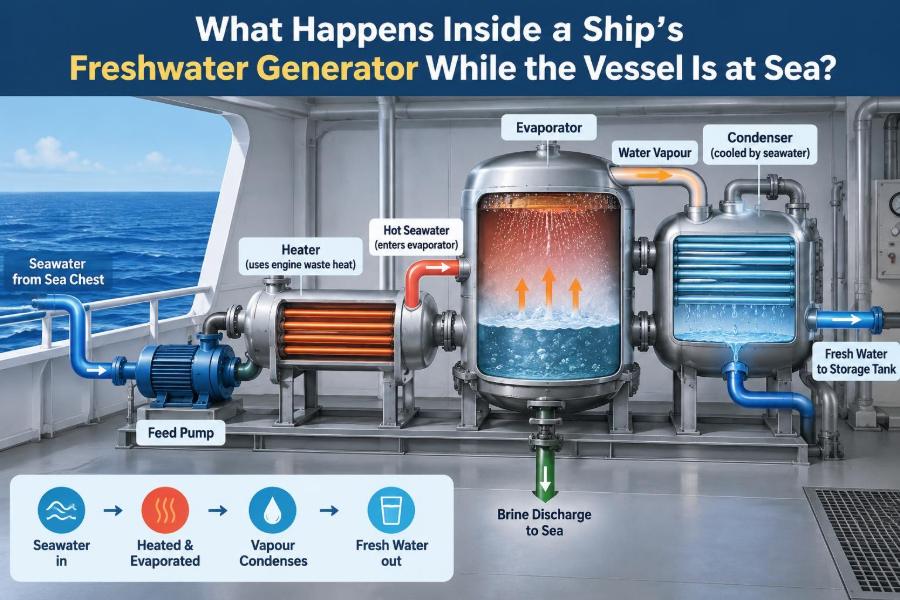

A vessel can travel for weeks without reaching a port, yet people still need drinking water, showers, laundry, cooking, boiler feedwater, and cleaning water. Carrying every litre needed for a long voyage as stored freshwater would consume valuable tank volume and reduce operational flexibility.
That is why many ships make water while underway. Deep inside the engine room, a freshwater generator quietly uses heat that the ship already has and the seawater surrounding the hull to produce distillate: water with most dissolved salts removed.
It sounds simple—boil seawater and collect the vapour—but a marine freshwater generator is designed around a more practical challenge. Seawater boils at much lower temperatures when pressure is reduced, allowing the plant to use low-grade heat rather than a large dedicated boiler.
Understanding this equipment connects thermodynamics to everyday ship operation. It also explains why engineers watch temperatures, vacuum, salinity, chemical dosing, and seawater conditions so closely while the vessel is at sea.
⚓ The basic purpose of a freshwater generator
A freshwater generator is a shipboard distillation plant. Its job is to separate relatively pure water from seawater by evaporating water and then condensing that vapour into liquid again.
The product is commonly called distillate. It is not the same as untreated seawater that has merely been filtered; evaporation leaves salts and many non-volatile contaminants behind in the concentrated brine.
On many merchant vessels, generated water supplements or replaces bunkered freshwater for domestic and technical uses. The exact arrangement depends on vessel design, machinery, voyage pattern, and the quality requirements of onboard consumers.
🌊 Why ships cannot simply rely on seawater
Seawater is abundant, but its dissolved salts make it unsuitable for drinking, cooking, and most freshwater services. It is also unsuitable for boiler feed unless extensively treated, because salts can form deposits and encourage damaging corrosion processes.
Even where seawater is used directly—for fire pumps, cooling circuits, deck washing, or sanitary flushing—its corrosive and fouling effects must be managed. Freshwater is needed where hygiene, machinery protection, or a closed-loop system demands it.
Storing water remains necessary. A generator can be stopped by maintenance, poor seawater conditions, machinery problems, or a port restriction, so freshwater tanks provide a vital reserve rather than becoming unnecessary.
🧪 Distillation: separating water from salt
Distillation works because water can become vapour while dissolved salts do not normally evaporate with it. If seawater is heated, water molecules escape from the liquid surface as vapour; when that vapour cools on another surface, it becomes fresh condensate.
The remaining liquid becomes saltier. This concentrate is called brine, and it must be removed continuously or regularly so salt does not accumulate inside the evaporator.
Distillation is not a magical purification step. Some volatile substances can travel with vapour under certain conditions, and entrained droplets of seawater can contaminate the product. That is why good separation and salinity monitoring are essential.
🌡️ Why evaporation happens under vacuum
At normal atmospheric pressure, pure water boils at about 100°C. A ship’s jacket cooling water is often much cooler than this, so it could not normally boil seawater efficiently.
Lower the pressure, however, and the boiling temperature falls. A freshwater generator operates under vacuum so seawater can evaporate at a temperature often compatible with main-engine cooling water, frequently in the approximate range associated with jacket-water heat recovery.
This is the central engineering idea: reduce pressure instead of demanding hotter heat. It turns waste heat from propulsion machinery into a useful source of freshwater production.
🔥 Where the heat usually comes from
On a conventional slow-speed diesel vessel, the heating medium is often main-engine jacket cooling water. After absorbing heat from engine cylinder liners and related components, this water still carries enough thermal energy to heat seawater in the generator.
Some installations use other sources, such as steam, thermal oil, or hot water from auxiliary engines. The available source determines the plant’s arrangement, output, and operating procedures.
Using jacket-water heat is efficient because the cooling system must reject heat anyway. But it also means freshwater production is linked to engine load: at low propulsion load, the heating-water temperature or flow may be inadequate.
🧱 The main parts inside the plant
Although designs differ, a typical low-temperature freshwater generator contains an evaporator section, condenser section, demister, ejector system, feed and brine connections, distillate collection arrangement, and monitoring instruments.
- Evaporator: where feed seawater is heated and partially vaporised.
- Condenser: where freshwater vapour gives up heat and becomes liquid.
- Demister: removes entrained saltwater droplets from the vapour.
- Ejector or vacuum pump: creates and maintains low pressure.
- Salinometer: checks whether product water is acceptably low in salt.
In plate-type units, these functions are packed into a compact stack of corrugated heat-transfer plates. Shell-and-tube designs use tubes and chambers instead, but the process logic is similar.
🌀 Creating the vacuum with an ejector
Many marine plants use a water ejector rather than a mechanical vacuum pump. Pressurised seawater passes through a nozzle at high velocity, creating a low-pressure region that draws air, non-condensable gases, and brine from the generator.
The ejector then discharges the mixture overboard. It has no rotating internal parts in the suction path, which makes it well suited to a marine environment, but it depends on sufficient seawater pressure and clean nozzles.
If ejector performance falls, vacuum weakens. The evaporation temperature rises, vapour production declines, and the unit may become unstable or stop producing acceptable distillate.
💨 Removing air and non-condensable gases
Air is one of the quiet enemies of heat transfer. It can enter through leaking gaskets, valve stems, imperfect joints, or from dissolved gases released as seawater warms under vacuum.
When air gathers on heat-transfer surfaces, it acts like an insulating blanket. Vapour cannot condense as efficiently, and the pressure-temperature relationship inside the plant becomes less predictable.
The ejector continuously removes these gases. Operators should not assume that a visible vacuum reading alone proves everything is healthy; reduced output, changing temperatures, or poor condenser performance can also indicate air ingress.
🌊 The seawater feed path
Seawater entering the freshwater generator has more than one role. It supplies the feed that will partly evaporate, and it often cools the condenser and powers the ejector.
In many plate-type systems, seawater first passes through the condenser. There it absorbs heat released by condensing vapour, which preheats the feed before it reaches the evaporator.
This arrangement recovers energy twice: vapour is condensed into product water, while incoming seawater arrives warmer at the evaporator. The balance of feed, cooling flow, and brine discharge is set by the unit design and operating condition.
♨️ What happens in the evaporator
In the evaporator, heated fresh or jacket water flows on one side of a heat-transfer surface while seawater is distributed on the other. Under vacuum, some of that seawater flashes or boils into vapour.
Only a fraction of the feed becomes vapour. The rest leaves as increasingly concentrated brine, carrying away salts that would otherwise deposit on the plates or tubes.
Good distribution matters. If feed does not wet the heat-transfer area evenly, some zones contribute little evaporation while other areas may scale more quickly or suffer local overheating in unusual operating conditions.
🧂 Why brine concentration must be controlled
As water evaporates, salt remains behind. If too much water is removed from too little feed, brine concentration rises and the risk of scale increases sharply.
The amount of concentration is often described using a concentration factor: the salinity of discharged brine compared with the incoming seawater. Operators follow the maker’s limits rather than pursuing maximum production at any cost.
Over-concentration can reduce heat transfer, contaminate distillate through carryover, and make cleaning more frequent. Stable, controlled production is generally more valuable than briefly forcing the plant to a higher output.
🫧 The demister’s small but critical job
Vapour rising from the evaporator can carry tiny droplets of seawater with it. This is called entrainment. If those droplets reach the condenser, their salt enters the product water directly.
A demister, often a mesh or specially shaped separator, forces the vapour to change direction or pass through a fine structure. Droplets strike the material, merge, and fall back into the brine space while cleaner vapour continues onward.
Foaming, excessive feed, unstable vacuum, or a damaged demister can overwhelm this protection. A sudden rise in product salinity is therefore a process warning, not merely an instrument nuisance.
❄️ Condensing vapour into distillate
After leaving the demister, vapour reaches the condenser. Cooler incoming seawater flows on the opposite side of the heat-transfer surface and absorbs latent heat from the vapour.
Latent heat is the substantial energy released when vapour turns back into liquid without a major temperature change. This heat exchange both produces distillate and preheats the incoming seawater feed.
The condensed water drains into a distillate tray or collection space. From there, a distillate pump normally transfers it through monitoring equipment to a freshwater tank or diverts it overboard if quality is unacceptable.
🔍 How a salinometer protects the freshwater tank
A salinometer measures the salt content, usually indirectly through electrical conductivity. Saltwater conducts electricity much better than low-salinity distillate, so conductivity provides a fast indication of contamination.
If salinity rises above the vessel’s set limit, an alarm may sound and an automatic three-way valve can divert product water overboard. This prevents a contaminated batch from entering the potable or technical freshwater tank.
Salinometer cells need clean flow paths and correct calibration or checking in accordance with the maker’s procedure. A faulty cell can create two bad outcomes: rejecting good water or, more seriously, accepting poor-quality water.
🚰 Why generated water still needs careful handling
Freshly distilled water is very low in dissolved minerals. Depending on the ship’s system and intended use, it may be stored separately, treated, or blended before distribution.
Potable-water arrangements may include disinfection and, where fitted, mineral adjustment or other conditioning. Distillation removes salts, but safe drinking water depends on the entire chain: production, storage, distribution piping, tank hygiene, and testing practices.
For technical uses, very low mineral content can be beneficial. Yet boiler feedwater normally requires additional treatment and monitoring because oxygen, pH, hardness, conductivity, and other parameters matter to boiler protection.
📏 Reading the key operating parameters
Engineers do not judge a freshwater generator by one gauge. They compare vacuum, heating-water temperatures, seawater temperatures, distillate rate, salinity, and the behaviour of pumps and ejectors.
| Observation | What it can suggest | Useful first check |
|---|---|---|
| Falling production | Low heat input, poor vacuum, or fouled surfaces | Temperatures, engine load, vacuum trend |
| High distillate salinity | Carryover, demister issue, leak, or faulty sensor | Salinometer, feed rate, internal condition |
| Weak vacuum | Air leak, ejector problem, insufficient seawater flow | Ejector pressure, strainers, joints |
| Rising pressure drop | Fouling or restricted seawater path | Strainers, valves, plate condition |
Trends are often more revealing than isolated readings. A gradual decline over several days commonly points toward fouling, while a sudden change may indicate a valve movement, blocked strainer, failed pump, or air leak.
🧼 Scale: the main threat to heat transfer
Scale is a hard mineral deposit that forms when dissolved substances in seawater precipitate onto hot surfaces. Calcium compounds are common contributors, though deposit composition depends on seawater chemistry and operating conditions.
Even a thin layer acts as insulation. The heating water may still enter at the expected temperature, but less heat reaches the seawater, reducing evaporation and distillate output.
Scale also narrows passages and can increase pressure losses. If left unmanaged, it turns an energy-efficient heat exchanger into a poorly performing one that demands shutdown and chemical cleaning.
🧴 Chemical dosing and its limits
Many freshwater generators use a scale-control chemical dosed into the feed seawater. The chemical is intended to interfere with crystal growth or keep scale-forming substances dispersed long enough for brine to leave the plant.
Dosing is not a substitute for correct operation. An excessive feed rate, wrong chemical, poor vacuum, or unsuitable water conditions can still result in deposits even when dosing equipment appears to be running.
Only approved chemicals and maker guidance should be used. Chemicals must also be handled under the vessel’s safety procedures, with appropriate protective equipment and attention to storage compatibility.
🧽 Cleaning plates and heat-transfer surfaces
When performance has degraded and diagnosis points to fouling, the unit may require cleaning. Plate-type generators can often be opened after isolation, draining, cooling, and pressure release, allowing plates and gaskets to be inspected.
Mechanical cleaning must be gentle enough not to scratch thin heat-transfer plates. Chemical cleaning requires a suitable solution, controlled concentration, compatible materials, adequate circulation, and thorough rinsing.
Cleaning is not simply a maintenance chore; it is an opportunity to find the cause. Repeated heavy scaling may reveal incorrect dosing, poor brine control, unsuitable temperatures, or a procedure being followed incorrectly.
🔩 Gaskets, plates, and hidden cross-leaks
Heat exchangers depend on intact barriers between different fluids. In a plate freshwater generator, gaskets seal channels so heating water, seawater, brine, and distillate follow their intended paths.
A damaged gasket, corroded plate, pinhole, or incorrectly assembled plate pack can allow cross-contamination. For example, seawater entering the distillate side can cause persistent high salinity even if vapour separation appears normal.
After opening a plate stack, engineers must follow the manufacturer’s tightening dimensions and plate pattern. Over-tightening can damage gaskets or plates; under-tightening can permit leaks and air ingress.
🛠️ A sensible start-up sequence
Exact start-up steps vary by maker and vessel procedure, but the process generally establishes cooling and ejector seawater flow before admitting heating water. This creates vacuum and prevents exposing a stagnant plant to unnecessary thermal stress.
- Confirm valves, strainers, drains, and tank line-up are correctly arranged.
- Start seawater supply and establish ejector operation.
- Verify vacuum is developing and that abnormal leakage is absent.
- Admit heating medium gradually as specified.
- Start distillate transfer only after quality is satisfactory.
Rushing the sequence can cause unstable operation, thermal shock, or contaminated initial product. The approved onboard checklist remains the controlling document.
🛑 Why shutdown needs equal care
Stopping the heating medium first reduces evaporation, but systems should be shut down in the order specified by the maker. Seawater flow may need to continue briefly to cool the unit and maintain ejector action while vapour production decays.
Opening a hot vacuum vessel casually is unsafe and can damage equipment. It must be isolated, allowed to cool, vented carefully to atmospheric pressure, drained as necessary, and made safe under the ship’s permit and isolation procedures.
For extended lay-up, stagnant seawater can promote corrosion, deposits, and biological growth. Drainage, freshwater flushing, preservation, or dry storage practices depend on the equipment design and planned duration.
🚢 The effect of engine load and voyage conditions
A generator linked to main-engine jacket water is most comfortable when the propulsion plant supplies stable heat. Slow steaming, manoeuvring, harbour waiting, or operation on auxiliary machinery can reduce available heating energy.
Seawater temperature also changes with route and season. Warmer cooling seawater makes condensation less effective, while colder water can improve cooling but may alter operating balance. Local water quality can affect fouling and biological contamination risk.
For these reasons, a capacity stated on a nameplate is a design reference, not a promise of identical output in every sea condition. Good operators adjust expectations to the real thermal and seawater environment.
⚠️ Common symptoms and practical diagnosis
Diagnosis starts by separating three questions: Is there enough heat? Is vacuum adequate? Is the product actually clean? This avoids replacing parts based on one symptom alone.
- Low output with normal salinity: investigate heat input, fouling, vacuum, and feed distribution.
- Normal output with high salinity: investigate entrainment, demister condition, cross-leaks, and salinometer accuracy.
- Low output with weak vacuum: check ejector supply, clogged strainers, nozzle condition, drains, and air leaks.
- Unstable readings: look for fluctuating seawater pressure, valve misalignment, air ingress, or an instrument problem.
Changing several settings at once makes troubleshooting harder. Record readings, make one justified adjustment, and observe the result long enough to identify cause and effect.
🧯 Safety risks during operation and maintenance
The generator combines hot fluids, vacuum, pressurised seawater, rotating pumps, chemicals, and confined engine-room spaces. None of these hazards are unusual onboard, but their combination requires disciplined work practices.
Hot jacket water can cause burns, while pressurised seawater lines can release forcefully if opened improperly. Chemical descalers may be corrosive, and a vacuum vessel can draw in air or loose items unexpectedly when connections are opened.
Before maintenance, crews need proper isolation, lockout or tagout where applicable, cooling, depressurising, permits, protective equipment, and communication with the watchkeeper. Manufacturer instructions and the vessel’s safety management system take priority over generic guidance.
💧 Freshwater management beyond the generator
Making water is only half the task. The chief engineer and deck department must know tank soundings, daily consumption, reserve requirements, transfer arrangements, and the quality of water in service tanks.
A practical daily water balance compares production, consumption, and tank inventory. Unexpected losses may indicate a leaking line, excessive domestic consumption, a malfunctioning evaporator, or an incorrect tank-level reading.
Protecting potable water also requires preventing cross-connections with non-potable systems. Clear identification, correct valve line-up, and hygienic tank maintenance are as important as the distillation process itself.
⚡ Freshwater generators and reverse osmosis
Not every ship makes water by evaporation. Reverse osmosis, often called RO, uses high pressure to force water through a membrane that rejects most dissolved salts. It does not rely on boiling or condensation.
RO can be attractive when electrical power and suitable feedwater are available, especially where waste heat is limited. Its membranes, however, are sensitive to fouling, require careful pretreatment, and need high-pressure pumping.
Thermal freshwater generators make particularly good use of engine waste heat, while RO offers a different operational trade-off. Some vessels use one method; others may have redundancy or alternative arrangements based on their service profile.
📚 What students should notice in this system
A freshwater generator brings several engineering subjects together in one compact machine. Thermodynamics explains boiling under reduced pressure; heat transfer explains evaporation and condensation; fluid mechanics explains ejectors and circulation; chemistry explains salinity and scale.
It also demonstrates a broader marine-engineering principle: waste energy is rarely truly waste until engineers have checked whether it can serve another purpose. Jacket-water heat is too low-grade for some tasks but is well suited to vacuum distillation.
When studying a piping diagram, trace each stream separately: heating water, cooling/feed seawater, brine, vapour, non-condensable gases, and distillate. This makes even a complex plate arrangement much easier to understand.
✅ The core principle to remember
At sea, a freshwater generator turns seawater into distillate by combining low pressure, recovered heat, vapour separation, condensation, and continuous quality control. Each part supports the others: poor vacuum wastes heat, poor separation raises salinity, and poor brine control promotes scale.
The plant performs best when operated as a balanced system rather than as a simple water-making machine. Stable flows, clean heat-transfer surfaces, healthy ejector performance, accurate instruments, and sound tank management all protect the vessel’s freshwater supply.
For engineers, the lesson extends beyond this one piece of equipment. Reliable shipboard utilities come from understanding the physical process, observing trends early, and maintaining the small components that prevent a larger failure.
A ship’s freshwater generator is a practical lesson in using energy wisely: lower the pressure, recover available heat, separate the vapour carefully, and never stop checking the quality of what reaches the tank. 🚢💧⚙️