
A passenger walking through a ship’s dining room may notice the horizon moving from side to side while the vessel continues steadily toward its destination. Cups slide slightly, doors swing, and even experienced crew adjust their stance without thinking about it.
That side-to-side motion is called roll. It is a natural response to waves, wind, vessel shape, loading condition, and speed. Some roll is unavoidable at sea, but excessive roll affects comfort, safety, equipment, cargo, and operational efficiency.
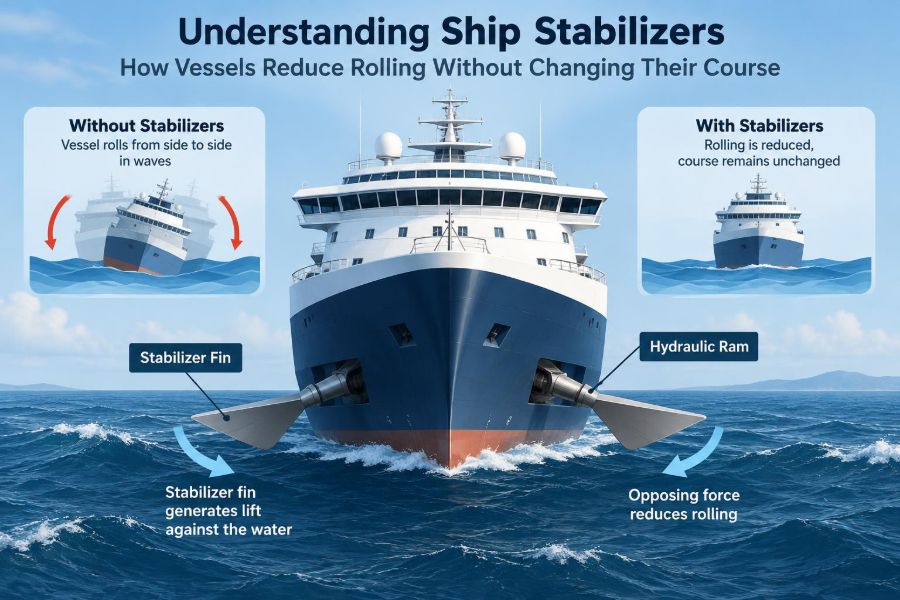
Ship stabilizers are designed to reduce this motion. Their job is often misunderstood: they do not steer the ship around waves, and they do not make rough water disappear. Instead, they create forces that oppose rolling while allowing the vessel to maintain its intended course.
Understanding how this works connects basic naval architecture with practical ship operation. From cruise ships and naval vessels to yachts, ferries, research ships, and offshore support vessels, stabilizing systems make life and work at sea more manageable.
🌊 What Ship Roll Actually Means
Roll is the angular motion of a vessel rotating about its longitudinal axis, an imaginary line running from bow to stern. When the port side rises and the starboard side falls, then reverses, the ship is rolling.
Roll differs from pitch, which is bow-up and bow-down motion, and heave, which is vertical movement. A vessel can experience all three at once, but stabilizers discussed here are primarily intended to reduce roll.
Think of a floating tray in a bathtub. Push water against one side and the tray tilts; as the water moves past it, the tray may tilt back the other way. A ship’s motion is more complex, but the basic restoring-and-oscillating behavior is similar.
🧭 Why Rolling Can Occur on a Straight Course
A ship does not need to turn in order to roll. Waves arriving from the side, known as beam seas, are especially likely to produce strong roll because they alternately lift and lower each side of the hull.
Quartering seas, approaching from aft and to one side, can also cause rolling. Even head seas may produce roll when wave patterns are irregular, wind gusts are strong, or the vessel encounters waves at a slight angle.
Course keeping and roll control are therefore separate tasks. The rudder controls heading; stabilizers create an opposing rolling moment. Modern control systems may coordinate these functions, but their physical purposes remain distinct.
⚖️ The Balance Between Gravity and Buoyancy
A floating vessel remains upright because gravity pulls its weight downward while buoyancy pushes upward through the underwater hull. When a ship heels, the shape of the submerged volume changes, shifting the effective buoyant force to create a righting moment.
This righting moment tends to bring the vessel back toward upright. However, momentum can carry it past that position, creating an oscillation from side to side.
Stabilizers do not replace the vessel’s inherent stability. A ship must be safely stable through sound design and loading practice before any active system is considered. Stabilizers refine motion; they are not a cure for a fundamentally unsafe stability condition.
📐 Natural Roll Period and Resonance
Every vessel has a characteristic natural roll period: the approximate time it takes to roll from one side to the other and back under given conditions. Hull form, displacement, beam, draft, center of gravity, and loading all influence it.
When wave encounters reinforce motion at or near this rhythm, the ship can experience resonant rolling. Like a person timing pushes on a playground swing, waves can add energy at the wrong moment and increase the roll angle.
Stabilizers work best when they sense this developing motion and apply an opposing force with the correct timing. Force applied too late, too early, or in the wrong direction can be ineffective or may even add energy to the roll.
🛠️ The Basic Stabilizer Principle
The central principle is simple: produce a force away from the vessel’s centerline, then use that force to generate a moment opposing the roll. The farther from the centerline the force acts, the more effective it can be for a given force level.
For example, when a ship begins rolling to starboard, a stabilizer system may generate an upward force on the starboard side and/or a downward force on the port side. Together, these forces resist the starboard heel.
The exact method varies widely. Fins use hydrodynamic lift, tanks move water, gyroscopes use angular momentum, and some hull forms gain passive damping from their geometry.
🪶 Fin Stabilizers: The Most Familiar Active System
Fin stabilizers are wing-shaped foils fitted below the waterline, commonly near the middle of the ship’s length. They extend outward from both sides of the hull and rotate through small angles under automatic control.
As water flows around a fin, its angle of attack creates hydrodynamic lift, much like an aircraft wing produces lift in air. On a ship, the desired lift may be upward on one side and downward on the other.
Fin systems are widely used on passenger ships, yachts, naval vessels, and specialized workboats because they can provide substantial roll reduction while underway.
💨 How Fins Create a Counter-Rolling Force
Suppose the vessel starts rolling to port. The control system commands the port and starboard fins to appropriate angles so their lift produces a moment resisting that portward roll.
The fins do not need to turn the vessel. Their opposing vertical forces are arranged as a pair, creating a rolling moment rather than a large net sideways force. In practice, some additional drag and small secondary effects still exist.
Fin effectiveness depends strongly on water flow over the foil. At higher speed, the fins can generate more lift for a given angle; at low speed or when stopped, conventional fins become much less effective.
🎛️ Sensors, Actuators, and the Control Loop
Active stabilizers rely on a fast feedback system. Motion sensors, often including gyroscopic instruments and accelerometers, measure roll angle, roll rate, and acceleration.
A controller calculates the needed corrective action and sends commands to hydraulic or electric actuators. Those actuators rotate the fins, regulate pump flow, or control other stabilizing equipment.
The system continuously repeats this cycle. Good control is not simply about applying the largest possible force; it is about applying the right force at the right time while respecting equipment limits.
⚡ Why Timing Matters More Than Brute Force
A stabilizer must react to both the direction and rate of roll. If a vessel is heeling to port but already moving rapidly back to starboard, the required response may differ from a vessel continuing to accelerate toward port.
This is why roll rate is so valuable to the controller. It helps predict where the motion is heading rather than merely reacting after a large angle has developed.
Overly aggressive control can cause unnecessary fin movement, increased drag, actuator wear, or a less comfortable motion. Engineers tune control laws to balance roll reduction, energy use, machinery loads, and ride quality.
🚤 Retractable and Non-Retractable Fins
Some ships use fixed, non-retractable fins. These are structurally straightforward, but they remain exposed and may add resistance even when not actively working.
Retractable fins can be drawn into hull recesses when entering port, operating in shallow water, maneuvering close to structures, or when the system is not needed. They are common where protection and low-speed practicality matter.
Retraction mechanisms add complexity. The designer must account for watertight integrity, hydraulic or electric actuation, structural loads, maintenance access, and reliable indication of fin position.
🛑 What Happens When a Ship Slows Down
Traditional fin stabilizers depend on forward speed because water flow creates their lift. As speed falls, their authority decreases. A vessel at anchor may still roll significantly even if it has large underway fins.
Some modern fin designs are marketed for low-speed or zero-speed operation. They may oscillate or move actively through the water to create force rather than relying only on ship speed.
These systems can be useful for yachts, expedition vessels, and ships that spend long periods drifting or at anchor. Their performance still depends on sea state, available power, hull characteristics, and system design.
💧 Anti-Roll Tanks and Moving Water
Anti-roll tanks reduce roll by allowing water to move across or within the ship in a controlled way. The moving water creates a counteracting moment that can absorb energy from the roll motion.
A simple passive arrangement may use a tank extending across the vessel, with ducts or restrictions controlling water flow. More advanced systems use pumps and valves to shift water actively from side to side.
Unlike conventional fins, tank systems can work when the vessel is stationary. Their trade-offs include volume requirements, added weight, free-surface effects, pumping energy for active systems, and careful integration with the ship’s stability design.
🔄 Passive Tanks Versus Active Tanks
| Feature | Passive anti-roll tank | Active anti-roll tank |
|---|---|---|
| Driving mechanism | Wave-induced vessel motion moves water | Pumps and controlled valves move water |
| Power demand | Low during operation | Requires electrical or hydraulic power |
| Control flexibility | Usually tuned to a narrower motion range | Can adapt more actively to conditions |
| Low-speed use | Possible, depending on design | Possible and often a key advantage |
| Main challenge | Performance can be condition-sensitive | Machinery complexity and energy use |
Passive tanks are often described as tuned systems. Their dimensions and internal restrictions are chosen so water motion lags the ship’s roll in a useful way, dissipating energy rather than amplifying it.
Active tanks provide greater control but introduce pumps, automation, power supply requirements, and more maintenance responsibilities. Neither approach is universally better; the operating profile matters.
🌀 Gyroscopic Stabilizers and Angular Momentum
A gyroscopic stabilizer contains a heavy flywheel spinning at high speed inside a frame. When the vessel rolls, controlled movement of the spinning assembly generates a resisting torque through gyroscopic precession.
Gyroscopes are common on some smaller vessels and yachts, particularly where at-rest stabilization is valuable and external fins are undesirable. They require electrical power and robust foundations because the forces transmitted into the structure can be substantial.
The technology is elegant but not magical. Size, mass, power demand, heat rejection, maintenance, and achievable torque all influence whether a gyroscope suits a particular vessel.
🧱 Bilge Keels: Simple Passive Roll Damping
Bilge keels are long, narrow fins fitted along the turn of the bilge, where the ship’s side meets its bottom. They have no moving parts and do not require sensors, pumps, or control software.
As the vessel rolls, bilge keels disturb surrounding water and create resistance to the motion. They do not eliminate roll, but they add roll damping in a reliable, economical way.
Many commercial ships use bilge keels because they are robust and suitable for continuous service. Their drawbacks include increased hydrodynamic resistance and the need to protect them from damage during docking or grounding events.
🏗️ Hull Form as the First Line of Defense
Stability and seakeeping begin with hull design. Beam, draft, bilge shape, displacement distribution, flare, appendages, and the location of weights all affect how a vessel responds to waves.
A wider vessel may have stronger initial stability, meaning it resists small angles of heel more firmly. But very stiff stability can lead to a short, abrupt roll period that passengers may find uncomfortable and that can increase loads on cargo and equipment.
Designers therefore seek a balance. The objective is not simply “maximum stability”; it is an acceptable combination of safety, operational capability, structural loading, comfort, resistance, and mission requirements.
📦 Loading Condition Changes the Roll Response
A stabilizer setting that works well in ballast condition may not be ideal when the ship is fully loaded. Cargo, fuel, ballast water, stores, and deck equipment can all change displacement, draft, center of gravity, and roll period.
High weights raise the vessel’s center of gravity and can reduce stability margins. Loose liquids in partially filled tanks can create free-surface effects, which may further reduce effective stability.
Stabilizers must never be used as an excuse for poor loading practice. Officers still need approved stability information, sound ballast management, secured cargo, and compliance with operating limits.
🧳 Passenger Comfort and Motion Sickness
Human comfort is one reason stabilizers are highly valued on passenger vessels. Roll can make walking difficult, disrupt meals and sleep, and contribute to motion sickness in susceptible people.
Motion sickness is not determined by roll angle alone. The frequency, acceleration, duration, visual environment, and individual sensitivity all matter. A smaller but sharply timed motion can feel worse than a slower, smoother one.
Reducing roll can also improve onboard service. Galleys, medical spaces, laboratories, seating areas, and accessible routes all operate more safely when sudden lateral motion is reduced.
⚓ Cargo, Equipment, and Operational Safety
Roll places repeated loads on lashings, container securing arrangements, vehicles, loose equipment, cranes, and pipe supports. On working vessels, personnel may be handling tools, conducting transfers, or operating machinery while the deck moves beneath them.
Stabilization can reduce the frequency and severity of these motions, but it cannot remove the need for proper securing. A poorly lashed item remains a hazard even on a well-stabilized ship.
For offshore and survey operations, reduced roll may improve the usable weather window for certain tasks. Decisions must still consider all vessel motions, weather forecasts, deck exposure, visibility, and procedure-specific limits.
🧪 A Hypothetical Ferry Crossing
Imagine a medium-speed ferry meeting irregular waves from its starboard beam. Without active stabilization, each wave raises the starboard side, and the hull’s righting action brings it back through upright before the next wave arrives.
With fin stabilizers operating, motion sensors detect the roll rate and angle. The fins adjust continuously to create forces that oppose the developing motion, reducing the peak roll and slowing the oscillation.
The ferry still encounters waves, and passengers may still feel movement. The realistic goal is not a perfectly level platform, but a safer and more comfortable response within the system’s operating capability.
🧭 Why Stabilizers Do Not Replace Good Seamanship
Changing speed or course can sometimes reduce uncomfortable or dangerous motion more effectively than relying on stabilizers alone. A small alteration in wave encounter angle may change the pattern of roll, pitch, and slamming significantly.
Masters and officers must consider the full situation: weather, wave direction, vessel condition, cargo, route constraints, traffic, fuel use, and the limits stated in the vessel’s operating guidance.
Stabilizers are one tool in a broader seamanship toolkit. They complement prudent navigation and ship handling; they do not override them.
📉 The Cost of Drag and Energy Use
When fins generate lift, they also create drag. That drag can increase propulsive power demand, particularly when seas are rough and stabilizer activity is high.
Active tanks require energy for pumps, and gyroscopic systems require continuous electrical power to spin and control the flywheel. Designers and operators must weigh these costs against comfort, safety, mission performance, and revenue considerations.
Efficient control strategies may reduce unnecessary activity in mild conditions. However, turning a system off solely to save energy can be a poor decision if roll then compromises safety or operational capability.
🔧 Maintenance Is Part of Stabilizer Performance
Stabilizers operate in a harsh environment of saltwater, vibration, cyclic loading, and sometimes marine growth. Fin systems need attention to seals, bearings, hydraulic lines, actuators, position feedback, and underwater structure.
Tank systems require inspection of pumps, valves, level sensors, piping, coatings, and controls. Gyroscopic units require monitoring of bearings, cooling, drive systems, containment, and electrical components.
Condition monitoring and planned maintenance are essential. A system that appears available at the control panel may perform poorly if sensors drift, a fin moves slowly, a valve sticks, or a hydraulic leak reduces actuator capacity.
🚨 Failures and Safe Operating Modes
Like any marine system, stabilizers can fail or become unavailable. Vessels are designed and operated with the understanding that active stabilization may be lost; basic intact stability and safe navigation cannot depend on it.
Common protective responses may include centering fins, retracting them where appropriate, isolating faulty hydraulic sections, limiting operation, or shifting to manual or degraded control according to approved procedures.
Crew training matters because an unexpected change in roll behavior can affect passengers, cargo operations, and watchkeeping. The correct response depends on the equipment, sea state, vessel instructions, and the nature of the fault.
🧠 Common Misunderstandings About Stabilizers
- “They stop all motion.” They primarily reduce roll and cannot eliminate wave-induced motion.
- “They steer the ship.” Their main function is roll control, not heading control.
- “Bigger fins always solve the problem.” Larger equipment brings structural, drag, power, and control challenges.
- “They make loading less critical.” Stability management and cargo securing remain essential.
- “They work equally well at every speed.” Conventional fins lose effectiveness as water flow decreases.
Clear expectations are important for crew, owners, and passengers. A stabilizer is best understood as a carefully controlled motion-management system, not a guarantee of calm conditions.
🧩 Choosing the Right System for a Vessel
The best stabilizer depends on the vessel’s mission. A fast ferry operating mainly underway may favor active fins, while a yacht that spends nights at anchor may value zero-speed fins, tanks, or a gyroscopic system.
Commercial cargo ships may prioritize robust passive damping through bilge keels. Offshore vessels may combine hull-form choices, anti-roll tanks, and active systems to support specialized operations.
Key selection questions include:
- At what speeds will the vessel spend most of its time?
- Is at-anchor stabilization required?
- How much internal volume, electrical power, and maintenance capacity are available?
- What roll reduction is needed for the vessel’s real operating profile?
- What drag, weight, installation, and lifecycle impacts are acceptable?
🧑✈️ What Operators Should Watch During Service
Operators should monitor roll behavior, fin position or tank levels, hydraulic or electrical status, alarms, temperatures, pressures, and system response. A trend toward slower response or unusually frequent alarms deserves investigation before a major failure occurs.
Sea conditions should also guide expectations. A stabilizer may be functioning correctly while reaching its designed limits in severe or confused seas.
Communication between bridge teams and engineering personnel is especially valuable after changes in loading condition, equipment maintenance, unusual vibration, or reported reductions in ride quality.
🌐 Automation and Future Development
Modern systems increasingly combine better motion sensors, digital control, diagnostic data, and integration with vessel-management systems. These tools can help controllers adapt to changing conditions and help engineers identify developing faults.
Future improvements will likely focus on reducing energy consumption, improving low-speed performance, and coordinating stabilization with route planning and propulsion management. Any automated feature must still be evaluated against real sea conditions and safe operating practice.
The fundamental physics will remain the same: a ship rolls because external forces and its own restoring characteristics create oscillation; a stabilizer reduces that oscillation by applying or dissipating energy intelligently.
✅ The Core Takeaway: Control Motion, Not the Sea
Ship stabilizers reduce rolling by producing a controlled counter-moment against the vessel’s natural side-to-side motion. Fins use water flow, tanks shift water, gyroscopes use angular momentum, and bilge keels add passive resistance.
Their effectiveness depends on speed, sea state, vessel geometry, loading condition, system capacity, and correct operation. They improve comfort and capability, but they cannot replace sound naval architecture, stability control, cargo securing, maintenance, and seamanship.
For marine engineers, the most useful perspective is to see stabilization as a complete system: hull, loading, sensors, machinery, controls, crew decisions, and the sea all interact.
Ship stabilizers do not change a vessel’s course to defeat the waves; they manage roll by applying the right opposing force at the right moment. That distinction explains both their remarkable value and their practical limits. ⚓🌊🚢