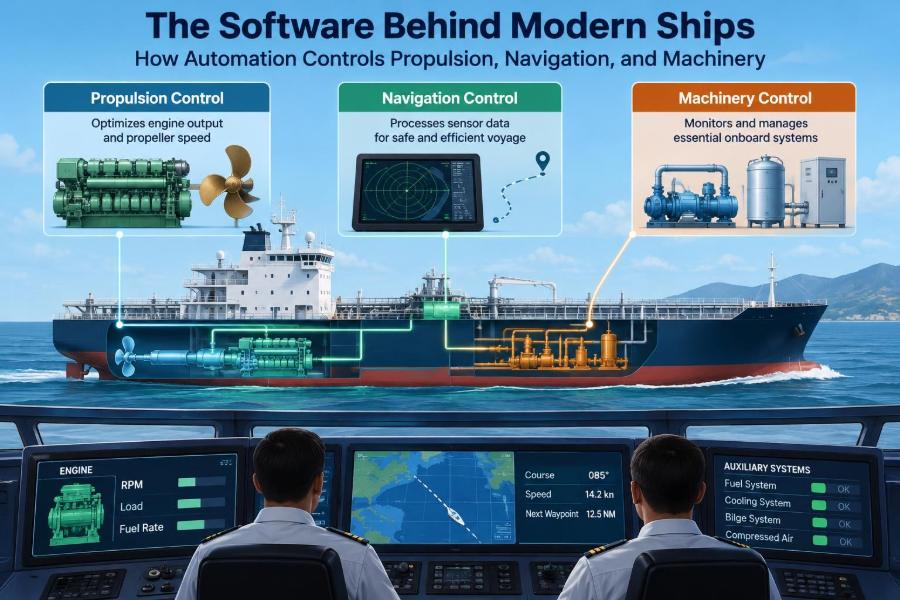

A ship’s bridge can look calm even while hundreds of decisions are being made every minute. A voyage plan is being followed, engines are responding to power demand, tanks are being monitored, alarms are being filtered, and electrical loads are being balanced.
Much of that work is no longer performed by separate mechanical devices and handwritten checks alone. It is coordinated by software: programs running in controllers, operator stations, sensors, networks, and decision-support systems throughout the vessel.
This does not mean a modern ship “drives itself.” Qualified people remain responsible for navigation, machinery operation, watchkeeping, maintenance, and emergency response. But automation changes what they see, what they control, and how quickly faults can develop or be contained.
For marine engineers, deck officers, electricians, and students, understanding this software layer is now as practical as understanding pumps, governors, switchboards, or radar. It explains how a command on the bridge eventually becomes thrust at the propeller—and why a bad signal can matter as much as a failed valve.
⚙️ What Ship Automation Actually Means
Ship automation is the use of sensors, controllers, software, and actuators to monitor equipment and carry out defined control actions. An actuator is the device that physically does something: it moves a fuel rack, opens a valve, changes a motor speed, or starts a pump.
Automation ranges from a simple thermostat-like control loop to an integrated vessel management system. The common purpose is to keep a process near its intended condition while giving operators clear information and safe ways to intervene.
🧠 Software Is Part of the Machinery System
Software should not be treated as an invisible office tool. In many systems, it is a functional part of the machinery plant. The engine may be mechanically sound, yet unable to start because a controller sees an unsafe condition, a permissive signal is absent, or a communication link has failed.
This is why troubleshooting increasingly requires three questions: what is the physical condition, what does the sensor report, and what logic is the controller applying?
🔄 The Basic Control Loop
Most automated marine functions follow a repeating loop: measure, compare, decide, and act. A sensor measures a value such as pressure or temperature. The controller compares it with a target or limit, then commands an actuator.
For example, a cooling-water controller may increase pump speed when temperature rises. If the temperature remains high despite that command, the system can raise an alarm and, where configured, reduce load or initiate protective action.
📡 Sensors Turn Physical Conditions into Data
Sensors are the software system’s eyes and ears. They measure speed, position, pressure, level, temperature, vibration, electrical current, exhaust conditions, and many other variables.
A sensor reading is not automatically the truth. A blocked impulse line, loose terminal, damaged cable, incorrect calibration, or unsuitable sensor location can create a believable but wrong value. Good automation depends on good instrumentation.
🧮 Controllers Make Local Decisions
Programmable logic controllers, dedicated engine control units, drive controllers, and embedded devices execute programmed logic. They read inputs, apply rules, and write outputs repeatedly, often far faster than an operator could inspect each signal manually.
Local control is useful because it keeps essential functions close to the equipment. A generator governor, for instance, can react to changes in speed without waiting for a high-level monitoring computer to make every adjustment.
🖥️ Human-Machine Interfaces Show the Plant
The human-machine interface, usually called the HMI, is the screen through which personnel view process data, acknowledge alarms, change approved setpoints, and issue commands. It may be on the bridge, in the engine control room, or at a local machinery panel.
An HMI is valuable only if its display matches reality and its design supports quick understanding. A crowded screen with poor alarm priorities can slow a watchkeeper precisely when clear action is needed.
🌐 Networks Connect Separate Systems
Modern ships use networks to exchange data between bridge equipment, engine-room automation, power management, cargo systems, alarm systems, and shore-facing services. Integration can reduce duplicate sensors and give operators a broader operational picture.
However, connected systems also create dependencies. A network fault should not turn a local control problem into a total loss of essential machinery control. Well-designed systems preserve safe local operation when higher-level communications are unavailable.
🛠️ Propulsion Control Begins with Demand
Propulsion automation translates a requested speed or power setting into controlled engine, shaft, propeller, or electric-motor behavior. The bridge may request a maneuvering order, but the machinery system must consider direction, available power, engine limits, clutch state, and interlocks.
On a conventional diesel mechanical vessel, this involves the main engine, reversing or controllable-pitch arrangements, and shaft-line equipment. On other vessels, the request may be converted into an electrical power demand for propulsion motors.
🌀 Fixed-Pitch and Controllable-Pitch Logic
A fixed-pitch propeller normally changes thrust by changing shaft speed and, where applicable, rotational direction. A controllable-pitch propeller changes blade angle while shaft speed may remain relatively steady.
Software coordinates these variables to avoid unsuitable combinations of pitch, speed, torque, and engine load. Rapidly demanding high pitch at low available engine power can overload machinery; limiting logic protects the plant while still responding as closely as practical to the operator’s request.
🔥 Main Engine Electronic Control
Electronically controlled diesel engines use software to manage fuel injection timing, fuel quantity, exhaust-valve operation, starting sequences, and protective limits. This supports accurate control across changing load and environmental conditions.
The software does not eliminate mechanical constraints. It works within them. Lubrication pressure, cooling, air supply, crankshaft speed, cylinder conditions, and manufacturer-defined operating envelopes still determine what the engine can safely do.
⚡ Diesel-Electric Propulsion Adds a Power Layer
In diesel-electric propulsion, generators produce electrical power and variable-frequency drives supply propulsion motors. The automation challenge is no longer only engine-to-propeller coordination; it is also matching generation, distribution, hotel load, and propulsion demand.
A sudden increase in propulsion demand may require another generator to start and synchronize. If available generation is insufficient, the power management system may limit nonessential loads or restrict propulsion demand to protect network frequency and voltage.
🔌 Power Management Protects the Electrical Plant
The power management system monitors generators, switchboards, breakers, and electrical demand. It can start and stop generators, share load, synchronize incoming machines, and manage load shedding.
Load shedding is not simply a convenience feature. During a severe imbalance, quickly disconnecting selected nonessential consumers can help prevent a blackout. The exact priority list is vessel-specific and must reflect operational and safety requirements.
🧭 Navigation Software Supports, Not Replaces, Judgment
Navigation software can combine chart data, position inputs, heading, speed, radar information, automatic identification system data, route plans, and alerts. Electronic chart systems improve route monitoring, but they do not remove the need for a competent navigational watch.
Position data can be incorrect, chart information may require updates, targets can be misunderstood, and a planned route may become unsuitable as conditions change. Bridge teams must cross-check information and maintain situational awareness beyond the screen.
🗺️ Route Planning and Route Monitoring Are Different
Route planning is the preparation of a safe intended passage, including waypoints, margins, limitations, and relevant information. Route monitoring is the real-time task of checking whether the vessel is following that plan safely.
Software can alert the bridge when a vessel approaches a boundary or deviates from a route corridor. Such alarms are useful, but they cannot decide whether altered weather, traffic, equipment limitations, or instructions make a deviation necessary.
📍 Position, Heading, and Motion Need Cross-Checks
Satellite positioning is central to modern navigation, yet it is only one source of evidence. Gyrocompasses, magnetic compasses, radar ranges and bearings, visual observations, echo sounders, and independent position sources can reveal inconsistencies.
A practical principle is simple: when one display conflicts with the vessel’s observed movement or another independent source, investigate before trusting the convenient answer. Automation is strongest when it supports verification rather than encouraging blind acceptance.
🚨 Alarm Systems Need Meaningful Priorities
Alarms tell personnel that a condition needs attention. A properly designed system distinguishes between information, caution, alarm, and emergency conditions so that urgent warnings do not disappear inside routine messages.
Alarm flooding occurs when many alarms arrive together, often after one initiating fault. Operators then spend time acknowledging symptoms instead of identifying the cause. Good alarm design suppresses predictable secondary alarms where appropriate without hiding critical information.
🧯 Interlocks and Permissives Prevent Unsafe Commands
An interlock prevents or modifies an action when defined conditions make it unsafe. A permissive is a required condition that must be true before an action can proceed, such as adequate lubricating-oil pressure before a machinery sequence continues.
These functions can frustrate operators when they block a command, especially during faults. Yet bypassing them casually can turn a manageable problem into equipment damage or injury. A bypass should be controlled, understood, authorized, and removed as soon as its purpose ends.
🛑 Shutdown Logic Is the Last Protective Barrier
Protective shutdowns are intended to prevent major damage or unsafe escalation when critical limits are exceeded. Depending on the equipment, the response may be an alarm, load reduction, automatic stop, fuel shutoff, or isolation of a system.
Shutdown settings involve trade-offs. Limits set too conservatively may produce nuisance trips; limits set too loosely may allow damage to develop. Changes should follow manufacturer guidance and the vessel’s management procedures, never informal trial and error.
💧 Pumps, Valves, and Tank Systems Are Software-Controlled Too
Ballast, bilge, fuel transfer, cooling, fire-fighting support, and cargo-related systems often use automated sequences. The controller may open valves in order, start pumps, confirm flow or level changes, and stop the sequence when the target is reached.
Sequence automation prevents routine omissions, but line-up errors remain possible. Valve feedback can fail, a manually operated valve may be in the wrong position, or a tank-level signal may be unreliable. Physical verification remains essential for critical transfers.
🏭 Cargo and Process Automation Require Boundaries
On tankers, gas carriers, offshore vessels, and specialized ships, automation may regulate pressure, temperature, pumps, compressors, valves, and transfer rates. These systems can maintain stable processes more consistently than manual adjustment during long operations.
They must still operate within carefully defined boundaries. A control system may hold a target pressure, for example, but it cannot replace procedural checks, communication between teams, or an understanding of where the product is actually flowing.
🧰 Condition Monitoring Helps Plan Maintenance
Automation platforms can trend vibration, temperature, pressure, electrical current, running hours, and other indicators. A trend is often more useful than one isolated value because it can show gradual deterioration before a hard limit is reached.
Condition monitoring supports maintenance decisions; it does not make failure prediction certain. A rising bearing temperature may justify inspection, while a stable value does not prove a bearing is perfect. Data must be interpreted alongside operating history and physical checks.
📊 Data Historians Turn Events into Evidence
A data historian stores time-stamped process values, commands, alarms, and events. After a trip or operational upset, this record can help reconstruct what happened: which signal changed first, what command was issued, and how the plant responded.
Trend review is also valuable during normal operation. Engineers can compare fuel-system pressures, cooling performance, generator loading, or pump behavior across similar conditions instead of relying only on memory.
👥 Automation Changes the Watchkeeper’s Job
Automation reduces some routine manual work but increases the need for supervision, interpretation, and intervention skills. The operator’s role shifts from continuously manipulating every control to managing exceptions and recognizing when the automated response is unsuitable.
This can create a subtle risk: skills may fade if people only observe systems during normal operation. Drills, local familiarization, and deliberate practice with manual modes help preserve the ability to act when screens, networks, or automatic sequences are unavailable.
🔁 Manual, Remote, and Local Control Must Be Clear
A system may have local manual control, remote manual control, automatic control, and emergency control. Confusion over which mode is active is a common source of delay and error, particularly during maintenance or changeover.
Good practice includes confirming control location, mode indication, feedback, and authority before issuing commands. A remote start request is not proof that a pump is running; operators should verify status through reliable feedback such as speed, pressure, flow, or local indication.
🧪 Testing Logic Without Creating Risk
Automation requires periodic testing, from alarm checks to shutdown verification and simulated input testing. Testing should be planned so that personnel know what will move, which alarms will occur, what protection is temporarily affected, and how normal configuration will be restored.
A common mistake is treating a successful screen indication as proof of a complete test. For a critical function, the chain may include sensor, wiring, controller logic, output, actuator, and physical process response.
🔐 Cybersecurity Is Operational Safety
Connected ship systems can be affected by malware, unauthorized access, poor account management, insecure portable media, and unsupported software. The concern is not only loss of business data; it can include loss of visibility, unavailable operator stations, or compromised control functions.
Practical defenses include network separation, controlled access, backups, patch management that respects operational constraints, and clear procedures for removable media. Cybersecurity must be coordinated with machinery reliability, because an update applied without understanding the plant can also create operational problems.
🧩 Integration Brings Efficiency and Complexity
Integrated systems can reduce duplicated information, support faster diagnosis, and coordinate functions such as propulsion and power generation. They also introduce shared dependencies: a software configuration error or network issue may affect multiple displays or functions at once.
For this reason, critical designs use segregation, redundancy, fallback modes, and clear failure behavior. The goal is not to make every system connected, but to connect systems where the operational benefit justifies the added complexity.
⚠️ Common Automation Mistakes at Sea
- Trusting a single sensor: compare doubtful values with independent evidence.
- Silencing alarms without diagnosis: acknowledge the message, then find the initiating condition.
- Changing setpoints to stop nuisance alarms: investigate whether the process, sensor, or configuration is wrong.
- Ignoring mode status: verify whether control is automatic, remote, local, or inhibited.
- Leaving overrides in place: track, review, and remove every temporary bypass.
These errors are rarely caused by carelessness alone. Time pressure, unclear interfaces, incomplete handovers, and weak familiarization can all make sensible people take unsafe shortcuts.
📚 Skills Marine Professionals Need Now
Marine professionals do not all need to become software developers. They do need a working understanding of control loops, sensors, alarms, networks, logic diagrams, trends, permissions, and failure modes.
Useful questions include: What input caused this output? What conditions permit this sequence? What happens if communication is lost? Is this value measured, calculated, or manually entered? These questions turn automation from a black box into an understandable engineering system.
🔮 The Direction of Smarter Ships
Ships are likely to use more remote support, equipment analytics, integrated energy management, and decision-support tools. Alternative fuels and hybrid power systems can add further control complexity because fuel handling, energy storage, emissions equipment, and propulsion may need closer coordination.
More automation does not remove the need for conservative engineering. New capabilities should be assessed for reliability, maintainability, training needs, cyber exposure, and safe behavior during degraded operation.
⚓ The Core Principle: Automation Must Remain Understandable
The best maritime automation makes normal operations steadier, faults easier to detect, and recovery more manageable. It does this by giving people accurate information, predictable controls, meaningful protections, and practical fallback options.
The essential standard is not whether a system appears advanced. It is whether crew members can understand its state, verify its actions, recognize its limits, and take safe control when circumstances demand it.
Modern ships depend on software, but safe operation still depends on people who can question, supervise, and recover the systems that software controls. ⚓🖥️🔧