
A drillship is working hundreds of metres above a subsea well. A cable-laying vessel is holding a narrow route while engineers lower equipment to the seabed. An offshore support vessel is transferring personnel near a platform. In each case, drifting even a few metres can turn a routine operation into a costly or hazardous problem.
Dropping anchor is not always possible. The water may be too deep, the seabed may contain pipelines or cables, or the vessel may need to move frequently between precise locations. Instead, many ships use dynamic positioning, usually shortened to DP.
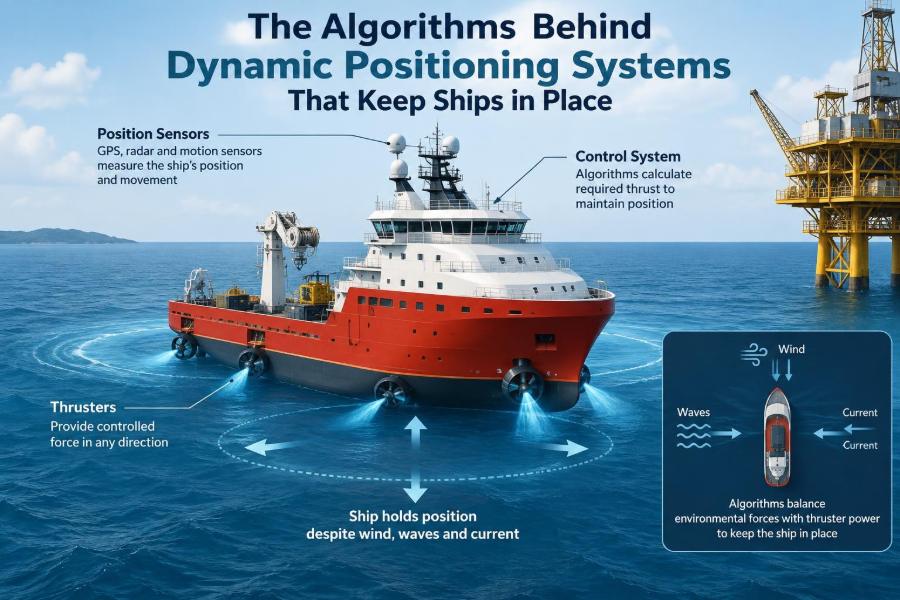
DP may look like an automated station-keeping feature, but its real task is more demanding. It must estimate where the vessel is, predict how wind, waves, and current will push it, and distribute corrective force across several thrusters—all while machinery performance and environmental conditions change.
The algorithms behind this process are a practical meeting point of navigation, control engineering, hydrodynamics, power systems, and human supervision. Understanding them makes DP feel less like a black box and more like a carefully managed closed-loop system.
⚓ What Dynamic Positioning Actually Means
Dynamic positioning is a computer-controlled system that automatically maintains a vessel’s position and heading, or moves it along a planned track, using propellers and thrusters. The vessel does not become motionless; it stays within an acceptable operating area called a position-keeping envelope.
A DP system usually controls three horizontal motions:
- Surge: forward and aft movement.
- Sway: sideways movement.
- Yaw: rotation about the vertical axis, or change of heading.
Roll, pitch, and heave matter to vessel operations, but conventional DP station keeping primarily commands the horizontal plane.
🧭 Why Holding Position Is Hard at Sea
At sea, the vessel is continually disturbed by wind, current, waves, changing draft, loading conditions, and interaction with nearby structures. A large vessel has inertia, so a correction made now may affect its movement several seconds later.
Waves add an especially awkward complication. They can make a position sensor appear to show rapid movement even when the vessel’s longer-term average position has barely changed. If the control system reacted strongly to every wave-induced motion, it could waste fuel and work the thrusters unnecessarily.
DP is therefore not simply “push back when the ship moves.” It must decide which movement needs correction and which movement should be filtered out.
🧠 The DP System as a Feedback Loop
The simplest useful model is a closed-loop control system. Sensors measure the vessel and its surroundings. A controller compares measured position and heading with the operator’s command. It calculates the force and turning moment needed to reduce the error.
Thrusters apply that command. The vessel responds, sensors measure the new state, and the cycle repeats many times. This loop must remain stable: excessive correction can cause oscillation, while weak correction lets the vessel drift too far before responding.
The fundamental question is always the same: given the vessel’s current motion and expected disturbance, what thrust should be applied now to keep the future error acceptable?
📍 The Reference Position Is a Deliberate Choice
DP begins with a target, often called the setpoint. It can be a fixed geographic position and heading, a location relative to an offshore installation, or a point that moves along a planned route.
The operator may choose a particular heading for practical reasons. Pointing the bow into the dominant weather can reduce lateral force and improve comfort. In other cases, crane operations, hose arrangements, or a subsea work layout dictate the heading.
Setpoints also need careful management. A sudden large change asks the ship to accelerate and rotate at once, possibly loading the power plant and thrusters heavily. Operators commonly use controlled moves rather than abrupt commands.
🛰️ Position Sensors Provide the Starting Evidence
No single sensor should be treated as unquestionable. DP vessels can use satellite-based position references, acoustic systems that measure relative location underwater, laser or radar references aimed at a fixed structure, and taut-wire systems in some applications.
Each method has operating limits. Satellite signals may suffer interference or poor geometry. Acoustic references can be affected by sound propagation conditions and subsea equipment placement. Optical systems need a reliable target and can be limited by weather or visibility.
Using independent reference principles helps the DP system detect a bad measurement before it becomes a dangerous control input.
🧩 Sensor Fusion Turns Measurements into a Best Estimate
Position references do not always agree perfectly. One may update slowly, another may be noisy, and another may momentarily fail. Sensor fusion combines them with motion data to produce a more reliable estimate of vessel position, velocity, and heading.
The controller should not blindly average every input. It assigns confidence based on expected accuracy, consistency, availability, and the vessel’s predicted motion. A measurement that suddenly disagrees sharply with other evidence may be rejected or given less weight.
This is why sensor diversity is more valuable than simply installing several similar receivers. Redundancy is strongest when failures are unlikely to share the same cause.
📐 The Kalman Filter and the State Estimate
A common approach to sensor fusion is the Kalman filter, or a related nonlinear variant. It maintains a mathematical estimate of the vessel’s state: position, heading, speed, drift, and sometimes slowly changing environmental forces.
The filter first predicts where the vessel should be using its motion model and recent thruster commands. It then compares that prediction with incoming sensor measurements and adjusts the estimate according to their expected uncertainty.
This prediction-and-correction structure is useful because sensors are imperfect and delayed. The system does not wait passively for a measurement; it continually maintains its best estimate of what the vessel is doing.
🌊 Separating Wave Motion from True Drift
Wave-frequency motion is rapid and oscillatory. Low-frequency motion, such as wind-driven drift or slow current effects, is the movement DP must counteract. A key control task is separating these two behaviours.
Low-pass filtering and vessel-motion models help prevent the controller from chasing every passing wave. The goal is not to deny that waves move the vessel, but to avoid demanding large alternating thrust for motion that will naturally reverse moments later.
Poor filtering creates a recognizable problem: thrusters repeatedly accelerate and reverse with little improvement in average position. Good tuning reduces this “thruster hunting” while preserving adequate station-keeping response.
🌬️ Wind Sensors Help the System Act Earlier
An anemometer measures apparent wind at the vessel. With heading, vessel speed, and appropriate corrections, the DP system can estimate the wind force and turning effect acting on the hull and superstructure.
This becomes a form of feedforward control. Rather than waiting for wind to create a position error, the controller can apply an initial compensating thrust as the disturbance appears.
Wind measurements require judgment. Airflow around cranes, accommodation blocks, helidecks, and exhaust outlets can distort readings. Sensor location, redundancy, and plausibility checks matter as much as the raw value.
🌊 Current Is Harder to Measure Directly
Current may act differently near the surface, around the hull, and at the depth of subsea equipment. A vessel can encounter changing current while operating close to a platform, in a narrow channel, or over uneven seabed features.
Many DP systems infer a slowly varying disturbance force from the difference between expected vessel behaviour and actual movement. In simple terms, if the vessel consistently needs extra sideways thrust despite steady wind, the estimator may identify an unmeasured current effect.
This estimate is useful, but it is not magic. Rapidly changing conditions, poor position data, or an incorrect vessel model can make environmental estimation less reliable.
🚢 A Vessel Model Predicts the Response
The controller needs a mathematical representation of how force produces motion. This vessel model includes mass, rotational inertia, hydrodynamic damping, and the way hull shape responds differently in surge, sway, and yaw.
A broad-sided construction vessel may need substantial sideways thrust in a beam wind. A long, slender ship may be more directionally stable but have different yaw characteristics. Draft and loading condition also change the response.
Models are approximations rather than perfect digital copies. Commissioning, trials, tuning, and operational observation help ensure that the model gives the controller a realistic basis for prediction.
🎛️ The Controller Converts Error into Demand
Once the state estimate and setpoint are known, the controller calculates a required force in surge and sway plus a yaw moment. Classical PID control is a familiar foundation: proportional action reacts to present error, integral action addresses persistent bias, and derivative action responds to changing error.
Modern DP control may also include model-based prediction, disturbance estimates, gain scheduling for different operating conditions, and constraints on rate of change. The purpose is not to use an impressive algorithm name; it is to make controlled behaviour predictable and stable.
Control gains that work well in calm water may not suit heavy weather, low-speed manoeuvring, or a vessel with changed loading.
🔮 Prediction Matters Because Ships Have Momentum
A ship cannot stop or rotate instantly. If a controller waits until a position error becomes large, it may already be too late to correct smoothly. Predictive elements estimate where the vessel will move if present velocity, environmental force, and thrust continue.
Consider a hypothetical cable vessel moving slowly sideways toward the edge of its permitted corridor. A predictive controller starts reducing that drift before the measured position crosses the boundary. A purely reactive system may respond later and require a stronger, less efficient correction.
Prediction is only as useful as its model and measurements. Controllers must avoid treating uncertain forecasts as certainty.
🌀 Thruster Allocation Solves a Separate Problem
Knowing the total force required is not enough. The vessel may have azimuth thrusters, tunnel thrusters, main propellers, rudders, or combinations of these. Thruster allocation decides how each available unit should contribute.
For example, a desired sideways force with no yaw moment may require two thrusters to push in complementary directions. Asking one forward unit to do all the work could rotate the vessel, forcing another unit to cancel that unwanted turn.
Allocation is an optimization problem: achieve the desired force and moment while respecting equipment limits and avoiding inefficient or conflicting commands.
⚙️ Azimuth Thrusters Add Flexibility and Constraints
An azimuth thruster can rotate to direct thrust through a wide range of angles. That flexibility is valuable, but rotation takes time. Rapidly commanding it to swing back and forth can create wear, delay useful thrust, and increase mechanical stress.
Allocation algorithms therefore consider forbidden sectors, steering-rate limits, minimum useful thrust, and interactions between propulsors. In some layouts, one thruster’s wash can reduce another’s effectiveness.
A practical allocator may accept a slightly less mathematically ideal thrust pattern if it avoids continual azimuth rotation and produces more stable machinery behaviour.
🔋 Power Management Sets the Physical Boundary
Every kilowatt demanded by a thruster must come from the vessel’s electrical or mechanical power system. DP control cannot safely assume unlimited power. Generator loading, spinning reserve, blackout risk, and the response time of engines or energy-storage systems all constrain available thrust.
A sudden command for maximum transverse thrust may create a sharp electrical load increase. If power generation cannot meet it, protective systems may reduce load or trip equipment, making station keeping worse rather than better.
Good DP design connects thrust demand with real-time power availability. The controller must know not only what it wants, but what the vessel can safely deliver.
🛡️ Redundancy Is Designed Around Failure Modes
DP reliability depends on the operation. Higher-consequence work generally requires greater independence between position references, computers, power generation, switchboards, and propulsion units. The exact arrangement is assessed against the vessel’s intended operations and applicable rules.
Redundancy is not just “more equipment.” Two systems supplied from the same vulnerable source may fail together. Engineers examine common-mode failures, such as a shared cooling circuit, contaminated fuel, a flooded compartment, or a software defect affecting identical controllers.
The useful question is: after a credible single failure, what remaining capability can keep the operation safe?
🚨 Failure Detection Must Be Fast and Selective
A failed sensor can be worse than an absent sensor if it produces believable but false data. DP systems use consistency checks, voting logic, alarms, and independent references to identify discrepancies.
False alarms are also costly. If the system rejects sound measurements too readily, it may degrade its own situational awareness. Detection algorithms must distinguish genuine faults from temporary noise, maneuver-induced effects, or expected differences between sensors.
Fault handling often includes a controlled transition: isolate the suspect input, reconfigure the estimator, inform the operator, and reassess whether the remaining system meets the operational requirement.
🖥️ Operators Remain Part of the Control System
DP does not remove the need for skilled watchkeepers. Operators select modes, set limits, monitor alarms, assess weather trends, verify reference quality, and decide whether conditions remain acceptable for the task.
Automation is good at repeated calculation. Humans are better placed to recognize a changing operational context: an approaching squall, a crane lift in progress, deteriorating visibility, or an unusual vibration that may signal thruster trouble.
A clear human-machine interface matters. The operator needs to see not merely that the vessel is holding position, but why: active references, available power, thruster loading, consequence of failures, and margin to operating limits.
🗺️ Modes Change the Algorithm’s Objective
DP systems may operate in several modes. In automatic position mode, the main goal is holding a geographic location and heading. In joystick mode, the operator commands movement while the system assists with heading or position control. Track-following modes guide the vessel along a route.
Follow-target modes use a moving reference, such as another vessel or an offshore structure’s relative coordinate system. The mathematics changes because the target itself may move, and measurement delays become more significant.
Mode awareness prevents a common misunderstanding: the same hardware can behave very differently depending on what the controller has been asked to optimize.
🧪 Testing Proves Behaviour, Not Just Installation
A DP system needs testing during construction, commissioning, and throughout service. Trials examine sensor handling, thruster response, power-system behaviour, alarm functions, and the vessel’s response to simulated failures.
Failure mode and effects analysis, often abbreviated FMEA, is a structured way to examine how faults can affect the overall system. Its practical value comes from connecting diagrams and assumptions to actual tests, not from treating paperwork as proof by itself.
Periodic trials can reveal configuration drift, maintenance errors, degraded equipment, or changes introduced by software updates. A system that worked correctly at delivery should not be assumed to remain unchanged indefinitely.
📏 Capability Plots Describe Operating Margin
A DP capability plot estimates the environmental conditions a vessel can resist for different wind directions and operating configurations. It can show where the vessel has strong station-keeping margin and where its available thrust becomes limiting.
These plots are planning tools, not a promise that every real condition will be safe. They depend on assumptions about wind force, current, waves, thruster condition, draft, and available power. Loss of a thruster or generator can alter the picture substantially.
Used well, capability information helps teams set sensible weather limits and understand which headings may reduce risk during a planned operation.
📉 Energy Efficiency Is an Algorithmic Trade-Off
DP operations can consume significant fuel or electrical energy, especially in poor weather. Algorithms can reduce unnecessary demand through better disturbance estimation, filtering, allocation, and use of the most efficient thruster combinations.
Yet efficiency cannot override operational safety. Turning off reserve generation or operating too close to power limits may save energy in benign conditions but reduce resilience if a disturbance increases or equipment fails.
The best operational point depends on the task. A vessel conducting low-consequence survey work may accept different margins from one working near subsea infrastructure or transferring people beside an offshore installation.
🔧 Maintenance Quality Appears in Control Performance
Algorithms assume actuators respond as expected. In reality, thruster pitch mechanisms, azimuth drives, cooling systems, sensors, hydraulic equipment, and generators all have delays, limits, and failure patterns that maintenance must control.
A degraded thruster may produce less thrust than commanded or respond slowly. If that condition is not correctly reported to the DP system, the allocator may plan around capability that no longer exists. This can lead to persistent error and overloaded healthy units.
Accurate feedback, condition monitoring, and honest equipment status are therefore part of control quality, not separate maintenance concerns.
⚠️ Common DP Misunderstandings
Several simplified ideas can lead to poor decisions:
- “DP means the vessel cannot drift.” DP reduces drift within defined capability and response limits; it cannot defeat all conditions or failures.
- “More thrusters automatically mean safer DP.” Layout, independence, power availability, and fault isolation matter as much as quantity.
- “GPS is the DP system.” Satellite position is only one possible reference within a larger estimation and control architecture.
- “Automation replaces watchkeeping.” Operators remain essential for supervision, decision-making, and emergency response.
Recognizing these distinctions leads to more realistic risk assessments.
🧱 Limits Near Platforms, Cables, and Other Vessels
DP becomes more demanding when the consequences of position loss are high. Close to a platform, another vessel, or subsea infrastructure, the acceptable excursion can be small and environmental effects may be distorted by structures or shallow water.
Thruster wash can also affect divers, remotely operated vehicles, mooring lines, or seabed sediment. A controller may hold the ship accurately while the thrust pattern still creates an operational problem below or alongside the vessel.
Planning must therefore include geometry, exclusion zones, escape routes, communication, and the effect of thrust—not only the numerical position error on a screen.
🔄 Software Changes Need Operational Discipline
DP software evolves through updates, bug fixes, parameter changes, and integration with new sensors or machinery systems. Even a modest change can alter filtering, alarm behaviour, allocation priorities, or communications timing.
Configuration control is essential. Teams should know which software version and parameters are installed, why a change was made, what was tested, and whether operational procedures need updating.
Blind confidence in a newer version is as unhelpful as refusing all updates. The appropriate approach is controlled verification, documented change management, and testing appropriate to the system’s safety role.
🤖 Emerging Tools Will Assist, Not Eliminate Judgment
More capable computing can improve disturbance prediction, fault diagnostics, energy optimization, and simulation-based training. Machine-learning methods may identify patterns in machinery condition or sensor behaviour that are difficult to express with fixed rules.
However, data-driven tools have limitations. They depend on representative data, understandable validation, and safeguards for unusual conditions. A model trained on ordinary operation may be least reliable during a rare combination of failures and severe weather.
For critical station keeping, transparent engineering models, independent checks, and trained operators will remain valuable even as intelligent assistance improves.
🧑🏫 A Simple Mental Model for Students and Watchkeepers
Think of DP as a person balancing a tray while standing on a moving bus. They use their eyes and inner sense of motion to estimate what is happening. They anticipate a turn, distinguish a short bump from a sustained lean, and shift their weight without overreacting.
A DP system does something similar with sensors, estimators, vessel models, controllers, and thrusters. Its “eyes” are position references; its prediction is the motion model; its corrective movement is allocated thrust.
The analogy has one important limit: a ship’s actions are constrained by machinery, power, hydrodynamics, and safety procedures. The algorithm must account for all of them.
✅ The Core Principle: Reliable Positioning Is Coordinated Evidence and Controlled Force
Dynamic positioning succeeds when several layers work together: trustworthy measurements, a realistic estimate of vessel motion, a stable control law, intelligent thruster allocation, available power, fault tolerance, and attentive human oversight.
No algorithm can compensate indefinitely for insufficient thrust, unreliable sensors, poor maintenance, or an operation that exceeds the vessel’s capability. Conversely, excellent machinery alone cannot deliver dependable station keeping without good estimation and control.
The most useful way to view DP is as a managed system of margins. It continually balances environmental disturbance, mechanical capability, energy, uncertainty, and operational consequence to keep the vessel where it needs to be.
The algorithms behind DP keep ships in place not by making the sea predictable, but by continuously measuring uncertainty, anticipating motion, and applying the right force within safe limits. That is the engineering discipline beneath the calm-looking vessel on a restless sea. ⚓🧭🌊