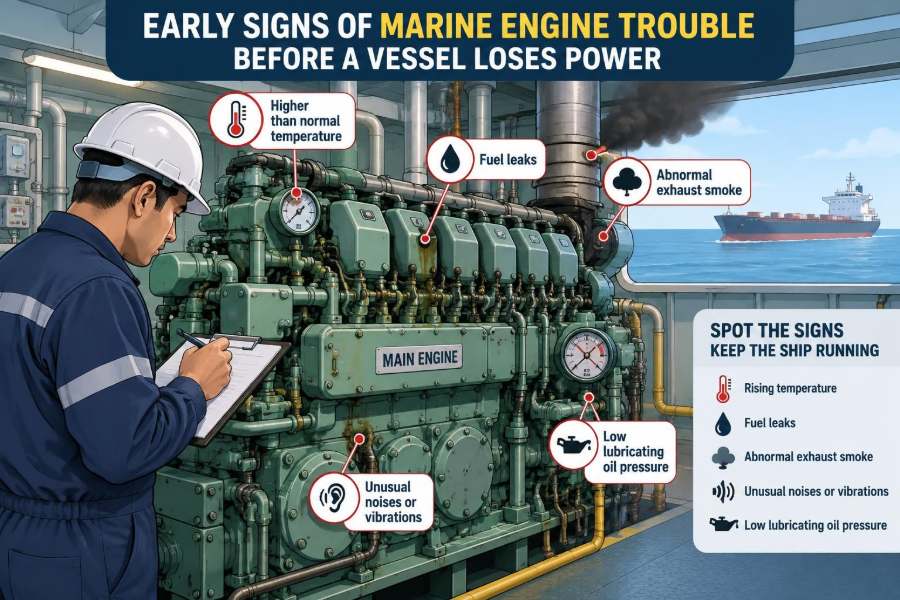

It often begins with something easy to dismiss: a slightly uneven exhaust note, an alarm that clears after acknowledgment, a new vibration felt through the deck plates, or a small but unexplained rise in jacket-water temperature.
On a vessel, these changes rarely stay isolated. A propulsion engine is a connected system of air, fuel, lubrication, cooling, combustion, controls, and rotating machinery. Trouble in one area can gradually load another until the crew is dealing with loss of power rather than an early defect.
The difficult part is that many warning signs are not dramatic. Engines normally make noise, run hot, vibrate, and show small fluctuations as weather, load, fuel condition, and manoeuvring demands change. Good watchkeeping means recognizing when a familiar pattern is no longer normal.
For students, this topic builds the habit of thinking in systems. For working engineers, it reinforces a practical truth: the most valuable fault report is often the one made before the engine trips, derates, or stops.
⚙️ What “Losing Power” Can Actually Mean
Loss of power does not always mean a complete engine stop. It may appear as an inability to reach commanded revolutions, automatic load reduction, repeated speed hunting, poor acceleration, or a protective shutdown.
On a diesel-driven vessel, the main engine may lose available torque because combustion is weak, air supply is restricted, fuel delivery is unstable, cooling temperatures are excessive, or mechanical friction has increased. On diesel-electric vessels, the problem may instead limit generator output and therefore propulsion power.
The operational consequence depends on location and conditions. A modest derating in open water may be manageable; the same derating during a channel transit, towing operation, or heavy-weather approach can become a serious navigational constraint.
👂 Why the Earliest Clues Are Usually Small
Most machinery failures develop through stages: a condition changes, the change creates measurable symptoms, protective limits are approached, and only then does a severe malfunction occur. The earlier stages are where routine observation has the greatest value.
A single unusual reading is not automatically proof of failure. The more meaningful clue is a trend: one cylinder becoming warmer than its neighbors, a filter differential pressure rising week by week, or lube-oil consumption changing after a maintenance period.
Think of the engine room as a clinical assessment. Temperature, pressure, sound, smell, appearance, and performance are individual observations; together, they form a diagnosis.
📋 Establishing the Engine’s Normal Baseline
Early detection depends on knowing what normal looks like for that particular engine. Manufacturer limits are essential, but they are not a substitute for the vessel’s own operating history.
Record stable readings at comparable load, speed, and ambient conditions. Include exhaust temperatures, scavenge or charge-air pressure, cooling-water temperatures, lube-oil pressure and temperature, fuel pressure, turbocharger speed where available, and vibration observations.
- Compare like-for-like conditions rather than comparing harbour idle with sea-going load.
- Watch cylinder-to-cylinder spread as well as absolute values.
- Record changes after fuel changeover, overhaul, injector replacement, or cooler cleaning.
- Note weather and seawater temperature when interpreting cooling performance.
A baseline makes a vague statement such as “the engine feels different” into a useful report: “At the same load, exhaust temperature on unit 4 is consistently higher than the other units.”
📈 Trending Matters More Than a Single Reading
Gauge readings vary. Sea temperature changes, load changes, and sensors drift. For that reason, a one-time value near a limit deserves attention but may not explain the whole condition.
A gradual movement often tells a clearer story. Rising charge-air cooler differential pressure can point toward fouling. Falling lube-oil pressure at similar oil temperature may suggest pump, relief-valve, bearing-clearance, or suction-side issues.
Modern monitoring systems can log large volumes of data, but a watchkeeper’s regular rounds remain valuable. An instrument shows a number; a person can also notice an odor, leak, abnormal heat, or change in sound.
🌡️ Uneven Exhaust Temperatures
Exhaust-gas temperature is one of the most useful early combustion indicators on multi-cylinder diesel engines. A cylinder running noticeably hotter or cooler than comparable units at steady load should be investigated, especially if the difference is new or widening.
A high temperature may result from late fuel injection, poor injector atomization, excess fuel, restricted cooling, inadequate air, exhaust-valve leakage, or a faulty sensor. A low temperature can indicate weak fuel delivery, poor compression, a sticking fuel component, or incomplete firing.
Do not adjust fuel settings simply to make displayed temperatures look equal. First verify the reading, check operating conditions, and investigate the cause. Masking a symptom can increase the risk of piston, valve, or turbocharger damage.
🔥 Smoke Colour and Changes in the Exhaust Plume
Exhaust appearance provides a quick, imperfect view of combustion. It should be assessed with caution because lighting, humidity, load changes, and fuel type affect what is visible.
| Observed condition | Possible direction of investigation | Why it matters |
|---|---|---|
| Persistent black or dark smoke under load | Air restriction, turbocharger performance, overfuelling, poor atomization, overload | Indicates incomplete combustion and higher exhaust-side thermal loading |
| White or pale smoke after normal warm-up | Unburned fuel, poor ignition, water ingress, low cylinder temperature | May signal a misfiring cylinder or contamination concern |
| Blue-grey smoke | Lubricating oil entering combustion spaces | Can accompany increased oil consumption and deposit formation |
Brief smoke during acceleration may be expected on some engines. Persistent smoke at a stable, appropriate load is more informative and should be compared with engine readings.
🌬️ Turbocharger Whine, Surging, and Lost Air
A turbocharger supplies compressed air so the engine can burn fuel efficiently at higher loads. A change in its familiar sound, speed, vibration, or response can be an early warning of reduced air delivery.
Surging is an unstable flow condition in which the compressor repeatedly loses and regains pressure. It may be heard as rhythmic pulsing or fluttering and can occur with fouled air paths, restricted exhaust flow, unsuitable operating conditions, or turbocharger faults.
Continued heavy loading during suspected surge is not a good test. Reduce load in accordance with operating procedures, assess charge-air and exhaust conditions, and avoid exposing the turbocharger to repeated unstable operation.
🧼 Fouled Air Filters and Charge-Air Coolers
An engine cannot maintain clean combustion without enough air. Intake filters, compressor-side deposits, scavenge spaces, charge-air coolers, drains, and air ducts all influence air quantity and quality.
Charge-air cooler fouling reduces heat transfer and may raise charge-air temperature. Hotter, less-dense air contains less oxygen per unit volume, which can elevate exhaust temperatures and reduce the engine’s margin under load.
Water carryover from a defective cooler or drain arrangement creates a different hazard. It can contribute to corrosion, abnormal combustion, and in severe cases liquid entry into cylinders. Investigate unexplained moisture in air-side drains promptly.
⛽ Fuel Pressure Instability and Filter Restriction
Fuel systems need clean fuel and stable supply pressure. A falling pressure, oscillating pressure, frequent filter changeover, or unexpected rise in filter differential pressure can precede rough running and load loss.
Common causes include contaminated fuel, clogged filters, air ingress on the suction side, transfer or booster-pump problems, incorrect fuel temperature or viscosity, and malfunctioning regulating valves. The exact arrangement differs among vessels, so follow the installed system’s procedures.
Repeatedly changing filters without examining what they contain misses useful evidence. Sludge, rust, fibrous material, water, or metallic particles each point toward different upstream problems.
💧 Water in Fuel and Its Subtle Effects
Water may enter fuel through poor storage practices, leaking tank heating coils, condensation, contaminated bunkers, or inadequate draining. It can cause corrosion, reduce lubricity in some systems, and interfere with consistent injection.
Small amounts may first show up as unstable running, difficulty maintaining load, abnormal filter contamination, or irregular fuel pressure. Larger contamination can produce misfires and can damage precision components.
Drain settling and service tanks as required by the vessel’s procedures, inspect samples where practical, and treat a sudden increase in drained water as a condition to trace rather than merely dispose of.
💉 Injector Problems and Rough Combustion
Fuel injectors atomize fuel into fine droplets so it can mix with compressed air and burn promptly. A worn, fouled, leaking, or sticking injector can alter spray pattern, injection timing characteristics, and combustion quality.
Possible signs include a high exhaust temperature on one unit, uneven engine sound, black smoke, increased fuel consumption, and abnormal peak-pressure indications where cylinder-pressure monitoring is fitted.
A hypothetical example: if one cylinder becomes hot shortly after injector work, the sensible sequence is to verify the sensor and installation, compare fuel and exhaust readings, and follow approved diagnostic procedures. Assuming the injector is correct because it is newly fitted can delay the real finding.
🧯 Combustion Knock and Abnormal Engine Sound
Experienced engineers learn the engine’s normal rhythm. Sharp knocking, irregular firing, metallic tapping, or a new low-frequency thud should prompt a closer check, particularly when it appears only at a certain load.
Not every noise originates in the cylinder. Loose guards, piping, exhaust leaks, worn couplings, and auxiliary equipment can transmit sound through the structure. The aim is not to diagnose by ear alone, but to use sound as a trigger for systematic verification.
Never place hands near unguarded rotating machinery or use unsafe listening methods. Approved inspection practices and appropriate tools are part of good fault finding.
🛢️ Falling Lube-Oil Pressure
Lubricating oil separates moving metal surfaces, carries heat away, suspends contaminants, and helps protect bearings and other precision parts. Low pressure may trigger alarms or shutdowns because oil-film failure can rapidly escalate into damage.
Pressure must be interpreted alongside oil temperature and engine speed. Hotter oil is thinner and may produce lower pressure; low speed also changes pump delivery. A sudden drop at otherwise similar conditions is generally more concerning than a predictable change during manoeuvring.
Potential causes include low sump level, blocked suction strainers, pump problems, a relief valve held open, leaks, excessive bearing clearance, and instrument faults. Verify safely, but do not treat a low-pressure alarm as merely an electrical nuisance.
🔬 Oil Condition and Wear-Debris Clues
Used-oil analysis can reveal information that pressure gauges cannot. Changes in viscosity, water content, fuel dilution, oxidation, soot, additive condition, and wear metals can indicate developing distress in the oil system or lubricated components.
Results require context. A laboratory report is not a standalone diagnosis, and one unusual sample may reflect sampling error or recent maintenance. Repeated changes, correlated with operating symptoms, carry much more weight.
Onboard observations matter too: milky oil can suggest water contamination, a strong fuel odor can suggest dilution, and visible metallic sparkle is a warning to escalate. Do not rely on appearance alone to clear an oil system.
💦 Rising Jacket-Water Temperature
Jacket water removes heat from cylinder liners, cylinder heads, and other engine components. A gradual temperature rise at unchanged load may indicate reduced cooling flow, fouled heat exchangers, pump deterioration, air pockets, thermostat problems, or higher-than-normal combustion heat.
Cooling systems are coupled to seawater conditions. A warm sea chest supply or a fouled central cooler can affect several temperatures at once, while a single-cylinder temperature issue suggests a more localized path.
High temperature is not only an alarm problem. It can affect lubrication, component clearances, combustion behavior, and the likelihood of protective derating.
🌊 Seawater-Side Restrictions and Cooler Fouling
Seawater strainers, sea chests, pumps, pipework, and cooler passages are exposed to debris, marine growth, corrosion products, and seasonal water conditions. Restriction on this side often develops gradually.
Signs may include declining cooling performance, increasing pump load, low seawater pressure where monitored, or more frequent need to clean strainers. In shallow, muddy, or debris-prone waters, fouling can accelerate quickly.
Opening a sea strainer is a controlled task, not an impulsive response to temperature. Isolate correctly, consider vessel operating conditions, and follow the ship’s procedures to avoid flooding or loss of cooling supply.
🫧 Air Locks, Leaks, and Cooling-System Level Changes
Air trapped in a closed cooling circuit can reduce circulation and create local hot spots. It may enter after maintenance, through leakage, from poor venting, or from gas entering the system through an internal fault.
Frequent expansion-tank level changes, repeated need for makeup water, bubbles where they should not appear, or unexplained pressure behavior deserve investigation. Simply adding water again and again can conceal a leak or an internal problem.
Because cooling systems may be hot and pressurized, do not open caps or connections until safe conditions and established procedures allow it.
📳 New Vibration Through the Hull or Machinery
Vibration is produced by rotating and reciprocating forces, but its pattern should be broadly repeatable. New vibration at a specific speed range can indicate misfire, imbalance, loose foundations, damaged mounts, shafting issues, coupling wear, or propeller-related problems.
Engine vibration and propulsion-train vibration can feel similar from a distance. Check whether the symptom changes with engine load, shaft speed, clutch engagement, sea state, or propeller condition before assigning a cause.
Portable vibration analysis can help identify frequencies associated with rotating equipment, but interpretation requires suitable training and reference data. It should support, not replace, physical inspection and operational awareness.
🔩 Loose Fasteners, Foundations, and Alignment Concerns
Fasteners that loosen repeatedly, fresh fretting marks around chocks, cracked paint at foundations, or unusual movement at flexible mounts may indicate that machinery loads are no longer being transmitted as intended.
Misalignment can increase bearing load and vibration, especially after grounding, heavy contact, engine movement, structural work, or replacement of components in the propulsion line. It may not produce an immediate alarm.
Do not simply tighten visible bolts without understanding why they loosened. Torque procedures, foundation condition, alignment checks, and component inspection may all be needed.
🌀 Scavenge-Space Deposits and Drain Findings
In two-stroke crosshead engines, the scavenge space provides valuable clues about liner, piston-ring, and combustion condition. Excessive oily deposits, abnormal drain contents, unusual heat, or smoke can indicate problems requiring prompt assessment.
In four-stroke engines, crankcase and breather observations serve a somewhat different role, but the same principle applies: deposits and drain material are evidence. Their color, quantity, smell, and recurrence can help distinguish normal residue from developing trouble.
Follow safe inspection rules carefully. Spaces associated with hot surfaces, combustible deposits, and moving machinery require controlled access and correct isolation.
🚨 Crankcase Mist and Bearing-Distress Warnings
Crankcase oil mist detectors are designed to warn of oil mist that can arise from overheated bearings or other abnormal conditions. Such alarms must be handled using the vessel’s emergency and manufacturer procedures; they are not invitations for immediate crankcase opening.
Bearing distress can also be suggested by abnormal oil temperature, falling oil pressure, vibration, debris in filters, or unusual noise. No single symptom confirms the fault, but the combination should lead to conservative decision-making.
The key lesson is that a protective alarm represents a risk-control boundary. Repeated resets without investigation remove the warning while leaving the hazard in place.
🎛️ Sensor Faults Are Possible—But Prove It
Temperature, pressure, speed, and level sensors can fail, drift, develop poor connections, or be affected by damaged wiring. A false alarm is possible, particularly when one value is inconsistent with all related indications.
However, assuming “it is only the sensor” is a common and costly mistake. Verify by comparing redundant instruments, using approved local gauges, checking signal plausibility, and inspecting the process condition where safe.
A sensor fault and a machinery fault can also occur together. Replacing a faulty transmitter does not automatically explain why the associated system behavior changed.
🖥️ Control-System Symptoms and Unstable Governing
Electronic governors, actuators, engine-management systems, and safety circuits influence how the engine responds to load. Hunting speed, slow response to commands, unexplained load limitation, intermittent trips, or disagreeing feedback signals can point to a control issue.
Before changing software settings or bypassing protections, inspect the basics: power supply quality, connectors, actuator linkages, pneumatic or hydraulic supply where fitted, sensor signals, and alarm history. Many apparent control failures begin with a physical input problem.
Any temporary override should be strictly governed by authorized procedures. Bypassing a safety system to maintain schedule can turn a manageable defect into a machinery casualty.
⚡ Electrical Load Issues on Diesel-Electric Vessels
On diesel-electric propulsion plants, the engine may be healthy while available propulsion power is limited by generator, switchboard, converter, motor, or protection-system conditions. Frequency instability, unequal load sharing, high winding temperatures, and repeated breaker events deserve coordinated engineering and electrical assessment.
Likewise, a generator engine that cannot accept load may show fuel, air, cooling, or governor symptoms familiar from a direct-drive engine. The diagnostic boundary is wider, not fundamentally different.
Clear communication between engine-room and electrical personnel prevents each side from treating the other system as a black box.
🧭 Changes After Manoeuvring or Heavy Weather
Some faults become visible only after rapid load changes, prolonged low-load running, heavy rolling, or propeller emergence in rough seas. These conditions can disturb fuel supply, expose cooling limitations, create transient overspeed tendencies, or move accumulated contamination.
After unusual operation, compare temperatures, levels, filter condition, and alarms with pre-event observations. A problem that disappears at calm, steady load may still return during the next demanding manoeuvre.
Operating limits exist for a reason. The ability to force short-term output does not mean the machinery has adequate thermal or mechanical margin for sustained service.
🧰 A Practical First-Response Sequence
When early warning signs appear, the first objective is to protect people and machinery while preserving useful information. The right response depends on the vessel and alarm, but a disciplined sequence is widely applicable.
- Confirm the symptom using available indications and safe local observations.
- Assess severity: Is there a safety alarm, rapid trend, smoke, leakage, abnormal noise, or risk of shutdown?
- Reduce load or alter operation if required by procedures and conditions.
- Compare related systems: air, fuel, exhaust, lubrication, cooling, and controls.
- Record readings, time, load, alarms, actions, and observed changes.
- Notify the responsible engineer and bridge as operational risk requires.
- Investigate and rectify only within approved maintenance and isolation procedures.
This approach avoids two unhelpful extremes: ignoring a weak signal and making hurried adjustments that destroy the evidence.
📝 Reporting Symptoms So Others Can Act
A useful defect report describes conditions, not guesses. “Main engine bad” gives little direction. “At 75% load, unit 3 exhaust temperature rose relative to comparable units; black smoke increased and charge-air pressure was lower than the previous watch” is actionable.
Include what changed, when it started, what operating condition existed, what alarms appeared, what checks were completed, and how the engine responded to any authorized load reduction. Photos of leaks, deposits, or filter contents can be useful when permitted by onboard practice.
Good handover prevents a developing issue from being reset to zero at every watch change.
🚫 Common Responses That Make Trouble Worse
Several shortcuts repeatedly reduce diagnostic quality and increase risk:
- Resetting recurring alarms without recording the conditions.
- Increasing fuel or load to “see if it clears.”
- Adjusting multiple variables at once, making cause and effect impossible to separate.
- Assuming a new spare part cannot be faulty or incorrectly installed.
- Ignoring small leaks, loose fasteners, or dirty drains because the engine still runs.
- Opening pressurized, hot, or hazardous spaces without proper isolation.
Reliable machinery care is not about reacting dramatically to every deviation. It is about responding proportionately, preserving safety margins, and gathering evidence before the defect grows.
🛠️ Planned Maintenance Versus Condition-Based Attention
Planned maintenance remains necessary for filters, lubricants, inspections, calibrations, and scheduled overhauls. It gives structure and ensures critical tasks are not forgotten.
Condition-based attention adds another layer. It uses trends, inspections, oil results, performance changes, and monitoring data to decide when a component needs closer assessment. This can identify deterioration between scheduled tasks, but it depends on reliable data and trained interpretation.
The strongest approach is usually a combination: follow maintenance requirements, then use actual machinery condition to prioritize investigation and avoid blindly treating every interval as a guarantee of health.
🎓 Building the Watchkeeper’s Diagnostic Habit
Students often expect diagnosis to begin with a fault code or a dismantled component. In practice, it begins much earlier: noticing a small difference, asking what related systems should also change, and checking the simplest explanations safely.
Build a habit of linking observations. High exhaust temperature plus low charge-air pressure points in a different direction from high exhaust temperature plus normal air pressure and unstable fuel pressure. The pattern matters more than any isolated value.
With experience, engineers develop pattern recognition. With discipline, they also avoid becoming overconfident in it. Measurements, procedures, and team discussion keep intuition useful rather than misleading.
✅ The Core Principle: Detect Change Before Protection Acts
Marine engines usually communicate distress before they lose power. They do so through temperature spread, pressure trend, smoke, sound, vibration, fluid condition, deposit patterns, and control behavior.
The goal is not to predict every failure from one clue. It is to recognize meaningful deviation early enough to verify it, reduce risk, plan repairs, and keep the vessel within safe operating limits.
Protective alarms and shutdowns are essential, but they are the final layer of defense. The better operating culture is built on regular rounds, accurate logs, careful handovers, and prompt investigation of changes that do not fit the engine’s normal pattern.
Before a vessel loses power, the most useful warning is often the small change that a prepared watchkeeper refuses to ignore. 🚢⚙️🔍