
A main engine begins to show its age in ways that are easy to dismiss. Starting air demand rises, exhaust temperatures drift apart, lubricating-oil consumption increases, or a crew member notices a dull knock during manoeuvring. The vessel still makes schedule, so the immediate temptation is to repair the obvious fault and continue operating.
Sometimes that is exactly the right decision. Replacing a leaking injector, renewing one exhaust valve, or correcting a fuel-pump setting can restore reliable performance without opening a healthy engine.
But repeated local repairs can become a warning that the machinery has crossed a different threshold. If wear is widespread, clearances are no longer stable, and defects return soon after correction, the problem may no longer be one component. It may be the condition of the engine as a system.
The overhaul-versus-repair decision affects safety, operating cost, charter commitments, spare-parts planning, and environmental performance. Making it well requires evidence, not simply running hours or a reaction to the latest alarm.
⚙️ Repair and Overhaul Are Not the Same Scope
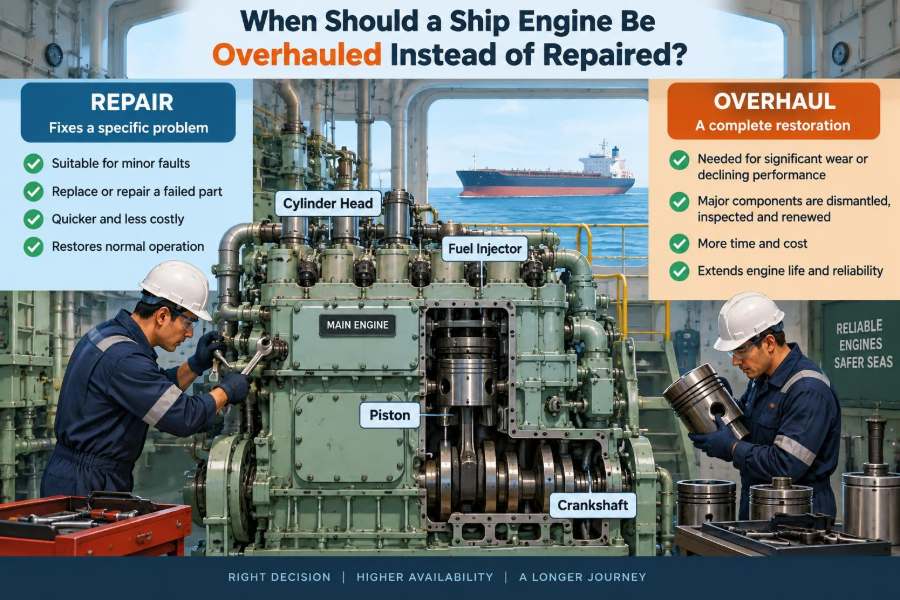
A repair corrects a defined fault or restores an individual component to serviceable condition. Examples include changing a fuel valve, renewing piston rings on one unit, repairing a cracked pipe, or replacing a damaged bearing shell after the underlying cause has been addressed.
An overhaul is a planned, systematic inspection and renewal of an assembly or engine section. It normally involves opening equipment, measuring wear, cleaning, testing, replacing consumable parts, and restoring specified clearances and settings.
The distinction is not merely how much work is done. A repair asks, “What failed?” An overhaul asks, “What is the condition of the whole mechanism, and what must be renewed before failure becomes likely?”
🧭 The Decision Is About Remaining Reliability
A ship engine does not need to be completely inoperative before an overhaul is justified. The more useful question is whether it can continue safely and predictably until the next practical maintenance window.
Reliability is especially valuable for propulsion machinery. A gradual loss of power, poor reversal response, or an unexpected slowdown near a port, channel, or offshore installation can create risks far beyond the repair bill.
For auxiliary engines, the consequence depends on redundancy. One generator may be repairable while another unit carries the load, but a vessel with limited electrical reserve may need more conservative action.
📘 Start With the Manufacturer’s Maintenance Basis
Engine makers provide maintenance guidance for piston assemblies, fuel equipment, bearings, turbochargers, valves, and other components. These intervals are a sound starting point because they reflect the design, operating duty, and expected wear mechanisms.
They are not automatic instructions to overhaul every item exactly at a calendar or running-hour figure. Actual condition can vary with fuel quality, load profile, ambient conditions, lubricating-oil management, maintenance history, and previous repairs.
Class requirements, flag-state obligations, company procedures, and planned-maintenance-system rules also matter. The chief engineer should treat them as a framework within which condition evidence is evaluated, rather than as a substitute for engineering judgement.
🕒 Running Hours Matter, but They Do Not Tell the Whole Story
Running hours are useful because many components experience wear broadly related to operating time. A piston ring pack, for example, accumulates sliding distance with every stroke, while valve spindles and guides see repeated thermal and mechanical loading.
Yet 5,000 hours at stable service load on clean fuel is not equivalent to 5,000 hours involving frequent starts, long low-load operation, overload events, fuel contamination, or poor combustion. Hours measure exposure; they do not fully measure severity.
A vessel’s logbook should therefore be read alongside trends in operating conditions. An interval-based overhaul may be sensible, but a condition-based decision is often more precise.
📈 Trend Data Often Gives the Earliest Warning
Single readings can be misleading. A high exhaust temperature may result from a temporary load change, sensor error, or a short-lived fuel issue. A persistent trend across comparable operating conditions is more meaningful.
Useful records include exhaust-gas temperatures, peak and compression pressures where measured, scavenge-air pressure, fuel index, turbocharger speed, lubricating-oil pressure, cooling-water temperatures, and crankcase condition.
Trend analysis helps distinguish a repairable adjustment from progressive deterioration. If one cylinder steadily diverges from the others despite correct settings, opening that unit may be justified. If several cylinders show similar decline, a broader overhaul plan becomes more credible.
🌡️ Exhaust Temperature Patterns Need Interpretation
A rise in one cylinder’s exhaust temperature can indicate late injection, poor atomisation, leaking exhaust valves, restricted air supply, reduced compression, or excess fuel. It cannot, by itself, identify the defective part.
Engineers should compare readings at similar load, verify sensor accuracy, and look for related signs. Uneven peak pressures, smoke, abnormal scavenge drains, or a changed fuel-pump index can narrow the diagnosis.
Overhauling a cylinder unit becomes more likely when temperature imbalance is repeated, supported by other evidence, and not corrected by normal fuel-system checks. Replacing one injector is appropriate when the diagnosis is clear; stripping a healthy cylinder “just in case” is not always wise.
🔍 Condition Monitoring Changes the Timing
Condition monitoring aims to identify deterioration before it becomes an operational failure. It does not eliminate hands-on inspection, but it can make maintenance windows more targeted.
Depending on the machinery and vessel arrangement, relevant methods may include lubricating-oil analysis, iron-content monitoring, vibration measurements, performance calculations, borescope inspection, thermography, and crankcase mist detection.
Each method has limits. Vibration may reveal a developing rotating-equipment fault but not explain every combustion problem. Oil analysis can show abnormal wear metals, yet contamination and sampling practice can affect results. Decisions should be based on a pattern of evidence rather than one alarming number.
🛢️ Lubricating-Oil Evidence Can Reveal Hidden Wear
Used-oil samples can indicate contamination, additive depletion, viscosity change, oxidation, water ingress, and wear particles. In trunk-piston engines, abnormal fuel dilution may reduce oil-film strength and accelerate bearing or liner damage.
For crosshead engines, separate system and cylinder-lubrication practices make interpretation different, but drain-oil observations can still provide clues about ring, liner, and piston condition. Laboratory findings should be compared with the engine’s own history and the oil supplier’s interpretation limits.
Repeated abnormal wear-metal trends, especially when matched by pressure changes or noise, may justify opening bearings or other components for inspection. The goal is to confirm the cause before a minor bearing defect becomes a crankshaft event.
🧪 Fuel Quality Can Turn Routine Wear Into Urgent Work
Fuel contamination, poor ignition quality, catalytic fines, water, or incompatible blends can accelerate damage. Abrasive particles that bypass or overwhelm separation and filtration may score fuel-pump components, injectors, piston rings, and cylinder liners.
A repair after a known fuel incident should include an assessment of the equipment exposed to it. Changing only the first failed part can leave related damage undiscovered.
That does not mean every fuel problem requires a full engine overhaul. It means the inspection scope should reflect the duration, severity, filtration performance, and symptoms observed after the event.
🔥 Combustion Defects Can Spread Beyond One Cylinder
Incorrect injection timing, worn nozzle holes, poor spray pattern, low compression, or inadequate scavenge air can create incomplete or delayed combustion. The visible result may be black smoke, uneven temperatures, deposits, or reduced efficiency.
Over time, poor combustion can burn exhaust valves, foul turbocharger gas paths, increase piston crown thermal stress, and contaminate lubricating oil. A component-level repair is suitable when the fault is isolated early.
When several units have deposit buildup, valve leakage, and deteriorated performance, the engine may need a coordinated overhaul. Restoring only one cylinder can shift load and expose weakness elsewhere.
🧱 Cylinder Liners and Piston Rings Have System-Level Effects
Liner wear, polishing, corrosion, scuffing, and poor lubrication affect sealing between the combustion space and crankcase. Worn or sticking piston rings can increase blow-by, oil consumption, scavenge deposits, and loss of compression.
Borescope inspections are valuable because they can reveal liner surface condition, ring marks, crown deposits, and valve-seat appearance without immediately dismantling the unit. They should be performed with proper procedures and interpreted by personnel familiar with normal engine-specific patterns.
If several cylinders show advanced liner and ring wear, a planned top-end overhaul is generally more rational than a sequence of unplanned single-unit repairs. The work can then include measurements, cleaning, and matching renewal parts across the affected units.
🪛 Bearing Condition Deserves a Conservative Approach
Main, crankpin, crosshead, and camshaft bearings depend on a stable lubricating film and correct alignment. Damage can develop from contamination, inadequate pressure, overheating, overload, misalignment, or loss of oil-film integrity.
A low oil-pressure alarm, elevated bearing temperature, metallic debris, or unusual knocking demands prompt investigation. Continuing operation while hoping the symptom disappears is a poor risk decision because bearing damage can progress quickly.
Whether the response is repair or overhaul depends on what inspection finds. A correctly identified local cause may allow renewal of one bearing and associated checks. Evidence of widespread debris, multiple affected bearings, or alignment concerns calls for a much wider scope.
🌀 Turbochargers Often Signal the Health of the Air Side
A turbocharger is not merely an accessory; it is central to combustion air supply. Fouled turbine nozzles, compressor deposits, worn bearings, damaged blades, air leaks, or poor gas flow can reduce air delivery and raise exhaust temperatures.
Routine cleaning or a cartridge-level repair can be enough when the issue is localized. However, repeated turbocharger fouling may be a symptom of poor combustion, excessive cylinder-oil carryover, or exhaust-side deposits elsewhere.
Before overhauling the turbocharger repeatedly, investigate why it is becoming dirty. Maintenance that treats only the accessible symptom can produce a frustrating cycle of recurrence.
🧯 Crankcase and Scavenge-Space Findings Change the Urgency
Abnormal crankcase mist, hot spots, smoke, metallic particles, or unusual odours can indicate serious internal distress. Scavenge-space fires, heavy oil deposits, or persistent drain abnormalities also require a disciplined assessment.
These spaces offer valuable clues, but they are hazardous. Inspection must follow the vessel’s safety procedures, including isolation, cooling, ventilation, atmosphere checks where required, and safeguards against inadvertent starting.
Findings suggesting active rubbing, overheating, or fire risk usually move the decision beyond routine repair. The engine may require shutdown, opening, and a formal inspection scope before it is returned to service.
🚦 Operational Symptoms Are Evidence, Not Annoyances
Hard starting, slow acceleration, unstable idle, repeated overload alarms, inability to achieve expected revolutions, increased vibration, or frequent governor corrections are operational symptoms worth recording.
On a controllable-pitch vessel, propulsion symptoms can also originate outside the engine: pitch mechanism faults, shafting issues, hull fouling, or control-system problems. Good troubleshooting avoids assuming that every power loss is an engine defect.
When the engine is confirmed as the source and symptoms persist despite reasonable corrective repairs, a planned overhaul may protect the vessel from a breakdown at a less convenient time.
🧰 Repeated Repairs Are a Strong Economic Signal
One repair is normal. A pattern of repairs to the same subsystem deserves review. Repeated injector changes, valve grinding, ring replacements, or fuel-pump adjustments may indicate that the root cause has not been removed.
The direct cost of each job is only part of the picture. Recurrent faults consume crew time, increase spare usage, interrupt planned work, and create uncertainty during critical operations.
A useful question is: does each repair restore a stable condition, or does it merely buy a short period before the next intervention? If the latter, a larger overhaul can be the lower-risk and lower-disruption choice.
💰 Compare Lifecycle Cost, Not Only Today’s Invoice
An overhaul has obvious costs: parts, labour, port stay, specialist attendance, testing, and possible off-hire exposure. Deferring it preserves cash and availability in the short term.
Deferral also has costs that can be harder to see: excess fuel consumption, increased lube-oil use, emergency freight for spares, collateral damage, lost schedule flexibility, and a higher chance of failure during a difficult voyage phase.
The financially sound option is not always the smallest immediate job. It is the option that gives an acceptable balance of cost, remaining risk, and operational availability for the vessel’s actual trading pattern.
📅 Choose a Maintenance Window Before the Engine Chooses One
Planned overhaul work can be aligned with drydock, port stay, reduced-demand periods, or a voyage where redundancy is available. Parts, lifting arrangements, measurement tools, and competent personnel can be prepared in advance.
Emergency work rarely enjoys those advantages. Weather, traffic, cargo operations, and limited berth time can turn a manageable internal defect into a complicated operational event.
Planning does not mean opening machinery prematurely. It means using condition evidence early enough that the vessel retains choices about when and where maintenance occurs.
🧾 Build the Scope From Measurements, Not Assumptions
Before an overhaul, review past measurements and establish what will be checked. Clearances, liner wear, ring condition, valve recession, bearing condition, injector test results, and fuel-pump condition should be assessed against maker limits and historical trend where available.
Measurements are most useful when recorded consistently. A number without its location, instrument, operating context, and prior comparison has limited diagnostic value.
During dismantling, unexpected findings may expand or reduce the scope. A good plan includes decision points: which defects require renewal, which can remain in service, and who has authority to approve changes.
📦 Spares Strategy Determines What Is Practical
An overhaul recommendation is only workable if correct spares, gaskets, seals, fasteners, tools, and consumables are available. Substituting unsuitable parts or reusing one-time-use items can undermine otherwise careful work.
Critical spares should reflect engine design, vessel redundancy, supply routes, and the expected consequences of failure. Inventory should also be protected from corrosion, contamination, and expiry where applicable.
Before scheduling work, verify part numbers against the engine’s current configuration. Modifications, superseded components, and cylinder-specific variations can cause costly delays if discovered after opening the machinery.
👷 Competence and Workmanship Influence the Choice
Overhaul creates opportunities for measurement errors, contamination, incorrect tightening, poor timing adjustment, and damage during lifting or assembly. A major scope should not be selected simply because it appears thorough.
Work should be carried out by trained shipboard personnel, maker-approved service engineers, or other competent technicians as appropriate to the task. The need for specialist support is greater when electronic controls, precision fuel systems, crankshaft alignment, or complex turbocharger work are involved.
Repair may be safer than a broad overhaul if the latter cannot be performed to the required standard at the available location. Conversely, a deteriorating engine should not be kept running solely because qualified support is inconvenient.
✅ Post-Overhaul Commissioning Is Part of the Job
Reassembly is not the finish line. The engine must be turned, checked for correct timing and clearances, tested for leaks, and operated progressively under controlled conditions according to the maker’s procedures.
Record baseline readings after the work: pressures, temperatures, exhaust balance, vibration observations, and oil condition. These data make it easier to judge whether the overhaul achieved the intended result.
A common mistake is declaring success after the engine starts. Stable performance at relevant loads, with no leaks, alarms, abnormal temperatures, or unusual sounds, is the meaningful outcome.
⚖️ A Practical Repair-or-Overhaul Comparison
| Situation | Repair is often suitable when | Overhaul is often justified when |
|---|---|---|
| Fault pattern | A single, well-diagnosed defect is present | Several related defects or recurring failures appear |
| Condition data | Trends remain stable apart from one anomaly | Multiple trends show progressive deterioration |
| Wear | Measurements are within limits and localized | Wear approaches limits across an assembly or units |
| Operational risk | Redundancy and remaining reliability are credible | Loss of propulsion or power would be unacceptable |
| Maintenance timing | A short intervention restores dependable service | A planned window can prevent likely emergency work |
This comparison is a decision aid, not a rulebook. Engine type, duty, class requirements, maker guidance, and the specific defect always determine the final scope.
🚫 Avoid the “Replace Parts Until It Works” Trap
Changing parts without confirming the failure mechanism can hide the root cause. For example, repeatedly replacing injectors will not solve high exhaust temperatures caused by low compression, restricted air flow, or incorrect fuel timing.
Likewise, a failed bearing should trigger examination of lubrication condition, oil supply, alignment, loading, and contamination. Replacing the shell alone may allow the same damage to return.
Structured fault finding takes time, but it reduces waste and protects the engine. Gather symptoms, verify instruments, inspect systematically, and test the explanation against the evidence.
🛑 Avoid the Opposite Trap: Running to Failure
Deferring all intrusive work can seem efficient when schedules are tight. It becomes dangerous when clear warnings are treated as normal aging or when crews become accustomed to recurring alarms.
Some components can be monitored safely until the next planned stop. Others, particularly those associated with lubrication failure, overheating, fuel leakage, abnormal crankcase conditions, or severe combustion imbalance, may require immediate action.
The responsible decision is not “always overhaul early” or “always get every possible hour.” It is to understand the consequence of failure and act before the remaining margin becomes too small.
🗣️ Communication Makes the Technical Decision Work
The engine department needs to communicate condition clearly to the master, superintendent, operator, and, where relevant, class or service providers. Vague statements such as “engine needs attention” do not support good planning.
A useful report explains the observed symptoms, trend history, inspection findings, operating risk, proposed scope, required spares, estimated downtime, and consequences of deferral. Photographs and measurement records can strengthen the case when properly documented.
Clear communication prevents a maintenance recommendation from being mistaken for an avoidable preference. It also gives operations staff time to protect the vessel’s schedule.
🧠 The Core Principle: Repair the Fault, Overhaul the Condition
Repair is the right response when evidence points to an isolated problem and the rest of the engine remains within acceptable condition. It preserves resources and avoids unnecessary disturbance of sound machinery.
Overhaul becomes the better response when deterioration is broad, recurring, nearing limits, or likely to threaten reliability before the next maintenance opportunity. The decision should combine maker guidance, measured condition, trend data, operational consequences, and the quality of available maintenance support.
The best maintenance decision is neither the quickest repair nor the largest job; it is the scope that restores dependable service while controlling risk and avoiding preventable collateral damage.
A well-kept engine log, careful inspection habits, and timely planning turn this judgement from a guess into an engineering decision. When the evidence shows a system-wide loss of condition, choose the overhaul before the engine forces the issue. ⚙️🚢🛠️