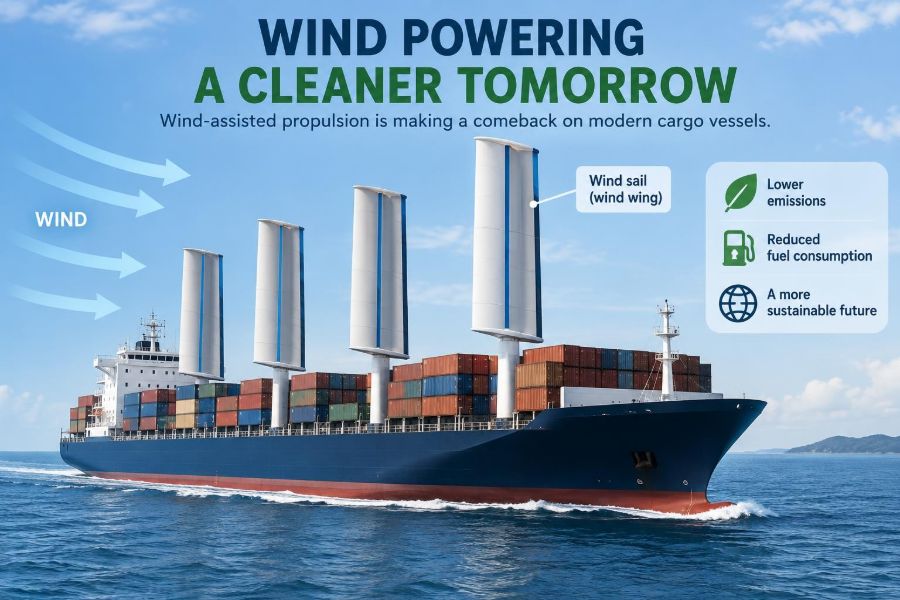

A bulk carrier leaves port with a familiar low-frequency vibration from its main engine, a full cargo hold, and a schedule that leaves little room for surprises. A few hours later, the crew raises large rigid panels above the deck. They are not sails in the traditional sense, yet the ship begins to draw useful energy from the wind.
For generations, commercial shipping treated wind power as a chapter closed by steam and diesel. Now it is returning in a different role: not as a romantic replacement for engines, but as an engineered source of auxiliary propulsion that can reduce fuel use under the right conditions.
This matters because ocean-going ships move most international cargo, while their engines consume substantial energy over long voyages. Fuel cost, emissions limits, charter-party requirements, and pressure to reduce lifecycle carbon emissions all make every practical efficiency measure worth examining.
Wind-assisted propulsion is therefore less about going backwards than using a free, variable energy source with modern materials, sensors, route planning, and control systems. Understanding where it works—and where it does not—is essential for marine engineers, deck officers, naval architects, and anyone assessing future vessel designs.
🌬️ What Wind-Assisted Propulsion Actually Means
Wind-assisted propulsion describes technologies that use aerodynamic force from the wind to provide part of a vessel’s propulsive force. The main engine, propeller, and steering system remain central to operating the ship; wind devices reduce the power they must supply when conditions are favourable.
This distinction matters. A conventional sailing ship relies primarily on sails and often needs a fundamentally different operating profile. A wind-assisted cargo ship is still a powered commercial vessel, designed to meet port schedules, manoeuvre safely, and maintain service even when the wind is weak or unfavourable.
🕰️ Why Wind Power Is Returning Now
The modern return is driven by a combination of fuel economics and decarbonisation. Shipping companies are considering multiple pathways—efficiency upgrades, alternative fuels, batteries for limited duties, and operational changes—and wind can complement rather than compete with many of them.
Technology has also changed. Composite structures, reliable hydraulic and electric actuators, weather-routing software, and automated controls make it more practical to operate large aerodynamic devices on working cargo vessels than it was decades ago.
Crucially, wind has no onboard fuel price and produces no exhaust gases while it contributes thrust. Its variability is a limitation, but that same energy source can be valuable across long ocean passages where exposure to wind is frequent.
⚓ The Physics Behind the Extra Push
Wind devices develop lift and, to a lesser extent, drag. Lift is the aerodynamic force acting roughly perpendicular to the apparent wind direction; it is the same broad principle that allows an aircraft wing to generate force, although a ship’s device operates in a different geometry and environment.
The useful forward component of that force is transmitted through the device, its foundations, and the hull. If it acts in the vessel’s direction of travel, propeller demand can be reduced. If it creates excessive sideways force, the rudder and hull must counteract it, which reduces the net benefit.
Performance depends on apparent wind: the wind experienced by the moving vessel. A ship steaming into a modest true wind may experience a much stronger apparent wind, but its direction may not be ideal for producing forward thrust. The control system must assess both speed and angle, not simply wind strength.
🧭 True Wind, Apparent Wind, and Course Choice
True wind is the wind relative to the Earth’s surface. Apparent wind combines true wind with the airflow created by the vessel’s own motion. This is why a device can remain productive even when the weather report alone seems unremarkable.
A route that is shortest on a chart is not always the route with the lowest energy consumption. Small changes in heading, where safe and commercially acceptable, may improve the angle between wind and ship. Weather routing evaluates this trade-off alongside waves, currents, weather limits, arrival windows, and fuel use.
It is not a license to chase wind at any cost. Deviating too far can add distance, delay cargo delivery, expose the vessel to worse seas, or create a net increase in fuel consumption.
🪽 Rigid Wing Sails
Rigid wing sails are tall, shaped aerofoils mounted on deck. Their controlled profile can generate significant lift, and some designs adjust camber or angle of attack to suit changing apparent-wind conditions.
Compared with fabric sails, rigid wings can be more predictable aerodynamically and easier to integrate with automated control. Their height and fixed structure, however, make bridge clearance, cargo operations, visibility, and structural foundation design major considerations.
Some concepts allow wings to fold, tilt, or telescope before entering port or passing beneath restrictions. These mechanisms add cost and maintenance needs, so their reliability is as important as their aerodynamic performance.
🌀 Rotor Sails and the Magnus Effect
Rotor sails are vertical rotating cylinders. When wind flows around a spinning cylinder, it creates a pressure difference that produces a lateral aerodynamic force, known as the Magnus effect. With suitable wind angle and vessel heading, part of that force becomes forward thrust.
Unlike a traditional sail, a rotor needs electrical power to spin. That consumption must be included in any performance calculation. The system is worthwhile only when the propulsion benefit exceeds the electrical and operational costs associated with running it.
Rotor sails are mechanically distinctive, but their basic operational question is familiar: what rotational speed and direction give the best net thrust without imposing unacceptable loads, heel, or interference with ship operations?
🪁 Suction Wings, Soft Sails, and Kites
Wind-assistance systems come in several forms, each suited to different vessel constraints. Suction wings use controlled airflow over an aerofoil surface to enhance lift. Soft sails use fabric membranes and may be deployed from masts or supported frames. Towing kites fly ahead of the vessel at higher altitude, where winds may differ from those at deck level.
These approaches do not have identical strengths. A kite can avoid consuming deck space when deployed, but it needs a launch, recovery, and control arrangement. A soft sail can be stowed compactly, while its rigging and handling requirements must suit the ship’s operations.
| Technology | Main operating principle | Key integration question |
|---|---|---|
| Rigid wing sail | Aerofoil lift | Height, folding, and deck layout |
| Rotor sail | Magnus-effect lift | Electrical demand and structural loads |
| Suction wing | Lift enhanced by controlled suction | Fan system reliability and power use |
| Soft sail | Flexible aerodynamic surface | Deployment and cargo-operation clearance |
| Towing kite | High-altitude traction force | Launch, recovery, and line management |
🏗️ Why Deck Layout Determines Feasibility
A wind device occupies more than its physical footprint. Engineers must protect access to hatch covers, cranes, manifolds, vents, mooring equipment, lifeboats, emergency escape routes, and maintenance areas. A concept that performs well in a simulation may fail when examined against the ship’s daily cargo workflow.
Bulk carriers, tankers, container ships, and ro-ro vessels present different constraints. A tanker may need unobstructed cargo-area access and careful hazardous-area classification. A container vessel must avoid disrupting container stowage, lashing operations, and crane outreach.
The best location is a compromise between aerodynamic exposure, structural support, bridge sightlines, and practical access. It must be evaluated vessel by vessel.
📐 Foundations, Loads, and Hull Strength
Wind devices introduce concentrated loads high above deck. These include steady aerodynamic forces, cyclic loading from gusts and vessel motion, inertia during deployment, and loads transferred during emergency stopping or locking.
Naval architects assess local deck strength, supporting structure, global hull-girder effects, fatigue, and stability consequences. Retrofitting may require reinforcement beneath the deck, which can influence cargo spaces, piping runs, electrical routes, and dry-docking scope.
A tall device also changes the ship’s windage. Mooring arrangements and port exposure require review because strong crosswinds can affect low-speed handling and line loads.
⚖️ Stability Is More Than a Simple Heel Angle
Aerodynamic side force can create heeling moment. Initial stability calculations consider whether the vessel retains sufficient righting ability under relevant loading conditions, but safe integration also requires dynamic thinking.
Rolling in waves, gust response, free-surface effects in partially filled tanks, and cargo distribution all influence the real operating margin. A system may need automatic limits based on heel angle, roll motion, wind speed, or apparent-wind direction.
Good control logic does not merely maximize thrust. It protects stability and avoids conditions in which wind assistance creates disproportionate operational risk.
🔩 Retrofitting an Existing Ship
Retrofit projects begin with a feasibility study, not a purchase decision. Owners need realistic voyage data, likely wind exposure, loading conditions, port restrictions, available deck space, structural drawings, and a plan for class and flag-state approval.
Installation often aligns with scheduled dry docking to reduce off-hire time. Even then, interfaces can be complex: foundations, cabling, hydraulic systems, control cabinets, fire boundaries, access platforms, and bridge displays must all be coordinated.
A retrofit is attractive because it can improve an asset already trading. Yet the remaining service life of the vessel, expected dry-dock dates, and contractual trading pattern strongly affect whether the investment makes operational sense.
🛳️ Designing Wind Assistance Into Newbuildings
Newbuildings offer more freedom. The hull, machinery arrangement, deck equipment, accommodation sightlines, and electrical system can be designed around the selected wind technology from the start.
Early design also enables better structural load paths and avoids later compromises caused by pipes, tanks, or equipment already occupying ideal foundation locations. Designers can consider future installation even if devices are not fitted immediately, sometimes by reserving structure and electrical capacity.
That said, designing “wind ready” still requires clear assumptions. A vague provision may not suit the dimensions, loads, or control needs of a future technology choice.
🔌 Electrical Power and Control Integration
Some systems consume electrical power for rotation, fans, actuators, sensors, or automated deployment. Their load must be evaluated against the vessel’s generator capacity, operating modes, and blackout-prevention philosophy.
The bridge needs clear information rather than a distracting extra display. Officers should be able to see device status, operating limits, alarms, thrust contribution where available, and the conditions that trigger automatic reduction or stowage.
Integration with propulsion control can support efficient engine loading, but control authority and fail-safe behavior must be unambiguous. The main propulsion plant must remain safely manageable if the wind-assistance system faults or becomes unavailable.
🧠 Automation Helps, but Crew Judgment Remains Central
Automation can continuously optimize angle, rotational speed, or deployment using wind sensors and vessel-motion data. It reacts faster than manual trimming and can prevent operation outside configured limits.
However, crew members still decide within a wider operational context. They understand approaching pilotage waters, congested traffic, crane operations, deck work, changing weather, and local port instructions—factors that a narrow optimization algorithm may not fully capture.
Training should cover normal use, manual override, loss of control power, emergency stowage, navigation impacts, and communication between bridge and deck teams.
🧯 Fire, Emergency, and Failure Modes
Every new deck system creates failure modes. A device might fail to rotate, fail to stow, lose power, produce an unexpected alarm, or obstruct access during an emergency. Designs need practical manual isolation and defined emergency procedures.
Fire safety reviews consider cable routing, motors, hydraulic fluids where used, equipment-room boundaries, and whether a device affects firefighting access or evacuation routes. Hazardous cargo operations can add further constraints.
A useful engineering question is simple: if the system becomes unavailable in the worst reasonable moment, can the crew secure it and continue operating the vessel safely?
👀 Visibility, Navigation, and COLREG Awareness
Tall structures can create blind sectors from the bridge, particularly close to the bow or along the deck. The effect depends on location, height, bridge geometry, and cargo arrangement, so it must be assessed for the specific ship.
Navigation safety also includes radar shadows, signal visibility, lookout arrangements, and manoeuvring at low speed. Under the International Regulations for Preventing Collisions at Sea, installing wind-assistance equipment does not reduce a vessel’s ordinary responsibilities for safe navigation.
The equipment should be treated as part of the ship’s operating envelope, not as a separate add-on that the bridge team remembers only during ocean passages.
🌊 Weather Routing Turns Wind Into a Usable Resource
Weather routing combines forecasts of wind, waves, swell, currents, and sometimes vessel-performance models to compare possible routes. With wind assistance, the model must represent both propulsion gains and operational constraints.
Forecast uncertainty is unavoidable. A route plan is a decision aid, not a promise of realized savings. Ships need re-evaluation points as conditions evolve, especially on long ocean crossings.
For a practical example, a voyage planner may find that a modest, safe course adjustment maintains favourable apparent wind for longer. If the extra distance is small and sea state remains acceptable, the lower engine demand may justify it; if not, the original route remains preferable.
⛽ Measuring Fuel Savings Properly
Claims about fuel savings require careful baselines. Comparing two voyages without accounting for weather, cargo draft, hull condition, current, speed, and engine operating point can produce misleading conclusions.
A robust assessment uses operational data over enough varied conditions to separate likely wind-device contribution from other variables. Shaft power, fuel flow, speed through water, wind data, device settings, and loading condition are all relevant.
Net benefit matters more than gross aerodynamic thrust. The calculation should include device electrical use, maintenance, route effects, and any operational restriction that changes the vessel’s normal service pattern.
📊 Speed, Power, and the Value of Small Reductions
For displacement ships, required propulsive power rises sharply as speed increases. This means a relatively modest reduction in resistance or added thrust can reduce required engine power meaningfully at certain operating points.
The relationship is not a fixed rule that applies equally to every hull and speed. Sea state, fouling, draft, trim, propeller condition, and engine characteristics all matter. Still, it explains why wind assistance can be useful even when it supplies only part of the total propulsion demand.
Operators may use the gain to reduce fuel at a fixed speed, preserve speed with lower engine margin, or combine it with voluntary speed reduction. The best choice depends on commercial commitments.
💨 Where Wind Assistance Performs Best
Long voyages with regular exposure to favourable winds tend to offer the greatest opportunity. Ships with predictable ocean routes can also build better performance knowledge because the operating environment is more repeatable.
Vessel type matters, but there is no universal winner. A ship with open deck area and long sea passages may be well suited; another ship may have excellent wind resources but no practical location for equipment.
Low-speed operation is not automatically poor for every technology. Apparent wind, course, and device design determine usable force, so assessments should be based on a route-and-vessel model rather than a simple speed threshold.
🚧 Ports and Routes Can Limit the Concept
Air-draft restrictions beneath bridges, port crane clearances, berth geometry, pilot requirements, and terminal rules may require devices to be lowered or stopped. Frequent stowage reduces the usable operating time and adds mechanical cycles.
Harbour manoeuvring is especially sensitive. Crosswind effects and restricted waters may lead operators to place devices in a safe neutral mode before arrival, even if they could theoretically create thrust.
These constraints are not evidence that the technology fails. They show why route-specific feasibility is more valuable than generic performance claims.
🧰 Maintenance in a Saltwater Environment
Marine equipment must survive salt spray, ultraviolet exposure, vibration, temperature changes, and continuous motion. Bearings, coatings, seals, sensors, actuators, and electrical enclosures need an inspection and maintenance strategy appropriate to the chosen system.
Access is a practical design requirement. If technicians cannot safely reach critical components at sea or in port, routine work becomes deferred, increasing downtime and risk.
Spare-part planning should focus on components that can disable the device or prevent safe stowage. Condition monitoring can help identify degradation, but it does not replace physical inspection.
💼 Commercial Decisions Beyond the Machinery
Who pays for installation and who receives fuel savings may not be the same party. Under different charter arrangements, owners and charterers can face different incentives, making transparent performance measurement especially valuable.
Commercial evaluation should include capital cost, installation downtime, maintenance, financing, expected utilization, trading flexibility, and residual value—not only estimated fuel reduction. Carbon-intensity reporting requirements and customer expectations may also influence the decision.
A technically sound installation can still be commercially unsuitable if it prevents the vessel from calling at key terminals or interferes with its most profitable cargo trades.
📜 Regulation, Class, and Documentation
Wind-assisted propulsion systems require review within the vessel’s applicable classification, flag-state, statutory, and port requirements. The exact path depends on vessel type, equipment design, operating area, and installation details.
Engineering documentation commonly addresses structural strength, stability, fire safety, electrical safety, machinery interfaces, visibility, emergency arrangements, and operating limitations. Manufacturers and shipyards provide essential input, but the owner remains responsible for safe integration into the whole vessel.
Regulatory requirements evolve, so project teams should verify current rules early rather than relying on a previous vessel’s approval package.
🧑✈️ What Deck and Engine Teams Need to Know
Wind assistance crosses traditional departmental boundaries. Deck officers manage navigation and safe operation; engine staff oversee electrical loads, machinery interfaces, and maintenance; shore teams interpret performance and schedule repairs.
- Bridge teams need clear operating limits and alarm responses.
- Deck crews need safe procedures for inspections, stowage, and work near moving equipment.
- Engine teams need fault-finding guidance, isolation procedures, and load-management awareness.
- Shore staff need consistent data definitions before comparing voyages.
Training works best when it uses the vessel’s actual trade and equipment rather than generic presentations alone.
❌ Common Evaluation Mistakes
One frequent mistake is treating a device’s peak aerodynamic output as its annual vessel-level benefit. Peak conditions may occur only occasionally, and safe operating limits, port time, and route direction all affect utilization.
Another is ignoring hydrodynamic and steering penalties. Strong side force can demand rudder angle, increasing drag. A system should be assessed by its net reduction in propeller power, not by the largest force reported at the device.
Teams also underestimate operational interfaces. A small obstruction to hatch access, crane travel, or emergency access can outweigh an otherwise promising energy calculation.
🔗 Wind Works Best as Part of a Package
Wind assistance is not a standalone answer to shipping’s energy transition. It can be combined with hull cleaning, propeller upgrades, trim optimization, shaft or engine efficiency measures, air lubrication where suitable, operational speed management, and lower-carbon fuels.
These measures interact. For example, a cleaner hull lowers baseline power demand, while a wind device reduces part of the remaining demand. The combined result is not always a simple sum, but integrated planning generally reveals better decisions than isolated projects.
Alternative fuels address the carbon content of energy; wind assistance reduces the amount of energy required. That complementary relationship is one reason the technology attracts attention.
🔮 The Direction of Future Development
Future progress is likely to focus on lighter structures, easier stowage, more reliable automation, better performance modelling, and smoother integration with voyage optimization systems. Standardized data practices may also make real-world comparisons more useful.
There will not be one design that suits every ship. The most successful solutions will be those matched carefully to vessel geometry, trade route, port constraints, crew capability, and commercial objective.
Engineers should remain cautious about early claims while remaining open to measured operational evidence. Shipping innovation becomes durable when it is maintainable, safe, and useful in ordinary service—not only in ideal weather.
🧭 A Practical Screening Checklist
Before advancing a project, a shipowner or technical manager can ask a focused set of questions:
- Does the vessel spend enough time on open-water routes with usable wind directions?
- Can the deck and supporting structure accommodate the system without harming cargo work?
- What happens at every regular port, bridge, terminal, and pilotage area?
- How will stability, visibility, emergency access, and mooring be affected?
- Can the crew operate and maintain the equipment within normal workload?
- What data will demonstrate net performance after installation?
If several answers remain uncertain, further engineering and operational study is needed before committing to a design.
🌍 The Core Takeaway for Modern Shipping
Wind-assisted propulsion succeeds when it is treated as a vessel-integration problem, not simply a deck-mounted product. Aerodynamic performance matters, but so do foundations, stability, weather routing, crew procedures, port compatibility, and commercial trading patterns.
The technology offers a credible way to reduce propeller demand during suitable conditions without requiring ships to abandon the reliability of conventional propulsion. Its contribution will vary widely from voyage to voyage, which is precisely why honest modelling and measured onboard data are essential.
The central principle is straightforward: use wind where it improves the ship’s total operating system, and design the vessel so that safety and cargo service are never sacrificed for a theoretical energy gain.
Wind is variable, but modern engineering can turn part of that variability into useful propulsion. For the shipping industry, the return of wind is not nostalgia—it is one practical tool in a broader, carefully managed transition. 🌬️⚓🚢