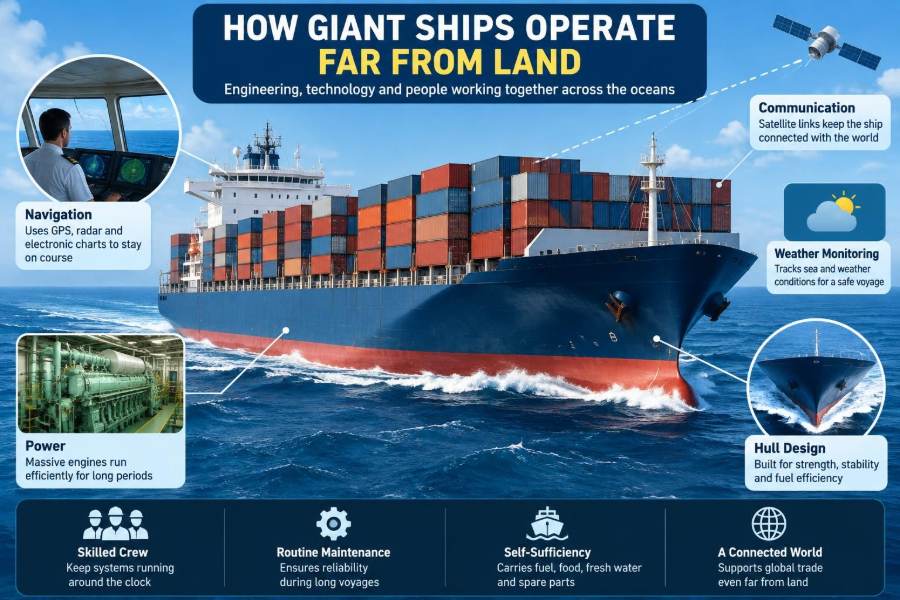

When a giant container ship disappears below the horizon, it can look strangely self-sufficient. There are no roads, no visible fuel stations, and no repair shops waiting around the next bend. Yet the vessel may continue across an ocean for weeks while carrying thousands of containers, a crew, machinery, fuel, food, and the systems needed to stay safe.
That apparent independence is not accidental. A modern ocean-going ship is part power plant, part factory, part home, part data network, and part moving structure designed to survive a demanding environment.
For marine engineers, the challenge is not simply making a ship move. It is keeping propulsion, electrical power, cooling, navigation support, maintenance, safety equipment, and people working together when land-based help is days away.
The following facts reveal what is happening below deck and behind the bridge windows when a giant ship operates far from shore.
🌊 A Giant Ship Is a Floating Industrial System
A large merchant vessel is often described as a floating city, but a floating industrial system is more accurate. Accommodation, galleys, water-making equipment, workshops, pumps, engines, electrical switchboards, and cargo systems must operate in a confined hull that is constantly moving.
Unlike a factory ashore, the ship cannot simply stop production when one support system fails. A cooling-water problem, for example, can quickly affect the main engine, generators, air compressors, refrigeration plant, and numerous pumps.
Marine engineering therefore focuses heavily on redundancy, routine inspection, and fault isolation. The aim is to contain a problem before it becomes a loss of propulsion, blackout, fire, flooding event, or cargo incident.
⚙️ Fact 1: One Slow Engine Can Move an Enormous Vessel
Many large cargo ships use a low-speed two-stroke diesel engine connected directly to a single large propeller. “Low-speed” refers to crankshaft speed rather than ship speed: the engine may turn at roughly the same relatively low rate needed by the propeller.
Direct drive avoids a large reduction gearbox and lets the propeller operate efficiently. The engine develops immense torque, which is the turning force needed to rotate a propeller several metres across through dense seawater.
At sea, efficiency matters more than rapid acceleration. A loaded ship has enormous mass and may need a long distance to change speed, so machinery and navigation decisions are planned well ahead.
🌀 Why the Propeller Produces Thrust
A propeller is not merely a spinning fan. Its blades are shaped like rotating hydrofoils, creating a pressure difference that accelerates water aft. The equal and opposite reaction pushes the vessel forward.
Propeller performance depends on blade geometry, rotational speed, vessel draft, hull condition, and sea state. If the blades rotate too quickly for the local pressure conditions, vapour bubbles can form and collapse on their surfaces. This phenomenon, called cavitation, wastes energy and can erode metal over time.
Engineers monitor vibration, bearing temperatures, shaft condition, and lubricating oil to detect developing drivetrain problems. A propeller may be out of sight, but it is never out of mind.
🔥 Fact 2: The Main Engine Is Only Part of the Power Story
The main engine usually provides propulsion, but it does not supply every electrical need on board. Separate auxiliary diesel generators typically produce electricity for lighting, pumps, navigation equipment, accommodation, cargo systems, workshops, and control equipment.
This separation is practical. A ship needs electrical power while manoeuvring, at anchor, and in port—even when the main engine is stopped. It also prevents routine hotel and machinery loads from depending entirely on the propulsion plant.
The electrical system is managed so that generators share load sensibly. If demand rises as several large pumps start, another generator may be connected before the running machines become overloaded.
⚡ A Blackout Is a Serious but Planned-For Emergency
A blackout is a loss of the main electrical supply. It can stop pumps, ventilation, steering support systems, machinery controls, and other equipment unless backup arrangements take over.
Ships are designed with emergency power arrangements, commonly including an emergency generator located away from the main engine room. It supplies selected essential services such as emergency lighting, communications, alarm systems, and other safety-critical loads.
Restoring power is not just a matter of pressing a reset button. Engineers must identify the cause, stabilize the electrical network, restart vital auxiliaries in a controlled sequence, and avoid creating a second overload.
🧠 Fact 3: Automation Helps, but People Still Run the Ship
Modern ships use automated control for alarms, generator load sharing, pump starts, tank levels, temperature control, and many engine functions. Sensors send information to monitoring systems in the engine control room and, often, to the bridge.
Automation does not eliminate engineering judgement. A sensor may fail, a reading may be misleading, or several ordinary alarms may point to one underlying fault. Skilled engineers distinguish between a nuisance alarm and a condition that needs immediate action.
A useful rule is that automation handles repeatable tasks well; people remain essential for diagnosing unusual combinations of events and making safe decisions under uncertainty.
📡 Sensors Turn Machinery into Usable Information
Temperature, pressure, level, flow, vibration, and speed sensors provide the basic language of a ship’s machinery plant. A falling lubricating-oil pressure, rising exhaust temperature, or unusual bilge level can reveal a fault long before it is visible.
Trends are often more valuable than one isolated number. If a pump’s discharge pressure declines gradually over several days, the cause could be a fouled strainer, wear, leakage, or a changing operating condition.
Good watchkeeping combines screen data with physical checks: listening for abnormal noise, checking for leaks, smelling for overheating insulation or fuel vapour, and verifying that the machinery space matches the displayed information.
🧭 Fact 4: Navigation Far from Land Uses Several Independent Methods
Satellite navigation provides highly useful position information, but ocean navigation does not rely on one source alone. The bridge team compares satellite data with gyrocompass heading, radar, electronic charts, visual observations when available, depth information near land, and voyage planning data.
Redundancy matters because equipment can malfunction, signals can degrade, and human input errors can occur. The officer of the watch must understand the ship’s position, intended track, surrounding traffic, weather, and safe water—not merely accept a point on a screen.
Before departure, a voyage plan identifies routes, reporting requirements, hazards, contingency areas, and expected conditions. It is reviewed and adjusted as weather, traffic, port instructions, or operational needs change.
🛰️ Communication Is a Lifeline, Not a Luxury
Far offshore, ships commonly use satellite communications alongside radio systems. These links support safety messages, weather information, operational reporting, maintenance advice, crew welfare, and contact with shore organizations.
Communication bandwidth and reliability may not resemble a land office connection, especially in poor weather or remote regions. Critical traffic is therefore prioritized, and crews are trained to use formal distress, urgency, and safety communication procedures.
Shore support can help diagnose faults, but it cannot physically repair a pump in mid-ocean. Clear descriptions, photographs where possible, machinery data, and disciplined troubleshooting make remote assistance more useful.
🌦️ Fact 5: Weather Changes Both Safety and Fuel Use
Wind and waves do more than make a ship roll. Heavy weather increases resistance, may reduce propeller efficiency, stresses cargo securing arrangements, and can make routine work hazardous.
A direct route is not always the best route. A weather-routing decision may choose a longer track or reduced speed to avoid severe conditions, protect cargo, reduce structural loads, and preserve a safe margin for the crew.
Forecasts are valuable, but they are forecasts rather than guarantees. The master and bridge team continuously compare predictions with real conditions and alter the plan when necessary.
📉 Slow Steaming Can Save Fuel, but It Has Limits
For many displacement ships, the power required to overcome water resistance rises sharply as speed increases. Reducing speed can therefore reduce fuel consumption substantially, depending on hull form, loading condition, weather, and engine operating limits.
This practice, often called slow steaming, has practical trade-offs. Longer voyages can affect schedules, cargo requirements, engine maintenance planning, and exposure to changing weather.
Engines must also operate within suitable ranges. Very low load for extended periods can create operational issues in some machinery arrangements, so speed decisions are coordinated with technical guidance rather than treated as a simple fuel-saving switch.
⛽ Fact 6: Fuel Management Is a Continuous Engineering Task
Fuel is not poured into one tank and forgotten. Ships carry fuel in several tanks for storage, settling, treatment, and daily use. It may need heating to flow properly, filtering to remove contaminants, and careful transfer between tanks.
Fuel treatment systems separate water and solids before fuel reaches sensitive engine components. Poor fuel condition can damage injection equipment, clog filters, reduce reliability, and create safety concerns.
Bunkering—the transfer of fuel to a ship—is a high-risk operation. Tank levels, valve line-ups, transfer rates, communication, and spill-prevention arrangements are checked carefully because a mistake can cause pollution or fire hazards.
🛢️ Different Fuels Bring Different Operating Demands
Marine fuel choices depend on vessel design, trading area, regulations, availability, and commercial decisions. Conventional liquid fuels, distillate fuels, liquefied gas fuels, and some newer alternatives each involve distinct storage, handling, combustion, and safety requirements.
The engineering question is broader than “which fuel is cleanest?” A practical assessment includes energy density, tank volume, supply infrastructure, emissions controls, maintenance needs, and risks such as low flash point or cryogenic handling.
There is no single transition path suitable for every ship. A short-sea vessel with predictable refuelling opportunities faces different constraints from an ocean-going bulk carrier.
💧 Fact 7: Ships Can Make Fresh Water from Seawater
Fresh water is required for drinking, cooking, washing, cleaning, and many technical purposes. Carrying all of it for a long voyage would consume valuable space and weight, so many ships produce water on board.
Two common approaches are evaporation-based distillation and reverse osmosis. Distillation uses heat to evaporate water and then condense it, while reverse osmosis forces water through membranes that reject most dissolved salts.
Produced water must be monitored and treated as required for its intended use. Not every technical water supply is automatically suitable for drinking, and storage tanks need hygienic management.
🚿 Water Conservation Still Matters at Sea
Water makers depend on energy, seawater quality, membranes or heat exchangers, and reliable pumps. Their output can fall when equipment is fouled or maintenance is needed.
That is why ships still track freshwater consumption. A leaking toilet flush valve, continuously running tap, or unnoticed pipe leak can steadily drain reserves that may be needed if the production plant is unavailable.
Engineering teams monitor tank levels and investigate unexpected changes. On a vessel, resource awareness is operational discipline rather than simply a household habit.
❄️ Fact 8: Refrigerated Cargo Depends on a Hidden Cold Chain
Refrigerated containers, often called reefers, carry cargo such as fruit, frozen food, pharmaceuticals, and other temperature-sensitive products. Each unit has its own refrigeration machinery, but the ship must provide electrical connections and monitor the fleet of containers.
A reefer’s specified temperature is only one part of cargo care. Ventilation settings, humidity considerations, cargo loading condition, and alarm response can also matter, depending on the product.
If a container reports an alarm, crew and shore operators assess it promptly. The cause might be a power connection, refrigeration fault, sensor issue, incorrect setting, or a condition within the container; assumptions can put cargo at risk.
🧯 Firefighting at Sea Requires Fast Isolation
Fire is especially dangerous at sea because external help may be remote and escape routes are limited. Prevention begins with good housekeeping, safe hot-work controls, fuel-oil leak prevention, electrical maintenance, and correct storage of flammable materials.
If a fire occurs in machinery spaces, the response may involve stopping ventilation, shutting fuel supplies, closing fire dampers, and using fixed firefighting systems when evacuation and isolation have been completed. These actions demand coordination because they affect machinery operation and breathable air.
Drills build familiarity with roles, equipment, communications, and muster arrangements. A written procedure is necessary, but practiced teamwork is what makes it usable under pressure.
🛟 Fact 9: Survival Equipment Is Maintained, Not Just Carried
Lifeboats, life rafts, lifejackets, immersion suits, emergency radios, flares, and launching appliances are all part of the ship’s safety system. Their value depends on inspection, servicing, crew familiarity, and the ability to use them in difficult weather.
Launching a survival craft from a moving or rolling vessel can be hazardous. For that reason, crews train in procedures and conduct drills within safe operational limits.
Emergency readiness also includes muster lists, which assign each person a specific duty. Clear roles reduce confusion when alarms sound and help account for everyone on board.
🧱 The Hull Flexes More Than Most People Expect
A large ship is a long beam supported unevenly by waves. In one wave pattern, the middle may be supported while bow and stern are less supported; in another, the ends may be supported more strongly. These conditions create global bending loads known as hogging and sagging.
The hull is designed to carry these loads, but loading decisions affect the stresses. Ballast, cargo distribution, fuel consumption, and sea conditions all influence the vessel’s structural condition.
Loading computers help officers and engineers verify stability, draft, bending moments, and shear forces. They support judgement; they do not remove the need to enter accurate cargo and tank data.
⚖️ Fact 10: Ballast Water Helps Keep the Ship Stable
When a ship is lightly loaded, it may take seawater into ballast tanks to improve draft, propeller immersion, stability, and structural loading. Ballast is shifted or discharged as cargo and operating conditions change.
Ballast operations require careful valve control. An incorrect line-up can cause unintended tank levels, list, overflow, or stresses outside the planned condition.
Ballast water can also transport organisms between regions. International rules and vessel-specific procedures therefore govern how ballast water is managed and, where required, treated before discharge.
🔧 Preventive Maintenance Is the Ship’s Repair Strategy
At sea, a small defect rarely stays conveniently small. Preventive maintenance schedules organize inspections, lubrication, testing, cleaning, calibration, and planned replacement before expected wear becomes failure.
Condition monitoring adds another layer. Oil analysis can reveal wear particles or contamination; vibration analysis can indicate rotating-equipment problems; thermography can help identify abnormal electrical heating.
Maintenance plans must remain practical. Deferring a noncritical job during bad weather may be sensible, while deferring a leaking fuel line or degraded emergency system may create unacceptable risk.
🧰 Workshops and Spare Parts Buy Time
Most ocean-going ships carry a workshop, tools, consumables, and selected spare parts. Engineers may machine a simple component, renew a seal, overhaul a valve, repair pipework, or fabricate a temporary support when conditions permit.
Not every repair can be completed at sea. Major crankshaft damage, complex electronic failures, or structural repairs may require specialist assistance or a shipyard. Good engineering includes knowing when a temporary repair is safe and when it is not.
Spare-parts planning is a balance: carrying everything would be impossible, but carrying too little can turn an ordinary fault into a costly delay. Critical spares are selected from equipment risk, service history, and manufacturer recommendations.
🩺 Crew Health Is an Operational Requirement
A ship’s crew manages complex systems, often on watch schedules that continue day and night. Fatigue, dehydration, illness, stress, and poor sleep can reduce attention and decision quality.
Medical facilities at sea are limited compared with a hospital, though ships carry medical stores and follow procedures for treatment and external medical advice. Severe cases may require diversion, rendezvous, or evacuation, depending on location and conditions.
Safe operation relies on a professional working environment: clear handovers, realistic rest arrangements, good food and water hygiene, and a culture where people can report hazards before they become emergencies.
👥 The Bridge and Engine Room Must Work as One Team
The bridge controls the navigational plan, while the engine department maintains the machinery that turns that plan into movement. During departure, arrival, restricted visibility, heavy weather, and emergencies, their coordination becomes especially visible.
For example, a planned speed reduction may protect the engine in rough seas, while an engine limitation may require the bridge to revise arrival timing and traffic decisions. Neither department can safely operate in isolation.
Reliable communication is specific: what is changing, when it will happen, what limitation exists, and what confirmation is required. Vague messages create avoidable risk in a system where timing matters.
🗺️ Ports Remain Essential Even on an Ocean Passage
A ship may be self-reliant at sea, but it depends on ports for cargo operations, fuel, provisions, waste reception, crew changes, surveys, repairs, and specialist services. Port stays are often busy periods rather than restful pauses.
Engineers use limited time alongside to complete maintenance that is unsafe or impractical underway. Cargo operations may also change ballast, electrical demand, cooling needs, and machinery readiness requirements.
Delays in port can have wide effects on schedules and fuel planning. Conversely, rushing a technical task can introduce defects, so the best operations balance efficiency with proper verification.
🌱 Environmental Protection Is Built into Daily Operations
Preventing pollution is not a single piece of equipment; it is a set of everyday controls. These include managing oily water, handling sewage and garbage properly, preventing spills during transfers, maintaining emission-control equipment, and recording regulated operations accurately.
Engineering systems such as oily-water separators, sewage-treatment plants, exhaust-gas equipment, and ballast-water treatment require competent operation and maintenance. A system that exists but is poorly understood does not provide dependable protection.
Environmental compliance can be operationally demanding, especially when routes cross different jurisdictions. Procedures, records, fuel planning, and crew training all need to align with the ship’s voyage.
🚨 Small Deviations Can Become Major Incidents
Many failures develop through a chain rather than one dramatic event: a minor leak is ignored, a drain blocks, an alarm is repeatedly acknowledged without investigation, and a standby pump is found unavailable when it is needed.
Good safety culture encourages reporting near misses and abnormal conditions. This is not about blame for every imperfection; it is about finding weak barriers while there is still time to correct them.
Checklists are valuable for routine high-risk tasks, but they work only when users understand the purpose behind each item. Ticking a box cannot confirm that a valve is truly shut or a system is truly ready.
📚 What Marine Engineering Students Should Notice
The machinery itself matters, but marine engineering is fundamentally a systems discipline. A fuel pump affects propulsion; propulsion affects navigation; navigation choices affect weather exposure; weather affects cargo, fatigue, and machinery loading.
Students can strengthen their understanding by connecting subjects rather than learning them as isolated modules:
- Thermodynamics explains engines, boilers, refrigeration, and heat recovery.
- Fluid mechanics explains pumps, piping, propellers, cooling, and stability-related flows.
- Electrical engineering supports generation, protection, motors, automation, and emergency power.
- Materials knowledge helps address corrosion, wear, fatigue, and lubrication.
- Human factors explains why communication, fatigue management, and procedures affect technical safety.
The strongest engineers ask how a local change affects the whole vessel.
🧭 The Core Principle: Resilience Comes from Layers
Giant ships operate far from land because they are designed and managed in layers. There are primary systems, standby systems, emergency systems, alarms, procedures, maintenance plans, trained people, and shore support working together.
No layer is perfect. Sensors fail, weather changes, parts wear, and people can make mistakes. The objective is to ensure that one failure does not automatically become a casualty.
This is why the most impressive feature of a ship is not simply its engine size or cargo capacity. It is the disciplined coordination of engineering, seamanship, planning, and human judgement over thousands of nautical miles.
A giant ship remains capable far from land not because it is independent of risk, but because it is built and operated to detect, contain, and recover from problems before they overwhelm the voyage. 🚢⚙️🌊