
A vessel has just left the berth. The engine order is steady, the shaft is turning at a known rpm, and the propeller pitch is known from the maker’s data. It can seem simple to predict how far the ship should travel in one minute.
Yet the measured speed through the water is always lower than that neat calculation suggests. The difference is not necessarily a defect, poor maintenance, or a misleading instrument. It is a normal consequence of using a rotating propeller to push a heavy hull through water.
This difference is called propeller slip. It matters to deck officers planning passages, engineers assessing propulsion performance, and students learning why ship speed is not determined by rpm alone.
Understanding slip turns a familiar calculation into a useful diagnostic tool. It also prevents a common mistake: treating a propeller like a screw moving through solid wood rather than a hydrodynamic device working in an ever-changing fluid.
⚙️ The Basic Idea of Propeller Slip
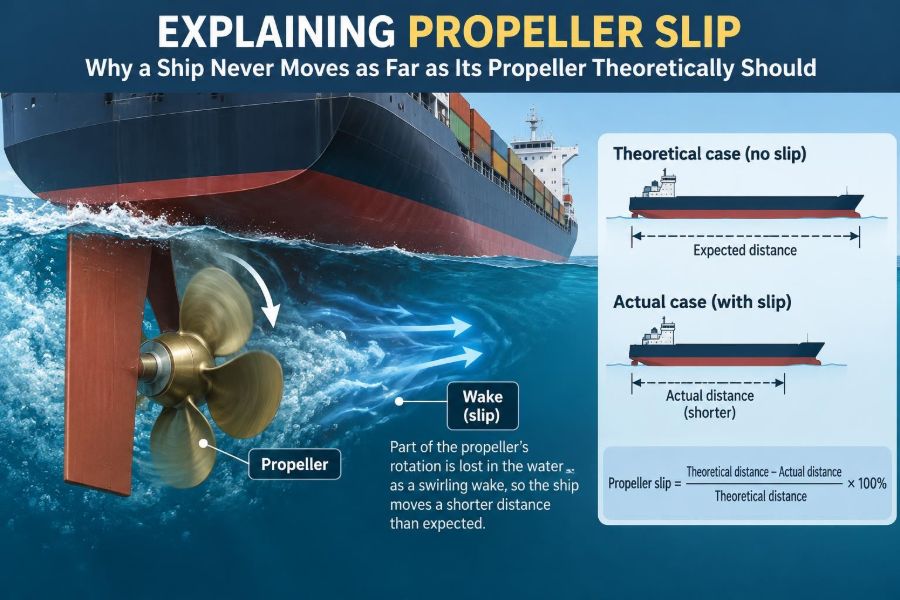
Propeller slip is the difference between a propeller’s theoretical advance and the distance a ship actually moves through the water during the same number of revolutions. Theoretical advance assumes that each revolution moves the propeller forward by exactly one pitch.
In reality, a propeller accelerates water aft to generate thrust. Because water can flow, deform, rotate, and be drawn into the propeller disc, the propeller does not advance through it as a screw would advance through a rigid nut.
Slip is usually expressed as a percentage. A positive slip is normal in ahead operation: actual ship speed is lower than the speed calculated from pitch and shaft rpm.
🧵 The Screw-in-a-Solid Analogy—and Its Limit
A threaded bolt gives a useful starting picture. If a bolt has a 50 mm thread pitch, one full turn advances it 50 mm through a fixed nut. There is no meaningful “slip” because the solid thread provides a firm reaction.
A marine propeller also has a helical geometry, but it works in water rather than in a rigid thread. The water is not fixed in place, and it is deliberately set in motion by the propeller.
The analogy helps explain pitch, but it fails if taken too far. A propeller is best understood as a set of rotating hydrofoils that create pressure differences and transfer momentum to water.
📏 Propeller Pitch: The Theoretical Distance
Pitch is the theoretical axial distance a propeller would advance in one revolution through a solid, non-yielding medium. A fixed-pitch propeller has blades with a permanently set pitch, although the pitch can vary from hub to tip in some designs.
For a simple calculation, use the nominal pitch stated for the propeller. A controllable-pitch propeller requires more care because its blade angle, and therefore effective pitch, changes with the pitch setting.
Pitch is commonly given in metres. A 6 m pitch propeller is treated, for calculation purposes, as moving 6 m per revolution before slip is considered.
🧮 Calculating Theoretical Speed
The basic relation is straightforward. Multiply pitch by propeller revolutions per minute to obtain theoretical distance travelled per minute.
Theoretical speed in knots = (Pitch in metres × propeller rpm × 60) ÷ 1852
The constant 1,852 converts metres per hour to nautical miles per hour, or knots. If a propeller has a 6 m pitch and turns at 100 rpm, its theoretical travel is 600 m per minute, or 36,000 m per hour. This corresponds to about 19.4 knots.
That result is not a speed prediction yet. It is the no-slip reference against which actual speed can be compared.
🧭 From Theoretical Speed to Actual Advance
Suppose the same hypothetical vessel measures 16.5 knots through the water at 100 rpm. The ship is moving more slowly than the 19.4-knot theoretical speed because the propeller-water interaction has not produced a rigid, one-pitch-per-turn advance.
The actual speed used in a slip calculation should normally be speed through the water, not speed over the ground. A speed log, when reliable and properly referenced, is more suitable than a GPS-derived speed for this purpose.
Using ground speed mixes propeller performance with tidal current. A favourable current can make calculated slip look unusually low; an adverse current can make it look excessive.
➗ The Standard Slip Formula
For ahead running, the common expression is:
Slip (%) = ((Theoretical speed − actual speed through water) ÷ theoretical speed) × 100
Using the hypothetical values above, the slip is approximately 15 percent. This means actual advance is about 85 percent of the nominal pitch-based advance, not that 15 percent of the engine’s power has been lost.
That distinction matters. Slip is a kinematic comparison of distance and speed. It is related to propulsion efficiency, but it is not itself a complete efficiency measurement.
🌊 Why Thrust Requires Water to Move Aft
A ship moves ahead because the propeller gives water an aftward change in momentum. The resulting reaction force pushes the propeller and ship ahead. If the propeller did not alter the motion of the water, it could not produce useful thrust.
This is why some degree of difference between theoretical advance and actual advance is unavoidable. A propeller must create an accelerated wake to propel the vessel.
The wake behind a working propeller is not simply a smooth stream moving straight aft. It contains velocity changes, rotation, turbulence, and pressure variation. All are part of real propulsion rather than evidence that the propeller has “failed to grip.”
🌀 The Propeller’s Rotating Wake
Propeller blades apply both axial and rotational energy to the water. The axial component produces the useful aft jet associated with thrust. The rotational component, often called swirl, represents energy that is not fully converted into forward motion of the ship.
Modern propeller design seeks to produce required thrust with as little unnecessary rotational loss as practical. Larger, slower-turning propellers often help, provided draft, hull form, strength, vibration, and clearance constraints allow them.
Devices such as pre-swirl stators or post-swirl fins may be used on some ships to improve how hull and propeller interact. Their purpose is not to eliminate slip, but to reduce avoidable losses in the overall propulsive system.
🚢 Hull Resistance Sets the Demand
A propeller does not choose the vessel’s speed independently. It must generate enough thrust to overcome hull resistance, which includes frictional drag, wave-making resistance, air resistance, appendage drag, and other effects.
As speed rises, resistance generally rises substantially. A modest increase in speed may therefore require a much larger increase in delivered power. The operating point changes until propeller thrust and vessel resistance balance.
At a given rpm, a fouled hull, deeper displacement, or rough sea can reduce speed through water. The calculated slip rises because the ship’s actual advance has fallen relative to the pitch-based reference.
🛶 Advance Speed Is Not the Same as Ship Speed
In propeller theory, advance speed describes the speed of water approaching the propeller. It is not always identical to the vessel’s speed through the water because the hull affects water flow around the stern.
The hull drags some water along with it. This phenomenon is represented by the wake fraction. As a result, water arriving at the propeller may have a lower average forward velocity than the ship itself.
This distinction explains why full-scale propulsion analysis uses more than a simple slip figure. A ship can have a normal operational slip value while the flow into the propeller remains non-uniform and creates efficiency or vibration concerns.
🧩 Wake Fraction and the Hull–Propeller Partnership
The stern shape, shaft brackets, bossings, rudder, bilge keels, and nearby hull surfaces influence the inflow reaching the propeller. A single-screw ship, twin-screw ship, podded vessel, and tug may therefore show quite different operating characteristics.
Wake is not automatically harmful. Designers can use hull wake beneficially by matching the propeller to the flow field. The aim is a good total hull–propeller–engine arrangement, often called the propulsive system, rather than the highest isolated propeller efficiency.
Because of this interaction, comparing slip percentages between unrelated vessels is rarely meaningful unless loading condition, speed, propeller geometry, and measurement methods are also known.
📉 Slip Is Not the Same as Propulsive Efficiency
A lower calculated slip can appear attractive, but it does not automatically prove that a vessel is using less fuel per mile. Propulsive efficiency depends on many linked factors, including propeller efficiency, hull efficiency, mechanical losses, engine performance, and the vessel’s operating point.
For example, a change in propeller pitch may reduce the simple slip figure while moving the engine away from an efficient load range. Conversely, a ship operating at a sound design condition may show a higher slip figure than an observer expects.
Treat slip as an operational indicator, not a standalone fuel-efficiency verdict. Meaningful assessment requires trends in speed, power, rpm, fuel consumption, draft, trim, weather, and hull condition.
🔢 Apparent Slip, True Slip, and Practical Language
On board, the term “slip” is often used for the result obtained from nominal pitch, shaft rpm, and ship speed through the water. This is commonly called apparent slip.
More detailed analyses may distinguish between nominal pitch, effective pitch, wake effects, and the propeller’s true hydrodynamic advance ratio. Definitions can differ among textbooks, manufacturers, and performance-monitoring systems.
The practical lesson is to state the method. If a report says “slip increased,” it should identify whether the figure uses GPS or log speed, what pitch value was assumed, and whether current and controllable-pitch settings were accounted for.
📊 A Worked Example at Sea
Consider a hypothetical fixed-pitch ship with a 5.5 m propeller pitch operating at 90 rpm. Its theoretical speed is:
(5.5 × 90 × 60) ÷ 1852 = approximately 16.0 knots
If the vessel’s verified speed through water is 13.6 knots, apparent slip is:
((16.0 − 13.6) ÷ 16.0) × 100 = 15 percent
If GPS shows 15.0 knots on the same heading, that does not reduce propeller slip to 6.25 percent. It indicates that current is contributing roughly 1.4 knots to the vessel’s speed over the ground, assuming the water-speed measurement is sound.
🌬️ Wind, Waves, and Added Resistance
Head seas cause pitching, heaving, hull slamming in severe cases, and repeated changes in immersion at the stern. Wind adds aerodynamic resistance above water. Both can lower speed at the same rpm and power.
The resulting increase in calculated slip may be real as an operating observation, but it should not be interpreted as evidence of a propeller-only problem. The propeller is responding to a harder towing task.
For performance comparisons, record sea state, wind direction, wave encounter angle, and course. Trials in opposite directions, or averaged reciprocal runs where conditions permit, can reduce the influence of current and wind.
⚓ Draft, Trim, and Propeller Immersion
Loading condition changes resistance and propeller inflow. A deeper ship has more wetted surface and may require more thrust, while a lightly loaded ship can experience poor stern immersion or altered trim.
Trim is especially relevant because it changes the flow approaching the propeller and the depth of the propeller below the free surface. Excessive stern rise can increase the risk of ventilation in some conditions; excessive stern immersion can also increase resistance.
There is no universal “best trim” for every voyage. The suitable condition depends on hull design, draft, speed, weather, cargo constraints, visibility, stability, and structural limits.
🫧 Ventilation: Air Reaching the Blades
Ventilation occurs when air or surface gas is drawn into the propeller flow. It can happen when a propeller works close to the surface, when the stern lifts in waves, during sharp manoeuvres, or when disturbed flow reaches the propeller.
Air around the blades reduces the water density available to carry load. Thrust can fall suddenly, rpm may fluctuate depending on the propulsion system, and the vessel can lose speed.
Ventilation is not the same as normal slip. It is a flow disturbance that can make calculated slip increase sharply and can contribute to vibration or poor manoeuvring response.
💥 Cavitation: Vapour Cavities, Not Air Bubbles
Cavitation occurs when local pressure on a blade falls below the water’s vapour pressure, allowing vapour-filled cavities to form. When these cavities collapse in higher-pressure regions, they can create noise, vibration, and, under damaging conditions, erosion.
Cavitation cannot be diagnosed from slip alone. A ship may have ordinary calculated slip and still suffer harmful cavitation, or show increased slip for entirely different reasons.
Repeated cavitation erosion changes blade surface shape and roughness. That can eventually affect thrust, efficiency, vibration, and maintenance requirements, making inspection findings valuable alongside performance data.
🧽 Hull Fouling and Propeller Roughness
Marine growth, slime, damaged coating, and roughness increase hull frictional resistance. Even before fouling becomes visually dramatic, a vessel may need more power to maintain the same speed.
Propeller fouling and blade roughness also matter. They disturb the smooth flow over blade surfaces and can reduce the propeller’s ability to convert shaft power into useful thrust efficiently.
A rising slip trend at comparable rpm, draft, and weather can therefore support a hull-and-propeller condition investigation. It is a clue, not proof: log error, current, loading, and machinery changes must be checked first.
🔧 Blade Damage and Geometry Changes
A bent blade tip, chipped edge, distorted section, or damage from contact with debris can alter pitch distribution and blade loading. The effects may include reduced speed, increased vibration, uneven torque, and changes in apparent slip.
Not every defect is visible from onboard observations. Dry-docking inspections, diver surveys where appropriate, vibration records, and machinery trends help build a clearer picture.
Never assume a poor slip number alone justifies a diagnosis of blade damage. It should prompt structured comparison with baseline data and, if other symptoms exist, a suitable inspection plan.
🎛️ Controllable-Pitch Propellers Need Extra Care
With a controllable-pitch propeller, shaft rpm can remain nearly constant while thrust changes through blade pitch angle. A calculation based on one nominal pitch value may be meaningless unless the actual pitch setting and its effective geometry are known.
At low pitch, during manoeuvring, or when operating astern, the simple fixed-pitch formula is particularly unreliable as a performance indicator. Flow is highly unsteady and the blades may operate far from their normal ahead-service condition.
Use the vessel’s approved pitch–rpm–power information and the monitoring system’s documented conventions. Operational records should distinguish commanded pitch from confirmed actual pitch where the system provides both.
🔄 Gear Ratio and the Correct RPM
The propeller usually does not turn at main-engine rpm. On geared installations, the reduction gear lowers engine speed to the shaft speed suitable for the propeller. Using engine rpm in the formula without applying the gear ratio produces a seriously wrong theoretical speed.
For a direct-drive slow-speed diesel, engine rpm and shaft rpm are generally the same in normal operation. Even then, verify which signal is being recorded and whether it represents a filtered or instantaneous value.
On diesel-electric, hybrid, and podded arrangements, the relationship between prime mover speed and propeller speed can be even less direct. The relevant value for slip is the actual propulsor rotational speed.
🧭 Speed Through Water Versus Speed Over Ground
Speed over ground answers a navigation question: how fast is the vessel moving relative to the Earth? Speed through water answers a hydrodynamic question: how fast is the hull moving relative to the surrounding water?
Both are essential, but they cannot be substituted casually. A passage planner cares about current-adjusted arrival time, while a propulsion analyst needs a reliable water-relative speed.
| Measurement | What it represents | Best use in slip work |
|---|---|---|
| GPS speed over ground | Motion relative to seabed or Earth | Use only after correcting for current |
| Speed log | Motion relative to local water | Usually the preferred operational input |
| Trial-derived speed | Controlled, corrected performance value | Useful for baselines and analysis |
📡 Instrument Error Can Mimic a Problem
A speed log may be affected by sensor condition, calibration, aerated water, shallow-water effects, hull boundary layer influences, or installation location. Shaft rpm signals can also be inaccurate if sensors, displays, or data interfaces are faulty.
Because slip combines several measurements, error in any input can distort the result. A small persistent speed-log bias can look like a change in propeller performance.
Before drawing conclusions, compare independent sources where possible: shaft counter readings, engine data, GPS tracks with current assessment, voyage records, and known benchmark conditions.
📝 Building a Useful Performance Trend
Single readings are vulnerable to weather, current, traffic-related manoeuvring, and measurement noise. A trend becomes useful when data are collected consistently under comparable operating conditions.
- Record shaft rpm, pitch setting where applicable, and speed through water.
- Record draft, trim, displacement estimate, and significant weather conditions.
- Include engine power or torque, fuel rate, and sea-water temperature when available.
- Note hull cleaning, propeller polishing, dry docking, and any machinery changes.
Over time, the pattern can reveal a gradual loss of performance or confirm an improvement after maintenance. The value lies in comparison, not in chasing one ideal slip percentage.
🧪 Sea Trials and Why Conditions Matter
Formal speed and power trials use controlled methods because environmental influences are large. Water depth, current, wind, waves, displacement, and water properties can all affect measured results.
Reciprocal runs are often used to help cancel the average effect of current by measuring on approximately opposite headings. This does not remove every source of uncertainty, especially in changing weather or non-uniform current.
Routine onboard calculations are less rigorous than contractual trials, but the same principle applies: compare like with like and document conditions honestly.
📈 Reading a Slip Change Alongside Power
Slip becomes more informative when viewed with shaft power and vessel speed. If rpm and power rise while speed remains flat, added resistance, fouling, weather, or a propulsion issue may be involved.
If speed falls at the same rpm but power also falls unexpectedly, machinery load limitation, pitch setting, fuel condition, control-system behaviour, or measurement error may deserve attention. The interpretation depends on the plant.
A practical question is not simply “Has slip increased?” but “What changed in the relationship among rpm, pitch, power, speed, loading condition, and environment?” That question leads to better troubleshooting.
🚨 When an Unusual Result Deserves Investigation
An abrupt departure from an established trend deserves more attention than a small day-to-day variation. Particularly relevant warning signs include a sudden speed loss, new vibration, unusual noise, unstable rpm, elevated bearing temperatures, or a marked change after suspected contact with debris.
Response should follow the vessel’s safety management procedures and machinery instructions. Reducing load, avoiding damaging operating ranges, checking alarms, and informing responsible personnel may be appropriate depending on the symptoms.
Slip calculations support decisions, but they do not replace inspection, vibration analysis, engine monitoring, or professional engineering judgment.
❌ Common Calculation Mistakes
Several routine errors make slip figures misleading:
- Using GPS speed over ground without allowing for current.
- Using main-engine rpm instead of propeller shaft rpm on geared ships.
- Applying a fixed-pitch formula to a controllable-pitch propeller without the actual pitch setting.
- Comparing ballast and loaded-voyage figures as though resistance were unchanged.
- Ignoring wind, sea state, trim, or shallow-water effects.
- Calling slip an efficiency percentage or a direct measure of power loss.
A correct-looking formula cannot compensate for unsuitable inputs. The quality of the operating data determines the quality of the conclusion.
🛠️ Practical Ways to Protect Propulsive Performance
Good performance begins with basic condition management. Maintain hull coatings, schedule cleaning based on operational need and environmental requirements, and inspect propellers after events that could cause damage.
Operate within approved power, rpm, pitch, and vibration limits. Avoiding persistent off-design conditions where practicable can reduce fuel waste and mechanical stress, although weather, schedule, and manoeuvring needs will sometimes dictate them.
Most importantly, preserve trustworthy records. A well-kept baseline after docking or cleaning gives later observations a meaningful reference point.
🧠 The Core Principle to Remember
Propeller pitch gives a theoretical distance per revolution, not a promise of ship speed. A real propeller must accelerate water aft to create thrust, while the hull, wake, weather, loading condition, and machinery arrangement determine the operating result.
Calculated slip is therefore normal and useful. It translates the gap between ideal geometric advance and real vessel motion into a number that can be trended, questioned, and interpreted in context.
The most reliable use of slip is as one part of a wider performance picture. Combine it with sound measurements, comparable conditions, power data, and physical inspection before deciding that anything is wrong.
A ship never travels its full pitch-based distance per revolution because propulsion depends on changing the motion of water—and that necessary interaction is exactly what creates thrust. Read slip as a practical clue, not as a verdict, and it becomes a valuable bridge between textbook propeller theory and everyday ship operation. 🚢🌊⚙️