
A ferry rolls gently as it leaves the harbour. A container ship appears almost impossibly tall above the water. A cruise ship carries hotels, theatres, pools, and thousands of people several decks above the sea. It is natural to look at these vessels and wonder why a strong gust or a passing wave does not simply knock them over.
Ships do roll, sometimes sharply. They can also lose stability through poor loading, flooding, ice accumulation, cargo shift, or damaged structure. Safe operation is not based on the idea that a ship is too heavy to tip; it depends on a carefully managed balance of geometry, buoyancy, weight distribution, and operating condition.
For marine engineers, deck officers, naval architects, and anyone who works around ships, stability is more than a design calculation. It influences loading plans, ballast transfers, fuel management, weather decisions, damage control, and the limits placed on passenger movement and cargo operations.
The key is not that a vessel resists every force without moving. A stable ship may heel under a force, develop a restoring tendency, and return upright when that force reduces. Understanding that sequence makes the apparent mystery much easier to read.
⚖️ Stability Is a Ship’s Ability to Recover
Ship stability is the tendency of a vessel to return toward an upright position after it has been inclined by an external force. That force may be wind, waves, a turn, a suspended load, a crowd moving across a deck, or cargo moving inside a hold.
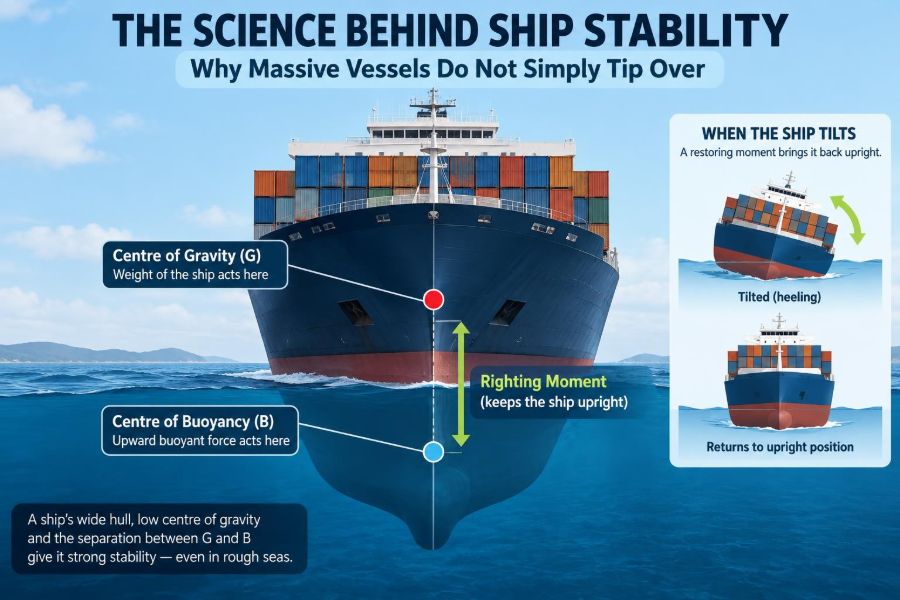
A ship with positive stability develops a righting moment: a turning effect that opposes the heel. A vessel can still roll uncomfortably while remaining stable. Conversely, a ship that looks level alongside may have dangerously little reserve stability.
🌊 Floating Starts With Displacement
A floating ship displaces an amount of water whose weight equals the ship’s total weight. This is Archimedes’ principle in practical form. Add cargo, fuel, stores, or ballast, and the vessel sinks slightly deeper until it displaces the additional water weight.
This explains why large ships can float, but it does not by itself explain why they remain upright. A round, sealed steel hull may float perfectly well and still be prone to rolling over. Stability depends on where buoyancy and weight act as the hull changes angle.
⬇️ The Centre of Gravity Matters
The centre of gravity, usually marked G, is the effective point through which the ship’s entire weight acts vertically downward. It represents the combined effect of the hull, machinery, cargo, fuel, ballast, superstructure, people, and equipment.
Weight placed low pulls G downward; weight placed high raises it. A lower G generally improves initial stability because the buoyant force has a better lever with which to restore the ship after it heels.
This is why heavy machinery is commonly located low in the vessel and why loading a heavy item onto an upper deck deserves careful analysis.
⬆️ Buoyancy Acts Through a Moving Point
The upward force of buoyancy acts through the centre of buoyancy, B: the geometric centre of the underwater volume of the hull. When the ship is upright, B lies on the vessel’s centreline for a symmetrical hull.
As a ship heels, its submerged shape changes. More hull volume becomes immersed on the low side, while volume emerges on the high side. The centre of buoyancy shifts toward the low side, and that shift is central to the restoring mechanism.
📐 Why a Heeled Hull Creates a Righting Lever
Imagine a ship heeled to starboard. Weight continues to act downward through G, while buoyancy acts upward through the shifted B. These two vertical forces no longer share the same line of action.
The horizontal separation between them is the righting arm, commonly called GZ. Weight multiplied by GZ gives the righting moment. If the buoyant force lies in a position that tends to rotate the ship upright, GZ is positive.
A larger positive GZ generally means a stronger capacity to resist the particular heeling angle involved. It does not mean the ride will automatically be comfortable.
📍 Metacentre and the Meaning of GM
For small angles of heel, naval architects use the metacentre, M, as a convenient reference point. The vertical distance between G and M is called GM, or metacentric height.
If M is above G, GM is positive and the ship has positive initial stability. If G rises above M, the ship has negative initial stability and will tend to heel further rather than return upright.
GM is useful because it offers a quick indication of small-angle stability, but it is not a complete description of safety at larger heel angles.
🧊 Low Weight Produces a Stiffer Ship
A ship with a relatively large positive GM is often called stiff. It resists small angles of heel strongly and tends to return upright quickly. Ballast placed low in double-bottom tanks is a common way to lower G and increase GM.
Stiffness is not always desirable without limit. A very stiff vessel can roll rapidly and violently, which may damage cargo, fatigue people, overload lashings, and create difficult working conditions. Stability design is a balance, not a contest to achieve the largest possible GM.
🪀 High Weight Can Make a Tender Ship
A vessel with small positive GM is often described as tender. It may heel more easily and roll more slowly, sometimes with a long, gentle-looking motion. That motion can be comfortable in some conditions, but a tender ship has less immediate resistance to heeling.
Adding weight high up, consuming low fuel or ballast, lifting a heavy item, or allowing water to accumulate on an elevated deck can all raise G. The result may be reduced GM and a smaller margin for operational disturbances.
📉 Stability Is a Curve, Not One Number
Initial GM describes behaviour near upright, while real survival often depends on what happens at moderate and large heel angles. Naval architects therefore examine a righting-arm curve, which plots GZ against angle of heel.
The curve shows how much righting lever is available, where it reaches its maximum, and at which angle it returns to zero. The area under the positive portion represents the vessel’s energy-like reserve against heeling, rather than merely its first response to a small tilt.
🚫 The Angle of Vanishing Stability
At a sufficiently large heel angle, the geometry of the submerged hull may no longer produce a positive righting arm. The point where GZ becomes zero is called the angle of vanishing stability.
Beyond that range, the buoyancy arrangement can encourage further capsize. The exact behaviour depends on hull form, openings, flooding, cargo movement, and sea conditions. It should never be treated as a target or an operational limit to approach.
🌬️ Wind Creates a Steady Heeling Moment
Wind acts on the exposed area of a ship: accommodation blocks, containers, cranes, deck cargo, and hull sides above the waterline. Unlike a short wave impact, a strong beam wind can create a sustained heeling moment.
A vessel finds an equilibrium angle when its righting moment balances the wind heeling moment, provided adequate stability remains. Wind becomes much more significant when combined with rolling, gusts, high freeboard, a high centre of gravity, or restricted righting range.
🌊 Waves Challenge Stability in Several Ways
Waves do not act as one simple sideways push. They can cause rolling, change the submerged hull shape, produce accelerations, and expose a vessel to sequences of forces that arrive near its natural roll period.
Beam seas are commonly associated with rolling, but following and quartering seas can also create difficult stability conditions, especially when ship speed and wave encounter period interact. Safe routeing and speed decisions consider these dynamics, not just wave height.
🔄 Resonance Can Build Dangerous Roll Angles
Every vessel has a natural roll period influenced by hull geometry, displacement, and GM. When waves repeatedly apply energy at a similar rhythm, roll angles can build through resonance.
This does not require every wave to be unusually large. A sequence that arrives at an unfortunate interval can progressively amplify motion. Altering course or speed changes the encounter period and may reduce the effect, although the safest response depends on the vessel, weather, traffic, and operational constraints.
🛞 Turning Produces Heel as Well
When a ship turns, its mass follows a curved path and experiences an apparent outward effect in the ship-fixed frame. This contributes to heel, along with rudder force and hydrodynamic effects on the hull.
Fast turns can be particularly demanding for vessels with high centres of gravity, deck cargo, or passengers moving about. Operating guidance may therefore limit turning speed, rudder angle, or manoeuvring conditions. A vessel’s turning capability and its stability margin must be considered together.
📦 Cargo Shift Is More Than a Loading Problem
If a heavy cargo item moves sideways, the ship’s centre of gravity moves sideways with it. This creates a permanent list until the weight is returned, counter-ballasted, or otherwise corrected. If the cargo shifts again during rolling, the situation can worsen quickly.
Securing arrangements are therefore part of stability protection. Lashings, stoppers, dunnage, locking devices, hold divisions, and clear loading instructions all help prevent a small initial movement from becoming a serious loss of stability.
🛢️ Free Surface Effect Weakens Stability
A partially filled tank is more harmful than its weight alone suggests. As the ship heels, liquid flows to the low side and shifts its centre of gravity. This is the free surface effect.
Engineers treat that movement as a virtual rise in G, reducing effective GM. Broad tanks are especially influential because liquid can move through a greater transverse distance. Slack tanks should be minimized where practicable, and their effects must be included in stability calculations.
💧 Flooding Can Change Both Weight and Buoyancy
Damage stability concerns what happens after water enters spaces that were intended to remain dry. Floodwater adds weight, may shift as the ship heels, and removes reserve buoyancy from the flooded volume.
Flooding also creates free-surface effects and may cause a list or trim change. Watertight subdivision limits the volume that can flood after damage, while watertight doors, valves, hatch covers, and penetration seals protect the boundaries that make subdivision effective.
🚪 Downflooding Openings Set Practical Limits
Ventilators, doors, hatches, air pipes, loading openings, and damaged windows can become paths for water entry at a particular heel angle. This is known as downflooding.
A ship may still have theoretical righting arm remaining, yet become unsafe if water can enter and progressively worsen its condition. Keeping closures properly maintained and secured is therefore a stability measure, not merely a housekeeping task.
🧱 Hull Form Shapes the Stability Response
Hull breadth, flare, draft, and the changing shape of underwater volume influence how B moves as a vessel heels. A broader waterplane often contributes to greater initial stability, while flared sides can provide increasing buoyancy on the immersed side at larger angles.
There is no universally “best” hull shape. A form suited to a ferry, tug, container ship, offshore vessel, sailing yacht, or naval vessel reflects different missions, speed demands, loading patterns, seakeeping needs, and regulatory requirements.
⚓ Ballast Is an Active Stability Tool
Ballast water is carried to control draft, trim, list, propeller immersion, hull stresses, and stability. Transfers between tanks can improve a ship’s condition, but they can also introduce a dangerous list or free-surface penalty if performed without a plan.
A ballast operation should follow approved procedures, tank capacity limits, sounding or level verification, and stability information. Ballast is not simply “extra weight”; its location and the sequence in which it moves are what determine its effect.
⛽ Fuel Consumption Changes the Voyage Condition
A ship is not in one fixed stability state from departure to arrival. Fuel, fresh water, consumable stores, and sometimes cargo are used or transferred. Tank levels change, and the vertical and longitudinal centres of gravity shift with them.
For this reason, stability is checked for a range of credible voyage conditions, such as departure, arrival, and intermediate stages. A satisfactory departure calculation cannot automatically be assumed to represent the safest or least favourable condition later at sea.
🧮 The Stability Booklet Turns Theory Into Limits
Approved stability information gives the master and crew a practical basis for operating the vessel within its design assumptions. Depending on vessel type, it may include loading conditions, tank data, maximum allowable centres of gravity, cross-curves, damage cases, and instructions for unusual operations.
Modern loading computers can calculate draft, trim, GM, shear force, bending moment, and other values quickly. They are powerful aids, but their results are only as reliable as the entered weights, tank contents, cargo locations, and configuration data.
🧾 A Loading Plan Must Track Every Significant Weight
Good stability control begins before cargo comes aboard. Each significant weight needs a known or verified mass and location, including heavy lifts, project cargo, vehicles, containers, deck equipment, and temporary structures.
- Confirm cargo weight and stowage position.
- Identify high, off-centre, or movable loads.
- Allow for slack-tank free surface effects.
- Check draft, trim, list, and structural limits after changes.
- Record deviations and reassess before sailing.
A plan is useful only when it reflects the ship as actually loaded, not merely the ship as intended to be loaded.
🏗️ Heavy Lifts Need Special Attention
When a crane lifts a weight clear of the deck, that weight is treated as acting at the point of suspension. In effect, the ship’s G rises toward the crane head, reducing GM. If the load is also moved sideways, it creates a heeling moment.
Lift plans consider the load, crane geometry, heel, wind, ballast condition, radius, dynamic effects, and clearance. Sudden load release, snagging, or lifting beyond planned limits can cause a rapid change in stability condition.
👥 Passengers, Vehicles, and Human Movement
On passenger vessels, a large group moving toward one side can produce a measurable heeling moment. Vehicle decks require additional care because vehicles can move if securing fails, and wide open decks may be vulnerable to water accumulation or downflooding.
Operational rules account for these realities through loading arrangements, crowd management, vehicle securing, closure procedures, and limits on weather exposure. The purpose is not to assume people will behave perfectly, but to preserve safety margins when normal operations are imperfect.
🧊 Ice and Water on Deck Raise the Centre of Gravity
Ice accretion adds weight high above the waterline, where it is especially harmful to stability. It may also accumulate unevenly, creating list. Similarly, water trapped on a deck can act as a high weight and may develop its own free-surface effect.
Ships operating in cold regions or exposed conditions need procedures for monitoring, removing, and accounting for accumulation. Drainage paths must remain clear, but drainage alone is not a substitute for assessing the overall condition.
🧭 List and Heel Are Different Conditions
Heel is a temporary inclination caused by an external force such as wind, a turn, or a wave. When that force ends, a stable vessel should return toward upright. List is a persistent inclination caused by an internal imbalance, such as uneven loading, cargo shift, or unequal tank contents.
The distinction matters operationally. Counteracting a wind heel with ballast may create an undesirable list when the wind changes. A persistent list, meanwhile, should be investigated rather than casually accepted as a normal feature of the voyage.
🛠️ Design Rules Provide a Baseline, Not Immunity
Ship design and approval involve applicable flag-state requirements, classification rules, and international stability criteria where relevant. These frameworks establish minimum assumptions and checks for particular vessel categories and operating conditions.
However, compliance does not remove the need for sound operation. A vessel can be safely designed yet placed in a hazardous condition by inaccurate cargo data, uncontrolled tank transfers, open watertight boundaries, degraded securing gear, or decisions made without regard to weather.
⚠️ Common Stability Mistakes at Sea
Many stability failures begin with ordinary actions whose combined effect is underestimated. Typical warning signs deserve early attention rather than informal correction.
- Assuming “more ballast” is always safer without checking its location.
- Leaving multiple tanks slack during a transfer.
- Using estimated cargo weights when verified weights are available.
- Ignoring a growing list or unexplained draft change.
- Operating with unsecured openings in exposed conditions.
- Treating rapid rolling as proof of safety because the ship returns upright.
The practical discipline is to calculate, verify, communicate, and stop when the observed condition no longer matches the plan.
🔍 Monitoring Connects Calculations to Reality
Draft marks, tank soundings, inclinometer readings, weather observations, cargo inspections, and machinery-space reports all provide evidence about the vessel’s actual state. A calculated GM does not replace watchkeeping; it gives the crew a framework for interpreting what they observe.
Unexpected list, unusual roll behaviour, water where it should not be, or a mismatch between predicted and observed drafts should trigger investigation. Small discrepancies may reveal an incorrect tank level, loading error, leakage, or cargo movement before the issue becomes harder to control.
🧠 The Core Principle: Manage the Relationship Between G and Buoyancy
Massive ships do not stay upright because size alone makes them immune to tipping. They remain stable when their weight distribution, hull geometry, and buoyancy response create sufficient righting energy over the angles and conditions they may realistically encounter.
That principle connects every practical control: place weight wisely, minimize free surfaces, secure cargo, preserve watertight integrity, account for changing consumables, use approved stability data, and adapt operations to the sea state. Stability is a managed condition that must be protected throughout the voyage.
A ship remains safely upright when its changing buoyancy can keep producing a reliable restoring moment against the forces acting on it. That balance is designed into the vessel, then maintained through disciplined decisions at sea. 🚢⚓🌊