
A chief engineer receives the voyage order: a bulk carrier must sail from one port to another, bunker prices have changed, and the commercial team needs a cost estimate before fixing the vessel. The question sounds simple: how much fuel will the ship burn?
The answer affects freight rates, voyage profitability, bunker planning, emissions reporting, and the margin available for weather delays. A small error in daily consumption, speed, or fuel price can become a significant difference over a long passage.
For students, fuel calculations turn machinery data into a practical shipboard decision. For working professionals, the same calculations are a routine bridge between the engine room, deck department, chartering desk, and port operation.
This guide builds the calculation from first principles, then shows how to turn an estimated fuel quantity into a realistic voyage-cost estimate. The figures used in examples are hypothetical and must always be replaced with the vessel’s approved performance data and current commercial information.
⚓ Start with the Question You Are Actually Answering
“Fuel consumption” can mean several different things. It may refer to main-engine fuel burned while sailing, total fuel burned over a voyage, or fuel required to be delivered on board before departure.
Define the scope before using a formula. A sea-passage estimate normally includes propulsion and auxiliary loads, while a voyage estimate may also include port stays, manoeuvring, waiting time, cargo operations, and a safety margin.
🧭 Separate Sea Days from Port Days
Ships do not consume fuel at one constant daily rate. At sea, the main engine usually dominates consumption. In port, the main engine may be stopped, but auxiliary generators, boilers, pumps, cargo equipment, and hotel loads may still consume fuel.
Use separate entries for each operating condition. This prevents the common mistake of multiplying a sea-going daily consumption by every day between departure and arrival.
📏 Establish the Voyage Distance
Start with the planned passage distance in nautical miles. A nautical mile is the standard distance unit used in navigation, and vessel speed is usually expressed in knots, where one knot equals one nautical mile per hour.
The commercial distance may differ from a simple charted straight line. It can include traffic separation routes, canals, safe-water detours, weather routing, pilotage distances, and deviations for bunkering.
⏱️ Convert Distance and Speed into Sailing Time
The basic sailing-time calculation is:
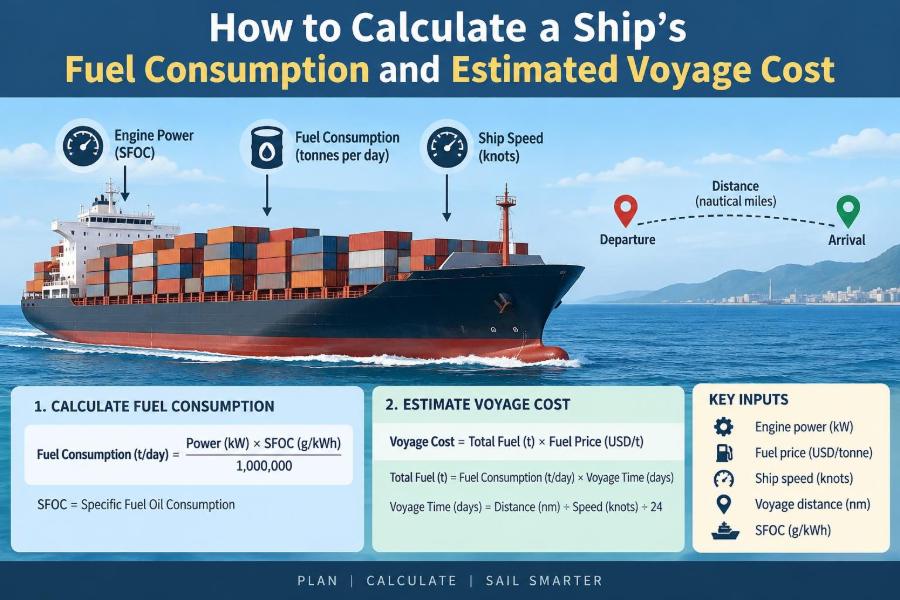
Sea time (hours) = Distance (nautical miles) ÷ Speed (knots)
Sea time (days) = Sea time (hours) ÷ 24
If a ship sails 2,400 nautical miles at 12 knots, the estimated sea time is 200 hours, or 8.33 days. This is an idealized calculation; real passages require allowance for conditions that reduce average speed.
🚢 Understand What “Service Speed” Means
Service speed is not an unconditional promise. It is usually associated with a stated draft, trim, hull condition, weather condition, engine condition, and fuel quality. A speed quoted for calm water may not be achieved economically in a loaded condition and rough sea.
For a voyage estimate, use a speed that matches the intended operating profile. The best source is often the vessel’s recent performance record, adjusted carefully for expected draft and route conditions.
🔥 Identify Every Fuel Consumer
Total voyage fuel is the sum of all meaningful consumers, not merely the propulsion engine. Typical consumers include:
- main engine during sea passage and manoeuvring;
- auxiliary engines supplying electrical power;
- oil-fired boiler or composite boiler when firing is required;
- cargo pumps, cranes, refrigeration, inert-gas systems, and ballast pumps;
- incinerators and other intermittent machinery.
Some loads are small individually but material over a long port stay. Their inclusion depends on the accuracy required and the vessel’s operating pattern.
⚙️ Use the Main-Engine Daily Consumption
Main-engine consumption is often recorded as tonnes per day at a stated speed or engine load. If the approved figure is 28 tonnes per day at the selected sea speed, then:
Main-engine sea fuel = Sea days × Main-engine tonnes per dayFor 8.33 sea days, the estimated main-engine consumption is 233.2 tonnes. This result should not yet be treated as total voyage fuel because auxiliary consumption remains to be added.
🔌 Add Auxiliary-Engine Consumption
Auxiliary-generator demand changes with operating condition. At sea, electrical demand may be modest; during cargo work, refrigeration or tanker operations, it can be much higher.
When daily consumption data are available, calculate auxiliaries separately for sea, port, and waiting periods. If generator consumption is known in tonnes per day, use the same time-based method as for the main engine.
♨️ Account for Boilers and Thermal Loads
Boiler fuel can be overlooked because it is not always consumed continuously. Yet steam may be needed for fuel heating, tank cleaning, cargo heating, accommodation services, or inert gas on relevant vessels.
Use actual operational expectations. A vessel carrying heated cargo may have a substantially different boiler demand from the same vessel on a dry-cargo voyage.
🛳️ Treat Manoeuvring as Its Own Operating Mode
Arrival, departure, canal transit, anchorage movement, and restricted-water navigation can involve low speed, frequent engine changes, tug assistance, thrusters, and increased generator loading. Consumption does not scale neatly with distance during these periods.
Where records exist, use a typical manoeuvring fuel quantity per call. Otherwise, make a transparent allowance based on prior comparable calls and identify it as an estimate.
🏗️ Estimate Fuel While in Port
Port fuel equals port duration multiplied by the port daily consumption. The duration should include expected berth time, not only cargo-working time.
Port fuel = Port days × Port consumption rateIf the vessel expects three port days at 3.5 tonnes per day, port consumption is 10.5 tonnes. Add separate allowances if cargo gear, ballast pumps, or boiler firing will materially alter the load.
⏳ Include Waiting, Drifting, and Anchorage Time
Waiting time is often commercially uncertain but operationally real. A ship at anchor may run one or more generators, maintain steam services, and periodically manoeuvre.
Do not hide this uncertainty inside an arbitrary sea-consumption figure. Enter expected waiting days separately, assign an anchorage consumption rate, and show the assumption to whoever uses the estimate.
🌊 Correct for Weather and Sea Margin
Wind, waves, swell, current, fouling, and safety-driven speed reductions can increase time at sea or demand more power to maintain speed. A weather margin is therefore an allowance for the gap between ideal performance and likely voyage conditions.
The appropriate margin depends on season, route, vessel type, and the quality of performance data. It should be based on company practice and route knowledge, rather than automatically applying one percentage to every voyage.
🧱 Consider Hull and Propeller Condition
A clean hull and propeller require less propulsive power than fouled surfaces at the same speed. Fouling increases resistance, which may raise fuel use or force a lower speed at a fixed engine load.
Recent dry-docking, underwater cleaning, time since docking, and voyage history can all affect the estimate. Performance claims from an old trial condition should not be used uncritically for a vessel with a fouled hull.
📉 Remember the Speed–Power Relationship
At normal displacement-ship operating ranges, required propulsive power rises roughly with the cube of speed. This is a rule of thumb, not a substitute for a vessel-specific performance curve.
Its practical meaning is powerful: reducing speed moderately can reduce daily fuel consumption substantially, even though the voyage takes longer. Conversely, trying to recover schedule with higher speed can become disproportionately expensive.
🐢 Compare Slow Steaming with Faster Sailing
Slow steaming lowers main-engine consumption per day but adds sea days and auxiliary consumption. Whether it reduces total voyage fuel depends on the vessel’s actual consumption curve and the additional time required.
For example, a hypothetical ship may burn 30 tonnes per day at 13 knots and 21 tonnes per day at 11 knots. The slower option should be evaluated over the full passage, not by comparing daily figures alone.
🧮 Build the Total Fuel Equation
A practical voyage-fuel formula is:
Total fuel = Sea main-engine fuel
            + Sea auxiliary fuel
            + Manoeuvring fuel
            + Port fuel
            + Anchorage/waiting fuel
            + Boiler and special-operation fuel
            + Contingency allowance
Keep each term visible in a worksheet. A transparent calculation can be checked, revised, and explained; one unexplained “total consumption” number cannot.
🛢️ Keep Fuel Grades Separate
Ships may use different fuels in different areas or equipment: very-low-sulphur fuel oil, marine gas oil, residual fuel, or other approved fuels. Prices, densities, storage limits, and compliance requirements may differ.
Calculate each grade separately when grade switching is expected. Combining all fuels into one quantity can conceal a shortage of the specific compliant fuel needed for a controlled-emission area or port requirement.
📦 Distinguish Consumption from Bunker Requirement
The fuel expected to be consumed is not necessarily the quantity to bunker. Bunker planning also considers remaining on board, unusable fuel, mandatory or company reserve, tank capacity, segregation, expected next-port availability, and pricing strategy.
Bunker quantity required = Expected consumption
                         + Required reserve
                         - Usable fuel remaining on board
Fuel remaining on board, often called ROB, must be based on reliable sounding, temperature correction where applicable, and inventory records—not an optimistic assumption.
🧯 Include a Sensible Reserve and Contingency
Reserve fuel protects the voyage against delay, adverse weather, diversions, equipment issues, and uncertainty in consumption estimates. It is a safety and operational planning matter, not simply spare inventory.
The reserve policy may be set by company procedures, charter-party obligations, route conditions, or the master’s assessment. Never reduce reserve merely to make a voyage estimate look commercially attractive.
💵 Turn Tonnes into a Fuel Cost
Once the expected consumption of each fuel grade is known, multiply each quantity by its delivered price:
Fuel cost = Fuel quantity (tonnes) × Bunker price (currency per tonne)If 280 tonnes of one fuel grade are expected to be consumed at a hypothetical delivered price of US$620 per tonne, the estimated cost is US$173,600. Price must match the intended bunker port, grade, delivery basis, and timing of the purchase.
🧾 Understand Why Bunker Price Is Not One Universal Number
Bunker prices vary by port, supplier, fuel grade, delivery arrangement, quantity, payment terms, and market movement. A quoted price may also exclude items that affect the delivered total, depending on the commercial arrangement.
Use a dated price indication and label it clearly. For planning scenarios, show a low, expected, and high price case instead of implying that a single price is certain.
📊 Calculate the Full Estimated Voyage Cost
Fuel is often the largest variable operating cost, but it is not the only voyage cost. Depending on the commercial calculation, include port charges, canal dues, pilotage, towage, agency fees, cargo-related costs, emissions-related charges where applicable, and any charter-party-specific items.
A simple structure is:
Estimated voyage cost = Fuel cost + Port costs + Canal costs
                       + Other voyage-specific costs
Do not mix fixed ownership costs, such as financing or long-term crew costs, into a voyage-cost estimate unless the purpose is specifically to calculate total operating economics.
🗂️ Work Through a Hypothetical Calculation
Consider a vessel with a planned passage of 2,400 nautical miles at 12 knots. Sea time is 8.33 days. Assume a main-engine rate of 28 tonnes per day, sea auxiliary consumption of 2 tonnes per day, two port days at 3.5 tonnes per day, 4 tonnes for manoeuvring, and a 5% contingency on operating fuel.
| Item | Calculation | Estimated fuel |
|---|---|---|
| Main engine at sea | 8.33 × 28 | 233.2 t |
| Auxiliaries at sea | 8.33 × 2 | 16.7 t |
| Port consumption | 2 × 3.5 | 7.0 t |
| Manoeuvring | Allowance | 4.0 t |
| Operating subtotal | Sum | 260.9 t |
| Contingency | 5% of subtotal | 13.0 t |
| Total estimate | Subtotal + contingency | 273.9 t |
At a hypothetical price of US$620 per tonne, the fuel-cost estimate is about US$169,800. This example is for method only; actual performance and price data can change the result considerably.
🧠 Use Specific Fuel Oil Consumption Correctly
Specific fuel oil consumption, or SFOC, expresses fuel used per unit of engine energy output, commonly in grams per kilowatt-hour. It is useful when estimating consumption from measured or planned engine power.
Fuel per day (tonnes) = Power (kW) × SFOC (g/kWh) × 24 ÷ 1,000,000SFOC varies with engine load, condition, ambient factors, fuel characteristics, and generator efficiency. Use manufacturer curves and verified operational data rather than one generic value across the entire load range.
🧪 Check Data Quality Before Trusting the Result
A precise spreadsheet can still produce a poor estimate if its inputs are weak. Compare noon reports, engine logs, flow-meter totals, bunker delivery records, shaft power, weather reports, and draft records where available.
Look for mismatches such as a consumption figure recorded at a different speed, draft, or fuel grade. A calculation is only as reliable as the operating condition attached to its data.
⚠️ Avoid Common Calculation Mistakes
- Using calendar days instead of calculated sea days.
- Applying calm-water service speed to a difficult seasonal route.
- Ignoring auxiliary and boiler consumption.
- Using one fuel price for multiple grades without checking availability.
- Forgetting canal, waiting, or manoeuvring time.
- Confusing fuel consumed with fuel that must be bunkered.
- Adding a contingency twice, once in daily rates and again at the total.
Most errors are not advanced mathematics problems. They are scope, data, and assumption problems.
📝 Present Assumptions So Others Can Review Them
A useful estimate identifies the source and basis of each input: route distance, assumed speed, draft, engine daily rate, port duration, fuel grades, price date, and contingency method. State whether figures are contractual, historical, planned, or provisional.
This makes updates fast when a port changes, weather routing lengthens the passage, or a new bunker quote arrives. It also prevents a preliminary estimate from being mistaken for a guarantee.
🔄 Update the Estimate During the Voyage
Fuel planning should continue after departure. Compare actual speed, daily consumption, and fuel remaining on board against the plan at regular intervals.
If performance drifts, revise the arrival estimate early. An updated forecast supports decisions on speed adjustment, bunkering, trim, weather routing, and communication with charterers or operators.
🌱 Link Consumption to Emissions and Compliance
Fuel burned is closely connected to emissions, so an accurate consumption estimate supports emissions monitoring and voyage reporting. Different fuels and machinery arrangements can have different reporting and compliance implications.
The calculation should not assume a fuel is compliant everywhere simply because it is available at one port. Confirm applicable area requirements, vessel approvals, changeover procedures, and company instructions for the intended voyage.
✅ The Core Principle: Build a Transparent Operating Model
The strongest fuel estimate is not the one with the most decimals. It is the one that models the actual voyage: distance and speed, operating modes, machinery loads, fuel grades, weather uncertainty, reserves, and current cost inputs.
Break the voyage into understandable parts, calculate each part using evidence-based rates, and keep the assumptions visible. That approach improves both engineering judgement and commercial decision-making.
A ship’s fuel cost becomes manageable when consumption is calculated by operating condition, checked against real vessel data, and converted to cost using clearly stated fuel-price assumptions. Good estimates are revised as the voyage and its conditions change. 🚢⚙️📊