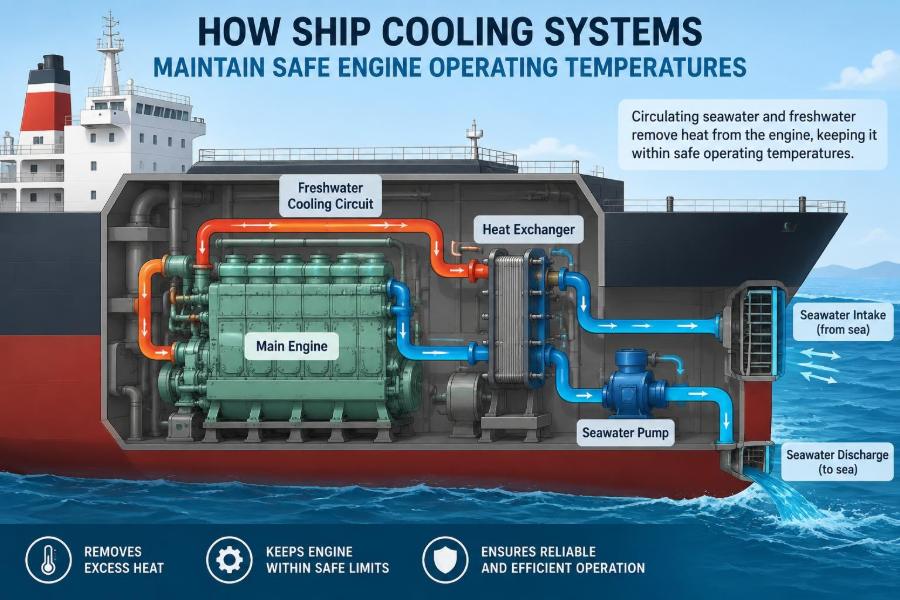

A ship’s main engine can produce enormous amounts of heat while moving a vessel across an ocean. Inside the engine room, that heat is not an abstract engineering issue: it affects lubricating oil, fuel combustion, metal clearances, electrical equipment, and the people working nearby.
Imagine a vessel leaving a cold port, then operating for days in tropical seawater with a heavily loaded propulsion engine. The engine must stay within a narrow operating temperature range despite major changes outside the hull and in the machinery space.
That job belongs to the cooling system. It is not one pipe carrying water through an engine, but a coordinated set of pumps, heat exchangers, valves, tanks, sensors, and control logic.
Understanding how this system works helps engineers recognize why a rising temperature alarm may be caused by far more than “not enough cooling water.”
🔥 Why Marine Engines Need Continuous Cooling
Only part of the chemical energy in fuel becomes useful shaft power. A significant remainder leaves with exhaust gases, radiation, and heat absorbed by engine components.
Without controlled heat removal, cylinder liners, cylinder heads, exhaust valves, turbocharger components, and lubricating oil would soon exceed their intended temperatures. Metals expand, oil films weaken, and component strength can fall.
Cooling is not intended to make an engine cold. It holds different parts at temperatures that support efficient combustion, adequate lubrication, acceptable material stress, and long service life.
⚙️ Where the Heat Comes From
Combustion is the primary source. Hot gases transfer heat through cylinder-head and liner surfaces into circulating cooling water, while piston undersides and bearings transfer heat into lubricating oil.
Friction adds heat at bearings, gears, pumps, and moving parts. Charge air compressed by a turbocharger also becomes hot and normally requires cooling before it enters the cylinders.
Auxiliary engines, generators, compressors, hydraulic power packs, and refrigeration plants create their own heat loads. A ship’s cooling arrangement therefore serves a machinery plant, not just one engine.
🌡️ The Operating-Temperature Window
Each engine maker specifies temperature and pressure limits for its circuits. These values vary with engine design, fuel, load, and operating philosophy, so a crew should use the vessel’s approved manuals rather than rely on a generic figure.
If jacket water is too cool, combustion surfaces may run below their preferred condition. This can encourage acidic condensation in some circumstances, reduce thermal efficiency, and create unstable control behavior.
If it is too hot, local boiling, excessive thermal expansion, degraded lubricating conditions, and material damage become more likely. The goal is a stable, controlled window, not simply the lowest achievable temperature.
🌊 Seawater as the Ultimate Heat Sink
Most conventional ships reject machinery heat to seawater. The sea absorbs heat through a cooler or central heat exchanger, then the warmed water returns overboard.
Seawater is plentiful, but it is not a perfect cooling medium. Its temperature changes with location and season, and it carries salt, suspended solids, organisms, and corrosive chlorides.
Those properties explain a central design principle: seawater is often kept out of the engine itself. Instead, it removes heat from a separate closed freshwater circuit.
💧 Freshwater Loops Protect the Engine
The term “freshwater” commonly refers to treated closed-circuit water, often called jacket water or cooling water. It circulates through clean internal passages in the engine and related machinery.
Chemical treatment helps control corrosion, scale formation, and cavitation-related damage. The exact treatment program depends on the engine maker, water quality, and shipboard procedures.
Keeping this circuit closed makes temperature regulation easier and reduces direct saltwater attack on expensive engine castings. It also allows inhibitors to remain at useful concentrations.
🔄 The Two-Circuit Cooling Arrangement
A common arrangement has a closed freshwater circuit on the machinery side and an open seawater circuit on the heat-rejection side. A heat exchanger transfers heat between them without normally mixing the fluids.
The freshwater pump sends warm water from engine jackets to the cooler. Seawater passes through the other side, absorbs the heat, and discharges overboard.
This separation is comparable to a radiator in a car, although marine systems are larger, often more redundant, and exposed to a much harsher external cooling medium.
🧩 Central Cooling and Conventional Systems
In a conventional arrangement, seawater may cool several separate items directly, such as jacket-water coolers, lubricating-oil coolers, and charge-air coolers. It is straightforward, but many seawater-fed exchangers require attention.
A central cooling system instead uses seawater chiefly to cool a central freshwater circuit. Individual consumers are cooled by cleaner freshwater loops, limiting seawater exposure across the machinery plant.
| Arrangement | Useful feature | Practical limitation |
|---|---|---|
| Conventional direct seawater cooling | Fewer intermediate loops | More coolers exposed to fouling and corrosion |
| Central cooling | Cleaner conditions for individual equipment | More control and piping complexity |
Neither arrangement removes the need for maintenance. The best choice depends on vessel type, machinery layout, redundancy requirements, and owner operating practice.
🛢️ Jacket Water Cools Engine Structures
Jacket water flows around hot stationary parts, particularly cylinder liners and heads. Its purpose is to limit metal temperature and keep thermal stresses within the engine’s design range.
In large low-speed engines, jacket cooling also helps protect liner surfaces while preserving conditions needed for cylinder lubrication and combustion. In medium-speed engines, the routing and number of circuits may differ, but the principle is the same.
A restriction in a single passage can create a local hot spot even when the outlet temperature seems normal. This is why trends and pressure differences matter as much as one displayed temperature.
🧯 Piston Cooling Handles Intense Local Heat
The piston crown faces some of the highest temperatures in an internal-combustion engine. Many marine engines cool pistons with lubricating oil or, in some designs, a dedicated cooling medium.
Oil may be directed through internal galleries beneath the crown, carrying heat away before returning to the lubricating-oil system. Reliable flow is essential because the piston moves continuously and experiences repeated thermal cycling.
Low oil pressure, blocked jets, contaminated oil, or incorrect clearances can compromise piston cooling. The consequence may develop quickly under high load, even if jacket-water temperatures appear satisfactory.
🌀 Charge-Air Cooling Improves Combustion Control
A turbocharger compresses intake air, and compression raises its temperature. Hot air is less dense, so an air cooler removes heat before the air enters the scavenge space or intake manifold.
Cooler, denser charge air supports the intended air supply for combustion. It can also reduce thermal loading on engine components when the engine is operating within its approved settings.
However, excessive cooling can create condensation risks in certain arrangements. Drains, air-side cleanliness, and correct temperature control all matter.
🛢️ Lubricating-Oil Cooling Preserves the Oil Film
Lubricating oil does more than reduce friction. It carries heat away from bearings, piston cooling spaces, gears, and other loaded surfaces.
If oil becomes too hot, its viscosity falls. A thinner oil film may no longer maintain the separation required between moving surfaces, increasing wear risk.
Oil that is too cold can also be undesirable because viscosity becomes high and water may not evaporate readily from the system. The oil cooler and temperature-control valve therefore aim for a specified operating range, not maximum cooling.
🚰 Pumps Create the Required Flow
Cooling capacity depends on both temperature difference and flow rate. A pump must deliver enough water through the circuit to collect heat without excessive pressure loss or inadequate distribution.
Most important cooling services have a duty pump and a standby pump, either ready for immediate use or arranged for automatic start. A standby unit is valuable only if it is maintained, correctly lined up, and capable of priming.
Loss of flow may result from pump failure, air ingress, a shut valve, a clogged strainer, worn impeller, or a blocked passage. A temperature alarm is often the later symptom of an earlier flow problem.
🧰 Heat Exchangers Transfer Heat Across a Barrier
Shell-and-tube coolers and plate heat exchangers are common onboard. Both place hot and cold fluids on opposite sides of a metal surface so heat can pass without normal fluid mixing.
Plate exchangers are compact and efficient but depend on clean narrow passages and sound gaskets. Shell-and-tube units may be more tolerant of some operating conditions and can allow mechanical tube cleaning, depending on construction.
A drop in performance may come from fouling, scale, low flow, air pockets, damaged plates or tubes, bypassing, or a reduced temperature difference between fluids.
🪸 Fouling Reduces Cooling Capacity
Marine growth, silt, shells, rust particles, and mineral deposits can accumulate in seawater systems. Even a thin deposit acts as insulation and restricts flow.
Fouling is often more severe in warm coastal waters, muddy harbors, or periods of low seawater velocity. It can also develop after a vessel spends time alongside rather than underway.
Regular strainer checks, planned cooler cleaning, and comparison of inlet and outlet temperatures help reveal deterioration before an engine reaches alarm limits.
🧂 Corrosion and Water Chemistry Need Control
Seawater is aggressive toward many metals, especially where dissimilar metals, oxygenated water, deposits, and electrical effects are present. Material selection and sacrificial anodes may reduce risk, but they do not eliminate it.
Closed freshwater systems need their own attention. Untreated or incorrectly treated water can cause corrosion products, scale, and deposits inside narrow cooling passages.
Adding chemicals without testing is not sound maintenance. Treatment concentration, test methods, and compatible products should follow the machinery maker’s and vessel operator’s procedures.
🫧 Expansion Tanks Manage Volume Changes
Water expands when heated. A header or expansion tank provides space for that change, maintains a static pressure at the high point of a closed system, and helps make up small losses.
Its level is an early indicator of leaks or abnormal consumption. A falling level may indicate an external leak, a cooler leak, venting losses, or—in serious cases—an internal engine leak.
The tank also assists air removal. Air trapped in high points can interrupt circulation and create local hot spots, which is why proper venting after maintenance is essential.
🎛️ Thermostatic Valves Regulate Temperature
A thermostatic valve automatically directs some flow through a cooler and some around it through a bypass. When the engine is cold, more bypass flow helps it warm up; as temperature rises, more flow is cooled.
This is a control device, not merely a switch. A valve that sticks open may cause overcooling, while one that sticks closed can cause overheating.
Manual bypasses are useful during testing and certain maintenance activities, but they create a risk of incorrect valve line-up. Clear tagging and independent checks reduce that risk.
📈 Sensors, Alarms, and Trend Monitoring
Temperature sensors are fitted at selected points such as engine outlets, cooler inlets and outlets, and seawater supply lines. Pressure gauges and differential-pressure indicators add information about resistance and flow condition.
A single high reading should be verified when safe to do so. Faulty sensors, poor connections, and local instrument problems can produce misleading indications.
Still, crews should never dismiss an alarm as an instrument fault without checking the system. Trends are especially valuable: a slow rise over several watches points toward fouling or declining flow, while a rapid rise suggests a sudden operational change or failure.
🚨 What a High-Temperature Alarm Can Mean
High jacket-water temperature may be caused by high engine load, insufficient seawater flow, a dirty cooler, low freshwater level, a failed pump, a stuck valve, air in the circuit, or an internal restriction.
The alarm identifies a condition, not its root cause. Reducing load may lower heat generation and buy time, but it does not repair the fault.
- Confirm the reading and compare related temperatures and pressures.
- Check pump status, tank level, valve positions, and strainer condition.
- Assess whether seawater temperature or engine load has changed.
- Follow the vessel’s approved alarm and slowdown procedures.
Actions must be appropriate to the engine maker’s instructions and navigational situation. Abrupt changes can create separate operational hazards.
⚠️ Low Temperature Is Not Automatically Safe
A system can be “cooling well” in the narrow sense of producing low outlet temperatures while still operating poorly. Excessive bypass changes, a failed thermostat, or very cold seawater can push temperatures below intended values.
Low temperatures can promote incomplete fuel vaporization in some engines, water contamination concerns in lubricating oil, and cold corrosion mechanisms in conditions where acidic products condense on surfaces.
Temperature control must therefore balance heat rejection against correct engine thermal conditions. This is why design setpoints and manufacturer guidance matter.
🔍 Recognizing Cooler Leakage
A leaking heat exchanger can allow seawater and freshwater—or oil and water in an oil cooler—to cross-contaminate. The direction of leakage often depends on relative circuit pressures.
Signs can include unexplained header-tank level changes, salinity in closed cooling water, oil contamination, unusual pressure behavior, or persistent losses with no visible external leak.
Early detection is valuable because seawater contamination can accelerate internal corrosion. Testing and isolation methods must be performed according to the equipment procedure; incorrect pressure testing can damage plates, tubes, or seals.
🧪 Water Testing Supports Reliable Operation
Routine sampling provides information that a temperature gauge cannot. Depending on the treatment program, checks may cover inhibitor concentration, alkalinity or pH-related condition, chloride contamination, hardness, and visible contamination.
Results should be trended rather than treated as isolated pass-or-fail events. A gradual change can show dilution, leakage, chemical depletion, or contamination before machinery symptoms become obvious.
Samples must be taken safely from designated points. Hot pressurized water presents a burn hazard, and an unrepresentative sample can lead to the wrong corrective action.
🧹 Maintenance Focuses on Heat Transfer and Flow
Effective maintenance preserves clean surfaces, open flow paths, correct pump performance, and dependable controls. It combines routine watchkeeping with planned work during suitable operating windows.
Practical maintenance priorities
- Clean sea chests and strainers at intervals suited to local conditions.
- Inspect cooler differential pressures and temperature approaches for signs of fouling.
- Service pumps, seals, bearings, and standby arrangements as planned.
- Inspect anodes, gaskets, valves, vents, and flexible connections where fitted.
- Record water-treatment results and investigate unusual trends.
Opening a cooler unnecessarily can introduce gasket and reassembly risks. Maintenance intervals should be guided by condition, maker guidance, and the vessel’s planned maintenance system.
🧭 Operating Conditions Change the Heat Balance
Cooling demand rises with engine load because more fuel is burned and more heat is produced. High ambient air temperature may also raise machinery-space temperatures and reduce the effectiveness of some auxiliary cooling paths.
Warm seawater reduces the temperature difference available across a cooler. A system that performs comfortably in cold water may operate closer to its limits in tropical service.
Engineers should anticipate these changes during load increases, restricted-water maneuvering, or seasonal route changes. Waiting for an alarm leaves fewer safe options.
🚢 Maneuvering Creates a Different Cooling Challenge
During maneuvering, propulsion-engine load can change rapidly. Repeated acceleration, deceleration, and reversing alter heat generation faster than a large cooling system can always respond.
Seawater intake conditions may also worsen in shallow, silty, or debris-prone water. A strainer can clog faster than it would in open sea.
Close monitoring is particularly useful at these times. Good watchkeeping means recognizing that a normal cruising trend may not predict behavior during frequent load changes.
🧑🔧 Human Factors and Valve-Lineup Discipline
Many cooling failures involve an otherwise healthy component placed in the wrong configuration after maintenance. A closed suction valve, open drain, mispositioned bypass, or isolated vent can defeat a well-designed system.
Clear procedures, valve labels, checklists, and handovers reduce this risk. Critical line-ups should be verified physically rather than assumed from a previous watch’s report.
When work is complete, a controlled restart should include leak checks, venting, level verification, and observation of temperatures and pressures as load increases.
🧯 Common Troubleshooting Mistakes
A frequent mistake is replacing parts before understanding the heat path. For example, changing a temperature sensor may be justified, but only after comparing it with independent indications and checking whether the system behavior supports the reading.
Another mistake is treating a dirty seawater strainer as the only possible cause of overheating. A clean strainer does not prove adequate pump delivery, correct valve position, clean cooler passages, or healthy freshwater circulation.
Avoid opening pressurized equipment, adding cold water to an overheated engine, or bypassing protective alarms outside approved procedures. These actions can turn a manageable problem into equipment damage or personal injury.
📋 A Logical Fault-Finding Sequence
Systematic troubleshooting prevents wasted effort. Start by establishing what has changed: load, sea temperature, recent maintenance, valve operation, water level, or alarm pattern.
- Verify indications using related instruments and safe cross-checks.
- Compare actual values with approved normal ranges and recent trends.
- Check flow evidence: pump condition, suction availability, pressure, and differential pressure.
- Check heat-transfer evidence: cooler temperatures, bypass position, and seawater conditions.
- Inspect for leakage, air ingress, restrictions, and incorrect line-up.
- Reduce load or stop equipment when required by the operating instructions.
This sequence does not replace ship-specific emergency procedures. It provides a disciplined way to move from symptom to probable cause.
🧠 Design Redundancy Improves Resilience
Marine machinery is designed around the possibility of component failure, but the level of redundancy varies. Standby pumps, duplex strainers, parallel coolers, and cross-connections can allow continued or limited operation while a fault is addressed.
Redundancy has limits. A standby seawater pump cannot solve a blocked sea chest, and parallel coolers cannot compensate for an untreated freshwater circuit indefinitely.
Operators must understand which backups are immediately available, what they share in common, and what restrictions apply when using them.
🧩 The Core Principle: Control Heat, Flow, and Cleanliness
Reliable ship cooling depends on three connected conditions: heat must have a path out of machinery, cooling fluids must circulate at the required rate, and heat-transfer surfaces must remain clean enough to work.
Temperature control then keeps the system within its intended operating window. Pumps, valves, tanks, chemicals, sensors, and crew routines all support that one outcome.
The strongest practice is preventive rather than reactive: monitor trends, maintain treatment, protect seawater intakes, verify line-ups, and investigate small changes before they become operating limits.
A marine cooling system maintains safe engine temperatures by moving heat through clean, controlled circuits—not by simply sending more water through the engine. When engineers understand the complete heat path, alarms become useful clues rather than isolated emergencies. 🌊⚙️🧭