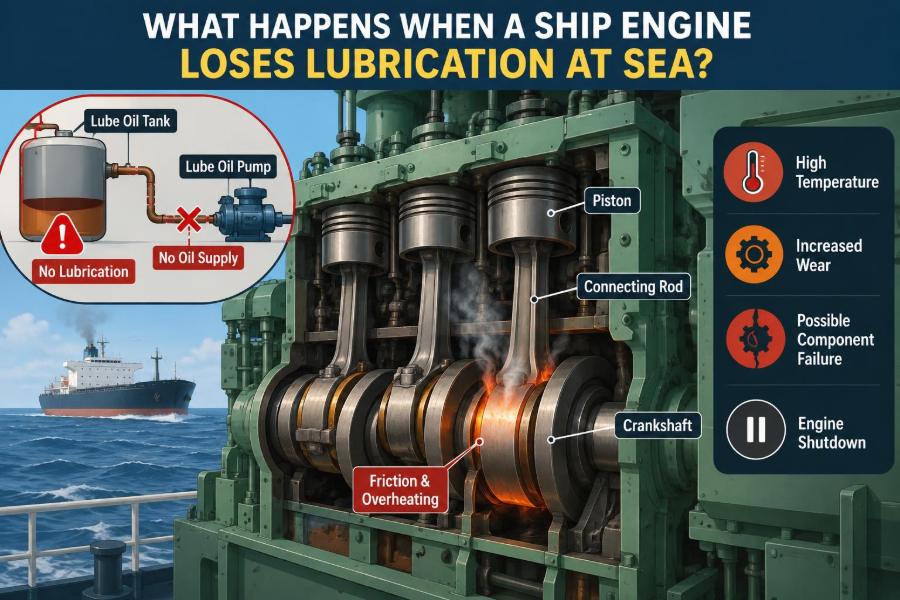

A ship is making a routine passage when an engineer notices an abnormal bearing-temperature trend. The lubricating-oil pressure has dipped, perhaps only briefly. The main engine is still turning, the bridge still has propulsion, and there may be no smoke or noise yet.
That is exactly what makes lubrication failures dangerous. By the time a large marine diesel engine announces the problem with a loud knock, a seized component, or a protective shutdown, damaging metal-to-metal contact may already have occurred.
Lubricating oil is not simply something poured into an engine to make it “slippery.” It is a working fluid that carries load, removes heat, controls contamination, protects surfaces, and provides early warning of machinery condition.
At sea, the consequences also extend beyond the engine room. A loss of propulsion can affect navigation, manoeuvring near traffic or land, cargo operations, schedules, and the safety of everyone on board.
⚙️ What Engine Lubrication Actually Does
In a marine engine, oil forms a thin film between moving surfaces such as crankshaft journals and bearings. This film separates the surfaces so they can carry high loads without directly rubbing together.
The oil also removes heat from loaded components, flushes small wear particles toward filters, helps seal certain clearances, and protects internal surfaces against corrosion during operation. A lubrication system therefore supports both reliability and heat control.
On a large slow-speed two-stroke engine, the system is commonly divided between circulating system oil for the crankcase and cylinder oil supplied separately to the liners. Medium- and high-speed four-stroke engines generally use a shared circulating oil system for many internal components, although arrangements vary by design.
🛢️ The Essential Lubricating-Oil Circuit
A typical circulating-oil system includes a sump or drain tank, suction strainers, pumps, coolers, filters, pressure-control valves, distribution galleries, and return drains. Oil leaves the tank, is pumped and conditioned, reaches bearings and other consumers, then drains back for reuse.
Many installations have a main engine-driven pump and an electrically driven standby or pre-lubrication pump. The standby pump may start automatically if pressure falls, but it cannot solve every failure. A blocked filter, an empty sump, an open bypass, or internal bearing damage may remain critical even if a pump is running.
🧪 Why the Oil Film Carries So Much Load
When a shaft rotates in a correctly loaded plain bearing, it draws oil into a narrowing clearance. The motion and geometry generate pressure in the oil film, allowing the shaft journal to ride on that film. This is called hydrodynamic lubrication.
A useful analogy is water skis: the skis stay above the water only while there is enough speed and the right surface condition. If oil supply, viscosity, shaft speed, or clearance becomes unsuitable, the protective film weakens and surfaces begin to touch.
At starting, stopping, very low speed, or under abnormal loading, lubrication can enter mixed or boundary regimes. In these conditions, anti-wear additives and correct surface condition matter more, but neither can compensate for a sustained loss of oil supply.
📉 The First Sign: A Pressure Drop
Low lube-oil pressure is an alarm condition, not automatically proof that every bearing lacks oil. Pressure is measured at a particular point, while the real question is whether each critical component receives sufficient flow and maintains a stable oil film.
A sudden pressure fall may result from pump failure, loss of suction, a burst pipe, a stuck relief valve, a major internal leak, or severe aeration. A gradual decline may point toward cooler problems, suction restrictions, filter loading, falling oil level, or changes in oil temperature and viscosity.
Engineers must read pressure alongside temperature, tank level, filter differential pressure, pump current, engine load, and recent operational changes.
🔊 What Crews May Notice First
Automatic alarms are usually the earliest warning, but human observations remain valuable. A change in engine sound, an unusual smell near a bearing space, mist formation, increasing bearing temperature, or abnormal vibration can all require immediate attention.
- Low lubricating-oil pressure or low-flow alarm
- High bearing, piston-cooling, or oil-outlet temperature
- Rising filter differential pressure
- Low sump or drain-tank level
- Milky, foamy, darkened, or burnt-smelling oil
- Unusual crankcase mist detector indication, where fitted
No single symptom should be interpreted alone. For example, hot oil may reduce viscosity and pressure, but hot oil may itself be caused by reduced cooler performance or friction within a distressed bearing.
🔥 Why Heat Rises So Quickly
Friction converts mechanical work into heat. With a healthy oil film, friction is low and the oil removes much of the heat. Once direct contact begins, friction rises sharply, and the remaining oil film can degrade further as its temperature increases.
This creates a damaging feedback loop: less separation causes more heat; more heat thins the oil and may oxidize it; thinner or degraded oil reduces film strength. Under heavy engine load, the progression can be fast.
🧱 Bearing Damage: The Usual Early Casualty
Plain bearings in marine engines often use a steel backing with a softer bearing lining. The soft layer is deliberately designed to embed small particles and accommodate minor misalignment, but it has finite capacity.
During oil starvation, the lining may wipe, smear, score, or melt. A bearing can then lose clearance, grab the journal, and transfer material onto the shaft surface. This is far more serious than ordinary wear because a damaged journal may require machining or replacement.
Crankpin, main, camshaft, crosshead, and thrust bearings all face different loads, but each depends on a dependable oil supply.
🌀 From Bearing Wipe to a Seizure
“Seizure” describes a condition in which surfaces bind together rather than sliding freely. In a rotating machine, this may stop the shaft, damage connecting rods, or overload gear trains and couplings.
It does not always happen instantly. An engine may continue to rotate while a bearing deteriorates, which can tempt operators to keep going. Continuing at load after credible evidence of oil starvation is often what turns a repairable defect into a major casualty.
Protective trips exist to interrupt that escalation, but their settings and logic differ between engines. They do not remove the crew’s duty to investigate a persistent alarm.
🚢 What the Bridge Experiences
If the main engine trips or must be stopped, the bridge loses normal propulsion. The vessel may still have steering, electrical power, tugs, anchors, or a second propulsion unit, depending on its design and operating condition, but none should be assumed without confirmation.
In open water, the immediate navigational risk may be manageable. In a narrow channel, near a berth, in heavy weather, or close to offshore structures, reduced manoeuvrability can become urgent. Engine-room and bridge teams must communicate promptly and use the vessel’s emergency procedures.
🧭 The First Operational Priority: Protect the Ship
A machinery failure at sea is both a technical and navigational event. The duty engineer should notify the responsible engineer and control room without delay, while the bridge needs clear, plain-language information about propulsion capability and expected restrictions.
Actions may include reducing load, stopping the engine, placing standby machinery in service, preparing anchors where appropriate, requesting tug assistance, broadcasting as required by the vessel’s procedures, and reassessing the passage plan.
The correct response is situation-dependent. The common principle is simple: do not treat a lubrication alarm as an engine-room-only problem.
🛑 Reduce Load or Stop? The Critical Decision
If pressure is briefly low during a known transition and returns to normal with all supporting readings satisfactory, the response may differ from a sustained low-pressure alarm with falling tank level. The engine manufacturer’s instructions and the vessel’s safety management procedures should govern.
However, a suspected failure of oil delivery to critical bearings generally calls for rapid load reduction or stopping. Running slowly is not automatically safe; at low shaft speed, hydrodynamic film formation can be weaker, and reduced pump speed may also reduce flow on systems driven by the engine.
Never defeat an alarm or trip simply to preserve schedule. A protective shutdown is inconvenient; a seized crankshaft can remove propulsion for far longer.
🔍 Finding the Cause Before Restarting
Restarting without understanding the cause risks a repeat failure. The investigation begins with safe isolation and a disciplined check of the oil circuit rather than immediate dismantling of the largest component.
- Confirm actual oil level and look for leakage, overflow, or transfer errors.
- Compare local gauges with remote indications where possible.
- Check which pump was running, suction conditions, discharge pressure, and standby-pump response.
- Inspect filter differential pressure, bypass position, and visible debris.
- Review cooler temperatures, cooling-water flow, and thermostatic-valve operation.
- Check for water ingress, foam, fuel dilution, or abnormal oil appearance.
Evidence can disappear if oil is topped up, filters are changed, or valves are moved without recording their initial condition. Good engineers document first, then restore the system methodically.
💧 Low Oil Level and Loss of Pump Suction
A low sump or drain-tank level can expose a pump suction during rolling, pitching, or rapid manoeuvring. Air enters the suction line, the pump may cavitate or lose prime, and delivery becomes unstable.
Oil can be lost through leaks, incorrect tank transfers, separator arrangements, drain errors, or failure to account for oil held in external equipment. A level indication may also be misleading if a float sticks or a sight glass is misread.
Keeping a safe operating margin is not merely good housekeeping. It helps the system tolerate vessel motion and allows entrained air to separate before the oil returns to the pump.
🌬️ Aeration and Foaming
Air in oil reduces its ability to form a strong, continuous lubricating film. Foamy oil can compress under load, disturb pump delivery, and contribute to erratic pressure readings.
Aeration may arise from low tank level, suction leaks, excessive return-line turbulence, wrong oil type, contamination, or over-aggressive mixing. The remedy is not always an antifoam additive; the source of air entry or turbulence must be found.
Foam also makes level assessment difficult. A tank that looks full of bubbles may contain less usable liquid oil than it appears to contain.
🧊 Cooler Failure and Incorrect Oil Temperature
Oil temperature affects viscosity, or resistance to flow. If the oil becomes too hot, it thins and may struggle to maintain film thickness under high bearing load. Oxidation also accelerates as oil is exposed to excessive heat over time.
Oil that is too cold is not ideal either. It can be overly viscous, create high pressure before filters, and flow poorly through small passages. Temperature-control valves, cooler cleanliness, and correct cooling-water flow all influence the usable operating range.
Pressure alone can mislead here: cold, thick oil may show high pressure while still reaching remote consumers slowly.
🧹 Filters, Strainers, and Bypass Valves
Filters remove contaminants that would otherwise score bearings and plug fine passages. As filters load up, differential pressure rises. Many systems have changeover filters or bypass arrangements to maintain oil flow during servicing or high restriction.
A bypass can prevent starvation caused by a blocked element, but it may allow unfiltered oil to circulate. It is a temporary protection against one risk, not a normal operating mode.
Finding metallic debris in a filter is especially significant. It may be the cause of damage, or evidence that damage has already begun elsewhere. The material, quantity, and likely source should be assessed before deciding on further operation.
⚗️ Water, Fuel, and Other Contamination
Water contamination can reduce lubricity, promote corrosion, disturb additives, and create emulsions. Fuel dilution can lower viscosity and reduce flash point. Solid particles can abrade bearings and act like grinding compound in loaded clearances.
Common sources include leaking coolers, defective seals, poor purification, condensation, incorrect top-up practices, and cross-contamination during storage or transfer. On trunk-piston engines, fuel leakage past piston rings is another possible route for fuel into crankcase oil.
Laboratory oil analysis is a useful trend tool, but it is not a substitute for responding to alarms. A sample reports what was in the bottle at one moment; a live system may be changing rapidly.
🧫 Reading Oil Analysis Sensibly
Used-oil analysis can indicate viscosity change, water, insolubles, oxidation, additive depletion, and wear metals. The most useful interpretation compares results with the same engine’s previous samples, the oil supplier’s limits, and manufacturer guidance.
An isolated elevated metal value does not automatically identify a failed bearing. Sampling method, recent maintenance, contamination, and the location from which the sample was drawn all matter. Trends and corroborating evidence are stronger than a single number.
Routine sampling gives crews a chance to investigate deterioration before it becomes an operational alarm.
🧰 Pumps, Drives, and Relief-Valve Problems
A pump may fail mechanically, lose drive, suffer worn internals, run with a blocked suction, or draw air. Even a healthy pump cannot build correct pressure if a relief valve is stuck open or a pressure-control valve is incorrectly set.
Conversely, high pressure is not automatically good news. It may indicate cold oil, a blocked downstream filter, a closed valve, or a restriction that deprives parts of the engine beyond it.
Maintenance teams should verify valve positions after work and use independent indications where possible. An incorrect lineup after routine maintenance is a preventable source of serious trouble.
🧩 Distribution Failures Beyond the Main Gauge
A normal reading at the main oil gallery does not guarantee that every branch line is clear. A blocked jet, damaged pipe, restricted drilling, or local leak can starve one component while system pressure looks acceptable.
This is why local temperatures, bearing inspections, piston-cooling return observations, and condition-monitoring trends matter. The main gauge tells a system-level story; a local defect may be hidden within it.
For example, a turbocharger bearing or camshaft bearing may suffer from a restricted supply even while crankcase pressure remains within its expected range.
🛠️ Damage Inspection After an Oil-Starvation Event
The scope of inspection depends on the severity, engine type, alarms received, and operating history. It may range from checking filters and temperatures to opening crankcase doors after the required cooling period and inspecting bearing caps, journals, and oil passages.
Safety controls matter. Before crankcase entry, crews must follow isolation procedures, ventilation requirements, and the manufacturer’s precautions. A recent hot bearing or crankcase event can create hazards beyond the original lubrication fault.
Discoloured metal, wiped bearing material, scoring, blocked drillings, or unusual clearances can all guide the repair plan. Decisions about polishing, re-metalling, replacing parts, or seeking specialist support should follow approved technical guidance.
💥 Crankcase Mist and Secondary Hazards
Overheated bearing surfaces can vaporize oil and create an oil mist inside the crankcase. If the mixture reaches an ignitable condition and a hot spot is present, there is a risk of a crankcase explosion.
Modern engines may use oil-mist detectors, bearing-temperature monitoring, and crankcase relief devices to reduce risk. These protections are valuable, but they are not permission to open a hot crankcase immediately after an alarm or trip.
Follow the engine maker’s waiting periods and shipboard procedures. Opening too soon can admit fresh air into an atmosphere that may still contain flammable mist.
🧯 Why Protective Devices Must Be Respected
Low-pressure alarms, automatic standby-pump starts, slowdowns, and shutdowns are layers of defense. Their purpose is to reduce damage when the underlying failure has not yet been identified.
Bypassing a device may occasionally be permitted under tightly controlled emergency procedures and with proper authority, but it is never a casual troubleshooting technique. A bypass changes the risk picture and should be treated as an exceptional, documented decision.
Testing alarms and trips during planned maintenance is essential because an untested safeguard may fail precisely when a crew needs time to react.
📋 A Practical Immediate-Response Sequence
Exact actions must follow the vessel’s procedures and machinery manual. Still, a general response sequence helps explain the priorities:
- Acknowledge the alarm and verify the reading using available independent indications.
- Inform the bridge and responsible engineering officer of the propulsion risk.
- Reduce load or stop as required by the alarm severity, instructions, and observed condition.
- Start or confirm standby lubrication arrangements if the design permits.
- Check level, leaks, pump suction and discharge, filter condition, and oil temperature.
- Do not restart until the cause, engine condition, and restart precautions have been assessed.
Speed matters, but random action wastes the few minutes in which a developing bearing problem may still be contained.
🧑🔧 Good Watchkeeping Prevents Escalation
Effective watchkeeping is built on trends. Engineers should know the normal pressure, temperature, level, and filter behaviour for their specific plant, not just the alarm set points.
A small but persistent change after a fuel changeover, maintenance task, rough-weather period, or cooler cleaning can be more informative than a single normal reading. Log entries should describe abnormalities clearly enough for the next watch to continue the investigation.
Rounds also matter because leaks, oil spray, noise, and smells are often found locally before an automation system identifies their cause.
🧠 Common Mistakes During Troubleshooting
One frequent mistake is adding oil immediately without first checking where it went. This can conceal a leak or transfer error and make the later investigation harder.
Another is assuming a pressure alarm is a faulty sensor. Sensors do fail, but treating every inconvenient reading as an instrumentation fault can delay a necessary shutdown. Verify the signal; do not dismiss it.
- Changing a dirty filter without inspecting and retaining evidence of debris
- Restarting at high load before oil temperature and circulation stabilize
- Leaving a bypass open after temporary use
- Ignoring a recurring low-level alarm because the level “looks close enough”
- Opening a hot crankcase before the prescribed waiting time
🔧 Maintenance That Protects the Oil System
Prevention combines routine care with correct planning. Tanks need periodic cleaning, strainers and filters need attention, coolers require inspection and cleaning, and pumps and valves need functional checks.
Oil purification is also central. Separators remove water and solids when correctly operated, but their effectiveness depends on temperature, throughput, gravity-disc or interface arrangements where applicable, and the nature of the contamination.
After maintenance, a deliberate valve-lineup check and leak inspection are as important as the repair itself. Many lubrication failures begin with a simple configuration error rather than a failed major component.
📦 Choosing and Handling the Right Oil
Marine lubricants are selected for a specific engine, fuel, operating temperature, load pattern, and manufacturer requirement. Viscosity grade and additive package are functional properties, not interchangeable labels.
Mixing incompatible oils can weaken additive performance or create deposits. Storage tanks, transfer hoses, sampling equipment, and top-up containers should be clean and clearly identified to avoid accidental cross-contamination.
For two-stroke cylinder oils, base number selection is linked to fuel sulphur level and engine-maker guidance. It should not be changed by habit alone, because liner condition and deposit control must also be considered.
🌊 Rough Weather Changes the Picture
Heavy rolling and pitching can uncover suction bells in low tanks, aerate oil, disturb tank sediments, and make level readings less reliable. Systems are designed with operational margins, but those margins can be eroded by low inventory or poor tank condition.
Before expected heavy weather, engineers commonly verify oil levels, secure transfer arrangements, check standby equipment, and increase vigilance on temperatures and pressures. This is practical risk control, not merely a checklist exercise.
⚖️ Repair at Sea or Await Assistance?
Some faults can be corrected at sea: a changed filter, restored oil level, corrected valve position, or repaired minor external leak may allow safe return to service after verification. Others, such as suspected main-bearing damage or a scored crankshaft journal, may require restricted operation, diversion, or specialist assistance.
The decision depends on evidence, available spares, manufacturer instructions, weather, location, redundancy, and the consequences of a second failure. The safest option is not always an immediate full repair, but it must be based on a realistic assessment of remaining risk.
📚 Training Turns Alarms into Decisions
Engine-room teams need more than memorized alarm responses. They need to understand why oil pressure changes with temperature, why a standby pump may not cure local starvation, and why a bearing can fail while the engine still appears to run normally.
Drills, simulator practice, fault-finding discussions, and post-maintenance reviews help build that judgment. Clear communication between the engine room and bridge is equally important because technical uncertainty must be translated into operational decisions.
✅ The Core Lesson: Oil Is a Safety System
Loss of lubrication is not a minor service issue. It can progress from a pressure fluctuation to bearing distress, overheating, seizure, crankcase hazards, and loss of propulsion if the underlying fault is not controlled.
The most effective defense is layered: correct oil and inventory, clean and properly lined-up equipment, reliable alarms, trend-based watchkeeping, disciplined investigation, and a willingness to reduce load or stop before damage spreads.
Every engine has its own limits and procedures, so crews must use the manufacturer’s documentation and vessel safety system. Yet the engineering principle remains universal: protect the oil film, and the oil film protects the machine.
When a ship engine loses lubrication at sea, the right response is early recognition, controlled action, and no compromise with a warning that could become irreversible damage. ⚓🛢️🧭