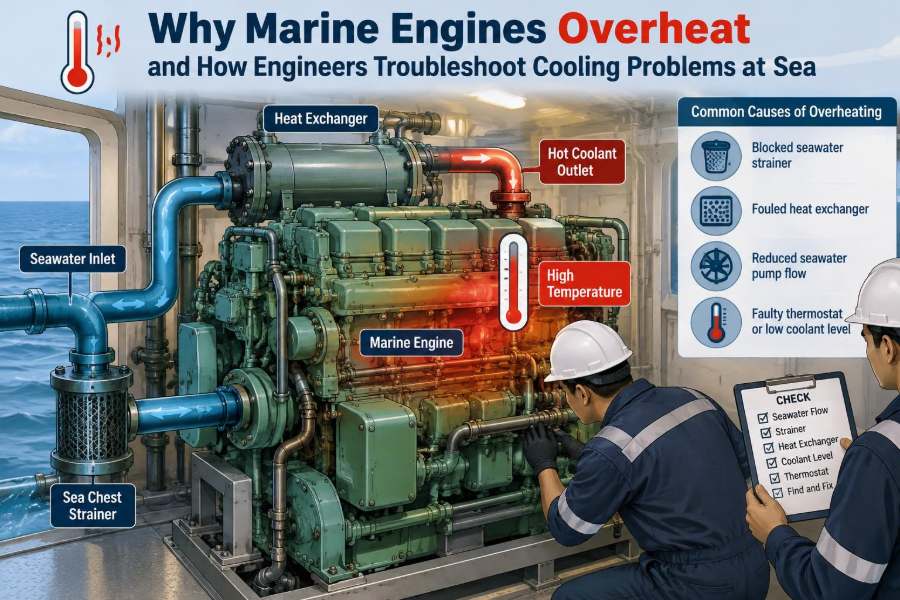

The alarm sounds during a routine watch: jacket-water temperature is rising, exhaust temperatures are beginning to spread, and the engine room suddenly feels less routine. A few degrees may not demand an immediate shutdown, but they demand attention. On a ship, heat that is not controlled can quickly become a machinery, safety, and operational problem.
Marine engines are built to work hard for long periods, often far from repair facilities and spare parts. Their cooling systems therefore do more than prevent discomfort or protect lubricating oil. They keep metal components within the temperature range where clearances, lubrication, combustion, and strength remain predictable.
Overheating is rarely a single mystery. It is usually the visible result of a heat-transfer problem: too much heat is being produced, too little is being carried away, or a control system is not directing the cooling flow as intended.
Good troubleshooting is not guesswork or an immediate rush to change parts. It is a disciplined comparison of temperatures, pressures, flows, loads, and recent operating changes. That approach helps engineers protect the engine while finding the real fault.
🔥 What “Overheating” Actually Means
An engine is overheating when a monitored component or cooling circuit exceeds its normal operating range, or when its temperature rises abnormally fast. The affected reading may be jacket water, piston cooling oil, lubricating oil, charge air, exhaust gas, or a local metal temperature.
A high temperature alarm is therefore a symptom, not a diagnosis. High jacket-water outlet temperature may arise from low seawater flow, restricted freshwater circulation, excessive load, poor combustion, or even a misleading sensor.
⚙️ Where the Engine’s Heat Comes From
Fuel releases energy during combustion, but only part of that energy becomes useful shaft power. A large share leaves with exhaust gases, while other heat passes through cylinder liners, heads, pistons, valves, bearings, and turbocharger components.
The cooling system moves this unwanted heat away before component temperatures become harmful. Think of it as a continuous heat-collection service: hot surfaces transfer heat to a liquid, the liquid transfers it to another medium, and the cycle repeats.
🌊 The Two Main Cooling Loops
Most seagoing engines use separate freshwater and seawater circuits. The freshwater circuit, often called the jacket-water circuit, circulates treated water around engine components. The seawater circuit carries heat away through coolers and eventually discharges it overboard.
Keeping these fluids separate protects the engine from saltwater corrosion and deposits. It also allows the freshwater side to operate at a controlled temperature, rather than being dictated directly by changing sea conditions.
🔄 Central Cooling and Direct Cooling Arrangements
In a direct cooling arrangement, seawater may cool individual equipment coolers more directly. In a central cooling system, seawater cools a central freshwater circuit, while several machinery consumers use separate freshwater loops.
Central cooling reduces the amount of seawater passing through sensitive machinery coolers. It can simplify corrosion control, but it adds heat exchangers, valves, pumps, and control logic that must all work correctly. Troubleshooting must begin by identifying the actual flow path on that vessel.
📏 Why Temperature Difference Matters More Than One Reading
A single temperature can warn that something is wrong, but the difference between inlet and outlet temperatures often explains more. Across a cooler, that difference indicates whether heat is being transferred. Across an engine, it helps indicate whether the coolant is collecting heat normally.
For example, a very hot engine outlet combined with an unusually cool cooler outlet may suggest poor coolant circulation. A hot seawater outlet with a small freshwater temperature drop may point toward insufficient heat transfer or excessive engine heat load. The interpretation always depends on flow and the system’s normal trend.
🧮 The Basic Heat-Balance Idea
Engineers often reason from a simple principle: heat removed depends mainly on fluid flow, the fluid’s capacity to absorb heat, and its temperature rise. In simplified form, heat transfer can be expressed as Q = m × cp × ΔT, where m is mass flow, cp is specific heat capacity, and ΔT is temperature change.
This does not mean every fault can be solved with one calculation. Flow is often not measured directly, instruments have tolerances, and control valves alter circuit behavior. Still, it explains why a blocked strainer, weak pump, or reduced cooler performance can raise temperatures.
🚢 Excessive Engine Load as a Heat Source
An engine can overheat because it is producing more heat than the cooling system can reject. Heavy weather, fouled hull and propeller surfaces, incorrect propeller pitch, towing load, or an over-fuelled engine can all increase load.
Before treating an alarm as a cooling-system failure, compare engine power, fuel index, shaft speed, scavenge pressure, and exhaust temperatures with normal operating records. If temperatures rose after a major load increase, reducing load is often the first protective action while investigation continues.
🧺 Sea Chest and Strainer Restrictions
Seawater must first enter through a sea chest, then pass through strainers and suction piping. Marine growth, plastic debris, silt, jellyfish, scale, or an incorrectly positioned valve can restrict this path.
A dirty strainer is a common and practical cause of weak cooling, especially after port stays, shallow-water operations, or passage through debris. Differential pressure, suction conditions, pump discharge pressure, and the physical contents of the strainer all provide useful evidence.
🌀 Seawater Pump Problems
A pump may be running without delivering its designed flow. Worn impellers, damaged wear rings, internal corrosion, slipping drives, air ingress on the suction side, or a partially shut discharge valve can reduce capacity.
Centrifugal pumps are particularly sensitive to poor suction conditions. If air enters the line or suction resistance is excessive, the pump may lose prime or cavitate. Cavitation creates vapor bubbles that collapse inside the pump, causing noise, vibration, reduced flow, and gradual damage.
💧 Freshwater Circulation Failures
The jacket-water pump must circulate coolant through the engine at an adequate rate. A defective pump, worn impeller, loose coupling, blocked passage, or air pocket can produce local hot spots even before the main outlet temperature becomes alarming.
Low freshwater flow may show as a larger-than-normal temperature rise across the engine, unstable temperatures, or localized cylinder differences. Engineers should not assume that a full expansion tank proves good circulation; fluid level and fluid movement are different things.
🧊 Fouled Heat Exchangers
Coolers rely on clean metal surfaces and unrestricted passages. On the seawater side, marine growth, scale, mud, and corrosion products reduce flow and insulate the heat-transfer surface. On the freshwater side, rust, sludge, treatment chemical imbalance, and oil contamination can have a similar effect.
Plate heat exchangers can lose performance through blocked channels or damaged gaskets. Shell-and-tube coolers can suffer from tube fouling or bypassing. A gradual temperature deterioration over weeks often fits fouling better than a sudden obstruction, although operating history matters.
🧪 Cooling-Water Quality and Chemical Treatment
Freshwater cooling systems need controlled water chemistry. Untreated or poorly treated water can cause corrosion, scale formation, and sludge, all of which restrict passages and weaken heat transfer.
Treatment should follow the engine maker’s requirements and the vessel’s water-management procedures. Overdosing chemicals is not a universal cure; it can introduce its own problems. Testing, recording, and correcting the actual condition is safer than treating by assumption.
🚧 Air Locks, Venting, and Lost Circulation
Air trapped at high points can interrupt coolant flow and create hot areas around cylinder heads or cooler sections. Air may enter after maintenance, through leakage on a suction side, or because a system was filled too quickly without proper venting.
Symptoms may include fluctuating temperatures, erratic expansion-tank level, poor heater performance, or a component that remains much hotter than nearby equipment. Venting must be carried out using the approved procedure because hot pressurized coolant can cause serious injury.
🎛️ Thermostatic Valves That Do Not Regulate
Thermostatic valves maintain a minimum operating temperature by routing coolant around or through a cooler. If a valve sticks closed toward the cooler path, cooling capacity falls. If it sticks open, the engine may run too cool, which can also harm efficiency and increase deposits.
A valve should be assessed from temperatures on both branches, its commanded or designed position, and maintenance history. Replacing it solely because an outlet temperature is high can miss the real issue, such as a cooler with poor seawater flow.
🧭 Control Valves, Bypasses, and Wrong Line-Ups
Manual isolating valves, automatic three-way valves, and bypass lines are useful during maintenance and temperature control. They are also frequent sources of accidental misalignment. A valve left partly shut after work can create a restriction that looks like pump trouble.
Line-up checks should use the current piping diagram and valve-position indications, not memory alone. On complex systems, trace the flow from suction to discharge and confirm that a bypass is not quietly returning most of the flow without using the cooler.
🛢️ Lubricating-Oil Cooler and Oil Temperature
High lubricating-oil temperature may be caused by poor cooler performance, but it can also reflect a lubrication problem. High bearing friction, low oil level, incorrect oil grade, excessive load, or internal leakage can add heat to the oil.
Oil temperature needs interpretation alongside pressure, filter differential pressure, bearing temperatures, and engine load. Reducing temperature by forcing a cooler bypass closed may mask the immediate symptom while an underlying mechanical fault continues.
🌬️ Charge-Air Cooling and Turbocharger Effects
Turbocharged engines depend on charge-air coolers to reduce the temperature of compressed intake air. Cooler, denser air supports cleaner and more controlled combustion. Fouling on air or water sides can raise scavenge-air temperature and contribute to higher exhaust temperatures.
A charge-air problem is not identical to jacket-water overheating, but the systems can be connected through a shared cooling circuit. Check drain arrangements, air-side contamination, water flow, and turbocharger performance before blaming fuel equipment alone.
🔥 Uneven Exhaust Temperatures as a Clue
A general cooling failure often raises temperatures across many cylinders. A single cylinder with unusually high exhaust temperature is more likely to indicate local combustion, injection, valve, compression, or cylinder-condition trouble.
The distinction matters. Increasing coolant flow may not correct a leaking exhaust valve or a faulty injector. Conversely, several elevated exhaust readings with high charge-air temperature may support a system-wide cooling or air-supply issue.
🔌 Sensors, Gauges, and False Alarms
Instruments can fail, wiring can develop resistance, and transmitters can drift. A suspicious reading should be verified where safe and practical with an independent calibrated instrument or a comparison against redundant sensors.
Never dismiss an alarm merely because it seems unlikely. Treat it as real until checks show otherwise. A useful comparison includes local gauge readings, control-room displays, trend records, nearby pipe temperatures, and whether related parameters respond as physics would predict.
📈 Trends Reveal More Than Snapshots
Engine-room log data becomes powerful when compared over time. A gradual increase in cooler outlet temperature at similar load may indicate fouling. A sharp change immediately after maintenance may suggest an air lock, wrong valve position, or disturbed connection.
Useful trend points include:
- Engine load and fuel demand
- Jacket-water inlet and outlet temperatures
- Seawater inlet and outlet temperatures
- Pump suction and discharge pressures
- Lubricating-oil and charge-air temperatures
- Individual exhaust temperatures
Conditions such as sea temperature, draft, operating area, and machinery configuration should be recorded too, because they affect the baseline.
🧰 A Safe First Response to Rising Temperature
The first priority is to protect people and machinery. Follow the vessel’s operating procedures, alarm set points, and the engine manufacturer’s guidance. If conditions allow, reduce load in a controlled way and inform the bridge or relevant watchkeeping personnel.
Then confirm the affected circuit and look for immediate hazards: low coolant level, obvious leaks, pump abnormalities, blocked strainers, abnormal pressures, and rapidly rising temperatures. Do not open pressurized covers, strainers, or cooling-system caps until the system has been isolated and made safe.
🕵️ A Logical Troubleshooting Sequence
Effective troubleshooting moves from broad evidence to targeted checks. Randomly opening equipment creates risk, loses time, and can introduce new faults.
- Confirm the alarm and identify which temperature or circuit is abnormal.
- Compare present values with normal trends at similar engine load.
- Reduce heat input if operating limits or procedures require it.
- Check coolant levels, pump status, pressures, valve positions, and strainer condition.
- Use temperature differences to locate the part of the circuit not transferring heat.
- Inspect, clean, test, or change components only after evidence narrows the cause.
- After correction, monitor trends to confirm stable recovery.
🧩 Reading Symptoms as a Pattern
The table below is a guide to reasoning, not a substitute for maker instructions. The same symptom can have several causes, and system design changes the expected readings.
| Observed pattern | Possible direction of investigation | Useful confirming checks |
|---|---|---|
| High jacket-water temperature with low seawater discharge flow | Seawater restriction or pump problem | Strainer, sea-chest line-up, suction condition, pump pressure |
| Gradual loss of cooling at similar load | Cooler fouling or declining pump performance | Temperature approach, pressure drop, cleaning history |
| Sudden high temperature after maintenance | Air lock, shut valve, bypass, or incorrect line-up | Vent points, valve checklist, circuit tracing |
| One cylinder’s exhaust temperature high | Local combustion or mechanical issue | Injector, valve condition, compression, cylinder data |
| High indicated temperature but normal related readings | Sensor or signal fault | Independent measurement and transmitter checks |
🧑🔧 Maintenance That Prevents Repeat Failures
Cooling reliability is built through routine work, not only emergency response. Planned cleaning of strainers and coolers, pump inspections, chemical testing, leak checks, and calibration of temperature instruments reduce the chance of an overheating event.
Maintenance intervals should reflect operating conditions. A vessel operating in silty water or areas with heavy marine growth may need more frequent seawater-side attention than one on a different route. Records help adjust plans based on observed condition rather than habit.
📝 The Value of Clear Watchkeeping Records
A detailed log entry can save hours for the next watch or the next port repair team. Record what changed, when the alarm appeared, engine load, temperatures and pressures, actions taken, valve positions checked, and the condition found.
“Cleaned strainer” is less helpful than noting whether it contained fine weed, hard scale, or plastic debris; whether suction improved afterward; and whether temperature returned to normal. Specific observations turn an isolated fault into useful fleet knowledge.
⚠️ Common Troubleshooting Mistakes
The most common error is replacing the component nearest the alarm rather than proving the fault. A high jacket-water temperature does not automatically mean the thermostat is defective, and a dirty strainer does not prove it was the only restriction.
- Ignoring engine load and assuming all heat is a cooling-side fault
- Opening hot, pressurized equipment without adequate isolation and cooling
- Trusting one faulty instrument without comparison
- Running with bypasses open as a permanent “temporary” solution
- Adding untreated make-up water without restoring chemical control
- Returning to full load before confirming stable cooling performance
🛟 When to Escalate the Problem
Some cooling faults can be stabilized by cleaning a strainer, restoring a valve line-up, or reducing load. Others require escalation because continued operation risks major damage. Rapid temperature rise, coolant loss, suspected internal leakage, repeated pump failure, abnormal bearing temperatures, or widespread alarm activity deserve prompt senior-engineer and vessel-management attention.
Decisions about continued operation must follow the machinery manual, safety-management procedures, available redundancy, voyage conditions, and the actual condition of the engine. There is no universally safe “keep running” temperature or workaround.
🧠 The Core Principle: Follow the Heat Path
Every overheating investigation becomes clearer when engineers follow the heat path. Ask where the heat is generated, which fluid should collect it, where that fluid should release it, and whether flow and control are working at each stage.
This prevents narrow thinking. If an engine is hot, the fault may be excessive heat generation, inadequate circulation, restricted heat exchange, poor regulation, or inaccurate measurement. The best diagnosis comes from matching the full pattern of evidence to the system’s physical heat path.
At sea, reliable cooling is not simply about keeping temperatures low; it is about maintaining controlled heat flow through a system that engineers understand, monitor, and troubleshoot methodically. 🌊⚙️🌡️