
A container ship is leaving port with thousands of tonnes of cargo, a fixed arrival window, and an engine room operating far below the waterline. On the bridge, the command may be simple: increase speed. Making that happen safely is anything but simple.
Large commercial ships depend on marine diesel engines because they can convert fuel into the enormous, steady torque needed to turn a propeller for days or weeks at sea. The propulsion plant is not a single machine; it is a tightly managed system of fuel, air, cooling water, lubricating oil, controls, shafts, and electrical equipment.
For engineers, understanding this system means seeing the connection between combustion in one cylinder and the movement of a ship weighing many thousands of tonnes. For everyone else, it explains how global cargo, bulk commodities, and passengers travel across oceans reliably.
Marine diesel propulsion is also changing. Efficiency, emissions control, alternative fuels, and automation are reshaping engine-room practice, while the core engineering principles remain remarkably clear. ⚙️
🚢 1. The basic job: make thrust
A ship moves ahead because its propeller accelerates water astern. By Newton’s third law, the water produces an equal and opposite reaction that pushes the vessel forward.
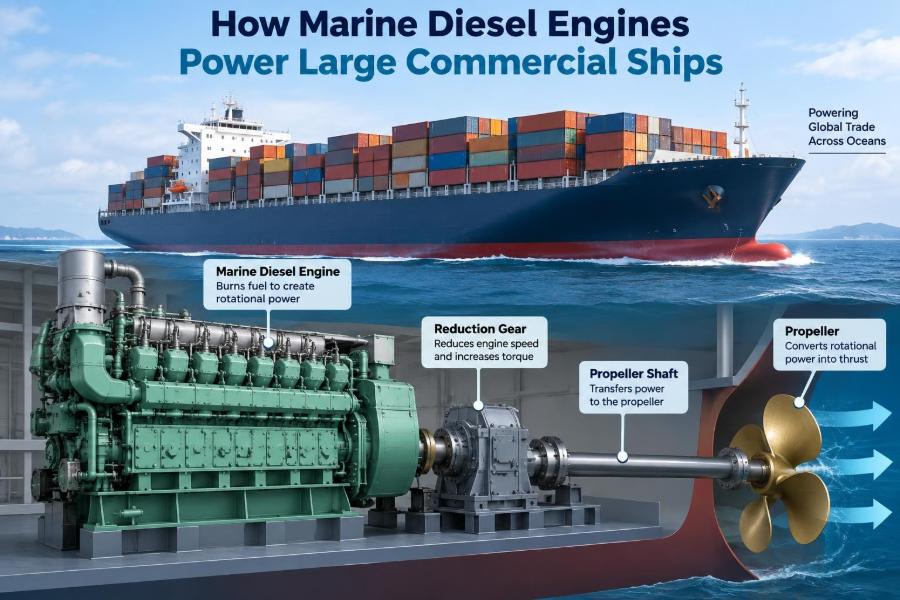
The diesel engine does not directly “push” the ship. It produces rotary mechanical power, which passes through the crankshaft, shaft line, and propeller to create thrust.
🔥 2. Why diesel engines suit commercial ships
Diesel engines are well suited to ships because they are robust, efficient at sustained high loads, and capable of operating for long periods with careful maintenance. They use compression ignition rather than spark plugs.
In a diesel cylinder, air is compressed until its temperature is high enough for injected fuel to ignite. This basic method gives diesel engines strong torque and dependable combustion under the steady-duty conditions common at sea.
🏗️ 3. Two main propulsion arrangements
Commercial vessels commonly use either a slow-speed two-stroke engine connected directly to the propeller or medium-speed four-stroke engines connected through gears, generators, or both.
| Arrangement | Typical feature | Common application |
|---|---|---|
| Low-speed two-stroke direct drive | Very low shaft speed and large propeller | Large cargo ships and tankers |
| Medium-speed four-stroke with gearbox | Higher engine speed reduced for the propeller | Ferries, offshore ships, smaller cargo vessels |
| Diesel-electric | Engines drive generators; motors drive propulsors | Cruise, offshore, specialist vessels |
The best arrangement depends on vessel size, operating profile, required manoeuvrability, machinery space, redundancy needs, and fuel strategy.
🔩 4. The slow-speed two-stroke engine
The largest merchant ships often use a low-speed crosshead diesel engine. It may be tall enough to occupy several decks of engine-room height and is built to turn a very large propeller at relatively low revolutions.
Its name can be misleading: a two-stroke engine completes its operating cycle in one crankshaft revolution. Every downward power stroke is followed by processes that clear the cylinder and prepare it for the next combustion event.
🌀 5. The four-stroke alternative
A four-stroke engine completes its cycle over two crankshaft revolutions: intake, compression, power, and exhaust. It is generally more compact for a given speed and is widely used for auxiliary generators and many propulsion installations.
Because its normal rotational speed is often higher than the preferred propeller speed, a reduction gearbox is frequently used. The gearbox trades speed for torque at the shaft.
💨 6. Air starts the combustion process
Every power cycle begins with clean air. The engine draws air into its cylinders, compresses it strongly, injects fuel, and releases energy through combustion.
For a large two-stroke engine, scavenging air also clears exhaust gases from the cylinder and fills it with fresh air. Good scavenging supports efficient combustion and reduces the risk of poor burning conditions.
🧯 7. Fuel injection: precise timing, fine droplets
Fuel must enter the combustion space at the right moment, at high pressure, and in a spray pattern that mixes effectively with hot compressed air. Injectors atomise the fuel into fine droplets rather than allowing a liquid stream to enter the cylinder.
Injection timing and quantity influence power, exhaust temperature, fuel consumption, and emissions. Modern engines often use electronically controlled systems to adjust these parameters with greater flexibility.
💥 8. From combustion pressure to turning force
Combustion raises cylinder pressure and forces the piston downward. The connecting rod transmits that force to the crankshaft, converting reciprocating motion into rotation.
With multiple cylinders firing in sequence, the crankshaft receives repeated power impulses. Its rotating mass and the connected shafting smooth these impulses into useful continuous motion.
⚙️ 9. The crosshead system explained
Large two-stroke engines commonly use a crosshead arrangement. The piston rod connects the piston to a crosshead, while the connecting rod runs from the crosshead to the crankshaft.
This design separates the cylinder’s vertical motion from the angular movement of the connecting rod. It helps manage side forces and supports the long piston stroke that makes slow-speed engines effective.
🛢️ 10. Fuel is a managed system, not just a tank
Marine fuel reaches the engine only after storage, transfer, heating where required, separation, filtration, and pressure control. Each stage protects the machinery and prepares fuel for reliable injection.
Fuel quality can vary, and contamination by water or particles can damage equipment. Engineers monitor tanks, purifiers, filters, temperatures, viscosity where applicable, and changeover procedures carefully.
Key fuel-system functions
- Store fuel safely in bunker and service tanks.
- Remove water and solid contaminants.
- Deliver fuel at suitable pressure and condition.
- Return unused fuel safely within the designed circulation system.
🌡️ 11. Why some marine fuels are heated
Some conventional marine fuels are too viscous at ambient temperature for effective pumping and atomisation. Heating lowers viscosity so the fuel can be cleaned, transferred, and injected correctly.
Fuel temperature cannot simply be increased without limit. It must remain within the equipment maker’s operating requirements, because fuel properties, pump performance, and safety all matter.
🧼 12. Separators protect the engine
Purifiers or separators use centrifugal force to separate contaminants from fuel and lubricating oil. In simple terms, rapid rotation helps separate materials of different density.
Separation is an important defence against abrasive solids and water. It does not eliminate the need for filters, inspections, and good tank management.
💧 13. Cooling keeps metal temperatures under control
Combustion releases far more heat than the engine can turn into shaft power. Cooling systems remove controlled amounts of heat from cylinder liners, cylinder heads, pistons, charge air coolers, and lubricating oil.
Ships often use a closed freshwater circuit near the engine, with seawater or another external heat-rejection arrangement on the other side of heat exchangers. This reduces direct seawater exposure inside sensitive engine passages.
🛢️ 14. Lubricating oil does several jobs
Lubricating oil reduces friction and wear between moving parts, but that is not its only role. It also helps cool components, carry contaminants toward filters, seal certain clearances, and protect surfaces against corrosion.
Large two-stroke engines typically distinguish between system oil for crankcase machinery and cylinder oil for liner and piston-ring lubrication. Their duties and treatment are different.
🔍 15. Oil condition reveals machinery health
Routine oil analysis can indicate contamination, wear metals, water ingress, or changes in chemical condition. It is a form of condition monitoring, not a substitute for physical checks.
Engineers also track pressures, temperatures, filter condition, consumption, and drain-oil observations. Trends often provide more useful warning than a single isolated value. 🔎
🌬️ 16. Turbochargers recover exhaust energy
Exhaust gas leaving the cylinders still carries substantial energy. A turbocharger uses this flow to spin a turbine connected to a compressor, which supplies denser air to the engine.
More air allows more complete combustion and greater power from a given engine size. Charge-air cooling then reduces the compressed air temperature, increasing density and helping control thermal loading.
📈 17. Matching air, fuel, and load
An engine must receive air and fuel in a suitable relationship. Too little air for the injected fuel can produce incomplete combustion, elevated temperatures, smoke, deposits, and poor efficiency.
Rapid load changes demand careful control because turbocharger response, scavenging pressure, and combustion conditions do not all change instantly. This is one reason operating limits and load-up programmes matter.
🧭 18. From bridge order to engine response
The bridge communicates propulsion demand through a control system. Depending on the ship’s design, the command may request a shaft speed, propeller pitch, motor torque, or a combination of these.
The engine-control system then manages fuel delivery and protective limits. Engineers must understand both the intended command and the machinery conditions that may restrict it.
🪜 19. The shaft line carries power aft
After leaving the main engine or gearbox, torque travels through shaft sections toward the stern. Bearings support the shaft and keep it aligned while allowing controlled rotation.
The shaft line includes components such as thrust bearings, intermediate shafts, bearings, and a stern tube arrangement. Alignment is critical because misalignment can increase vibration, heat, and bearing wear.
⚓ 20. The thrust bearing transfers force to the hull
The propeller’s thrust must ultimately be delivered to the ship’s structure. The thrust bearing takes the axial force generated by the propeller and transfers it into the hull.
Without this component, the shaft could turn but would not effectively propel the vessel. It is a clear example of how machinery and naval architecture meet in one essential part.
🌀 21. The propeller turns torque into thrust
A propeller is shaped like a rotating wing. Its blades create a pressure difference and accelerate water backward, producing forward thrust.
Propeller performance depends on diameter, pitch, blade shape, rotation speed, hull wake, immersion, and sea conditions. The engine and propeller must be matched so neither is forced into an inefficient or unsafe operating region.
🎛️ 22. Fixed-pitch and controllable-pitch propellers
A fixed-pitch propeller has blades set at one angle. Ship speed is generally controlled by changing shaft speed, and reversing may require reversing the engine or using another transmission arrangement.
A controllable-pitch propeller can change blade angle while the shaft continues to rotate. This can offer flexible manoeuvring and allows thrust to change without necessarily changing engine speed in the same way.
🔌 23. Auxiliary engines keep the ship alive
Main propulsion is only part of the engine-room picture. Auxiliary diesel engines commonly drive generators that supply electrical power for pumps, navigation equipment, lighting, cargo systems, accommodation services, and many other loads.
Some ships use diesel-electric propulsion, where generator sets provide electricity to propulsion motors. In that arrangement, electrical distribution becomes a central part of moving the ship.
🧠 24. Automation supports, but does not replace, engineers
Sensors measure temperatures, pressures, levels, speeds, vibration, and other conditions. Alarm and monitoring systems help crews detect abnormal operation before it develops into serious damage.
Automation can start standby pumps, regulate fuel or cooling systems, and initiate protective actions. However, engineers still need to interpret alarms, verify causes, and make safe decisions rather than treating every signal as a simple instruction.
🚨 25. Protective systems prevent major damage
Marine engines are fitted with shutdowns, slowdowns, relief devices, alarms, and interlocks. Their exact design varies, but their purpose is to prevent dangerous conditions from escalating.
Examples of conditions requiring attention
- Low lubricating-oil pressure.
- High cooling-water or exhaust temperature.
- Overspeed.
- Crankcase mist or abnormal pressure.
- Loss of essential cooling, lubrication, or control air.
Bypassing a protection without formal authority and risk control can turn a manageable fault into machinery damage or a safety emergency.
🛠️ 26. Maintenance is planned around risk and condition
Maintenance includes routine rounds, cleaning, inspections, testing, overhaul, measurement, and replacement of worn components. Manufacturers’ instructions, class requirements, company procedures, and actual machinery condition all influence the plan.
Good maintenance is not only about opening equipment on schedule. It also means identifying changes in performance early and finding the cause before availability is affected.
📊 27. Engineers measure performance, not just speed
Engine-room teams use performance data to understand how efficiently machinery is operating. Important observations can include fuel consumption, exhaust temperatures, scavenging conditions, shaft power, cooling performance, and vibration.
A deviation between cylinders may point to an injector issue, air-side restriction, fuel problem, or another developing fault. Diagnosis requires comparing evidence rather than assuming one reading tells the whole story.
🌍 28. Efficiency and emissions shape modern operation
Every tonne of fuel saved can reduce operating cost and emissions, so ships seek efficient hull condition, propeller condition, route planning, machinery maintenance, and sensible speed management. The engine is only one part of this system.
Emission control may involve cleaner fuels, exhaust after-treatment, engine tuning, energy-saving equipment, or alternative energy carriers. The practical solution depends on the ship, its trade, applicable rules, fuel availability, and safety case.
♻️ 29. New fuels bring new engineering questions
Marine propulsion is increasingly considering fuels such as methanol, ammonia, bio-derived fuels, and other energy pathways, alongside conventional fuels and hybrid systems. These options can change fuel handling, storage, ignition, materials compatibility, ventilation, and emergency response requirements.
The central lesson is that a new fuel is not merely a different liquid in the bunker tank. It affects the entire machinery plant and the competence needed to operate it safely.
🧑🏭 30. Core principle: controlled energy conversion
The core principle of marine diesel propulsion is straightforward: fuel chemical energy is released in controlled combustion, transformed into piston force and shaft torque, then converted by the propeller into useful thrust.
Everything around that principle exists to make the process safe, efficient, and repeatable. Fuel treatment supplies clean fuel; air and turbocharging support combustion; cooling and lubrication protect components; controls, monitoring, and maintenance keep the machinery within safe limits.
A large commercial ship moves because thousands of carefully controlled engineering actions turn combustion pressure into propeller thrust, hour after hour at sea. ⚙️🚢🌊