
A chief engineer notices the main engine jacket-water temperature creeping upward while the vessel is waiting outside a warm, silty port. The seawater strainers were recently cleaned, but differential pressure is rising again. The immediate question is not simply whether to open another valve; it is which cooling arrangement is safe, available, and intended for this condition.
On another ship, the crew prepares for dry dock. The vessel normally uses a central cooler supplied by seawater, but a temporary shore connection and maintenance plan change the boundaries of the system. A wrong changeover could introduce seawater into a treated freshwater circuit, or leave essential equipment without heat rejection.
These decisions matter because cooling systems protect machinery from overheating, corrosion, deposits, and loss of lubrication quality. They also affect fuel efficiency, maintenance workload, and the ship’s ability to keep propulsion and electrical power available.
The important point is that a ship rarely “switches” its entire cooling philosophy at will. Engineers usually change between designated cooler branches, pumps, sea chests, bypasses, or operating modes within an approved system. Understanding that distinction makes every changeover safer.
🧭 1. Start with the Meaning of Open and Closed Cooling
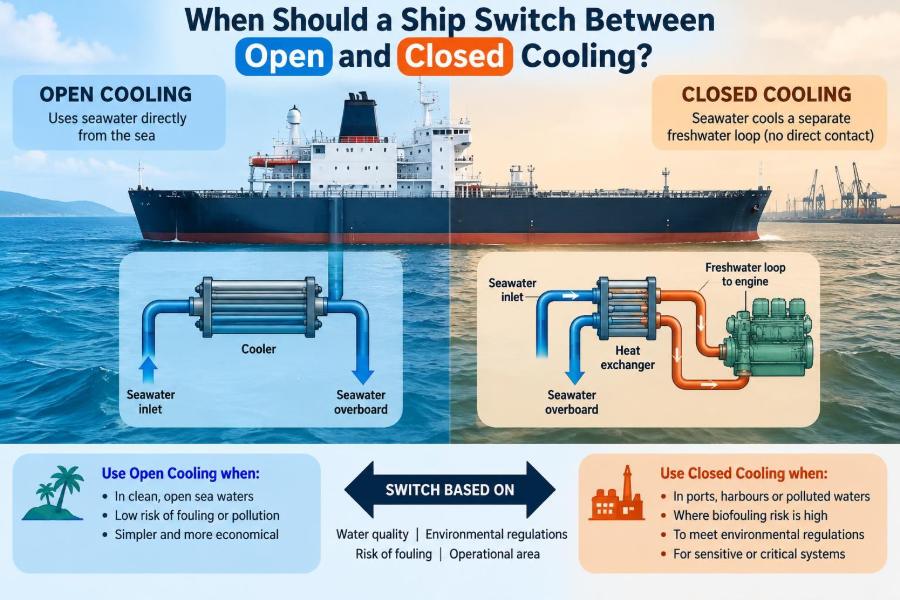
Open cooling, often called direct seawater cooling, sends seawater from a sea chest through strainers, pumps, coolers or machinery passages, and then overboard. The sea is both the heat sink and the working fluid in the cooling path.
Closed cooling circulates treated freshwater, sometimes called fresh water, glycol-water, or coolant, in a sealed loop around machinery. Heat leaves that loop through a heat exchanger, commonly a central cooler that is itself cooled by seawater.
Many modern ships use both concepts simultaneously. Their machinery cooling is closed, while the seawater side of the central cooler remains an open circuit.
⚙️ 2. Recognize the Common Shipboard Arrangements
Before discussing a changeover, identify the actual design on board. The piping diagram, operating manual, and valve labels—not generic terminology—define what is possible.
| Arrangement | Heat path | Typical implication |
|---|---|---|
| Direct seawater cooling | Machinery → seawater → overboard | Simple but exposes equipment to seawater |
| Central closed cooling | Machinery freshwater → central cooler → seawater → overboard | Protects machinery with treated coolant |
| Two-temperature central cooling | High- and low-temperature freshwater loops → cooler → seawater | Allows different machinery temperature needs |
| Keel or box cooling | Machinery coolant → hull-mounted heat exchanger → sea | May reduce seawater pump and strainer dependence |
A vessel may also have separate arrangements for the main engine, generator engines, HVAC, cargo plant, hydraulic oil, and emergency equipment. Never assume one system’s procedure applies to another.
🌊 3. Understand Why Open Cooling Is Vulnerable
Seawater is an effective heat sink, but it carries salts, organisms, suspended solids, and dissolved gases. These can corrode metal, block passages, foul heat-transfer surfaces, and damage pumps.
Conditions vary greatly with location. Harbor mud, river water, ice, jellyfish, weed, marine growth, and warm tropical water can all reduce the reliability or effectiveness of an open seawater circuit.
Direct seawater cooling can be appropriate where it was designed and maintained for the duty. It is not inherently unsafe; it simply demands careful protection and monitoring.
💧 4. See Why Closed Loops Protect Machinery
A closed loop allows the crew to control coolant quality. Properly treated water reduces internal corrosion, scale formation, cavitation risk, and deposit buildup in engine jackets, pump bodies, and small passages.
The loop can operate at a selected pressure and temperature. This improves boiling margin and lets manufacturers design engines and auxiliary equipment around more stable conditions.
Closed cooling does not eliminate maintenance. It moves much of the seawater exposure to heat exchangers, strainers, sea chests, and the open side of central cooling equipment.
🗺️ 5. Do Not Treat Changeover as a Routine Preference
A ship should switch configuration only when the system design, maker’s instructions, and operating procedure permit it. A closed loop is normally kept closed; a crew does not open it to seawater merely because cooling demand is high.
Similarly, a direct seawater-cooled engine cannot necessarily be converted to closed cooling by routing water through an available heat exchanger. Flow rates, pressures, materials, expansion capacity, controls, and safety devices may be unsuitable.
The correct question is usually: which approved cooling path should be in service now?
📘 6. Use the Piping Diagram Before Touching Valves
The line diagram shows normal flow, standby equipment, bypasses, isolating valves, non-return valves, vents, drains, and cross-connections. It also reveals whether a proposed route could backfeed another system.
Trace both sides of every heat exchanger. A crew member may correctly line up the freshwater side yet accidentally isolate or starve the seawater side that removes the heat.
- Confirm suction source and discharge destination.
- Identify the duty and standby pumps.
- Check which valves are locked, sealed, or administratively controlled.
- Find vents and drains needed to prevent air locks.
Use the ship’s approved valve line-up and have a second person verify critical changes where procedures require it.
🌡️ 7. Switch Paths When Cooling Margin Is Being Lost
The most defensible reason to change to a standby cooler, alternate sea chest, or alternate cooling branch is a worsening trend that threatens temperature control. Rising jacket-water temperature, lube-oil temperature, or cooler differential pressure deserves investigation before alarms occur.
A changeover should not mask a fault. If an alternate cooler restores temperature, the fouled or failed item still requires inspection, cleaning, or repair at the earliest safe opportunity.
Trend data is more useful than a single reading. Compare temperatures, pressures, pump current, cooler differential pressure, and machinery load over time.
🏗️ 8. Consider Water Conditions at the Vessel’s Location
Open seawater systems face their hardest service in shallow, muddy, biologically active, or contaminated waters. A ship may change from a low sea chest to a high sea chest, or vice versa, if the design and current draft make that beneficial.
In sediment-heavy water, a higher suction may avoid some bottom disturbance. In rough seas, a low suction may give more reliable submergence. The right choice depends on hull design, draft, trim, weather, and the documented operating guidance.
Closed machinery loops remain valuable in these conditions because they limit contaminated water to the seawater side of exchangers. 🌊
🧊 9. Adapt to Cold Water and Ice Conditions
Very cold seawater can overcool low-temperature circuits, affect viscosity, create control instability, or contribute to freezing risks in vulnerable equipment. Automatic temperature-control valves and bypasses are intended to manage this, but they need correct adjustment and functioning sensors.
Ice and slush can restrict sea chests and strainers. Ships designed for cold regions may have sea-chest heating, steam arrangements, or specific suction procedures; these must be used exactly as approved.
Do not defeat temperature controls by permanently forcing maximum seawater flow. Stable operating temperature is usually more important than the lowest possible temperature.
🔥 10. Account for High Seawater Temperature
Warm seawater reduces the temperature difference across a cooler. Since heat transfer depends on that difference as well as flow and surface condition, a central cooler may have less capacity in tropical or enclosed waters.
In this situation, switching to a clean standby cooler, increasing approved seawater flow, reducing machinery load, or operating another designated cooling branch may be necessary. The closed loop should remain within the engine maker’s prescribed temperature limits.
Opening a freshwater bypass around a cooler may temporarily worsen heat rejection. Know whether a bypass is for warm-up, temperature regulation, maintenance isolation, or emergency use before operating it.
🧽 11. Change Over When a Cooler Is Fouled, Not After It Fails
Fouling may appear as increasing pressure drop, reduced outlet temperature difference, declining cooling performance, or a need for progressively higher pump output. Plate coolers, shell-and-tube coolers, and box coolers each show problems differently.
If the installation has duplex coolers or parallel central cooler sections, transfer duty in a controlled manner. Bring the standby unit into service, confirm stable flow and temperatures, then isolate the fouled unit according to procedure.
Cleaning should address the cause as well as the deposit. Marine growth, scale, silt, oil contamination, and damaged sacrificial anodes require different corrective actions.
🧰 12. Respond Properly to Strainer Problems
Sea suction strainers protect pumps and narrow cooler passages, but they can become a restriction themselves. Differential pressure, suction vacuum, low discharge pressure, and pump noise can all indicate blockage.
A duplex strainer allows cleaning one basket while the other remains in service, provided the changeover is done carefully. Equalize pressure where the design requires it, move the selector fully, and verify that the isolated side is actually depressurized before opening.
Never open a seawater strainer cover until isolation, venting, and shipboard safety precautions are confirmed. Flooding risk is real.
🔄 13. Distinguish a Cooler Changeover from a System Conversion
Changing from cooler A to cooler B is a normal operational changeover on many ships. Changing from seawater cooling to a closed freshwater loop is a fundamental system conversion and is usually not an underway option.
This distinction prevents dangerous improvisation. Temporary hoses, cross-connections, and unusual valve line-ups can create contamination, overpressure, loss of cooling, and flooding hazards.
When the normal arrangement is unavailable, use the emergency procedures written for that vessel. If no approved alternative exists, reduce load or stop the affected machinery rather than inventing one.
🛢️ 14. Protect Oil Coolers and Fuel-Related Equipment
Lube-oil and fuel systems often depend on cooling water to keep temperatures within a workable range. Loss of cooling may lower oil viscosity, reduce bearing protection, increase leakage, or upset fuel conditioning.
These consumers may sit on a low-temperature freshwater loop or on direct seawater branches. Check the actual circuit because a change intended to help the engine can unintentionally reduce cooling to an oil cooler.
After any changeover, verify oil temperature and pressure as well as coolant readings. One stable temperature does not prove the entire heat balance is healthy.
⚡ 15. Give Generators Their Own Priority Check
Electrical generation supports steering, navigation, pumps, accommodation services, and sometimes cargo operations. Generator cooling must therefore be considered separately during a central-cooling disturbance.
Some ships have dedicated generator coolers or independent seawater pumps. Others share a central system with the main engine. Understand whether a changeover could overload the remaining cooler capacity when several generators are online.
Before planned maintenance, calculate the operational consequence in practical terms: which loads, engines, and redundant paths remain available?
🚨 16. Know the Signs That Demand Immediate Action
Some conditions call for prompt changeover to approved standby equipment or for load reduction. The exact alarm setpoints come from the machinery maker and ship’s alarm system, but common warning signs are recognizable.
- Rapidly rising jacket-water, lube-oil, or bearing temperatures.
- Loss of seawater pump discharge pressure or abnormal suction conditions.
- High cooler differential pressure or repeated strainer blockage.
- Visible leakage, unusual vibration, or cavitation noise at a pump.
- Coolant level changes that suggest a leak or cross-contamination.
Inform the bridge early if propulsion, maneuverability, electrical supply, or operational speed may be affected.
🧪 17. Keep Closed-Loop Water Chemistry Under Control
A closed system is only protective when its coolant is properly maintained. Testing and treatment should follow the engine maker’s requirements and the approved chemical programme.
Key concerns include corrosion inhibitor concentration, pH control where specified, hardness, chlorides, contamination, and reserve alkalinity where relevant to the treatment chemistry. Adding untreated water indiscriminately can dilute protection and introduce scale-forming minerals.
When makeup water is needed, use the designated quality of water and record the amount. A repeated need for makeup water is a fault signal, not normal operation.
🧂 18. Treat Seawater Contamination as a Serious Fault
Seawater entering a freshwater loop can introduce chlorides and oxygen that accelerate corrosion. It may indicate a leaking cooler, an incorrect valve alignment, or an unintended cross-connection.
If contamination is suspected, follow the vessel’s response plan: identify the source, isolate it if safe, sample as directed, maintain essential cooling, and arrange corrective treatment or renewal. The correct response depends on the equipment and extent of contamination.
Do not assume that topping up inhibitors alone solves saltwater ingress. The leak path must be found.
🫧 19. Vent Air After Any Meaningful Line-Up Change
Air pockets reduce pump performance and can stop circulation through high points in a freshwater loop. They may also cause local overheating in engine jackets or erratic readings at temperature sensors.
Use installed vents in the prescribed order, particularly after draining, refilling, or returning a cooler to service. Confirm expansion tank level and system pressure after temperatures stabilize.
On seawater systems, air ingress at the suction side can cause cavitation and loss of flow. Check gland condition, suction valves, strainer covers, and priming arrangements.
📈 20. Verify the Result with a Heat-Balance Mindset
A successful changeover is not merely a valve position. It is a stable heat-transfer condition demonstrated by sensible readings.
Compare inlet and outlet temperatures on both sides of the cooler, coolant pressure, seawater pressure, pump condition, and controlled temperatures at the machinery. A very small temperature change may imply low heat load, excessive flow, bypassing, poor sensor placement, or a measurement issue.
Allow time for the system to stabilize, but do not wait passively when temperatures are rising rapidly. Use the trend and the emergency procedure together.
🧯 21. Use Bypasses Only for Their Intended Purpose
Cooling-system bypasses may support engine warm-up, temperature regulation, maintenance isolation, emergency flow, or minimum pump flow. They are not interchangeable.
A bypass left too far open can reduce flow through a cooler and cause overheating. A bypass closed against a control valve’s needs can overcool the circuit or create high differential pressure.
Marking, lock arrangements, and clear operating instructions are especially important where several similar valves are close together.
🧍 22. Coordinate the Engine Room and the Bridge
A cooling change can alter the propulsion margin within minutes, especially at high load or during maneuvering. The engineer in charge should communicate limitations before they become a navigational problem.
During arrival, departure, restricted-water navigation, or cargo operations, decide whether a nonessential cooling-system change can wait. If it cannot wait, agree on speed, generator availability, and contingency actions with the bridge.
Good communication turns a technical adjustment into a managed operational decision. 📣
📝 23. Record What Changed and Why
Log the time, reason for changeover, relevant temperatures and pressures, equipment placed in service, and any abnormalities found. This creates continuity between watches and supports later troubleshooting.
A useful entry also states the follow-up action: clean strainer, inspect pump, pressure-test cooler, take coolant sample, or return the normal unit to service after maintenance.
Clear records help reveal recurring patterns, such as a particular port causing frequent fouling or a cooler gradually losing performance.
🔧 24. Plan Maintenance Around Redundancy
Maintenance is the safest time to isolate a cooler, clean a strainer, renew an anode, or inspect a seawater pump—provided adequate cooling redundancy remains. Confirm the actual duty of the standby equipment before declaring it available.
A standby pump that has not been tested, a cooler with closed isolating valves, or an empty freshwater expansion tank is not meaningful redundancy. Periodic operational tests expose these weaknesses.
Where work affects a seawater boundary, use the ship’s permit, isolation, and flooding-control procedures.
🧑🏫 25. Build Competence Through Scenario Training
Engineers learn cooling systems best by tracing real piping and rehearsing realistic faults. A tabletop exercise can ask the watchkeeper to respond to rising jacket-water temperature, a blocked strainer, or suspected seawater contamination.
Useful questions for a drill
- Which reading confirms loss of heat rejection rather than a sensor fault?
- What standby route is approved and ready?
- Which consumer is most vulnerable if the central cooler is isolated?
- Who must be informed before propulsion load is reduced?
Training should emphasize deliberate valve management, independent checks, and consequences—not memorizing valve numbers alone.
⚖️ 26. Balance Efficiency, Reliability, and Environmental Care
Central closed cooling can improve machinery protection and simplify temperature management, but its seawater side still consumes pumping power and requires clean heat-transfer surfaces. Direct systems may be simpler yet demand more attention to seawater corrosion and fouling.
Discharges, chemical handling, cleaning methods, and any use of anti-fouling arrangements must follow applicable regulations, vessel procedures, and environmental controls. Operational convenience never justifies an improper discharge or untreated chemical release.
The most efficient arrangement is the one that maintains required temperatures reliably with equipment in sound condition.
✅ 27. The Core Principle: Keep the Designed Heat Path Intact
A ship should switch between approved cooling branches or modes when operating conditions, fouling, equipment condition, or maintenance require it—and when the drawings and procedures show that the alternative path can safely carry the heat load.
Do not confuse the open seawater side of a central cooling plant with the protected closed freshwater loop. Preserve coolant quality, maintain seawater flow, monitor trends, and use standby equipment before a manageable degradation becomes an overheating event.
The right time to switch is when evidence shows the approved alternate path will restore or protect heat rejection, not when improvisation seems faster. 🧭🌊🔧