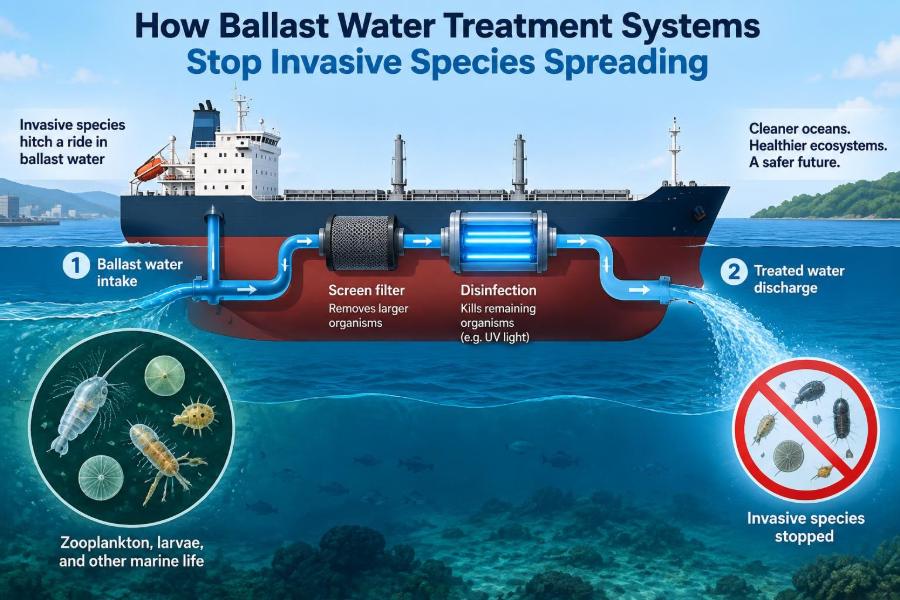

A bulk carrier arrives after a long voyage, loads cargo, and discharges thousands of tonnes of ballast water that helped keep it stable at sea. That water may look ordinary, but it can contain microscopic algae, bacteria, larvae, eggs, and small animals collected in a distant port.
If those organisms are released into a new harbour or estuary, some may survive, reproduce, and establish a population. A species that is harmless in its native ecosystem can become highly disruptive where predators, competitors, and diseases do not keep it in balance.
This is not simply an environmental issue. Invasive aquatic species can affect fisheries, aquaculture, cooling-water systems, port infrastructure, biodiversity, and the livelihoods connected to coastal waters.
Ballast water treatment systems are designed to interrupt that pathway. They treat ballast water so that living organisms are removed, damaged, or inactivated before the water is discharged, turning a major shipping necessity into a more controlled environmental operation. 🌊
⚓ 1. What Ballast Water Does on a Ship
Ballast water is water taken into dedicated tanks to control a vessel’s draught, trim, heel, stability, and structural loading condition. Ships commonly take ballast when they have unloaded cargo or are otherwise lightly loaded.
By changing the amount and distribution of water in ballast tanks, the crew can keep propellers immersed, maintain safe visibility from the bridge, and manage stresses in the hull girder. Ballast is therefore a core part of safe ship operation, not an optional extra.
🦠 2. Why Ballast Water Can Carry Living Organisms
When a ballast pump draws in seawater, brackish water, or freshwater, it also draws in whatever is suspended in it. This can include plankton, larvae, cysts, bacteria, sediments, and very small invertebrates.
Some organisms remain in the water column, while others settle in tank sediment. Their survival depends on temperature, salinity, oxygen, voyage duration, tank conditions, and the biology of the species itself.
🌍 3. The Invasive Species Pathway
The pathway is straightforward: uptake in one location, survival during transit, discharge in another location, then survival and reproduction in the receiving environment. Treatment is aimed primarily at breaking the pathway before the discharge stage.
Not every discharged organism becomes invasive. But a small number of successful introductions can create long-term ecological and economic consequences, which is why prevention is generally more practical than attempting eradication after establishment.
🐚 4. What Makes a Species Invasive
A non-native organism is not automatically invasive. It is generally considered invasive when it establishes, spreads, and causes or is likely to cause harm to ecosystems, economies, or human activities.
Rapid reproduction, broad environmental tolerance, efficient feeding, and a lack of natural controls can give introduced organisms an advantage. Ports are particularly important because they connect many routes and often contain disturbed habitats.
📜 5. The International Regulatory Framework
The International Maritime Organization’s Ballast Water Management Convention provides an international framework for reducing risks from ballast water and sediments. Its requirements apply through national implementation, flag-state obligations, port-state control, and vessel certification.
The Convention distinguishes between ballast water exchange and ballast water performance requirements. In practice, many ships meet the performance approach by installing an approved ballast water management system.
🎯 6. Understanding the D-1 and D-2 Standards
The D-1 standard concerns ballast water exchange, where ships replace coastal water with water from the open ocean under specified conditions. It was an earlier risk-reduction approach because oceanic organisms are less likely to thrive in coastal waters, and vice versa.
The D-2 standard is a discharge performance standard. It limits the concentration of viable organisms and specified indicator microbes in discharged ballast water, so treatment systems are designed and tested against defined biological categories.
🔬 7. Treatment Is About Viability, Not Just Visibility
Clear-looking water is not necessarily biologically safe. Many of the organisms of concern are too small to see without magnification, and a treatment system must address living material rather than simply making water appear clean.
For this reason, compliance concepts focus on viable organisms. A system may remove organisms physically, damage them so they cannot reproduce, or apply a treatment that renders them non-viable.
🧰 8. The Two Main Treatment Stages
Most systems combine a physical separation step with a disinfection or inactivation step. The exact sequence and equipment vary, but the purpose is to handle a broad range of particle sizes and organism types.
- Pre-treatment: usually filtration or separation to reduce larger organisms and suspended solids.
- Primary treatment: ultraviolet light, electrochlorination, chemical dosing, or another approved method to inactivate organisms.
- Verification and control: sensors, alarms, flow control, recording, and sometimes neutralisation.
🕸️ 9. Filtration: The First Line of Defence
A filter removes particles above its nominal mesh or separation capability from incoming ballast water. This can reduce the load of larger plankton and sediment before the water reaches the main treatment stage.
Filters commonly use automatic backflushing. When differential pressure rises as the filter becomes loaded, the unit cleans itself by reversing flow through part of the filter element and discharging the concentrated reject stream as arranged by the system design.
💡 10. Ultraviolet Treatment
Ultraviolet, or UV, systems expose organisms to germicidal light energy. The exposure can damage genetic material and impair reproduction, making organisms non-viable even if they are not physically removed from the water.
UV performance is affected by water quality. Turbid water, coloured dissolved material, and particles can absorb or scatter light, or shield organisms from exposure, so UV systems rely on monitoring and control of factors such as UV intensity and transmittance.
⚡ 11. Electrochlorination and Active Substances
Electrochlorination uses electrical energy to generate disinfecting oxidants from seawater. These oxidants are introduced into ballast water to inactivate organisms during uptake, during discharge, or according to the system’s approved operating sequence.
Because oxidants can remain active after treatment, systems may measure residual oxidant levels and use neutralisation before discharge where required. Safe chemical handling, ventilation, and correct sensor calibration are especially important in these installations.
🧪 12. Other Approved Treatment Approaches
Some systems use chemical biocides supplied from stored chemicals, while others use ozone, deoxygenation, cavitation-related processes, or combinations of technologies. Each approach has different operational limits, safety demands, power needs, and environmental considerations.
The key question is not which technology sounds strongest. It is whether the complete system can operate within its approved limitations under the vessel’s actual trading pattern and water conditions.
📊 13. Comparing Major Technology Types
| Technology | Main mechanism | Typical operational consideration |
|---|---|---|
| Filtration plus UV | Separates particles and inactivates organisms with UV energy | Water clarity and UV sensor performance matter |
| Electrochlorination | Generates oxidants to disinfect water | Residual control, salinity, and neutralisation may be important |
| Chemical dosing | Adds an approved active substance | Chemical storage, dosing accuracy, and crew safety require attention |
| Alternative physical methods | Uses a physical condition or energy process to inactivate organisms | May have specific flow, temperature, or treatment-time limitations |
Many installed systems include more than one mechanism. Comparing systems therefore means comparing the full treatment train, not just a single item of equipment.
🚢 14. Treatment During Ballasting
Many systems treat water as it enters ballast tanks. The intake line directs water through a filter and treatment unit before it reaches the tank, reducing the number of viable organisms stored on board.
This arrangement addresses organisms at the start of the voyage. It also means that poor intake-water conditions, such as heavy sediment or low UV transmittance, must be managed while ballasting is underway.
🔄 15. Treatment During Deballasting
Other systems focus treatment on discharge, or include treatment at both uptake and discharge. Treating at deballasting can provide a final barrier immediately before water enters the receiving environment.
However, water stored for a voyage may contain sediment, corrosion products, or organisms released from tank surfaces. The system must be operated exactly as its approved procedure requires, including any required holding time.
⏱️ 16. Why Holding Time Matters
Some active-substance systems need time for a disinfectant to reach its intended effect. The required interval may begin after dosing or after a defined treatment event, depending on the system’s approved arrangement.
This affects passage planning. A crew cannot assume that a tank treated shortly before arrival is ready for discharge unless the relevant treatment time, residual limits, and operating instructions have been satisfied.
🌡️ 17. Water Quality Changes System Performance
Ballast water is not uniform. Temperature, salinity, turbidity, organic content, and biological load may change substantially between ports, seasons, and even tidal conditions.
For example, electrochlorination depends on seawater chemistry for oxidant generation, while UV systems can be challenged by low-transmittance water. The ship’s type approval limitations and operating manual define how the system should be used when conditions become difficult.
🧭 18. System Design Starts With the Ship’s Trade
Selecting a system requires more than matching a treatment capacity to pump capacity. Designers consider vessel type, ballast flow rate, available space, electrical load, tank arrangement, trade routes, port stays, and expected water characteristics.
A ship trading mainly in saline water may present different design conditions from one regularly visiting rivers, lakes, or sediment-heavy ports. A practical design must also leave room for maintenance access and safe operation.
🔌 19. Power, Pumps, and Flow Control
Ballast systems operate within a hydraulic network of pumps, valves, pipelines, tanks, and control equipment. A treatment unit must maintain the required treatment conditions without creating unsafe pressure losses or unacceptable delays.
Flow meters, pressure sensors, and automatic valves help ensure water passes through the treatment equipment at a permitted rate. Bypassing a treatment unit without authorised procedures defeats the environmental purpose and may create a compliance issue.
🖥️ 20. Automation and Crew Oversight
Modern systems use programmable controllers to start equipment, monitor sensors, manage backflushing, dose chemicals, control neutralisation, and record operating data. Automation reduces routine workload but does not eliminate the need for competent supervision.
Engineers and deck officers need to understand alarms, interlocks, manual modes, and the consequences of stopping a treatment sequence. A seemingly minor alarm can indicate a condition that affects discharge compliance.
📝 21. Documents That Support Compliance
A vessel normally needs an approved Ballast Water Management Plan, relevant certification, equipment manuals, and a record of ballast water operations. These documents show how the vessel is intended to manage ballast water and how it has actually done so.
Accurate records matter because inspectors need to trace events such as uptake, treatment, exchange where applicable, discharge, internal transfer, and exceptional operational situations. Good records also help the crew investigate faults and recurring trends.
🧾 22. What Data Recording Systems Capture
The control system may record dates, times, location inputs, flow, volume, treatment mode, sensor readings, alarms, and system status. The exact data set depends on the installed equipment and applicable requirements.
Data should be reviewed, not merely stored. A repeating low-UV alarm, unusually frequent filter backflushing, or unstable oxidant residual can reveal a developing problem before it becomes an operational failure.
🛠️ 23. Maintenance Keeps Treatment Effective
Like any marine system, a ballast water treatment system needs planned maintenance. Filters, UV lamps or reactors, electrodes, dosing pumps, seals, sensors, sample lines, valves, and control components all require inspection according to manufacturer instructions.
Sensor calibration is particularly important because the automation may rely on measurements to decide whether treatment can continue. Maintenance records should clearly show what was checked, replaced, calibrated, and tested.
⚠️ 24. Common Operational Challenges
Ships may encounter cold water, very dirty water, low salinity, restricted port time, clogged filters, sensor drift, electrical faults, or limited availability of trained service personnel. These are operational realities, not reasons to ignore the management plan.
Examples of practical responses
- Review operating limitations before entering challenging waters.
- Plan ballast operations early rather than treating them as a last-minute task.
- Keep critical spares and consumables within the vessel’s maintenance strategy.
- Escalate faults promptly to the master, company, and authorised technical support.
👷 25. Safety Risks for Marine Engineers
Treatment protects the environment, but the equipment can introduce hazards. Chemical systems may involve oxidants, hazardous reagents, gas generation, and confined-space considerations, while electrical systems involve high voltage and powered machinery.
Risk controls include correct personal protective equipment, ventilation, leak detection where fitted, lockout and isolation procedures, chemical safety information, and crew familiarity with emergency actions. Environmental compliance and personnel safety must be managed together.
🔍 26. Inspection, Sampling, and Port State Control
Port state control may examine certificates, plans, records, equipment condition, crew knowledge, and operational data. Authorities may also use sampling approaches to assess whether discharged water meets applicable requirements.
Sampling and analysis are technically demanding because organisms vary in size, condition, and distribution. The practical lesson for crews is simple: treat compliance as a continuous operational discipline, not a document prepared only for inspection day.
🌱 27. Why Sediment Management Still Matters
Even an effective water treatment system does not make tank sediment irrelevant. Sediment can harbour organisms and can interfere with ballast operations, corrosion management, and treatment performance when it is disturbed.
Ships should follow their ballast water management plan for sediment handling and avoid unnecessary discharge of accumulated material. Tank inspections, cleaning, and sediment disposal must be planned safely and in accordance with applicable procedures.
🤝 28. The Shared Role of Ship and Shore
Shipboard crews operate the equipment, but reliable management also depends on designers, shipyards, class and flag administrations, manufacturers, service engineers, operators, chartering decisions, and port authorities. A weak link in planning or support can affect performance at sea.
Clear communication is especially valuable when a vessel changes trade, experiences equipment limitations, or requires specialist servicing. The best outcomes come from treating ballast water management as part of the ship’s overall safety and environmental management system.
🧠 29. Core Principle: Prevent Release Before It Becomes an Invasion
The central principle is prevention. Once a non-native species becomes established in a marine ecosystem, controlling it can be difficult, expensive, and sometimes impossible without causing further harm.
Ballast water treatment systems reduce risk by ensuring that the water needed for safe navigation is managed before it is returned to the sea. Effective equipment, trained people, sound procedures, and honest records work together to protect receiving waters.
Every correctly treated ballast operation is a practical barrier against moving ecosystems from one coast to another. ⚓🌍💧