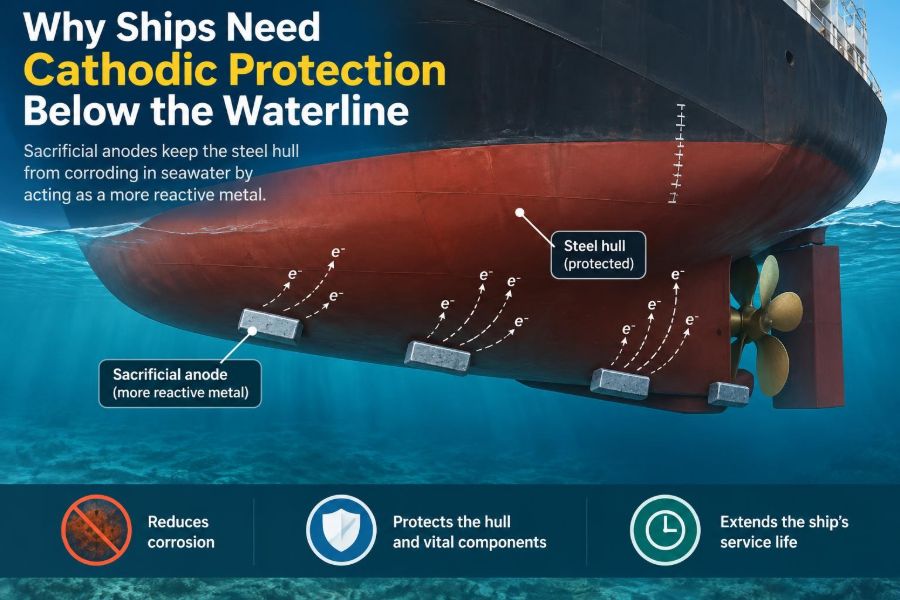

A ship can look sound from the quay while a quiet chemical and electrical process is removing metal beneath the waterline. Seawater, oxygen, protective coatings, dissimilar metals and small defects in paint all interact at the hull surface every day.
For a vessel owner, that hidden deterioration can mean more than cosmetic rust. It can threaten hull plating, sea chests, rudders, propellers, cooling systems and the reliability of equipment needed for safe operation.
For marine engineers, cathodic protection is one of the principal tools used to control this risk. It does not replace coatings or good maintenance; it works alongside them to slow electrochemical corrosion where seawater reaches the metal.
Understanding why it works helps crews recognize normal anode wastage, investigate abnormal corrosion, and make better decisions during dry docking and underwater inspections. ⚓
⚓ 1. The Hidden Corrosion Zone
The underwater hull is an especially demanding corrosion environment. It is continuously exposed to an electrolyte—seawater—which allows electrical current to move between different areas of metal.
Below the waterline, corrosion may be hidden by marine growth, sediment, coatings and the surrounding water. By the time serious wastage is visible in dry dock, the process may have been active for a long period.
🧪 2. Corrosion Is an Electrochemical Reaction
Steel corrosion in seawater is not simply metal “getting wet.” It is an electrochemical reaction involving anodic and cathodic sites, an electrical path through the metal, and an ionic path through the water.
At an anodic site, iron atoms lose electrons and enter the environment as ions. This is the location where metal is consumed.
At a cathodic site, a reduction reaction consumes electrons. In aerated seawater, dissolved oxygen commonly participates in that reaction.
🔌 3. Why a Hull Can Have Both Anodes and Cathodes
A single steel hull can develop many small anodic and cathodic areas. Differences in oxygen concentration, coating condition, deposits, temperature, stress and surface chemistry can create electrochemical cells.
Electrons flow through the metal from anodic areas toward cathodic areas. Ions move through seawater to complete the circuit, allowing corrosion to continue.
The engineering objective is to prevent the hull steel from acting as the anode. Cathodic protection does this by making the protected structure more cathodic.
🌊 4. Why Seawater Makes the Problem Worse
Seawater is a good electrolyte because it contains dissolved salts. Its conductivity supports ionic current flow more effectively than fresh water in many practical situations.
Seawater also contains oxygen, biological activity and suspended matter. These conditions affect corrosion reactions, deposits, coating performance and the distribution of protective current.
- Salt content supports electrical conduction.
- Oxygen supports common cathodic reactions.
- Flow and turbulence can remove protective deposits.
- Marine growth can create local differences in oxygen availability.
🛡️ 5. The Core Idea of Cathodic Protection
Cathodic protection, often called CP, supplies electrons to the steel structure so that the steel remains cathodic rather than anodic. If the hull is held at a suitably protective electrochemical condition, the rate at which iron leaves the steel is greatly reduced.
The system deliberately shifts corrosion activity away from the hull steel. Depending on the method used, another metal is consumed or an external power source provides the required current.
⚙️ 6. Two Main Systems Used on Ships
Ships commonly use either sacrificial-anode cathodic protection or impressed-current cathodic protection. Both seek the same outcome, but they produce and control protective current in different ways.
| Feature | Sacrificial-anode system | Impressed-current system |
|---|---|---|
| Current source | More active anode material | DC power supply and inert or slowly consumed anodes |
| Control | Primarily determined by material and environment | Adjustable automatically or manually |
| Anode behavior | Anodes are intentionally consumed | Anodes are designed for long service, but need inspection |
| Typical concern | Insufficient remaining anode mass | Incorrect output, component faults or overprotection |
🔩 7. Sacrificial Anodes: Metal That Corrodes First
A sacrificial anode is made from a metal or alloy that is more electrochemically active than the protected steel. When connected electrically and immersed in seawater, the anode becomes the preferred corrosion site.
Common anode materials include zinc, aluminum-based alloys and magnesium in appropriate environments. Material selection depends on the service water, the vessel’s design and compatibility with the intended application.
As the anode gives up metal, it releases electrons to the steel. Those electrons help keep the steel cathodic, while the anode gradually wastes away as intended.
⚡ 8. Impressed Current: Protection From a Power Source
An impressed-current cathodic protection system uses a DC power source to drive current from installed anodes into the surrounding seawater. The hull receives the returning protective current.
Reference electrodes measure the hull’s electrochemical condition. A controller can use that feedback to increase or decrease output as the vessel moves through water of changing conductivity, temperature or fouling condition.
This approach can protect large wetted areas with relatively few anodes, but it introduces electrical equipment, sensors, cabling and control-system maintenance requirements.
📍 9. Reference Electrodes Give the System Feedback
Impressed-current systems cannot be managed safely by simply applying the highest available output. The hull condition must be measured relative to a stable reference electrode installed for the purpose.
The control system compares the measured hull potential with its intended operating range and adjusts output. Engineers should understand that readings are meaningful only when sensors, connections and instrumentation are in sound condition.
A damaged reference electrode, failed cable or poor calibration can lead to misleading feedback. In that case, apparent automation may not equal effective protection.
🎨 10. Coatings and CP Are a Team
Hull coatings form the first broad barrier between steel and seawater. A sound coating reduces the exposed steel area and therefore reduces the protective current demand.
Cathodic protection supports the coating system at scratches, pinholes, edges and damaged zones where seawater reaches the substrate. It is especially valuable because coating damage is unavoidable over a vessel’s service life.
CP is not a justification for poor surface preparation or neglected coating repair. A heavily damaged coating can demand more current than the system can distribute effectively.
🧷 11. Why Coating Defects Need Protection
A tiny defect in an otherwise intact coating can create an exposed steel area surrounded by a large coated surface. Local electrochemical conditions may concentrate corrosion risk at that exposed spot.
Protective current can reach the defect through the seawater and suppress the anodic dissolution of steel. However, current distribution beneath disbonded coating can be complex, which is one reason coating adhesion still matters.
🧭 12. Current Must Reach the Entire Wetted Surface
Protection is not only about generating enough current. It is also about delivering it to the areas that need it.
Hull geometry, appendages, sea chests, thruster tunnels, rudder gaps, bilge keels and recesses can influence current distribution. Shielded or poorly accessible areas may receive less protection than broad, open hull plating.
- Recesses may require special attention in design and inspection.
- Complex appendages can create local flow and access challenges.
- Coating damage changes current demand from place to place.
- Marine deposits can alter electrical resistance at the surface.
🚢 13. Propellers and Shafts Create Special Risks
Propellers are often made from copper-based alloys, while shafts, hulls and connected equipment may include steel and other metals. When dissimilar metals are electrically connected in seawater, galvanic effects can develop.
Shafting arrangements may include bonding, earthing devices or shaft grounding arrangements intended to manage electrical continuity and reduce damaging potential differences. Their design and maintenance must follow the vessel’s approved arrangement.
A poor electrical connection can leave a component outside the intended protection system. It can also make diagnostic readings difficult to interpret.
🌀 14. Rudders, Thrusters and Sea Chests Need Attention
Appendages are not secondary details. They often contain narrow clearances, mixed materials, moving parts and localized coating damage.
Sea chests are particularly important because they admit seawater to vital systems. Their internal coatings, gratings, valves and associated piping may need dedicated corrosion-control measures based on the vessel’s design.
Thruster tunnels and rudder recesses can be difficult to inspect and repair. Engineers should include them explicitly in dry-dock scopes rather than assuming hull-wide protection is automatically uniform.
🧲 15. Electrical Continuity Is Essential
For cathodic protection to work, protective electrons need an electrical path into the metal being protected. This requirement is called electrical continuity.
Painted joints, insulated fittings, flexible couplings, nonconductive gaskets and deteriorated bonds can interrupt that path. A component isolated from the hull may need its own designed protection arrangement.
Continuity checks are therefore not merely electrical housekeeping. They help confirm that CP current can actually reach the intended structure.
🔍 16. What Engineers Inspect in Dry Dock
Dry docking provides the clearest opportunity to examine the physical evidence of cathodic protection performance. Inspection should assess both the protective devices and the condition of the structure they are meant to protect.
- Remaining sacrificial-anode material and attachment integrity.
- Coating breakdown, rusting, blistering and mechanical damage.
- Condition of impressed-current anodes, shields and cables.
- Reference electrode condition and protective housings.
- Local wastage near appendages, sea inlets and dissimilar-metal fittings.
- Bonding straps, shaft earthing arrangements and related connections.
Photographs and repeatable location records make later comparison much more useful. Patterns often matter more than an isolated defect. 📷
📏 17. Anode Consumption Is Useful Evidence
Sacrificial anodes are supposed to be consumed, but their consumption should be assessed in context. Very little wastage may indicate low current output, poor electrical connection, unsuitable anode behavior or a well-coated surface with low demand.
Very rapid wastage may suggest high current demand from coating damage, unfavorable environmental conditions, unintended electrical effects or an anode system that needs engineering review.
Visual inspection alone does not establish the cause. Engineers should compare anode condition with coating condition, service history, continuity and any available potential measurements.
📉 18. Underprotection Leaves Steel Vulnerable
Underprotection occurs when the hull or component does not receive enough protective current to suppress corrosion effectively. The result may be continued steel wastage at exposed areas.
Possible causes include depleted sacrificial anodes, low impressed-current output, faulty sensors, damaged cables, poor continuity, heavy coating breakdown or inaccessible geometry.
Underprotection is often a system problem rather than a single-component problem. Troubleshooting should follow the current path from power source or anode to seawater and then to the protected steel.
⚠️ 19. Overprotection Has Consequences Too
More current is not always better. Excessively negative conditions can contribute to coating disbondment and may increase the risk of hydrogen-related effects on susceptible materials or high-strength components.
Impressed-current systems are particularly dependent on correct sensing and control because their output can be actively driven. Operating guidance should come from the vessel’s approved system documentation and applicable class or flag requirements.
The aim is controlled protection, not maximum output. This is why reference electrodes and routine functional checks are so important.
🫧 20. Marine Growth Changes the Surface Environment
Biofouling changes roughness, local water flow and the chemistry near the hull. It can also conceal coating damage and make underwater inspection more difficult.
CP is not an antifouling system, although its operation may influence surface deposits in localized ways. Antifouling coatings, cleaning practices and cathodic protection have distinct purposes and should not be confused.
A clean, documented hull condition gives engineers a better basis for judging whether anodes and coatings are performing as expected.
🌡️ 21. Water Conditions Affect System Behavior
Vessels do not operate in one constant environment. Salinity, temperature, water movement, pollution, port residence time and marine growth can all affect corrosion processes and CP current demand.
Fresh, brackish and seawater environments may behave differently. A system selected for one service profile should be evaluated carefully if the vessel’s operating pattern changes substantially.
Engineers should avoid interpreting a single observation without considering where the ship has traded and how long it has spent in each environment.
🔄 22. Stray Current Corrosion Is a Different Threat
Galvanic corrosion arises from electrochemical differences between connected materials. Stray-current corrosion involves unintended direct current entering and leaving a structure through the electrolyte.
Where current leaves the metal and enters seawater, accelerated metal loss can occur. Possible sources include faulty DC systems, shore installations, welding arrangements or electrical faults, depending on the situation.
Stray-current investigation requires careful electrical diagnosis. Adding more sacrificial anodes without finding the source may not solve the underlying problem.
🧰 23. Maintenance Is More Than Replacing Anodes
A reliable CP maintenance program combines inspection, measurement, records and corrective work. Replacing visibly depleted anodes is important, but it is only one part of the task.
- Review system drawings and previous inspection findings.
- Check anode attachment, continuity and physical damage.
- Inspect coatings around anodes and high-demand areas.
- Test controllers, alarms, rectifiers and reference electrodes where fitted.
- Record repairs so trends can be identified at the next docking.
Maintenance should preserve the designed system, not create improvised electrical paths or substitute materials without engineering approval.
📝 24. Good Records Turn Observations Into Decisions
Corrosion control is easier to manage when each dry dock builds on the last. Clear records can show whether coating breakdown is recurring in the same zone or whether anode consumption has changed unexpectedly.
Useful records include photographs, sketches, anode locations, remaining condition, coating observations, repair locations, system readings and details of altered equipment. Consistent terminology makes comparisons more reliable.
For working professionals, this documentation links the practical work of divers, dockyard teams and ship staff with longer-term asset management decisions.
👷 25. The Crew’s Role During Operation
Shipboard personnel may not perform full underwater surveys at sea, but they can identify warning signs. Alarm indications, unusual rectifier behavior, damaged cabling, changed shaft-earthing performance or unexplained corrosion reports deserve attention.
Crews should follow the manufacturer’s instructions and the vessel’s planned maintenance system. Electrical protection equipment should be isolated, tested and restored only through approved procedures.
Good reporting is valuable. A small anomaly noted early can be investigated before the next docking rather than becoming an expensive surprise.
🧠 26. Common Misunderstandings to Avoid
“Anodes are failing because they are disappearing.”
In a sacrificial system, controlled consumption is the intended function. The real question is whether the rate and pattern of consumption are consistent with the vessel’s condition and service.
“A painted hull does not need CP.”
Even excellent coatings are damaged by impacts, abrasion, fabrication details and normal aging. CP provides support where the barrier is imperfect.
“More protection is always safer.”
Overprotection can create its own problems. Effective corrosion control means maintaining an appropriate condition, not applying unlimited current.
📚 27. Cathodic Protection in the Bigger Corrosion Plan
CP is one layer in a broader integrity strategy. Material selection, coating specification, drainage, electrical isolation, bonding, inspection planning and repair quality all influence the final outcome.
For example, a poor coating repair can sharply increase local current demand, while an electrically isolated fitting may remain unprotected despite a healthy hull system. No single control measure can compensate for every design or maintenance weakness.
The best approach is integrated: reduce exposure with coatings, manage electrochemistry with CP, and verify performance with inspection and records.
✅ 28. The Core Principle Below the Waterline
The central principle is straightforward: corrosion removes metal where steel behaves as an anode. Cathodic protection supplies electrons so that the hull and connected components are encouraged to behave as cathodes instead.
Whether those electrons come from consumable anodes or an impressed-current system, success depends on sound design, electrical continuity, workable current distribution, suitable coatings and regular verification.
Ships need cathodic protection below the waterline because seawater makes corrosion electrochemically active, while CP shifts that destructive activity away from vital hull steel and onto a controlled protection system. ⚓🛡️🌊