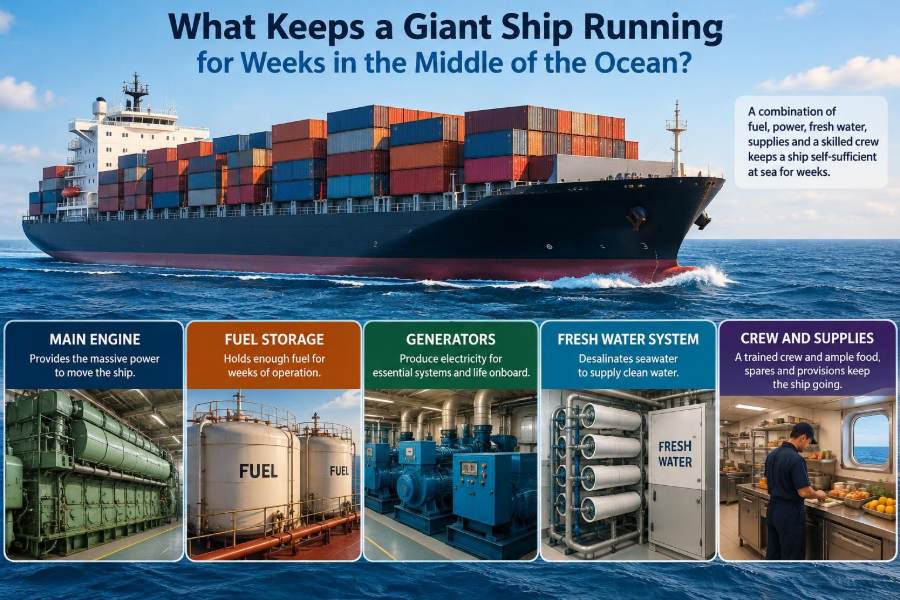

A container ship disappears below the horizon carrying thousands of boxes, a tanker crosses an ocean with cargo in its tanks, and a cruise ship continues serving meals, lighting cabins, and making fresh water far from land. From shore, it can look almost effortless.
But a large ship at sea is not simply “running on fuel.” It is a moving industrial plant that must generate propulsion, electricity, cooling, clean water, compressed air, navigation data, and safe living conditions without a utility connection.
There is no roadside breakdown service in the middle of an ocean passage. Engineers therefore design, operate, inspect, and maintain systems with redundancy, margins, procedures, and a strong awareness of what can fail next.
Understanding that self-sufficiency explains why marine engineering is much more than keeping a main engine turning. It is the coordinated work that keeps a vessel moving, habitable, safe, and ready to respond for weeks between ports.
🌊 A Ship Is a Self-Contained Utility System
A seagoing vessel is often compared with a small floating city, although its systems are more tightly connected than those of most cities. It makes much of its own electrical power, manages its own water, handles waste, controls machinery temperature, and carries the supplies needed to sustain people and equipment.
The central challenge is continuity. A ship cannot pause propulsion just because a cooling pump needs attention, nor can it lose navigation equipment because one generator is being serviced. The machinery plant must keep essential services available while the crew maintains it.
🧭 The Mission Determines the Machinery Plant
Not every giant ship needs the same equipment. A container vessel is optimized for scheduled cargo transport; a tanker needs cargo-handling systems and, depending on cargo, specialized pumps and safety arrangements; a cruise ship supports a large hotel load.
A vessel’s route matters too. Long ocean passages favor reliable, economical machinery and substantial consumable storage. Ice operation, dynamic positioning, refrigerated cargo, offshore work, or frequent port calls can change the power demand and the redundancy expected.
🔥 Fuel Is the Stored Energy Reserve
For most conventional commercial ships, fuel oil remains the primary stored source of energy. It is kept in tanks arranged within the hull, transferred through the fuel system, cleaned, conditioned, and supplied to engines or boilers.
Fuel consumption depends on hull condition, weather, speed, loading, engine condition, and the electrical demand onboard. A head sea or fouled hull can increase resistance, requiring more propeller power to maintain the same speed.
Before sailing, operators calculate fuel needs for the intended voyage and include appropriate reserves under company procedures and applicable requirements. The calculation is not merely distance divided by a published consumption figure; it must reflect operational uncertainty.
🛢️ Fuel Tanks Need More Than Capacity
Carrying fuel is only useful if it can be delivered reliably. Ships commonly separate storage tanks from settling and service tanks. Fuel is transferred from storage, allowed time for water and solids to separate where applicable, then prepared before use.
Tank soundings or electronic level measurements help the crew track quantities. Sounding pipes, remote gauges, alarms, vents, and overflow arrangements are part of safe management, not minor details.
Good fuel management also considers stability. Moving large quantities of liquid changes weight distribution and may create free-surface effects, where liquid moving in a partly filled tank reduces stability.
🧪 Cleaning Fuel Before It Reaches an Engine
Marine fuels can contain contaminants or water, and even cleaner fuels require careful handling. Centrifugal separators use rapid rotation to help remove water and solid particles before fuel reaches the engine’s fine filters and injection equipment.
This protection matters because fuel pumps and injectors work with close clearances. Abrasive particles can accelerate wear, while water may cause corrosion, poor combustion, or loss of lubrication in components designed for fuel.
The exact treatment arrangement depends on the fuel type and engine design. Modern fuel choices may simplify some handling tasks while introducing different requirements for temperature control, viscosity, materials, or safety.
⚙️ The Main Engine Creates Propulsive Power
On many large cargo ships, a slow-speed two-stroke diesel engine drives the propeller shaft directly. Its large crankshaft turns at relatively low revolutions, making direct propulsion efficient for a large fixed-pitch propeller.
Other ships use medium-speed engines connected through reduction gears, diesel-electric plants, gas turbines in specialized applications, or hybrid arrangements. The principle is unchanged: stored energy is converted into controlled shaft power that pushes water aft.
The main engine is impressive in scale, but it cannot operate alone. It depends continuously on clean fuel, lubrication, cooling, starting air, exhaust flow, control systems, and a functioning propeller shaft line.
🌀 The Propeller Turns Power into Thrust
A propeller works by accelerating water backward. The resulting reaction force pushes the ship forward. It is not “gripping” water like a wheel grips a road; it produces thrust by creating a pressure difference and changing the momentum of water.
Propeller efficiency is strongly influenced by hull wake, blade design, vessel speed, draft, and surface condition. Damage, heavy marine growth, or poor matching between engine and propeller can waste fuel and reduce speed.
Some vessels use controllable-pitch propellers, allowing blade angle to change while shaft speed remains comparatively steady. This helps where frequent maneuvering or variable operating modes justify the added mechanical complexity.
🧷 The Shaft Line Must Stay Precisely Supported
Between engine and propeller is a shaft line supported by bearings and passing through the hull at the stern tube. Alignment is critical: a shaft that is not properly supported can overload bearings, create vibration, and damage seals.
Hull deflection changes as a ship loads cargo, moves through waves, and experiences temperature changes. Engineers monitor machinery behavior and investigate unusual bearing temperatures, vibration, leakage, or oil condition before small symptoms become serious defects.
The stern-tube arrangement also prevents seawater from entering the ship around the rotating shaft. Seal design and lubricating arrangements vary, but maintaining that boundary is a basic watertight-integrity task.
🔌 Generators Supply the Electrical Backbone
Propulsion is only one demand. Diesel generators usually provide electricity for pumps, fans, lighting, navigation equipment, communications, galley equipment, refrigeration, and accommodation systems. On some ships, shaft generators or other arrangements supplement the generator sets.
The electrical load varies throughout a voyage. Starting a large motor can create a brief high demand, while refrigerated containers, cargo pumps, thrusters, or hotel services may create major sustained loads.
Engineers operate generators so that capacity is available without running more machinery than necessary. A generator working far below its intended load can be inefficient; one operating too near its limit leaves little room for a sudden demand.
⚡ The Switchboard Balances Demand and Supply
The main switchboard distributes electrical power and protects the system from faults. When generators operate in parallel, their voltage, frequency, and phase must be synchronized before they are connected to the same busbar.
Load sharing then divides electrical demand between the online generators. If one generator trips unexpectedly, the remaining sets must accept load quickly enough, or automatic protection may shed nonessential consumers to preserve vital services.
This is why electrical failures can cascade. A fault in one cable, breaker, control circuit, or generator may affect pumps and auxiliary equipment that the main engine relies on.
🧯 Emergency Power Is Kept Separate
Ships carry an emergency source of electrical power, commonly an emergency generator located away from the main machinery space. Its separation improves the chance that it remains available after a fire, flooding event, or major blackout in the engine room.
Emergency power supports selected essential services, which may include emergency lighting, communications, alarms, navigation aids, firefighting equipment, and steering-related systems according to the vessel’s design and regulatory requirements.
It is not intended to run the full ship indefinitely. Its role is to give the crew the ability to assess the situation, communicate, navigate safely, and restore the main plant.
❄️ Cooling Prevents Machinery from Cooking Itself
Combustion engines convert only part of fuel energy into useful work. A substantial amount becomes heat. Without controlled cooling, metal temperatures would rise beyond safe limits, lubricating oil would degrade, and clearances inside machinery would change.
Large ships commonly use separate cooling circuits. Freshwater circuits cool engine components, while seawater often removes heat through central coolers. Keeping seawater out of sensitive engine passages reduces corrosion and deposit problems.
Cooling performance is watched through temperatures, pressures, flow indications, and alarms. Rising temperature can point to a blocked cooler, failing pump, air lock, fouling, low water level, or a developing machinery fault.
💧 Fresh Water Comes from Sea Water or Shore Supply
Crew members need drinking water, and machinery needs treated fresh water for cooling and boilers where fitted. Ships may take potable water in port, produce it at sea, or use both methods depending on vessel design and voyage needs.
Evaporators use heat, often recovered from engine cooling systems, to evaporate seawater and condense fresh water. Reverse-osmosis plants use pressure and membranes to separate water from dissolved salts.
Produced water is tested and managed before use. Potable-water systems need sanitation and monitoring because producing water does not automatically make it safe for every onboard use.
🌬️ Compressed Air Starts and Controls Machinery
Compressed air is a quiet but essential utility. Large diesel engines may use high-pressure starting air to turn the engine until combustion takes over. Control air can operate valves and actuators, while service air supports tools and routine work.
Air compressors refill receiver bottles, and the system includes drains because compressed air carries moisture. Water in air lines can cause corrosion, freezing in some conditions, or unreliable pneumatic controls.
Starting-air safety deserves special attention. Oil deposits and high temperatures in air systems can create dangerous conditions, so maintenance and correct operating practices are fundamental.
🛢️ Lubricating Oil Creates a Protective Film
Lubricating oil reduces friction, carries heat away from moving surfaces, helps seal certain clearances, and transports contaminants toward filters. In a main engine, a healthy oil film protects bearings that carry enormous loads.
Oil condition is assessed through routine checks and laboratory analysis where available. Viscosity changes, water contamination, metal particles, oxidation products, or fuel dilution can reveal problems before an obvious failure occurs.
Changing oil on a calendar alone is not always the best strategy. Condition monitoring, maker guidance, operating history, and analysis results provide a better basis for maintenance decisions.
🧰 Pumps Are the Ship’s Circulatory System
Most ship systems depend on pumps: fuel-transfer pumps, cooling pumps, bilge pumps, ballast pumps, fire pumps, lubricating-oil pumps, and freshwater pumps. A vessel can have an excellent engine and still lose mobility if a vital pump fails.
Critical duties often have a standby pump or an alternative supply path. Redundancy is useful only when it is ready: valves must be correctly lined up, the standby unit maintained, and crew members familiar with changeover procedures.
A common operational lesson is simple: never assume a standby machine is available merely because it is installed. It should be tested and inspected under controlled conditions.
⚖️ Ballast Controls Draft, Trim, and Stability
Ballast water is taken into dedicated tanks to adjust a ship’s draft, trim, list, and stability. When a vessel sails lightly loaded, ballast helps position the propeller and rudder properly in water and can reduce excessive structural stresses.
Ballasting must be planned. Incorrect tank combinations can create unwanted list, high bending moments, torsional stress, or free-surface effects. The stability information approved for the vessel guides safe loading conditions.
Ballast water is also an environmental concern because organisms can be transported between regions. Ships use operational practices and treatment systems designed to manage this risk under applicable requirements.
🧱 The Hull Is Part of the Engineering System
The hull is not a passive shell around the machinery. Its shape determines resistance, its tanks store vital liquids, its structure carries cargo and machinery loads, and its watertight subdivisions limit flooding consequences.
Corrosion control, coatings, anodes, inspections, and thickness measurements all help preserve structural integrity. Marine growth on the underwater hull increases drag, so hull condition can influence fuel use over time.
Engineers also consider vibration and noise. These may signal imbalance, misalignment, cavitation, loose foundations, or structural resonance, rather than being merely uncomfortable side effects.
🧭 Navigation Depends on Machinery Too
The bridge navigates the vessel, but navigation relies on reliable electrical supply and machinery support. Radar, electronic navigation displays, gyro systems, communication equipment, steering gear, and navigation lights all need power and maintenance.
Steering gear is especially critical. It uses hydraulic or electro-hydraulic equipment to move the rudder, and ships have emergency steering arrangements and drills because losing directional control at sea can rapidly become hazardous.
Clear communication between bridge and engine room matters during maneuvering. Changes in speed or direction create immediate machinery demands, particularly in confined waters where response time is limited.
👀 Automation Extends the Crew’s Awareness
Modern ships use sensors, alarms, programmable controls, and monitoring systems to watch temperatures, pressures, levels, vibration, and equipment status. Automation can reduce routine workload and alert crews to abnormal conditions early.
It does not eliminate the need for engineering judgment. A sensor can fail, an alarm can be misunderstood, and an automatic sequence may not reflect every unusual operating condition.
The most useful automation supports a crew that understands the process. Operators need to know what a normal trend looks like, why an alarm exists, and what secondary effects might follow a corrective action.
🔍 Rounds Find Problems Before Alarms Do
Regular machinery rounds remain valuable even on highly automated vessels. Engineers listen for unfamiliar sounds, feel cautiously for abnormal heat where safe, look for leaks, check tank levels, and compare local gauges with remote readings.
A small drip from a seal, a new vibration, or a slight change in exhaust temperature may not trigger an alarm. Yet these observations can provide early warning of wear or a developing system imbalance.
Good rounds are deliberate rather than ritual. Recording observations makes trends visible across watches and helps the next engineer understand what changed.
📋 Planned Maintenance Turns Work into Reliability
Planned maintenance systems organize inspections, overhauls, tests, and replacements around manufacturer guidance, operating hours, condition data, and regulatory obligations. Their purpose is not to create paperwork; it is to prevent avoidable loss of function.
Maintenance must be balanced with real operating conditions. Opening equipment unnecessarily can introduce contamination or assembly errors, while postponing a known defect can turn a manageable repair into a voyage-disrupting failure.
Clear records matter because ships have rotating crews. A well-documented history tells the next team what was done, what parts were fitted, what readings were observed, and what requires follow-up.
📦 Spare Parts and Workshops Extend Endurance
A ship cannot carry every conceivable replacement part, but it must carry parts likely to be needed for critical machinery. Filters, seals, gaskets, valves, bearings, injectors, pump components, and electrical items may be held according to the vessel’s needs.
The engine-room workshop allows controlled repairs and fabrication of some simple items. However, making a part onboard is not automatically acceptable for safety-critical components; dimensions, material properties, and approval requirements matter.
Inventory control is a reliability issue. A low-cost seal can become operationally expensive if its absence disables an essential pump midway through a passage.
👨🏭 People Connect Every System
Even the best machinery plant depends on competent people. Engineers interpret trends, isolate faults, change over equipment, manage fuel, plan maintenance, and coordinate with deck officers, electricians, shore teams, and port personnel.
Fatigue, unclear handovers, poor housekeeping, and weak communication can undermine technically sound equipment. A shift handover should identify running machinery, equipment under maintenance, isolations, alarms, abnormal trends, and tasks that cannot be forgotten.
Training also includes knowing when to slow down. Rushing a valve lineup, bypassing a protection, or starting machinery without confirming its condition may create a problem far larger than the delay being avoided.
🚨 Blackout Recovery Is Designed, Then Practiced
A blackout is a loss of main electrical power. It can stop pumps, ventilation, control systems, and many auxiliaries at once. The main engine may then be unable to continue even if it has no internal mechanical defect.
Recovery typically involves emergency power, identifying the cause, starting an available generator, stabilizing the electrical network, and restoring services in a controlled order. The exact sequence is vessel-specific and governed by approved procedures.
Drills and testing matter because blackout response is time-sensitive. The goal is not simply to restart machinery, but to restore safe control without overloading the recovering electrical system.
🧯 Firefighting Systems Protect the Power Plant
The engine room contains fuel, hot surfaces, electrical equipment, and moving machinery. Fire prevention begins with leak control, insulation of hot surfaces, clean housekeeping, correct storage, and rapid attention to abnormal conditions.
Fixed firefighting systems, portable extinguishers, fire pumps, detection systems, and emergency shutdowns provide layers of defense. Each system has limitations, so crew training and correct decisions are as important as the hardware.
After a fire or flooding event, the difficult question is often whether machinery can be safely restarted. Electrical insulation, lubrication, alignment, ventilation, and structural condition may all need assessment first.
🌱 Efficiency and Emissions Shape Modern Operation
Fuel cost, air emissions, and environmental requirements have made energy management a central marine-engineering task. Operators may optimize speed, trim, engine loading, weather routing, hull cleaning, and generator use to reduce unnecessary energy demand.
Alternative fuels, batteries, wind-assist devices, shore power, and improved control systems are expanding options. None is a universal replacement: feasibility depends on vessel type, route, fuel availability, space, safety arrangements, and lifecycle considerations.
The practical engineering question is not which technology sounds most advanced. It is whether a system can deliver reliable propulsion and ship services safely across the vessel’s real operating profile.
🧠 A Simple Ocean-Passage Example
Imagine a cargo ship halfway across an ocean. The main engine turns the propeller, while auxiliary generators supply electricity for cooling pumps, navigation, lighting, accommodation, and cargo-related equipment.
Fuel moves from storage through treatment equipment; lubricating oil protects bearings; freshwater cooling carries heat to central coolers; compressors maintain air supplies; and engineers track readings during rounds. Meanwhile, ballast and hull condition influence how efficiently the vessel moves.
If one seawater cooling pump begins to lose performance, the crew may start the standby pump, investigate strainers and valves, monitor temperatures, and plan repairs. The ship keeps operating because the plant was designed and managed around foreseeable failures.
🛠️ Common Misconceptions About Ship Endurance
- “The engine alone keeps the ship going.” The engine depends on multiple auxiliary systems, especially electrical power, cooling, fuel treatment, and lubrication.
- “A large fuel tank means unlimited range.” Fuel quantity is only one constraint; maintenance, water, provisions, weather, cargo needs, and machinery condition also shape endurance.
- “Automation means no one needs to watch the machinery.” Automation provides information and protection, but crews still verify conditions and make decisions.
- “Redundancy removes risk.” A standby system can share the same hidden weakness, such as contaminated fuel, a common electrical supply, or an incorrectly positioned valve.
🔗 The Core Principle: Managed Independence
What keeps a giant ship running for weeks is not a single oversized engine or tank. It is a carefully integrated system of energy storage, propulsion, electrical generation, cooling, water production, pumping, controls, maintenance resources, and trained people.
The strongest designs include redundancy, but true reliability comes from independent backup paths, disciplined operation, and early detection of deterioration. Every system must be understood in terms of its inputs, outputs, failure modes, and links to other systems.
That is the enduring lesson of marine engineering: a ship remains independent at sea only when its machinery is continuously managed as one connected plant.
A giant ship stays underway because fuel, machinery, electrical power, auxiliary systems, and skilled crews work together as a resilient whole. Far offshore, that connected discipline is what turns a floating steel structure into a reliable vessel. 🚢⚙️🌊