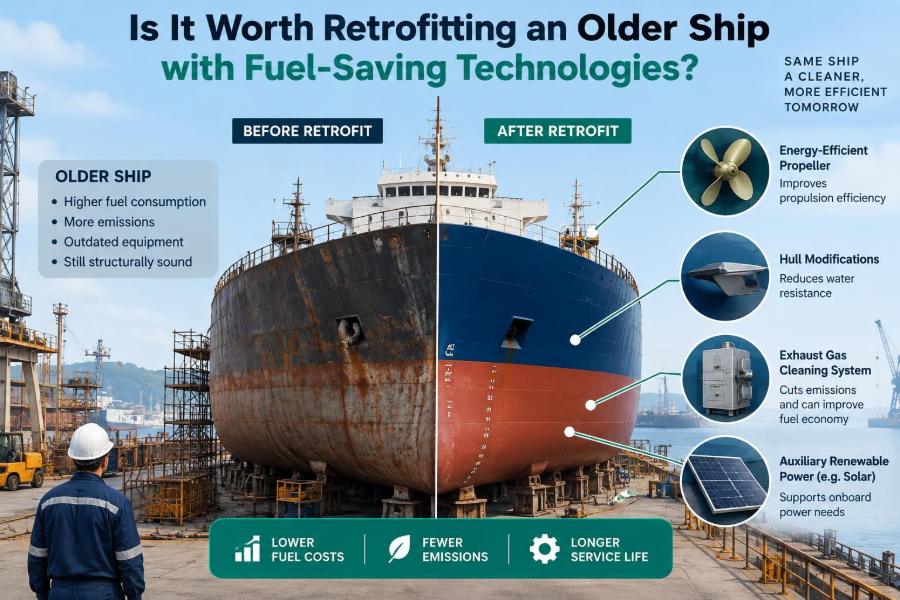

A vessel may still be structurally sound, fully classed, and busy with profitable work—yet consume noticeably more fuel than a newer competitor on the same route. For an owner, that creates an uncomfortable question during every dry-docking plan: invest in upgrades now, or continue operating as before?
The answer is rarely as simple as fitting a new device to the hull. A fuel-saving retrofit affects hydrodynamics, machinery operation, cargo capacity, maintenance routines, charter commitments, emissions reporting, and the remaining economic life of the ship.
For seafarers and engineers, these projects are equally practical. The promised savings must appear in real operating data, not only in a supplier’s performance curve. A device that works well on one hull, route, and loading condition may offer far less on another.
Retrofitting can be an excellent decision, but only when the technology, vessel, and operating profile fit each other. The discipline is to build that case before steel is cut or equipment is ordered.
⚓ What a Fuel-Saving Retrofit Actually Means
A retrofit is a modification made after a vessel enters service. In this context, it usually aims to reduce fuel consumed per unit of transport work, lower greenhouse-gas emissions, or help the ship meet a regulatory performance requirement.
Some projects are physical: a new propeller, hull appendage, air-lubrication system, or shaft generator. Others are operational and digital, such as trim optimization, performance monitoring, or improved voyage planning. The strongest programmes often combine both.
It is useful to distinguish a retrofit from ordinary maintenance. Replacing a worn propeller with an equivalent one restores condition; changing its geometry to better match the vessel’s actual service profile is an efficiency retrofit.
📉 Why Older Ships Attract Attention
Older ships can lose efficiency gradually. Hull roughness increases between cleanings, propeller surfaces deteriorate, engine settings may no longer match the way the ship trades, and cargo or ballast arrangements can change over years of service.
They also tend to have more room for improvement than a recent design optimized at delivery. That does not mean every older ship is a good candidate. A vessel near retirement may not have enough operating years left to recover the investment.
Age is therefore a screening factor, not a verdict. Condition, earnings potential, route stability, and compliance exposure matter more than the launch year alone.
🌍 The Regulatory Pressure Behind the Decision
Fuel efficiency is no longer only a commercial preference. International and regional emissions rules increasingly require ships to document carbon intensity and energy-efficiency performance. Requirements vary by ship type, size, trading area, and flag or port jurisdiction.
For many existing ships, a technical efficiency index and an annual operational carbon-intensity rating have made performance more visible. Owners should verify the rules applicable to their vessel with class, flag, and specialist advisers; regulations and their implementation can change.
A retrofit may help create compliance margin, but it should not be selected solely because it appears on a generic list of approved solutions. The expected benefit must be credible for that individual vessel.
🧭 Begin with the Ship’s Real Operating Profile
Design speed is often a poor guide to retrofit value. The relevant question is how the ship has actually operated over recent voyages: speed, draft, trim, weather exposure, engine load, waiting time, cargo condition, and route.
A bulker making long ballast passages behaves differently from a container ship on a fixed schedule. A tanker that spends substantial time at low power may benefit from different measures than a vessel consistently operating near its original design point.
- Collect noon reports, shaft-power records, fuel logs, weather data, and voyage information.
- Separate laden and ballast conditions instead of averaging them into one misleading figure.
- Identify recurring operating modes: slow steaming, maneuvering, port stays, or long ocean passages.
- Check whether charter-party terms allow changes in speed, equipment, or off-hire time.
Without this baseline, a retrofit proposal is largely an assumption.
📊 Establishing a Trustworthy Performance Baseline
Fuel consumption should be compared against a meaningful reference, commonly speed and displacement or draft. A simple daily fuel figure is not enough, because head seas, current, hull fouling, and cargo loading can change demand dramatically.
Performance analysis uses normalization: adjusting or filtering data so that unlike conditions are not treated as directly comparable. The method must be transparent, especially if savings will influence finance, charter discussions, or contractual guarantees.
Engineers should also check sensor quality. A drifting fuel-flow meter, inconsistent draft entry, or incorrect shaft-torque signal can create an apparent saving—or loss—that does not exist.
🌀 Hull Resistance: The First Place to Look
The hull must push water aside, overcome friction along its wetted surface, and create waves. Resistance rises rapidly with speed, so modest reductions in speed demand can produce meaningful reductions in propulsion power.
Before installing advanced equipment, address basic hull condition. Coating condition, corrosion, marine growth, damaged fairings, and poorly maintained sea chests all affect resistance. These issues are often less glamorous than a new appendage, but they may offer a clearer operational benefit.
A hull retrofit is most compelling when the ship spends many days at sea and its underwater form has a known mismatch with its usual loading or speed range.
🎨 Coatings, Cleaning, and Fouling Control
Marine fouling is biological growth on submerged surfaces. Even relatively light slime increases frictional resistance; heavier fouling can create a substantial penalty and may introduce invasive-species concerns.
Modern antifouling coatings, planned in-water cleaning where permitted, and careful dry-dock surface preparation are practical efficiency measures. Their effectiveness depends on idle periods, water temperature, coating selection, cleaning practice, and the vessel’s trading pattern.
Cleaning must be controlled. Aggressive tools can damage a coating, while uncontrolled removal of fouling may conflict with local environmental restrictions. A hull-management plan should define inspection intervals, acceptance criteria, and approved cleaning methods.
🧩 Appendages That Improve Water Flow
Pre-swirl stators, ducts, fins, and other energy-saving devices aim to improve the flow arriving at the propeller or recover part of the rotational energy left in its wake. They are not interchangeable accessories.
A device that improves inflow on one hull can create vibration, cavitation concerns, or little gain on another. Placement, structural integration, clearance, and compatibility with the propeller are critical.
Suppliers often use model tests, computational fluid dynamics, or prior installations to estimate performance. These are useful inputs, but full-scale results still depend on the actual hull condition and service pattern.
🔩 The Propeller Is a System, Not a Standalone Part
The propeller converts shaft power into thrust, but its efficiency depends on inflow, diameter, pitch, blade area, engine speed, and vessel resistance. Altering one part changes the balance of the whole propulsion train.
Propeller polishing is an accessible first step. For a larger intervention, an owner may consider a redesigned fixed-pitch propeller, a modified blade tip, boss-cap fins, or a controllable-pitch optimization.
A propeller suited to high-speed original service may be poorly matched to years of slow steaming. Conversely, optimizing solely for today’s low speed can be risky if future employment requires a return to higher service speed.
⚙️ Engine Derating and Power Matching
Many ships now operate below the power range envisaged at newbuilding. Engine derating or de-rating changes the engine’s continuous rating to better suit lower-load operation, potentially moving normal service closer to an efficient operating region.
This is not simply a software adjustment. It requires assessment of combustion, turbocharger matching, exhaust temperatures, cylinder lubrication, torsional vibration, and the ship’s required reserve power.
There is also a safety question: can the vessel maintain adequate speed and maneuverability in heavy weather or emergencies? Any power limitation must preserve operational margins required by rules, company policy, and prudent seamanship.
🔌 Shaft Generators and Electrical Load Management
A shaft generator produces electrical power from the main engine through the shaft line. When conditions are suitable, it can reduce reliance on auxiliary generators, which may operate less efficiently at low load.
The value depends on electrical demand, main-engine loading, operating hours at sea, and the configuration of the electrical plant. A vessel with high hotel load or refrigeration demand may have a different business case from a simple bulk carrier.
Power-management logic matters. Poorly coordinated generators, pumps, and large consumers can erase part of the expected benefit. The retrofit should include control philosophy, protection studies, and crew training—not merely new hardware.
🔋 Batteries and Hybrid Systems: Useful but Specific
Battery systems are often discussed as universal efficiency upgrades, but their strongest cases are usually ships with repeated short voyages, frequent maneuvering, port restrictions, or variable electrical loads. They can shave generator peaks, support zero-emission port operations where infrastructure exists, and improve generator loading.
On a deep-sea vessel, batteries may still have useful roles, but energy capacity, space, weight, cooling, fire safety, and installation cost require careful assessment. They do not replace liquid fuel for long ocean passages at present operating energy densities.
Battery projects must be designed with class and flag requirements, dedicated fire protection, ventilation, monitoring, emergency response, and clear procedures for abnormal conditions.
💨 Air Lubrication and Its Operating Limits
Air-lubrication systems introduce bubbles or an air layer beneath sections of the hull to reduce skin-friction resistance. In favorable conditions, this can reduce the power needed to maintain speed.
The result depends heavily on hull geometry, draft, trim, sea state, compressor power, and whether the air remains distributed as intended. The system itself consumes energy, so the net result—not the gross friction reduction—is what matters.
It can be attractive for vessels with long, predictable sea passages, but less compelling where operation is highly variable or installation access is difficult. Reliability and maintainability of blowers, piping, and hull outlets deserve early attention.
🌬️ Wind-Assisted Propulsion
Rotor sails, rigid wings, suction wings, and towing kites use wind to provide auxiliary thrust. They are not replacements for the main propulsion plant on most commercial ships, but they can reduce engine demand on suitable routes.
The best candidates have adequate deck space, trading patterns with useful wind exposure, and operational flexibility. Tankers and bulk carriers may offer favorable deck areas, while container-stack geometry, crane operations, air-draft limits, and cargo handling can constrain installation.
Route analysis is essential. A technology that appears impressive in a favorable wind scenario may deliver limited value on a sheltered, short, or tightly scheduled service.
🧠 Digital Monitoring Is an Enabler, Not Magic
Fuel-monitoring systems can show the relationship between fuel flow, shaft power, speed, weather, trim, and machinery status. This helps crews and shore teams identify deviations early and verify whether a physical retrofit performs as expected.
However, a dashboard does not automatically save fuel. Its value comes from decisions: cleaning at the right time, selecting an economical trim, correcting a machinery fault, or agreeing a realistic arrival time rather than racing toward a congested port.
Data ownership, cybersecurity, sensor calibration, and clear responsibilities should be agreed before installation. Otherwise, the system can become another screen producing numbers nobody trusts.
📐 Trim Optimization and Loading Practice
Trim is the difference between a vessel’s forward and aft draft. Small changes can alter wetted area, wave-making resistance, propeller immersion, and rudder effectiveness. The most economical trim is not necessarily level keel.
Trim-optimization tools use hydrostatic and performance data to recommend conditions for particular drafts and speeds. Their advice should be checked against stability, strength, slamming risk, visibility, maneuverability, and cargo constraints.
For a ship with predictable loading patterns, this may be one of the lower-disruption improvements available. It also demonstrates a broader lesson: some fuel savings come from using the existing ship more intelligently.
🛠️ Machinery Efficiency Beyond the Main Engine
Auxiliary machinery consumes fuel indirectly through electrical demand and directly where steam or thermal systems are involved. Pumps, fans, compressors, purifiers, boilers, and refrigeration equipment all deserve review.
Variable-speed drives can reduce unnecessary throttling losses where flow demand varies. Heat recovery may be useful when there is a reliable heat sink. LED lighting and improved control of accommodation loads are smaller measures individually, but can be sensible within a wider dry-dock package.
Each modification should preserve redundancy and maintainability. An efficient pump arrangement that leaves no practical backup for ballast or fire-service duties is not a sound marine-engineering outcome.
🧪 Alternative Fuels Are Not Always a Retrofit Shortcut
Changing fuel can reduce certain emissions, but fuel conversion is among the most complex retrofit paths. It may require new tanks, piping, ventilation, gas detection, fuel-conditioning equipment, hazardous-area arrangements, stability review, and revised emergency procedures.
Fuel availability, price uncertainty, bunkering arrangements, crew competence, and the vessel’s remaining life are central to the decision. A technically feasible conversion may still be commercially unsuitable.
It is also essential to distinguish tank-to-wake emissions from lifecycle emissions. The environmental outcome depends on how the fuel is produced, transported, and used, not only on what leaves the funnel.
🧱 Space, Weight, and Stability Constraints
Older ships were not designed around every modern efficiency technology. New equipment competes for deck space, machinery-room volume, electrical capacity, structural support, cable routes, and maintenance access.
Weight high above the center of gravity can affect stability. New tanks or machinery may affect deadweight, cargo volume, trim, and damage-stability calculations. Wind-assisted devices may introduce air-draft and visibility considerations.
A concept that looks simple on a general arrangement drawing can become expensive once foundations, access platforms, structural reinforcement, and class-approved calculations are included.
🏗️ Planning the Dry-Dock Window
Many structural and underwater modifications are best completed during scheduled dry dock. Combining work scopes can reduce repeated off-hire periods and mobilization costs, but it also increases project complexity.
Critical-path planning should include design approval, long-lead items, steelwork, coating cure times, electrical integration, commissioning, and contingency for findings after the vessel is opened up. A dry dock is not the ideal place to discover that a component does not fit.
Owners should avoid overloading a dock specification with unproven additions. A manageable package delivered well is usually preferable to a broad programme that creates delay and incomplete commissioning.
🧾 Calculating Payback Without False Precision
Payback compares the installed cost with expected annual savings. It is useful, but it can be misleading when presented as a single precise number based on uncertain fuel prices, utilization, and performance assumptions.
A more robust business case uses scenarios. Consider a lower, central, and higher fuel-price environment; conservative and favorable savings estimates; expected operating days; financing cost; additional maintenance; and likely off-hire.
| Business-case input | Question to test |
|---|---|
| Fuel saving | Is it net of extra electrical or compressor power? |
| Operating days | Will the ship trade enough after retrofit to realize savings? |
| Installation cost | Does it include design, class, steelwork, commissioning, and contingency? |
| Revenue impact | Could off-hire, cargo loss, or route restrictions affect earnings? |
| Residual value | Will the modification help, hinder, or have no effect on resale? |
Decision-makers should see the range of outcomes, not just the most attractive case.
🤝 Charter Parties and Who Receives the Saving
The party paying for a retrofit may not be the party buying the fuel. Under some charter arrangements, that difference creates a weak investment incentive unless the benefit is shared or reflected in hire, speed-consumption terms, or a green-financing arrangement.
Equipment installation can also require charterer consent, particularly where it affects cargo operations, deck space, speed, or off-hire. Contract language should be reviewed before commitments are made.
Technical merit does not overcome a misaligned commercial structure. Early discussion between owner, charterer, manager, and financier can prevent an otherwise useful project from stalling.
📜 Class, Flag, and Approval Requirements
Retrofits commonly require class review of drawings, structural modifications, machinery changes, electrical protection, stability information, and testing arrangements. Flag-state requirements and port-state expectations may also apply.
The approval path varies greatly by technology. A new monitoring system may be relatively straightforward; fuel conversion, battery installation, or major propulsion changes demand much deeper engineering and safety assessment.
Engage class and flag early enough to resolve principle-level questions before detailed procurement. Late approval issues can cause expensive redesign during a fixed dock window.
👷 Crew Workload and Maintainability
Every new system adds inspection, troubleshooting, spare-parts, and training needs. The most elegant efficiency device loses value if crews cannot safely operate or maintain it with the resources available onboard.
Ask practical questions: Can filters be reached? Are critical spares available in normal trading areas? Does the alarm philosophy distinguish urgent faults from advisory messages? Can the system be isolated safely for repair?
Involve chief engineers, superintendents, and intended users during selection. Their experience often identifies practical problems that are invisible in a vendor presentation.
⚠️ Common Reasons Retrofit Projects Underperform
Underperformance does not always mean the technology failed. Often, the expected saving was based on an operating condition that the vessel rarely experiences, or the post-retrofit comparison ignored weather, draft, and hull condition.
- Using supplier estimates as guaranteed annual savings without vessel-specific validation.
- Ignoring energy consumed by supporting equipment.
- Combining several modifications but failing to measure their individual and total effects.
- Deferring crew familiarization until after commissioning.
- Neglecting hull and propeller condition after installing a high-value device.
- Assuming a short payback means low technical or commercial risk.
A verification plan should be agreed before the project starts, including data sources, comparison periods, and responsibilities for reviewing results.
🔍 A Sensible Technology Screening Process
Start broad, then narrow quickly using evidence. The objective is not to select the most fashionable technology; it is to find measures that match the vessel’s constraints and operating economics.
- Define the ship’s likely remaining trading life and expected routes.
- Build a normalized fuel and power baseline from reliable data.
- Inspect hull, propeller, machinery, and available installation space.
- Screen options for technical fit, approval burden, and operational impact.
- Request vessel-specific proposals with assumptions clearly stated.
- Test the financial case under conservative scenarios.
- Plan installation, commissioning, training, and post-retrofit verification together.
This sequence prevents a solution from being chosen before the problem has been properly defined.
🚢 A Hypothetical Bulk Carrier Example
Consider a hypothetical bulk carrier that now spends most of its sea time slow steaming, alternating between long laden and ballast legs. Its hull coating is near renewal, its propeller shows surface deterioration, and its next special survey is approaching.
A sensible package might compare a premium coating system, propeller restoration or redesign, a pre-swirl device, trim guidance, and upgraded performance monitoring. Air lubrication or wind assistance could be screened too, but only after checking hull suitability, deck operations, and route winds.
The owner would not assume that every measure should be installed. If the vessel has limited remaining employment visibility, lower-cost measures integrated into the planned docking may be more rational than a capital-intensive package with a long recovery period.
🧮 When Doing Nothing Can Be Rational
Deferring a major retrofit can be reasonable when the ship has uncertain future employment, is approaching disposal, faces structural condition concerns, or would require extensive off-hire during a strong market.
It may also be sensible when the operational profile is changing soon. Optimizing for one trade just before moving to another can lock the vessel into the wrong design point.
Doing nothing should still be an active decision supported by evidence. Basic maintenance, accurate monitoring, voyage optimization, and compliance planning remain necessary even when major capital work is postponed.
✅ The Core Principle: Fit Beats Fashion
The best retrofit is not necessarily the one with the largest claimed percentage saving. It is the one that delivers a credible net improvement for a particular ship, over its remaining useful life, without creating unacceptable safety, reliability, or commercial drawbacks.
Start with sound data and fundamentals: hull condition, propeller condition, machinery loading, and operating practice. Then assess larger technologies through realistic engineering, approval, installation, and financial lenses.
For students, this is a valuable reminder that marine engineering decisions are systems decisions. For working professionals, it reinforces a familiar truth: a good modification must work at sea, in the engine room, in the dockyard, and in the business plan.
Retrofitting an older ship is worth it when measured performance, remaining service life, and operational fit support the investment—not simply because a technology is available. A careful, vessel-specific approach turns efficiency from a promise into an operating result. ⚓🌊📈