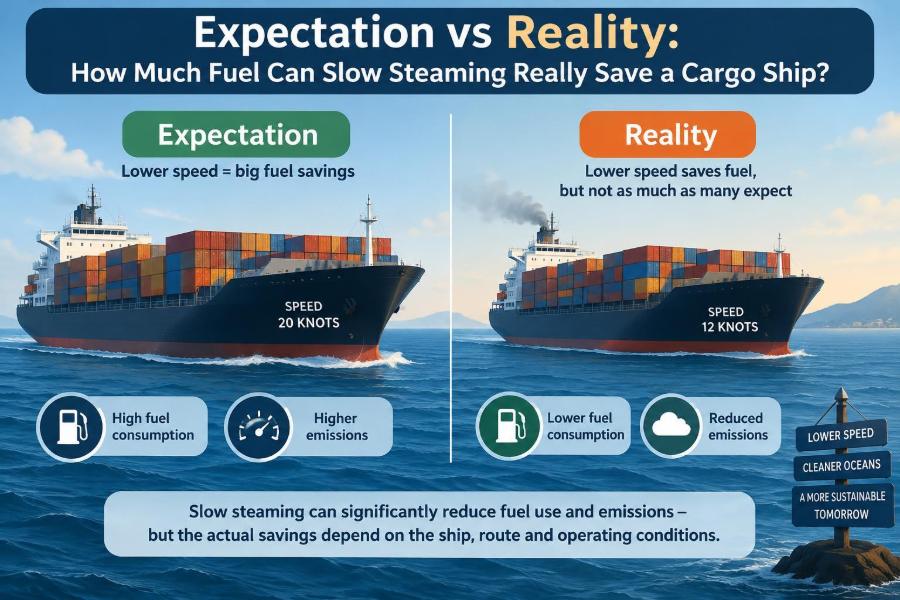

A voyage plan says a container ship will reduce speed by a few knots. In the engine control room, that can sound like a straightforward instruction: use less power, burn less fuel, arrive later.
The commercial expectation is often even simpler. If speed falls by 10%, fuel use should fall by roughly 10% too. But a ship does not behave like a road vehicle with a linear fuel gauge, and the daily bunker report soon tells a more interesting story.
Slow steaming can produce very substantial savings, especially on long sea passages. It can also create new constraints involving schedules, engine condition, weather margins, charter-party obligations, cargo care, and emissions compliance.
The useful question is therefore not just “how much can we save?” It is: what speed, power, loading condition, route, and machinery arrangement deliver the lowest practical fuel use for this particular voyage?
⚓ Start with the two different fuel questions
Fuel may be reported as tonnes per day, but voyage decisions need two measures. Daily consumption is the fuel burned in 24 hours. Fuel per mile is the fuel needed to move the ship one nautical mile.
At a lower speed, daily consumption usually falls. Yet the ship also takes longer to cover the same route. Slow steaming saves voyage fuel only when the reduced daily burn outweighs the additional days at sea, including the energy used by auxiliary machinery.
📉 Why the speed–power relationship is so powerful
For a conventional displacement cargo ship in calm water, required propulsive power is often approximated as varying with the cube of speed. Written simply, P ∝ V³, where P is power and V is speed.
This is a useful rule of thumb, not a universal law. Hull form, draft, trim, fouling, waves, current, and propeller condition all affect the real curve. Still, it explains why modest reductions in speed can cut required main-engine power much more sharply than intuition suggests.
🧮 Turning the cube rule into a practical estimate
Suppose a ship needs 24 MW to maintain 18 knots in comparable calm-water conditions. At 16 knots, the cube-law estimate is 24 × (16/18)³, or about 17 MW.
That is roughly a 29% reduction in propulsive power for an 11% reduction in speed. It does not mean the ship automatically saves 29% of total voyage fuel, because it spends more time sailing and still has hotel, pumping, cooling, and cargo-related electrical loads.
🛳️ Power is not exactly the same as fuel burn
Main engines have a specific fuel oil consumption, commonly called SFOC: grams of fuel burned per kilowatt-hour delivered. SFOC is not perfectly constant across the engine load range.
A large low-speed two-stroke engine may remain efficient over a broad operating band, but very low loads can move it away from its best point. Generator loading, boiler demand, and the selected fuel type also change the total energy picture. A power saving is real, but translating it into tonnes needs actual machinery data.
⏱️ The longer-voyage effect
Distance divided by speed gives sailing time. A 3,600-nautical-mile passage takes about 8.3 days at 18 knots and 9.4 days at 16 knots, assuming no delays or currents.
The slower voyage adds more than a day of exposure to auxiliary consumption, weather, crew workload, and schedule uncertainty. The main engine may still save enough fuel to make slow steaming attractive, but the comparison must use total fuel for the full passage rather than a daily figure alone.
🔌 Auxiliary loads set a lower limit
Refrigerated containers, cargo pumps, ventilation fans, accommodation services, navigation equipment, ballast operations, and hydraulic systems can require electrical power whether the vessel is at 12 knots or 18 knots.
For a container vessel with many refrigerated boxes, auxiliary consumption can be particularly significant. If propulsion power falls while auxiliary demand stays broadly steady, the fixed-load portion becomes a larger share of the fuel bill. This is one reason the headline cube rule should never be applied to total fuel without adjustment.
🌊 Calm-water calculations meet the real sea
Ships rarely travel in the clean, steady conditions used for textbook curves. Head seas increase resistance, wind adds aerodynamic drag, and pitching or propeller emergence can reduce propulsive efficiency.
Slow steaming may reduce slamming and machinery stress in rough weather, but it may also extend the time spent within a weather system. A weather-routing plan needs to compare safe speed, arrival requirement, expected resistance, and available power margin—not merely choose the lowest planned speed.
🧭 Currents can improve or erase the result
A favourable current increases speed over ground without requiring the same increase in speed through water. An adverse current does the opposite. Fuel is burned to overcome water resistance, while the schedule is driven by progress over the ground.
That distinction matters on routes with persistent currents. A voyage optimizer may recommend different engine orders on different legs: reduce speed with a following current, then preserve enough margin against an adverse stream to meet the arrival window.
⚖️ The right comparison is fuel per mile
Consider a deliberately simplified hypothetical case. One speed burns 80 tonnes per day at 20 knots, equivalent to 4 tonnes per nautical mile. A slower speed burns 55 tonnes per day at 16 knots, or about 3.44 tonnes per mile.
The slower case uses less fuel for a fixed distance, even though it remains at sea longer. But if auxiliary fuel adds, say, a relatively fixed daily amount, the advantage narrows. This is why a useful voyage model separates main-engine consumption from non-propulsion loads.
📊 A simple voyage-model checklist
Before treating a speed reduction as a saving, collect a comparable set of inputs. The aim is not false precision; it is a transparent estimate that can be checked against noon reports and meter data.
- Route distance, expected currents, and weather allowance
- Speed through water and required arrival time
- Main-engine power and SFOC at candidate loads
- Auxiliary engine, shaft-generator, and boiler fuel demand
- Draft, displacement, trim, hull condition, and propeller condition
- Fuel grades, emission-control requirements, and operational limits
With these inputs, fuel can be estimated for each leg and then summed for the complete voyage.
🔧 Main-engine load matters more than many assume
Marine propulsion engines are designed around defined operating envelopes. Long periods at very low load can increase the risk of incomplete combustion, deposits, fouling, poor turbocharger performance, and unstable running, depending on engine design and operating practice.
Manufacturers publish guidance on minimum continuous load, low-load procedures, cylinder lubrication, and periodic higher-load operation. These instructions are vessel-specific. A fleet policy that says “go slower” cannot replace the engine maker’s limits or the chief engineer’s condition monitoring.
🔥 The low-load combustion challenge
At reduced load, exhaust gas temperatures and air supply characteristics change. If combustion quality deteriorates, unburned products and deposits may accumulate in exhaust spaces or on turbocharger components.
Operators may use measures such as auxiliary blowers, adjusted fuel settings where approved, and planned load increases. The purpose is not to defeat slow steaming; it is to ensure that lower fuel consumption today does not become avoidable maintenance, reliability, or safety trouble later.
🌀 Turbochargers do not always love ultra-low load
A turbocharger depends on exhaust-gas energy. At sufficiently low engine loads, compressor delivery and scavenging conditions can become less favourable, especially on older or less flexible arrangements.
Modern engines may include turbocharger cut-out systems, bypass arrangements, or other features that improve low-load performance. Their value and operating rules depend on the installation. Engineers should use the approved performance curves rather than assume every engine responds the same way.
⚙️ Derating can make a slower operating point healthier
Some vessels use engine derating, where the engine’s maximum continuous rating is intentionally reduced or its operating layout is adjusted for a lower normal service speed. This can shift the expected load point into a more efficient and manageable range.
Derating is a technical and commercial decision, not simply a bridge order. It may require assessment of propeller matching, turbocharging, thermal loads, contractual performance, and reserve power for bad weather. Done properly, it supports a long-term slow-steaming profile.
🧱 Hull fouling changes the answer over time
Marine growth and roughness on the hull raise resistance. A fouled propeller can also lose efficiency. The ship may need more shaft power than expected to achieve the same speed through water.
This means a slow-steaming calculation based on clean-hull trial data can be overly optimistic after months in service. Trending shaft power, RPM, weather-corrected speed, and fuel consumption helps identify whether the problem is speed selection or deteriorating underwater condition.
📐 Draft and trim are quiet fuel levers
Draft changes wetted surface, wave pattern, and propeller immersion. Trim—the difference between forward and aft draft—also changes resistance and can influence how efficiently water reaches the propeller.
There is no single “best trim” for every vessel and loading condition. Some ships use trim-optimization guidance derived from model tests, computational analysis, or operational records. Even a sensible slow-steaming order should be paired with a loading and trim check.
🚢 Propeller matching decides where efficiency lands
The engine, shaft, and propeller operate as one system. At lower RPM, a fixed-pitch propeller follows a different absorption curve, and the engine’s torque and scavenging requirements remain relevant.
Controllable-pitch propellers add another choice: whether to reduce RPM, alter pitch, or use a combination. Incorrect pitch–RPM selection can waste fuel or create unfavourable engine loading. The vessel’s approved operating diagrams are more reliable than generic advice.
🗺️ Arrival windows can be worth more than top speed
Port congestion creates a familiar inefficiency: a ship races to an anchorage and then waits. “Just-in-time” arrival aims to coordinate passage speed with berth, pilot, terminal, and cargo readiness so the ship can proceed with fewer idle hours.
Slow steaming is most productive when it replaces unnecessary waiting rather than simply adding delay. It requires credible information exchange. If a berth window changes late, the vessel may have to regain speed, weakening both fuel and emissions benefits.
📜 Commercial terms can constrain the engine order
Charter parties, voyage instructions, laycan periods, cargo commitments, and service schedules can establish speed and performance expectations. A technically sensible fuel-saving speed may not be commercially available if the vessel must meet a fixed connection or delivery date.
Clear wording matters. Parties need to know who authorizes speed changes, how weather allowances are treated, what consumption basis applies, and whether schedule recovery is permitted. Marine engineers contribute reliable machinery limits and consumption data to that discussion.
📦 Cargo type affects how slow is practical
A dry bulk vessel on a flexible schedule may have more speed freedom than a liner vessel maintaining weekly port calls. Perishable cargo, refrigerated cargo, live cargo, cargo requiring heating, and some project shipments may impose additional time or energy constraints.
For example, a longer transit can increase reefer-generator fuel demand and requires continued attention to cooling reliability. The answer is not that slow steaming is unsuitable; rather, cargo-related energy and risk must appear in the voyage calculation.
🌡️ Boiler and thermal demands do not disappear
Tankers and some cargo operations require steam for heating, tank cleaning, pumping support, or accommodation services. Boiler fuel can form a material part of total consumption on certain voyages.
At low main-engine load, exhaust-gas economizer performance may also change because exhaust temperature and mass flow are lower. An auxiliary boiler may need to carry more duty. Counting only main-engine fuel therefore gives an incomplete picture.
🌱 Emissions usually fall, but the boundary matters
Burning less fuel generally reduces carbon dioxide emissions for the same fuel type. Lower engine output can also reduce some other exhaust emissions in absolute terms, though the exact outcome depends on engine condition, fuel, after-treatment, and operating profile.
Environmental comparisons should state their boundary. Emissions per day, per mile, per tonne-mile of cargo, and per completed voyage answer different questions. A slower ship burning less per mile may improve transport efficiency, while the added transit time can matter to the wider logistics system.
🧾 Carbon-intensity metrics encourage careful measurement
Modern shipping increasingly tracks operational carbon intensity. Such metrics create an incentive to understand actual fuel use rather than rely on nominal service-speed figures.
They do not eliminate trade-offs. A vessel may improve an annual intensity figure through speed management while still needing enough operational flexibility for safety, port windows, and commercial commitments. Good data supports both compliance reporting and better engineering decisions.
🛟 Reserve power is a safety requirement, not waste
A ship needs the ability to respond to deteriorating weather, traffic, restricted waters, machinery contingencies, and manoeuvring demands. Planning very close to the minimum possible power can leave too little margin when conditions change.
Slow steaming should therefore be planned with a realistic reserve. The master’s responsibility for safe navigation and the chief engineer’s responsibility for machinery safety remain decisive, regardless of a fuel target or an attractive consumption forecast.
🚫 Common mistakes in slow-steaming calculations
The biggest errors tend to be conceptual rather than mathematical. They make projected savings look cleaner than operating reality.
- Applying the cube rule to total fuel instead of propulsive power
- Using speed over ground where speed through water is needed
- Ignoring added voyage days and auxiliary loads
- Assuming clean-hull performance throughout the docking cycle
- Running below approved engine limits without a low-load plan
- Forgetting reserve power, weather routing, and arrival uncertainty
- Comparing noon reports taken in unlike drafts and sea states
Each error can be corrected by defining the comparison basis before the voyage starts.
📒 Noon reports are useful, but not perfect instruments
Noon reports provide essential operational data, including position, distance, speed, weather, engine load, and fuel figures. They are valuable for trend analysis, but a single day can be distorted by current, sea state, ballast work, generator transfers, or fuel-tank sounding uncertainty.
Better analysis groups comparable days and checks data against flow meters, shaft-power measurement where available, fuel transfer records, and weather data. The goal is to identify a repeatable operating pattern, not to draw major conclusions from one unusually good or bad day.
🧪 A hypothetical route comparison
Imagine a vessel with a 4,000-nautical-mile sea passage and two feasible arrival plans. Plan A uses a higher speed and a shorter transit; Plan B cuts main-engine power substantially but adds sailing time.
To compare them, calculate main-engine fuel from the power and SFOC at each point, then add predicted auxiliary and boiler fuel for the corresponding days. Next include the likely weather margin, expected current, port-window consequence, and any need to increase load periodically under the engine maker’s guidance.
If Plan B uses fewer total tonnes and still preserves a safe, contractually acceptable arrival, it is a genuine saving. If the extra time causes missed berthing, higher auxiliary demand, or a later high-power catch-up, the apparent advantage may shrink or disappear.
🔄 Weather routing and speed management work together
Weather routing is sometimes treated as separate from fuel optimization, but the two are tightly connected. A route with slightly more distance may avoid severe head seas and require less power overall; a direct route may be better in benign conditions.
The strongest plan is dynamic: update forecasts, currents, port readiness, and machinery status, then adjust within safe operational limits. This is not constant speed chasing. It is controlled speed management guided by verified information.
👷 What the engine department should monitor
Slow steaming changes the normal operating picture. Engineers should trend parameters that reveal whether reduced load remains stable and healthy.
- Scavenge-air pressure and temperature
- Exhaust temperatures and cylinder balance
- Turbocharger condition and fouling indicators
- Fuel index, RPM, shaft power, and specific fuel trend
- Lubricating-oil condition and cylinder-oil feed where applicable
- Generator loading, boiler firing, and overall daily fuel split
Abnormal trends deserve investigation even if total consumption looks favourable. A low daily burn is not a success if it is achieved by operating machinery outside sound practice.
🤝 What the bridge and shore team need from each other
The bridge needs a realistic speed–power envelope, reserve-power guidance, and prompt advice on machinery restrictions. The engine room needs clear arrival targets, routing updates, and notice of anticipated manoeuvring or schedule changes.
Shore teams need honest data rather than idealized curves. When operations, technical management, and commercial planners work from the same assumptions, they can avoid the damaging pattern of slow steaming for days followed by a costly last-minute sprint.
🎯 So how much can a cargo ship really save?
There is no single defensible percentage for every cargo ship, route, and speed reduction. The cubic relationship shows why lower speed can create large reductions in propulsive power, but total voyage fuel savings are moderated by longer transit time, auxiliary demand, weather, hull condition, and machinery constraints.
The practical result can range from modest to substantial. Savings are most credible when the vessel has schedule slack, operates within an efficient engine range, avoids needless anchorage waiting, and is assessed using measured fuel data rather than one simplified formula.
✅ The core principle: optimize the voyage, not one number
Slow steaming is not merely “run the engine slower.” It is a voyage-wide operating strategy that connects hydrodynamics, engine performance, electrical demand, cargo requirements, weather, and port coordination.
The best target is usually not the lowest possible RPM or the lowest daily bunker figure. It is the speed that completes the required voyage safely, reliably, and on time while minimizing total fuel and emissions within the vessel’s approved operating limits.
Slow steaming delivers its real value when reduced speed is matched to the whole ship and the whole voyage—not when a cubic rule is treated as a promise. 🚢⚙️🌊