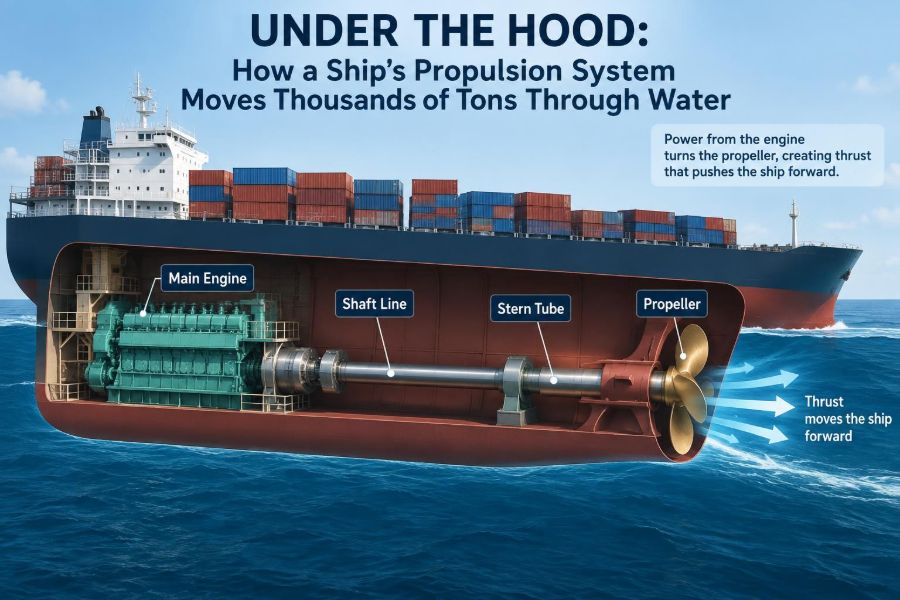

A container ship leaving port can look almost effortless. Steel hull, stacked cargo, a thin wake spreading astern—and a vessel weighing many thousands of tonnes begins to move across open water.
That apparent simplicity hides a tightly coordinated energy system. Fuel or electrical energy becomes controlled rotation, rotation becomes thrust at the propeller, and thrust overcomes the resistance of a hull pushing through a dense, moving fluid.
For engineers, propulsion is not just about making a ship go faster. It affects fuel consumption, machinery reliability, maneuverability, emissions, vibration, cargo schedules, and safety in restricted waters.
Understanding the chain from engine room to propeller makes many everyday shipboard decisions easier to interpret. Here is what is happening under the hood—or, more accurately, below the waterline.
⚓ The Basic Job: Create Useful Thrust
A ship propulsion system has one central purpose: generate enough thrust to overcome resistance and move the vessel at the required speed. Thrust is the forward force created when a propeller accelerates water aft.
Newton’s third law describes the principle neatly. If the propeller pushes a mass of water backward, the water exerts an equal and opposite reaction that pushes the ship forward.
The challenge is doing this efficiently, predictably, and safely across changing drafts, weather, sea states, water temperatures, and operating conditions.
🌊 Why Moving Through Water Takes So Much Energy
Water is roughly far denser than air, so a large hull must continually displace and redirect a substantial volume of it. Ship resistance is not one single force; it is a combination of effects that vary with speed and hull condition.
At low and moderate speeds, friction between the hull surface and water is a major contributor. As speed rises, wave-making resistance can increase sharply because the vessel is creating and carrying a wave system.
Wind, current, shallow water, fouling, trim, and rough seas can all increase the power needed to maintain the same speed. The bridge may request a speed, but the machinery must deliver the torque required by the actual conditions.
🧭 Resistance Sets the Propulsion Demand
Engineers often think of propulsion as a balance between available power and total resistance. A clean hull in calm deep water needs less power than a fouled hull driving into a head sea.
- Frictional resistance: drag along the wetted hull surface.
- Wave-making resistance: energy used to form waves around the hull.
- Air resistance: wind drag on accommodation blocks, containers, or deck cargo.
- Added resistance: extra drag from waves, steering, shallow water, ice, or hull fouling.
This is why a modest increase in service speed can require a disproportionately large increase in power. It is also why speed reduction can be an effective operational lever when schedules permit.
🔥 The Prime Mover Supplies the Power
The prime mover is the machine that provides the initial mechanical or electrical energy. On many deep-sea cargo ships, it is a slow-speed two-stroke diesel engine directly connected to the propeller shaft.
Other vessels use medium-speed diesel engines, gas turbines, steam turbines, or electric motors. The best arrangement depends on the vessel’s duty: a tanker on a long steady voyage has different needs from a cruise ship, offshore vessel, ferry, or ice-capable ship.
Regardless of type, the prime mover must deliver power reliably while operating within temperature, pressure, speed, and load limits.
🔩 Why Slow-Speed Diesels Suit Large Ships
Large two-stroke marine diesels turn slowly enough to drive a large propeller directly, often without a reduction gearbox. Their low rotational speed matches the needs of an efficient, large-diameter propeller.
They are designed for sustained high-load operation and can burn suitable marine fuels after proper treatment. Their size can be striking: the engine may extend several decks high, yet its basic function remains converting fuel energy into shaft rotation.
Direct drive reduces transmission components, but it also links engine speed closely to propeller speed. That affects maneuvering choices and the way the engine is started, reversed, and loaded.
⚙️ Medium-Speed Engines and Reduction Gears
Medium-speed diesel engines rotate faster than the propeller should. A reduction gearbox lowers engine rpm while increasing torque at the output shaft, allowing the propeller to turn more slowly and efficiently.
This arrangement is common where flexibility matters. Several engines may feed one or more gearboxes, enabling operators to run only the number of engines needed for a particular speed or electrical load.
Gearboxes add complexity, lubrication requirements, and potential failure points. In return, they can support compact machinery layouts, multiple operating modes, and controllable-pitch propellers.
⚡ Diesel-Electric Propulsion Changes the Energy Path
In a diesel-electric system, diesel generators produce electricity instead of driving the propeller mechanically. Electrical switchboards distribute that power to propulsion motors, which turn the shafts or azimuthing units.
The arrangement separates engine speed from propeller speed. Generator sets can operate at efficient load points while motors provide finely controlled torque and rapid response.
This is particularly useful for vessels with large “hotel” loads or highly variable power demands, such as cruise ships, research vessels, offshore support vessels, and some ferries. Conversion losses and the cost of electrical equipment must be considered alongside those advantages.
🔌 The Electrical Network Behind the Motor
Electric propulsion depends on more than a motor. It requires generators, switchboards, transformers where fitted, variable-frequency drives or other motor-control equipment, protection devices, and sophisticated control logic.
A variable-frequency drive adjusts the frequency and voltage supplied to a motor, giving close control over motor speed and torque. That makes low-speed maneuvering and dynamic positioning more precise than a simple fixed-speed arrangement.
Electrical faults can spread rapidly if protection is poorly coordinated. Engineers therefore treat insulation condition, cooling, harmonic effects, and breaker settings as propulsion concerns—not merely electrical housekeeping.
🛢️ Fuel Energy Must Be Prepared Before Use
Fuel does not move directly from a bunker tank to an engine injector. It is stored, transferred, settled, heated where needed, filtered, and conditioned before it reaches the engine’s fuel system.
Contaminants such as water, solids, or incompatible fuel blends can damage pumps and injectors or cause unstable combustion. Separators and fine filters reduce that risk, while viscosity control helps the fuel atomize correctly at the injector.
Alternative fuels introduce their own preparation systems. The governing principle remains the same: the engine needs fuel at the right cleanliness, temperature, pressure, and composition for the equipment installed.
💥 Combustion Becomes Rotating Force
Inside a diesel cylinder, compressed air is heated by compression. Fuel injected at the correct moment ignites in that hot air, and expanding gases push the piston downward.
The connecting rod transfers the piston’s reciprocating motion to the crankshaft, converting it into rotation. Each cylinder contributes torque in sequence, smoothing the output delivered to the shaft line.
Combustion quality matters. Poor atomization, incorrect injection timing, inadequate air, or dirty turbocharger components can reduce power and raise exhaust temperatures. Those symptoms are operational clues, not merely numbers on a display.
🌬️ Turbochargers Help the Engine Breathe
A turbocharger uses energy in the exhaust gas to drive a turbine. The turbine turns a compressor that forces more air into the engine’s scavenge or intake system.
More air permits more complete combustion and supports higher power from a given engine size. On two-stroke engines, the scavenge system also helps clear exhaust gases and refill the cylinder with fresh air.
Turbochargers are highly effective but sensitive to fouling, bearing condition, surging, and poor maintenance practices. An air-side restriction or turbine-side deposit can show up as changed scavenge pressure, exhaust temperature imbalance, or reduced engine response.
🌀 From Crankshaft to Shaft Line
The crankshaft’s rotation must travel aft through the shaft line. Depending on the ship, this may include a thrust shaft, intermediate shafts, couplings, bearings, and sometimes a gearbox or clutch.
Alignment is critical. The engine, shaft bearings, and propeller do not remain perfectly fixed relative to one another as hull loading and sea conditions change. Designers account for expected deflection, while engineers monitor bearing temperatures and lubrication condition.
A misaligned shaft can create vibration, bearing distress, seal damage, and expensive repairs. Small changes in measurements can be meaningful when compared with baseline trends.
📍 The Thrust Bearing Pushes the Hull
A turning shaft alone does not move the ship. The propeller creates an axial force—force along the length of the shaft—and the thrust bearing transfers that force into the ship’s structure.
In many direct-drive installations, the main engine incorporates the thrust bearing. In other arrangements, a separate thrust block performs the job.
Think of it as the solid handoff point between spinning machinery and the hull. Without a properly functioning thrust bearing, the force generated at the propeller could not be safely transmitted to move the vessel forward.
🛞 Bearings Support Rotation Without Metal Contact
Shaft bearings support the weight and position of rotating components while maintaining an oil film or water-lubricated film between surfaces. Proper lubrication prevents destructive metal-to-metal contact.
Intermediate bearings along the shaft tunnel carry the shaft and guide its position. The stern tube bearings support the propeller shaft where it passes through the hull near the stern.
Heat, vibration, oil analysis, leakage, and shaft movement all offer clues about bearing health. A developing lubrication problem is far easier to manage before a bearing wipes or seizes.
🚪 The Stern Tube Seals the Hull Opening
The propeller shaft has to pass through the hull, creating an obvious challenge: how can it rotate while keeping the sea outside? The stern tube contains bearings and sealing arrangements at this interface.
Some systems use oil lubrication, while others use water-lubricated bearings. Seal designs vary, but all aim to limit seawater ingress and prevent lubricant release to the environment.
Seal leakage needs careful assessment. It can indicate wear, debris damage, shaft surface issues, incorrect pressure balance, or a more serious alignment problem. The response depends on the system design and observed condition.
🪛 The Propeller Turns Torque into Thrust
A propeller is a rotating set of hydrofoil-shaped blades. Each blade meets the water at an angle, creating a pressure difference that accelerates water aft and develops thrust forward.
The blade does not simply “screw” through water. Water is fluid, so some energy is lost through rotational flow, turbulence, and changes in pressure around the blade. Good propeller design seeks useful thrust with the least practical loss.
Diameter, blade area, pitch, number of blades, rotational speed, and hull clearance are selected as a system. A propeller that is efficient for one hull and operating profile may be unsuitable for another.
📐 Pitch Explains How Far a Propeller Wants to Advance
Propeller pitch is comparable to the lead of a screw: it describes the theoretical forward distance per revolution through a solid medium. In water, the vessel advances less than that ideal distance because the water yields and flows around the blades.
The difference is called slip, although it is not automatically a fault. Some slip is inherent to producing thrust in a fluid.
If the propeller pitch is too high for the available power or conditions, the engine may overload. If it is too low, the system may not make the best use of the engine’s capability at service speed.
🔄 Fixed-Pitch and Controllable-Pitch Propellers
A fixed-pitch propeller has blades permanently set at one angle. Its simplicity and robust construction suit many vessels, especially direct-drive ships where engine rpm is varied to control speed.
A controllable-pitch propeller, or CPP, changes blade angle through a hydraulic mechanism in the hub. Shaft speed may remain relatively constant while thrust changes from ahead to astern.
| Feature | Fixed-pitch propeller | Controllable-pitch propeller |
|---|---|---|
| Blade angle | Permanent | Adjustable in service |
| Control method | Usually varies shaft rpm | Varies pitch, often with rpm control |
| Strength | Simple, efficient at design condition | Flexible thrust and maneuvering control |
| Trade-off | Less flexible off-design operation | More hydraulic and mechanical complexity |
Neither type is universally better. The vessel’s route, maneuvering duty, redundancy requirements, and machinery arrangement guide the choice.
🫧 Cavitation Is a Performance and Damage Problem
Cavitation occurs when local pressure around a propeller blade falls low enough for vapor-filled cavities to form. When those cavities collapse in higher-pressure regions, they can create noise, vibration, loss of efficiency, and surface erosion.
It is more likely when blades are heavily loaded, inflow is uneven, clearances are limited, or the vessel is operating outside the propeller’s preferred range. Cavitation cannot always be eliminated, but it can be managed by careful design and operation.
Propeller damage, rough blade surfaces, or a changed hull wake can worsen the condition. A sudden new vibration pattern deserves investigation rather than being dismissed as normal propulsion noise.
🧼 A Clean Hull and Propeller Save Power
Marine growth and roughness increase drag. Even a thin layer of slime changes the frictional behavior of water along the hull, while propeller fouling disrupts the smooth flow needed for efficient blade performance.
Hull coating selection, planned inspection, cleaning strategies, and propeller polishing are therefore operational choices as well as maintenance choices. They can affect voyage fuel demand and the ability to meet speed requirements.
Cleaning must still be managed responsibly. Local restrictions, coating condition, and the risk of transferring invasive organisms can influence when and how underwater work is carried out.
📈 The Propeller Law Shapes Engine Loading
For a given fixed-pitch propeller operating in similar conditions, power demand tends to rise roughly with the cube of rotational speed. This relationship is commonly called the propeller law.
In practical terms, a small rpm increase can require a much larger power increase. It explains why an engine that appears comfortable at one speed may approach its limits after a modest request for more rpm.
The relationship is an operational model, not a promise. Weather, draft, fouling, current, propeller condition, and engine characteristics shift the actual load curve. Engineers use measured performance, not a rule of thumb alone.
🎛️ Governors and Control Systems Hold the Balance
A governor regulates engine fuel delivery to control speed or load. In propulsion service, it helps the engine respond to changing propeller demand without unstable speed fluctuations.
Modern systems may integrate remote bridge control, pitch control, engine protections, load limits, clutch logic, shaft generators, and alarm monitoring. Automation improves consistency, but it does not remove the need to understand the plant.
Control settings must respect machinery limits. Fast changes in demand can cause thermal stress, turbocharger response issues, overload, or poor combustion if the system is operated carelessly.
🛑 Reversing and Stopping Need Their Own Strategy
To stop a ship, propulsion thrust is reduced and may be reversed. A direct-drive reversible diesel can stop and restart in the opposite direction, turning a fixed-pitch propeller astern.
A CPP vessel can reverse thrust by shifting blade pitch through zero to an astern angle while the shaft continues rotating. Electric propulsion can reverse motor direction or command thrust changes through its control system.
Stopping distance is never determined by machinery alone. Vessel mass, speed, draft, wind, current, and available reverse power all matter. Bridge teams plan maneuvers with those realities in mind.
🛟 Redundancy Protects Control, Not Just Motion
A propulsion failure can become a navigation emergency when a ship is near land, traffic, an offshore installation, or confined water. Redundancy may include multiple engines, separate generator sets, duplicated controls, emergency steering arrangements, or independent propulsion units.
Redundancy has limits. Two systems sharing the same fuel supply, cooling circuit, electrical bus, or compartment may still have common-cause vulnerabilities.
Good design asks a more useful question than “Is there a backup?” It asks whether the backup remains available after a realistic fault, fire, flooding event, or maintenance error.
🔍 Condition Monitoring Finds Trouble Early
Propulsion machinery usually gives warning signs before major failure. Engineers combine observations from rounds with alarms, trends, and laboratory analysis to distinguish normal variation from deterioration.
- Exhaust temperature spread may suggest a combustion or air-path issue.
- Rising bearing temperature may point to lubrication or alignment concerns.
- Changes in vibration can indicate propeller, shaft, or machinery problems.
- Oil analysis can reveal wear metals, water contamination, or degraded lubricant condition.
- Unexpected power demand at a familiar speed may indicate hull or propeller fouling.
No single indication is conclusive. The strongest diagnosis comes from comparing several signals with the vessel’s known baseline.
🧰 Maintenance Is About Preserving Clearances and Surfaces
Marine propulsion reliability depends heavily on unglamorous tasks: maintaining clean filters, checking fasteners, renewing lubricants, verifying safety devices, inspecting seals, measuring clearances, and recording trends accurately.
Planned maintenance systems organize these tasks by time, running hours, condition, or manufacturer guidance. They are useful frameworks, but a calendar cannot replace observation.
For example, a component that is nominally within its service interval may still need attention if vibration, temperatures, or performance show an abnormal change.
⚠️ Common Operating Mistakes and Their Consequences
Many propulsion problems begin with small operational errors rather than dramatic equipment failures. Rapid load changes, ignored alarm trends, poorly managed fuel changeover, or operation beyond approved limits can create cumulative damage.
Other common mistakes include assuming a speed-power relationship will remain unchanged after hull fouling, treating repeated minor seal leakage as normal, or disabling a protective alarm without understanding its cause.
A sound habit is to ask what has changed: fuel, weather, draft, machinery configuration, maintenance work, vibration, or control response. That question often narrows the fault-finding path.
🌱 Efficiency and Emissions Are Connected
Every unit of unnecessary resistance requires additional energy, and for fuel-burning ships that generally means more fuel consumed and more exhaust emissions produced. Propulsion efficiency is therefore closely linked to environmental performance.
Operational measures can include speed management, trim optimization, hull and propeller maintenance, route planning, appropriate engine loading, and careful use of auxiliary machinery. Their value depends on the vessel and voyage; no single measure fits every case.
New fuels, batteries, fuel cells, wind-assist devices, and hybrid systems are expanding the design options. Each brings different constraints involving energy density, infrastructure, safety, space, cost, and maintenance competence.
🧪 Alternative Propulsion Requires Whole-System Thinking
Changing the energy source does not remove the hydrodynamic problem. A battery-powered ferry and a conventional diesel ship still need efficient hulls, propellers, shafts or thrusters, controls, and reliable maneuvering capability.
Alternative fuels may need specialized storage, ventilation, detection, containment, or fuel-conditioning systems. Electric systems need careful battery management, thermal control, and fault protection.
The useful question is not whether one technology is inherently superior. It is whether the complete arrangement suits the vessel’s route, power profile, port facilities, risk controls, and lifecycle operating plan.
🧠 A Practical Way to Trace a Propulsion Problem
When the ship does not achieve expected speed, avoid jumping immediately to one suspected component. Trace the energy path and compare current observations with normal performance.
- Confirm the operating condition: draft, weather, current, trim, and route constraints.
- Compare commanded rpm or pitch with actual values, shaft power, and vessel speed.
- Check engine load, exhaust temperatures, scavenge or intake conditions, and fuel parameters.
- Review vibration, bearing temperatures, stern tube condition, and alarm history.
- Consider hull and propeller condition before assuming an internal machinery fault.
This structured approach prevents wasted effort and helps teams communicate clearly between the engine room, bridge, and shore support.
🏁 The Core Principle: An Energy Chain Must Stay Healthy
A ship moves because an unbroken chain converts stored energy into controlled thrust: fuel or electricity powers a prime mover, the prime mover supplies torque, the shaft line transmits it, the propeller accelerates water, and the thrust bearing transfers reaction force into the hull.
Every link matters. Combustion losses, electrical losses, bearing friction, poor alignment, propeller damage, cavitation, and hull fouling each reduce what reaches the sea as useful thrust.
The best propulsion operation is not simply maximum power. It is the right thrust, delivered reliably and efficiently, with enough control and margin for the conditions ahead.
Once you see propulsion as an energy chain rather than a single engine, the movement of a massive ship becomes easier to understand—and easier to manage well. ⚓🌊🔧