
A ship entering port looks much the same whether it burns conventional fuel oil, liquefied natural gas, methanol, or ammonia. The visible difference may be no more than a new bunker connection, a different tank arrangement, or additional safety equipment on deck. Below deck, however, the choice of fuel changes machinery, procedures, cargo-space planning, and the work expected from the crew.
For marine engineers, this is not a distant design-office discussion. Newbuild contracts increasingly specify “methanol-ready” or “ammonia-ready” features, while existing ships are being assessed for conversion. Students entering the industry may encounter these fuels during their first assignments.
The pressure behind the change is straightforward: shipping needs to reduce greenhouse-gas emissions while continuing to move large volumes reliably across long distances. There is no single replacement that fits every vessel, route, port, and operating profile.
Methanol and ammonia are two leading candidates because both can be made with low-carbon energy pathways and carried as liquids. Their advantages are real, but so are their hazards. Understanding the trade-offs is more useful than treating either fuel as a simple answer.
🌊 Why conventional marine fuel is being challenged
Most deep-sea ships have historically relied on petroleum-derived fuels because they are energy-dense, widely available, and compatible with robust diesel engines. Heavy fuel oil and marine gas oil made long voyages practical with relatively modest fuel-tank volumes.
The problem is their life-cycle climate impact. Combustion releases carbon dioxide, and fuel production and transport add further emissions. Air pollutants such as sulfur oxides, nitrogen oxides, and particulate matter also remain operational and regulatory concerns.
Future propulsion must therefore be judged by more than whether an engine can burn a fuel. Engineers must consider the entire chain from energy production to use onboard, as well as safety, cost, availability, and vessel capability.
🧭 What “without traditional marine fuel” really means
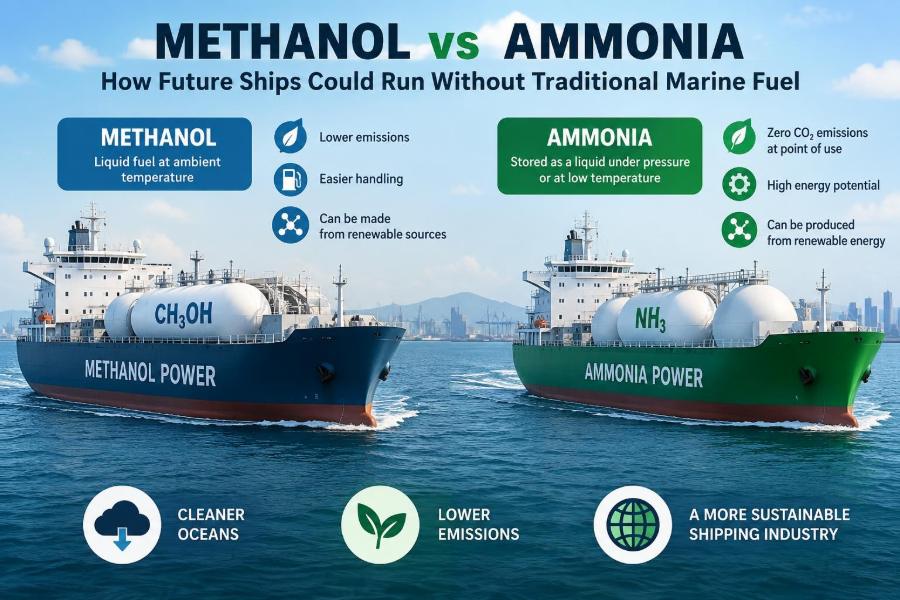
A low-carbon fuel is not automatically a zero-emission fuel. Methanol contains carbon, so burning it produces carbon dioxide. Ammonia contains no carbon, so carbon dioxide is not formed at the point of use, but its production can still have a substantial footprint.
The meaningful question is: how was the fuel made? A molecule can be chemically identical whether produced from fossil feedstocks, renewable electricity, captured carbon, or biomass. Its climate performance depends heavily on that production route.
This distinction is often described as well-to-wake. “Well” covers extraction or production, processing, and transport; “wake” covers what happens onboard the ship. Looking only at the exhaust is incomplete.
🧪 Meet methanol as a marine fuel
Methanol, CH₃OH, is an alcohol and a clear liquid at normal ambient conditions. It is already transported globally as a chemical cargo and used in industrial processes, which gives the maritime sector practical experience in handling it.
For propulsion, methanol can be used in adapted internal-combustion engines and is also relevant to some fuel-cell concepts. It is liquid without cryogenic storage or high-pressure containment, a major operational advantage compared with several gaseous alternatives.
Yet methanol is flammable, toxic, and less energy-dense than conventional fuel. A ship needs more tank volume to obtain the same voyage range, and fuel-system design must manage its particular leakage and material-compatibility issues.
⚗️ Meet ammonia as a marine fuel
Ammonia, NH₃, is best known as a fertilizer feedstock and industrial refrigerant. It contains hydrogen but no carbon. When it is used as a fuel, its carbon-free chemistry makes it attractive for pathways aiming to eliminate onboard carbon dioxide emissions.
At ambient temperature, ammonia is a gas, but it can be stored as a liquid under moderate pressure or at low temperature. That is technically familiar in industry, although it creates a more demanding fuel-containment and transfer environment than methanol.
Ammonia’s defining challenge is acute toxicity. Even a relatively small release can be dangerous to people nearby. A workable ammonia ship is therefore not simply a methanol ship with different tanks; it requires a safety philosophy built around prevention, detection, isolation, and escape.
📏 Energy density changes ship layout
Energy density describes how much useful energy is available per unit mass or volume. It matters because a ship has limited space for fuel, cargo, machinery, ballast, and accommodation.
Both methanol and liquid ammonia generally require substantially more tank volume than conventional marine fuels for a comparable energy demand. Methanol is particularly penalized by lower volumetric energy content, while ammonia also requires tank and conditioning arrangements suited to its storage state.
For a coastal vessel with frequent bunkering, the penalty may be manageable. For a long-haul container ship or bulk carrier, it can affect cargo capacity, range, and the economics of the entire design.
📊 A practical comparison at a glance
| Design question | Methanol | Ammonia |
|---|---|---|
| Carbon in the molecule | Yes | No |
| Storage near ambient conditions | Liquid at ambient pressure | Requires pressure and/or refrigeration |
| Primary human hazard | Flammability and toxicity | High toxicity; also corrosive to tissues |
| Onboard carbon dioxide when used | Produced during combustion | Not produced from the fuel molecule |
| Tank-volume challenge | Significant | Significant |
| Existing industrial handling base | Chemical and fuel applications | Fertilizer, refrigeration, and chemical applications |
This comparison is deliberately simplified. Actual performance varies with engine type, tank pressure, fuel temperature, voyage pattern, emissions controls, and the production pathway used to supply the vessel.
🌱 The color labels can mislead
Terms such as “green,” “blue,” and “grey” are shorthand for production routes, not guaranteed environmental grades. They can be useful labels, but engineers and operators should ask what energy and feedstocks were actually used.
Renewable methanol may be made using renewable hydrogen combined with a sustainable carbon source. Ammonia can be produced from renewable hydrogen and nitrogen separated from air. Fossil-based routes remain common in broader chemical markets.
Claims about fuel quality should therefore be supported by credible lifecycle accounting. The same bunker tank can receive fuel with very different upstream emissions depending on where and how it was produced.
🔥 How methanol burns in a ship engine
Methanol can be used in compression-ignition marine engines designed for dual-fuel operation. Because methanol has different ignition characteristics from diesel fuel, a small amount of pilot fuel may be used in some engine concepts to initiate combustion.
Fuel is delivered through dedicated pumps, piping, valves, and injection equipment. The system must limit leak paths, detect abnormal conditions, and safely return or drain fuel. Unlike conventional fuel oil, methanol’s low lubricity and solvent behavior require careful equipment selection.
Dual-fuel capability gives operational flexibility where methanol availability is uncertain. It also means the vessel’s real emissions depend on which fuel it actually uses, not just on the label attached to its design.
⚙️ How ammonia could power propulsion
Ammonia can be burned in suitably developed internal-combustion engines or converted in fuel-cell systems. Combustion is technically challenging because ammonia is relatively difficult to ignite and burns more slowly than many conventional fuels.
Engine designs may use pilot fuel, fuel cracking, or other combustion-supporting measures. Cracking means breaking ammonia into hydrogen and nitrogen; hydrogen is more reactive but adds equipment, energy demand, and control complexity.
Engine development is progressing, but performance, reliability, emissions behavior, and maintenance requirements must be proven across real operating conditions. A test installation and a fleet-wide, long-life solution are not the same thing.
💨 Nitrogen oxides remain an engineering problem
Removing carbon from the fuel does not remove every exhaust challenge. High-temperature combustion of ammonia can form nitrogen oxides, commonly called NOx. These pollutants are associated with air-quality and environmental impacts.
Combustion control and exhaust after-treatment may be needed to meet applicable emission limits. Selective catalytic reduction, for example, is an established approach for reducing NOx in some marine applications, but its integration still adds operational systems and consumables.
Engineers must also consider nitrous oxide, N₂O, because it is a potent greenhouse gas. Its formation depends on combustion and after-treatment conditions, so it cannot be dismissed merely because ammonia contains no carbon.
🫧 Methane slip has a useful lesson
“Slip” means unburned fuel escaping from an engine or fuel system. Methane slip became a major discussion point for natural-gas-fueled ships because methane has a strong climate effect over relevant time periods.
The broader lesson applies to every alternative fuel: incomplete conversion, venting, leakage, and trace emissions can change the environmental result. For ammonia, this includes the possibility of ammonia slip; for methanol, leaks and evaporative handling losses need attention.
Fuel choice is a system problem, not just an exhaust-pipe problem. Accurate measurement and practical operating controls matter as much as fuel chemistry.
☠️ Ammonia toxicity shapes every design decision
Ammonia has a pungent odor, but odor alone is not a safety system. Exposure can injure the eyes, skin, and respiratory tract, and a concentrated release can rapidly create a life-threatening atmosphere.
Fuel spaces need effective ventilation, fixed gas detection, alarms, emergency shutdown arrangements, and clear separation from accommodation and other occupied spaces. Pipe routing, valve locations, and ventilation exhaust outlets must be selected to limit exposure pathways.
Personnel protection also includes escape routes, emergency equipment, drills, and medical response planning. The right response to a leak depends on concentration, location, wind conditions, and vessel-specific procedures; it cannot be reduced to one universal action.
🧯 Methanol hazards need equal respect
Methanol is easier to store as a liquid, but that does not make it benign. It is flammable and burns with a flame that can be difficult to see in bright conditions. It is also toxic if swallowed, inhaled in significant quantities, or absorbed through prolonged skin contact.
Its flame behavior affects firefighting strategy. Detection, suitable extinguishing media, drainage design, and crew training must reflect the fuel’s properties rather than assumptions borrowed from fuel oil operations.
Methanol can also affect certain seals, coatings, and non-metallic materials. Compatibility checks should cover tanks, gaskets, hoses, sampling equipment, and maintenance consumables, not only the main fuel pumps.
🛢️ Tank design is more than a volume calculation
Methanol tanks can be designed around a liquid held close to ambient pressure, but they still require structural protection, segregation, venting, level control, and arrangements for preventing releases. Their location may affect damage survivability and cargo-space layout.
Liquid ammonia tanks must account for pressure, temperature, boil-off behavior where relevant, relief arrangements, and the consequences of a leak. Tank materials and fabrication details must also be appropriate for the selected storage conditions.
In both cases, designers must evaluate a collision or grounding scenario. A tank placed where it is convenient for piping but vulnerable to hull damage can create a safety risk that no control-room alarm can fully solve.
🔧 The fuel supply system is the real transition point
Fuel preparation turns stored liquid into a stable, correctly conditioned flow for the engine or fuel cell. It may include pumps, filters, heaters or coolers, pressure-control valves, double-wall piping, inerting arrangements, and leak monitoring.
This is where design intent meets daily reliability. A minor valve leak, unstable supply pressure, or poorly maintained detector can stop propulsion, trigger an emergency shutdown, or expose personnel to hazardous fuel.
Redundancy should be considered carefully. Duplicate critical pumps or sensing paths can improve availability, but more equipment also creates more inspection points and possible failure modes.
🧱 Materials compatibility prevents hidden failures
Alternative fuels interact with materials differently from conventional marine fuel. Methanol can degrade or swell some elastomers and may affect protective coatings. Ammonia can be incompatible with certain metals and materials under particular conditions.
Compatibility is not a minor purchasing detail. A seal that performs well in a workshop test may fail after extended exposure, temperature cycling, vibration, and pressure variation aboard ship.
Engineering teams should use verified compatibility data for the exact fuel grade, concentration, temperature, and pressure expected. “Suitable for chemicals” is too vague for a critical fuel-system component.
⚡ Fuel cells offer a different propulsion pathway
Fuel cells generate electricity through electrochemical reactions rather than direct flame combustion. They can be combined with batteries, electric motors, and power-management systems, especially where quiet operation or low local emissions are valuable.
Methanol can be used directly in some fuel-cell types or reformed into hydrogen. Ammonia can also be cracked into hydrogen for suitable fuel cells, or used in concepts still developing for direct use.
Fuel cells do not eliminate the need for careful fuel handling. They shift some engineering priorities toward gas purity, thermal management, electrical integration, and stack durability. Their suitability depends on duty cycle, power demand, maintenance capability, and total system cost.
🔌 Batteries and alternative fuels can work together
The most realistic future ship may not rely on one energy source. Batteries can handle rapid load changes, harbor maneuvering, spinning reserve, or short zero-emission segments, while a liquid fuel supports long-distance endurance.
This hybrid arrangement can allow engines to operate closer to efficient load ranges and reduce unnecessary idling. It also creates a more complex power-management problem, requiring clear priorities for charging, reserve capacity, fault response, and fuel consumption.
A harbor tug, offshore service vessel, or short-sea ferry may use the balance differently from an ocean-going tanker. The best combination follows the operating profile rather than fashion.
🏗️ Newbuilds have an advantage over retrofits
A newbuild can place tanks, cofferdams, ventilation trunks, control rooms, and machinery spaces around the chosen fuel from the first sketch. This makes it easier to protect tanks and preserve a sensible maintenance layout.
Retrofitting an existing vessel is possible in some cases, but it is constrained by hull geometry, stability, cargo arrangement, shaft power, electrical capacity, and the location of existing machinery. Losing cargo volume or deck space may be commercially significant.
A conversion study should compare more than installation cost. It should assess remaining vessel life, anticipated fuel access, route requirements, class approval, downtime, crew competence, and the value of flexibility.
🧭 Route pattern determines fuel suitability
Fuel choice is often decided by the route before it is decided by the engine. A ship returning to one or two regular ports can build a dependable bunkering plan. A tramp vessel trading globally needs confidence that fuel is available across changing destinations.
Shorter routes reduce the penalty of larger tanks and make frequent bunkering realistic. Long voyages increase the value of energy density and expose gaps in the developing supply network.
Consider a hypothetical coastal ro-ro vessel with overnight calls at the same terminals. It can coordinate fuel delivery with its timetable. An ocean-going bulk carrier may spend weeks between predictable calls, making fuel flexibility much more valuable.
⛽ Bunkering is an operation, not a delivery
Alternative-fuel bunkering requires compatible connections, transfer procedures, communication protocols, emergency shutdown links, spill or release planning, and trained personnel on both the vessel and shore side.
For ammonia, exclusion zones, gas monitoring, weather considerations, and emergency coordination become particularly prominent. For methanol, flammable-liquid controls, leak containment, and ignition-source management require disciplined execution.
Every port may have different local infrastructure and operational restrictions. A vessel cannot assume that a fuel technically available in a region can be delivered safely at its berth, during its port stay, and at the required quantity.
👷 Crew competence is a primary safety barrier
Automation improves control, but it does not replace a crew that understands the fuel system. Engineers need to recognize normal operating conditions, interpret alarms, isolate equipment, and decide when an abnormal condition requires shutdown.
Training should include fuel properties, system line-up, permit-to-work interfaces, personal protective equipment, bunkering roles, emergency drills, and maintenance hazards. Familiarity is especially important because alternative fuel systems may look orderly on drawings but behave differently under pressure, temperature, and load changes.
Training also needs to reach deck officers, ratings, shore staff, and emergency responders. A well-trained engine team cannot manage a transfer safely if other participants do not understand the alarms, boundaries, and communications plan.
📋 Rules, class, and flag requirements are evolving
International and national requirements for ships using low-flashpoint or novel fuels are developing alongside technology. Classification societies, flag administrations, port authorities, engine builders, and insurers may all influence the final arrangement.
For a project team, this means engaging regulators and class early. Waiting until detailed design to ask whether a tank location, vent outlet, or machinery-space arrangement is acceptable can cause costly redesign.
Requirements can vary according to vessel type, fuel capacity, service area, and whether the ship is a newbuild or conversion. Engineers should use current project-specific rules rather than relying on an older example vessel.
💰 The economic calculation is broader than fuel price
A fuel’s price per tonne tells little on its own. Operators need to compare delivered energy, tank volume, fuel-system capital cost, port charges, maintenance, cargo-space impact, downtime risk, and likely compliance costs.
Methanol may offer a more straightforward storage arrangement, while ammonia may offer a route to lower onboard carbon emissions. Neither advantage automatically outweighs the other once ship type and supply conditions are included.
Contract structure matters too. A charterer, owner, fuel supplier, and cargo customer may not bear the same costs or receive the same benefits. Clear commercial allocation is as necessary as a sound piping diagram.
🧮 Lifecycle accounting prevents false solutions
A ship can reduce visible stack emissions while shifting impacts upstream to electricity generation, hydrogen production, carbon capture, transport, or chemical processing. That does not make the effort pointless; it means the full chain must be measured honestly.
For methanol, the source of both hydrogen and carbon is crucial. For ammonia, the energy used to produce hydrogen is central. Renewable power availability, production efficiency, and transport distance can all influence lifecycle results.
Lifecycle methods involve assumptions, and different schemes may set boundaries differently. When comparing proposals, check that they use comparable boundaries rather than accepting a single headline value.
🧰 Maintenance practices will have to adapt
Routine maintenance on alternative-fuel systems includes calibration of gas detectors, testing shutdown functions, inspection of double-wall piping and drainage, verification of ventilation performance, and checking seals and valves for early signs of deterioration.
Before opening equipment, technicians need a safe isolation, depressurization, draining, purging, and gas-testing sequence appropriate to the fuel. A conventional fuel-oil maintenance habit cannot simply be transferred to a toxic or low-flashpoint fuel circuit.
Good records are particularly valuable during the early years of a new system. Repeated alarms, seal failures, filter contamination, and pressure instability can reveal a design or operating issue before it becomes a major event.
🚫 Common mistakes in methanol and ammonia discussions
- Calling a fuel clean without naming its production pathway. Chemical identity alone does not establish lifecycle performance.
- Comparing tonnes rather than useful energy. Fuel consumption and tank requirements must be evaluated on an energy basis.
- Treating ammonia as safe because it is carbon-free. Its toxicity demands rigorous engineering and operations.
- Assuming existing chemical experience solves marine use. Ship motion, confined spaces, port interfaces, and emergency escape create different conditions.
- Designing only for normal running. Start-up, shutdown, bunkering, maintenance, and fault response often create the highest risks.
🛠️ A sensible fuel-selection workflow
A structured decision process reduces the chance of choosing a fuel for the wrong reason. Begin with the vessel’s energy demand, voyage length, port pattern, and required delivery date.
- Define the operational profile, including worst-case range and reserve needs.
- Compare tank volume, cargo impact, stability, and machinery-space changes.
- Assess realistic fuel supply and bunkering arrangements at intended ports.
- Evaluate lifecycle emissions using transparent assumptions.
- Complete hazard identification and emergency-response planning early.
- Confirm regulatory, class, engine-maker, and crew-training requirements.
- Test the commercial case under changing fuel availability and price assumptions.
The result may be methanol, ammonia, a hybrid system, another fuel, or a design kept adaptable for later conversion. A disciplined “not yet” can be a sound engineering conclusion.
🔭 What remains uncertain
Fuel availability, production scale, port infrastructure, technical maturity, and regulation will continue to change. It is difficult to predict which fuel will dominate every shipping segment because each segment faces different constraints.
Some ships may adopt methanol as an early practical step, particularly where its handling and engine pathway fit the trade. Others may move toward ammonia where the safety case, supply chain, and emissions objective support it. Additional options, including hydrogen-derived fuels and electrification, will remain part of the wider picture.
Flexibility has value under uncertainty. Space reservations, adaptable machinery arrangements, and well-chosen interfaces can make future conversion less disruptive, although “ready” claims should be examined carefully to see what work is genuinely deferred.
🎯 The core takeaway for future marine engineers
Methanol and ammonia are not interchangeable substitutes for marine fuel oil. Methanol offers relatively simple liquid storage and an accessible transition path, but it contains carbon and requires larger fuel volume. Ammonia offers a carbon-free molecule at the point of use, but its toxicity, combustion behavior, and containment demands raise the safety and engineering challenge.
The strongest solution is the one that matches fuel origin, vessel duty, route, machinery, bunkering network, crew capability, and emergency preparedness. Decarbonizing shipping is not about finding one perfect fuel; it is about designing a credible, safe, whole-system pathway for each ship.
For students and working professionals alike, that is the opportunity ahead: combine sound thermodynamics with practical shipboard judgment, and make each new fuel system as dependable as the vessel it is meant to power. 🚢⚙️🌱