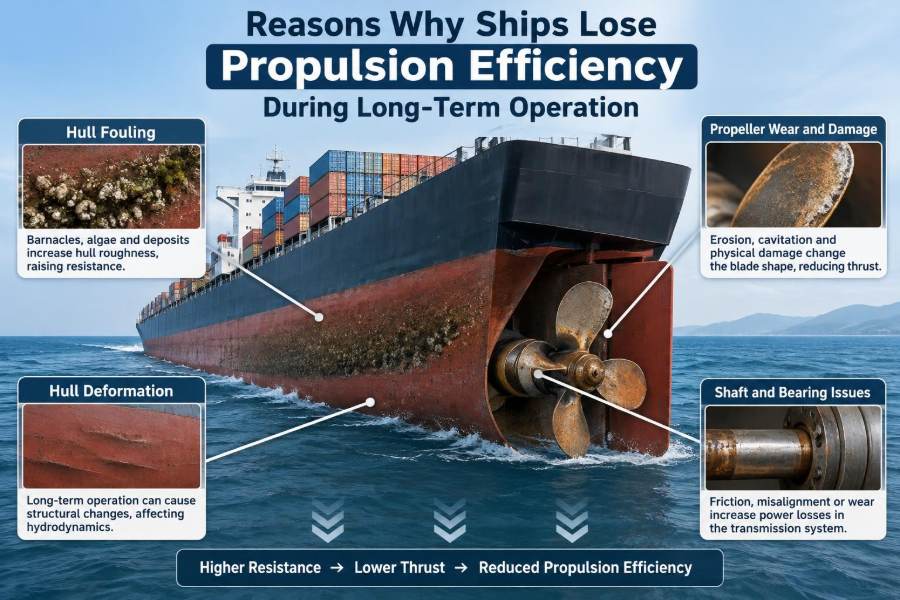

A ship may leave dry dock with a clean hull, a polished propeller, and machinery responding crisply to every engine order. Months later, the same vessel can need more fuel to hold the same schedule, or lose a little speed even though the main engine appears to be running normally.
That gradual change is easy to miss at sea. Weather varies, loading changes, and schedules leave little room for controlled comparisons. Yet small losses in several parts of the propulsion system can combine into a substantial operational penalty.
For engineers, the question is not simply why fuel consumption rises. It is whether the added power is being lost in the water, in the propeller, along the shaftline, inside the engine, or through the way the ship is operated.
Understanding the mechanisms helps crews interpret performance data, target maintenance intelligently, and avoid treating every speed loss as an engine problem.
⚙️ Propulsion Efficiency Is a Chain, Not One Number
Propulsion efficiency describes how effectively fuel energy is converted into useful movement of the ship. It is the result of a chain: fuel combustion produces engine power, the shaft transmits that power, the propeller turns it into thrust, and the hull moves through water with a certain resistance.
A loss at any point reduces the overall result. A slightly rough hull increases resistance; a fouled propeller reduces thrust efficiency; poor combustion raises the fuel needed to deliver shaft power. None of these defects must be dramatic before the ship’s daily consumption begins to drift upward.
This is why diagnosis should follow the complete energy path rather than focusing immediately on the main engine.
📉 The Usual Symptom: More Power for the Same Speed
The clearest operational symptom is often a change in the relationship between speed, shaft power, and fuel consumption. Under comparable draft, trim, weather, and current conditions, the vessel needs more revolutions or more shaft power to make the speed it previously achieved.
Engineers sometimes describe this as a deterioration in the speed-power curve. It does not automatically identify the cause, but it establishes that the vessel’s performance baseline has moved.
A second pattern is the opposite: the engine develops roughly the expected power, but the ship’s speed falls. That frequently points toward increased hull resistance or reduced propeller effectiveness.
🌊 Hull Fouling Adds Resistance Continuously
The underwater hull is normally the largest surface moving through the sea. Marine growth, slime, algae, barnacles, and other organisms disrupt the smooth flow of water along that surface. Even thin slime can increase frictional resistance, especially on a large vessel with extensive wetted area.
Fouling is not uniform. Areas with lower water velocity, sheltered recesses, sea chests, and regions around appendages may develop growth sooner. Long idle periods in warm, biologically active waters commonly make the problem worse.
The key mechanism is simple: the ship is not necessarily becoming heavier, but it is becoming harder to push. More resistance demands more propulsive thrust, which demands more power and fuel.
🦪 Why Coatings Do Not Eliminate Fouling
Antifouling coatings are designed to reduce attachment or make attached organisms easier to remove. They are valuable, but they do not create permanent immunity. Their performance depends on coating type, application quality, vessel trading pattern, water temperature, idle time, cleaning practices, and mechanical damage.
A coating that performs well on a regularly sailing vessel may behave differently on a ship that remains alongside for extended periods. Contact damage, poor surface preparation, and local coating failure can also create starting points for more aggressive growth.
It is a mistake to assume that a relatively recent dry dock rules out hull roughness. Performance monitoring is still needed between dockings.
🪨 Coating Roughness Raises Skin Friction
Not all hull-related losses are biological. Paint overspray, uneven repairs, coating runs, abrasion, corrosion products, and poorly faired steelwork all increase surface roughness. Water flowing over a rough surface develops more turbulence near the hull, increasing skin friction.
This deterioration can occur slowly enough that it attracts little attention. A ship may look acceptable during a visual inspection while its roughness profile has changed enough to affect the resistance experienced at service speed.
Good hull preparation and controlled coating application therefore support propulsion performance, not just corrosion protection and appearance.
🛶 Appendages Create Their Own Drag
Rudders, bilge keels, shaft brackets, thruster tunnels, stabilizer fins, gratings, and anodes are all part of the underwater resistance picture. Fouling or damage on these appendages can have an outsized effect because they disturb flow in sensitive areas.
The region immediately ahead of the propeller deserves particular attention. Uneven flow entering the propeller disc reduces its ability to produce thrust smoothly and can encourage vibration and cavitation.
Cleaning plans that focus only on broad flat hull panels may leave meaningful losses untouched. Underwater inspections should include appendages, recesses, and the propeller zone.
🌀 Propeller Fouling Reduces Thrust Directly
A propeller is an underwater wing system. Its blades rely on a controlled pressure difference between their faces and backs to accelerate water aft and create thrust. Slime, shell growth, fishing-line remnants, or damaged leading edges disturb that flow.
Because the propeller is the final device creating thrust, fouling there can be especially costly. The engine may still turn the shaft, but more of the delivered power is wasted in turbulence rather than converted into useful thrust.
A hypothetical example is a vessel that undergoes a hull clean but receives only a superficial propeller wash. It may show less resistance afterward, yet fail to regain expected speed because the propeller surface remains rough.
🔧 Blade Damage Changes the Designed Geometry
Propeller blades are shaped and pitched for a particular operating range. Bent tips, edge dents, erosion, cracks, and surface pitting alter that geometry. Damage can arise from debris strikes, grounding contact, cavitation erosion, ice, or poor handling during maintenance.
Even when the damage appears local, it can produce imbalance and uneven blade loading. The result may include lower efficiency, increased vibration, and a higher risk of fatigue issues in associated equipment.
Propeller repair must restore the intended geometry as closely as practicable. Simply smoothing a damaged area may remove a sharp defect but not necessarily recover the original hydrodynamic performance.
💥 Cavitation Can Become a Self-Reinforcing Loss
Cavitation occurs when local pressure falls sufficiently for vapor-filled cavities to form in water. When these cavities collapse near a blade surface, they can cause noise, vibration, and material erosion.
Some cavitation can occur in normal operation, particularly under demanding conditions, but excessive or poorly controlled cavitation is harmful. It reduces effective blade action and can progressively pit the blade surface, making the flow still less smooth.
High loading, uneven wake flow, wrong pitch settings on controllable-pitch propellers, damaged blades, and operation outside the design condition can all contribute. Persistent cavitation warrants investigation rather than being accepted as an unavoidable sound.
🧭 Wake Changes Affect the Propeller Inflow
The propeller does not work in undisturbed water. It receives the wake created by the hull moving through the sea. The velocity and direction of this incoming water vary across the propeller disc, and the vessel’s stern shape is designed with that reality in mind.
Hull fouling, trim changes, damaged appendages, and loading condition can alter the wake. A more uneven wake causes cyclic blade loading: each blade encounters different conditions as it rotates. This harms efficiency and may raise vibration levels.
For this reason, a propeller problem can sometimes originate forward of the propeller. Inspection and analysis should not treat the screw as an isolated component.
⚓ Draft and Displacement Change the Power Demand
A deeper-loaded ship displaces more water and generally has greater wetted surface area. At the same speed, it commonly needs more power than when lightly loaded. This is normal physics, not necessarily deterioration.
Long-term comparison becomes misleading when reports ignore displacement. A vessel carrying different cargo quantities, ballast arrangements, or consumables may show different fuel performance even with the hull and machinery in identical condition.
Performance records should therefore be normalized as far as practical for draft and displacement. Otherwise, a change in loading can be mistaken for a loss of propulsion efficiency.
📐 Trim Can Help or Harm Water Flow
Trim is the difference between draft forward and draft aft. Small changes in trim alter how the hull sits in the water, which affects wave-making resistance, wetted area, and flow into the propeller.
There is no universal best trim for every ship and speed. A condition that improves one vessel’s performance may be unsuitable for another, and the optimum can shift with displacement, sea state, and speed.
Crews should use approved loading guidance and observed performance data, not assumptions. Excessive stern trim, for example, may deepen the propeller adequately but also increase resistance or worsen wake quality.
🌬️ Weather Can Hide the Underlying Trend
Wind, waves, swell, current, and sea temperature all influence a ship’s observed performance. Head seas increase resistance and propeller load; following current increases speed over ground without improving propulsion; adverse current can conceal a healthy through-water speed.
For meaningful comparison, distinguish speed through water from speed over ground, and record sea state and wind direction where possible. A noon report from a rough passage should not be compared casually with one from calm water.
Weather correction methods can improve analysis, but they have limitations. Their quality depends on reliable input data and suitable assumptions for the particular vessel.
🗓️ Slow Steaming Alters the Operating Point
Many ships operate below their original design speed for commercial, environmental, or schedule reasons. This can save fuel overall, but it also moves the hull, propeller, and engine away from the conditions for which some components were optimized.
At low load, a large two-stroke engine may face different combustion and thermal conditions. A fixed-pitch propeller may also operate at a less favorable combination of torque, revolutions, and advance speed.
Slow steaming is not inherently a propulsion defect. The practical issue is to recognize the intended operating profile and maintain machinery according to maker guidance for that range.
🔥 Combustion Quality Affects Fuel-to-Power Conversion
Inside the cylinder, the engine must release fuel energy at the correct time and mix fuel with sufficient air for efficient combustion. Injector wear, poor atomization, incorrect injection timing, inadequate compression, and uneven cylinder condition can reduce the useful work produced from each unit of fuel.
Symptoms may include uneven exhaust temperatures, increased smoke, unstable running, abnormal cylinder pressure patterns, or a gradual rise in specific fuel consumption. No one symptom alone confirms the cause.
Indicator diagrams, exhaust temperature trends, fuel index information, and routine inspection together give a stronger diagnostic picture than a single reading.
🧪 Fuel Quality Can Create Operational Penalties
Marine fuel properties influence ignition, atomization, combustion deposits, and the load placed on fuel treatment equipment. Poor compatibility between fuel batches, inadequate purification, water contamination, or inappropriate handling temperature can all affect engine performance and reliability.
Fuel quality issues should be handled through established onboard procedures, sampling, segregation where required, and consultation with the operator and engine maker. It is unsafe to draw broad conclusions from appearance alone.
Even compliant fuel can require careful treatment. The goal is to deliver fuel to the engine at the correct cleanliness, viscosity, and temperature for the installed system.
🌡️ Air Coolers and Turbochargers Lose Effectiveness
Diesel engines depend on an adequate supply of clean, dense scavenge air. Fouling on turbocharger gas paths, compressor blades, charge-air coolers, filters, or scavenge spaces restricts airflow or reduces cooling effectiveness.
Warmer intake air is less dense, so less oxygen enters the cylinders for a given volume. The engine may then burn fuel less efficiently, run hotter, or be unable to sustain the desired load without approaching operational limits.
Trending scavenge pressure, air-cooler temperature difference, turbocharger speed where available, and exhaust temperatures can reveal deterioration before it becomes a severe restriction.
🛢️ Exhaust-Side Fouling Limits Gas Energy
The turbocharger is driven by exhaust-gas energy. Deposits in exhaust valves, gas passages, turbine nozzles, economizer-related paths, or the turbine itself can interfere with that energy transfer and raise back pressure.
Higher exhaust back pressure makes it harder for cylinders to expel burned gases. Combined with reduced turbocharger performance, this can create a cycle of poorer scavenging, hotter exhaust, and lower combustion efficiency.
Cleaning intervals should be condition-based where possible and always follow the maker’s procedures. Aggressive cleaning without understanding deposit type or equipment limits can introduce separate risks.
🧱 Cylinder Wear and Blow-By Reduce Useful Work
Over long service periods, piston rings, liners, valves, and sealing surfaces wear. If combustion gases leak past the rings into the crankcase area, known as blow-by, less pressure remains available to push the piston down.
Wear can also affect oil consumption, deposit formation, compression pressure, and thermal balance. These changes are usually gradual, which makes trend monitoring more useful than waiting for a single alarming symptom.
Condition assessment may include scavenge drain observation, oil analysis, inspection findings, cylinder-pressure analysis, and measurements taken during planned maintenance. Results must be interpreted in the context of the specific engine.
🔩 Shaftline Misalignment Wastes Energy and Causes Wear
The main engine, gearbox where fitted, shaft bearings, and propeller must remain aligned as a system. Hull deflection, bearing wear, foundation movement, thermal expansion, and changes in loading can alter the load distribution along the shaftline.
Misalignment increases bearing friction and can create vibration, elevated temperatures, abnormal wear, or local shaft stresses. Severe cases are reliability concerns, but minor misalignment can also contribute to a quieter, persistent efficiency loss.
Alignment should be assessed with appropriate measurements and engineering guidance. It is not a condition that can be judged reliably from fuel consumption alone.
🛞 Bearing Condition Adds Mechanical Losses
Thrust bearings, intermediate bearings, stern tube bearings, and gearbox bearings support rotating machinery while maintaining an oil film between surfaces. Incorrect lubrication, contamination, wear, excessive clearance, or abnormal loading raises friction and heat generation.
Mechanical losses are usually smaller than a heavily fouled hull’s hydrodynamic loss, but they matter because they may signal a developing machinery fault. Bearing temperature trends, oil condition, vibration data, and inspection records are valuable clues.
A rising bearing temperature should never be treated merely as an efficiency issue. Safe operating limits and the vessel’s maintenance procedures take priority.
⚡ Electrical Loads Can Increase Apparent Fuel Use
Not every rise in total fuel consumption comes from main propulsion. Auxiliary generators may be carrying increased hotel, cargo, pumping, refrigeration, or deck machinery loads. On some vessels, shaft generators or power-take-in arrangements further connect electrical demand with the propulsion plant.
When analyzing voyage fuel, separate main-engine consumption from auxiliary consumption where practical. Otherwise, a change in electrical operating mode can be incorrectly attributed to poor propeller or hull performance.
This distinction is especially relevant for ships with energy-intensive cargo systems or variable accommodation loads.
📊 Baselines Turn Observations into Evidence
A useful baseline is established when the vessel is known to be in good condition, often after dry docking, propeller work, or confirmed machinery overhaul. It should include speed, power, fuel use, draft, trim, weather, sea state, and operating mode.
One data point is rarely enough. A series of comparable observations is more revealing because it separates a persistent trend from normal voyage-to-voyage variation.
Useful records may include:
- shaft revolutions, torque or shaft power where fitted, and pitch setting;
- speed through water and speed over ground;
- draft, displacement, trim, and rudder activity;
- fuel consumption by consumer and engine performance readings;
- hull, propeller, and machinery maintenance dates.
🧮 Compare Like with Like Before Diagnosing
A performance claim is only as good as its comparison conditions. The most reliable comparisons use similar displacement, trim, speed range, weather exposure, fuel type, and machinery configuration.
The table below is a practical guide to separating common patterns. It is not a substitute for vessel-specific analysis or maker recommendations.
| Observed pattern | Possible area to examine | Useful supporting checks |
|---|---|---|
| More shaft power required at similar through-water speed | Hull, appendage, or propeller condition | Underwater inspection, cleaning history, weather-normalized trend |
| Higher fuel rate at similar shaft power | Engine combustion or air supply | Exhaust trends, cylinder data, turbocharger and cooler condition |
| New vibration with speed loss | Propeller, shaftline, or wake disturbance | Vibration records, propeller inspection, bearing checks |
| Higher total fuel but stable main-engine figures | Auxiliary electrical or cargo demand | Generator loading and operating-mode review |
🧼 Underwater Inspection Should Be Purposeful
Diver or remotely operated vehicle inspections can provide valuable evidence between dry dockings. The best inspections answer specific questions: Is there slime, hard growth, coating damage, blade damage, line entanglement, or obstruction of an appendage?
Photographs and video should be clear enough to compare condition over time. A vague report of “some fouling” is less useful than identifying location, coverage, type of growth, and condition of the propeller and rudder.
Cleaning decisions should also consider coating compatibility, local environmental requirements, and the risk of damaging surfaces or spreading invasive organisms.
🧽 Hull and Propeller Cleaning Need a Business Case
Cleaning may recover performance, but the correct timing is not identical for every vessel. It depends on expected remaining time before dry dock, measured performance loss, trading route, access to approved cleaning services, coating condition, and operational constraints.
Cleaning too late wastes fuel for longer than necessary. Cleaning too aggressively or too frequently can damage coatings and shorten their service life. The right decision balances immediate recovery against long-term hull preservation.
Propeller polishing can be particularly worthwhile when surface roughness is evident, but it should be performed using methods appropriate to the propeller material and condition.
🛠️ Machinery Maintenance Must Address Root Causes
Replacing a fuel injector may improve a symptom, but the wider question remains: why did its performance deteriorate? Contaminated fuel, incorrect maintenance practice, poor filtration, or prolonged off-design operation may cause the next injector to suffer the same fate.
Effective maintenance combines scheduled tasks with condition monitoring. It also closes the loop by checking whether the intervention changed exhaust temperatures, fuel use, vibration, or other relevant performance indicators.
Following engine-maker limits and procedures is essential. Adjustments to injection, turbocharging, or cylinder settings without proper measurements can reduce reliability even if they appear to improve a short-term reading.
🚫 Common Diagnostic Mistakes to Avoid
A frequent mistake is blaming the hull whenever daily fuel use rises. Hull fouling is common, but rough weather, adverse current, a deeper draft, auxiliary demand, and engine condition can produce similar operational impressions.
Another mistake is treating speed over ground as proof of propulsion quality. Current can make a struggling ship look fast or make a healthy ship appear slow.
- Do not compare voyages with very different loading and weather conditions.
- Do not ignore new vibration, abnormal temperatures, or exhaust imbalance while pursuing fuel savings.
- Do not assume a clean-looking propeller has correct geometry or balance.
- Do not use one corrective action as proof that every cause has been removed.
🤝 Deck and Engine Departments Share the Evidence
Propulsion efficiency crosses departmental boundaries. Deck officers record speed, weather, draft, trim, routeing, and steering demands. Engine officers observe fuel rates, machinery loads, temperatures, pressures, and maintenance condition.
Better decisions result when these observations are reviewed together. For example, a report of increasing rudder activity in certain loading conditions may help explain a wake or trim-related change that engine data alone cannot identify.
A short, consistent performance review after significant maintenance, hull cleaning, or unusual voyages can prevent valuable evidence from being lost in separate logs.
🧠 Digital Monitoring Helps, but Does Not Replace Judgment
Modern performance systems can combine ship data, weather information, engine signals, and voyage records to identify trends faster than manual spreadsheets. They are useful for flagging deviations and supporting decisions about cleaning or maintenance.
However, sensor errors, missing data, incorrect drafts, unrepresentative weather inputs, and changing operating profiles can produce misleading outputs. A model is only as trustworthy as its data and assumptions.
Engineers should treat digital results as a prompt for investigation. Physical inspection, machinery knowledge, and safe operating practice remain essential.
🛡️ Efficiency Work Must Never Override Safety
Aiming for lower fuel use should not lead to operation beyond machinery limits, inadequate safety margins, deferred critical maintenance, or unsafe underwater work. Running closer to load limits to regain schedule speed can increase thermal and mechanical stress.
Similarly, a suspected efficiency loss may be the first visible sign of a condition with wider safety implications, such as propeller damage, bearing distress, turbocharger fouling, or abnormal vibration.
The correct priority is clear: operate safely, investigate systematically, and improve efficiency within approved technical and operational boundaries.
🧭 The Core Principle: Find Where the Energy Is Being Lost
Long-term propulsion deterioration is rarely a single mystery fault. It is usually an energy-balance problem expressed through more fuel, more power, less speed, or some combination of all three.
The most effective approach is to establish a sound baseline, compare similar operating conditions, inspect the underwater body, review propeller and shaftline health, and evaluate engine air, fuel, combustion, and mechanical condition. Each step narrows the search without relying on guesswork.
Efficient ships are maintained as complete propulsion systems, where hull condition, propeller performance, machinery health, and operating practice are examined together.
When crews recognize small performance changes early and investigate them with reliable data, they can reduce unnecessary fuel use while protecting the machinery that keeps the vessel moving safely and predictably. 🚢⚙️🌊