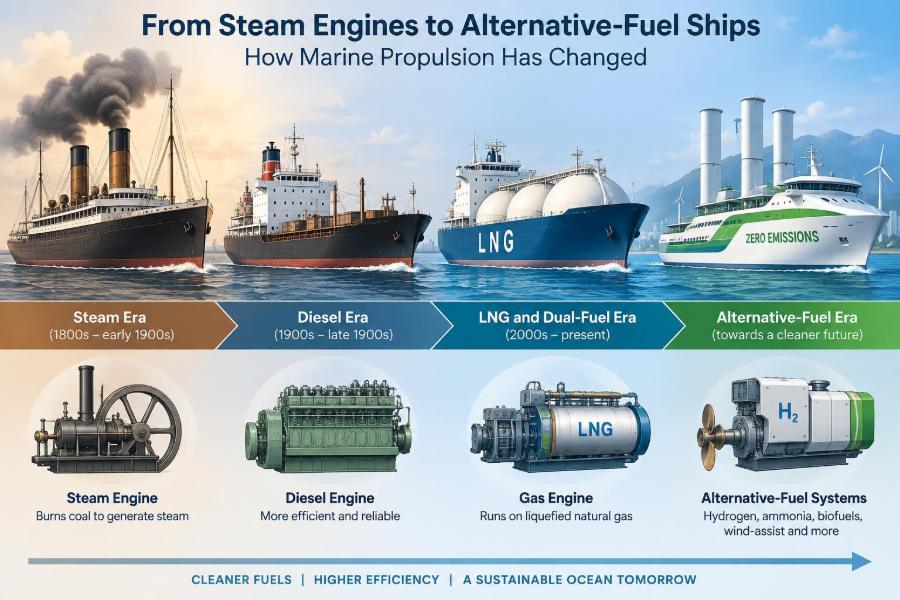

A ship leaving port can look much the same as it did decades ago: hull low in the water, containers stacked above deck, a wake spreading behind the stern. Below deck, however, the machinery producing that motion may be radically different.
For a marine engineer, propulsion is never just about making a vessel move. It determines fuel storage, engine-room layout, maintenance routines, voyage range, cargo capacity, emissions, crew training, and what happens when equipment fails far from shore.
The move from steam to diesel transformed global shipping because it made long-distance operation more efficient and practical. The current shift toward lower-carbon fuels is similarly consequential, but it is not a simple replacement of one fuel with another.
Understanding that history helps students see why modern propulsion plants are designed as complete systems rather than isolated engines. It also helps working professionals evaluate new technology with the right question: what trade-offs does this ship need to manage?
⚓ Propulsion Is a Complete Energy Chain
Marine propulsion converts stored energy into thrust. Fuel or another energy source is processed, an engine or electric machine produces rotating power, a shaft turns a propeller or waterjet, and that device accelerates water astern to push the vessel ahead.
Each link has losses. Combustion is not perfectly efficient, gears and bearings create friction, and a propeller loses energy in swirl and turbulence. A good propulsion design considers the entire chain rather than focusing only on engine output.
🌊 Why Ships Need Their Own Solutions
Ships operate for days or weeks without refuelling, carry large loads, and face changing weather and sea states. Their prime movers must be reliable, compact enough for the hull, maintainable at sea, and capable of delivering high torque for long periods.
Unlike a road vehicle, a ship cannot always stop safely when machinery needs attention. Redundancy, emergency power, steering capability, and dependable auxiliary systems are therefore central engineering concerns.
🔥 The Age of Coal-Fired Steam
Early steamships used boilers to heat water and make high-pressure steam. That steam expanded in engines, initially reciprocating piston engines, producing mechanical motion for paddle wheels and later propeller shafts.
Steam propulsion freed vessels from complete dependence on wind, although coal bunkering remained a major operational constraint. Coal occupied substantial volume, demanded intensive manual handling, and produced ash that had to be managed.
🔩 Reciprocating Engines and Their Limits
A reciprocating steam engine converts the back-and-forth movement of pistons into shaft rotation through connecting rods and crankshafts. The mechanism was understandable and serviceable, but large installations were heavy and mechanically complex.
As ships grew faster and larger, operators needed machinery with better power-to-weight characteristics. That search led to a different way of using steam energy.
🌀 Steam Turbines Changed Ship Speed
A steam turbine directs high-velocity steam through rows of blades, causing a rotor to spin continuously. Its rotary motion suited propellers better than the alternating motion of pistons, and turbines could provide very high power smoothly.
They became especially valuable in fast naval ships and large passenger vessels. Their weakness was that turbine efficiency depended strongly on operating conditions, while conventional propellers work best at much lower rotational speeds than a turbine rotor.
⚙️ Reduction Gears and Better Propeller Matching
Reduction gearing allowed a fast turbine to drive a slower propeller at its efficient speed. This was an important system-level improvement: neither the turbine nor the propeller had to operate at an unsuitable compromise speed.
The same principle remains relevant. Gearboxes, controllable-pitch propellers, and electrical drives are all ways to match a power source to the load it must serve.
🛢️ Oil Fuel Improved the Steam Plant
Replacing coal with fuel oil simplified bunkering and reduced the labour of moving fuel to boilers. Oil also made combustion control more consistent and removed ash handling from the daily routine.
Oil-fired boilers did not eliminate the complexity of steam systems. They still required careful water treatment, boiler operation, condensate recovery, and management of high temperatures and pressures.
🧰 The Arrival of the Marine Diesel Engine
Diesel engines use compression ignition: air is compressed until it becomes hot enough for injected fuel to ignite. In large slow-speed marine engines, the crankshaft can be coupled directly to the propeller shaft, avoiding a reduction gearbox.
This combination of good fuel efficiency, robust torque, and practical fuel storage made diesel propulsion dominant in commercial shipping. It also changed the engineer’s work from boiler-focused operation toward fuel injection, lubrication, cooling, scavenge air, and combustion management.
📏 Slow-Speed, Medium-Speed, and High-Speed Engines
Marine diesels are commonly grouped by rotational speed, but the categories also suggest their typical application and drivetrain arrangement.
| Engine type | Typical arrangement | Common use |
|---|---|---|
| Slow-speed two-stroke | Direct drive to propeller | Large oceangoing cargo ships |
| Medium-speed four-stroke | Gearbox or generator sets | Ferries, offshore vessels, cruise ships |
| High-speed diesel | Gearbox, waterjet, or generator | Smaller fast craft and workboats |
No category is automatically superior. A slow-speed engine suits sustained ocean passage, while a vessel needing frequent manoeuvring or multiple power consumers may gain more from medium-speed generator sets and electric propulsion.
🌬️ Turbocharging Made More Power Possible
A turbocharger uses exhaust-gas energy to spin a compressor that supplies pressurised air to the engine. More air supports more complete combustion and allows greater power from a given engine size.
It also illustrates why machinery systems must be understood together. Fouled turbocharger components, restricted air filters, poor exhaust flow, or incorrect fuel settings can all affect combustion, temperatures, and engine reliability.
🛞 The Propeller Became a Precision Device
A propeller is not simply a rotating fan. Its blades act like rotating hydrofoils, generating a pressure difference that creates thrust. Blade pitch, diameter, number of blades, immersion, and hull wake all influence performance.
Cavitation occurs when local pressure drops enough for vapour bubbles to form and collapse. It can cause vibration, noise, lost efficiency, and blade erosion. Matching propeller design to vessel speed and power is therefore essential.
↔️ Fixed and Controllable Pitch
A fixed-pitch propeller has blades with a permanent angle. It is mechanically simple and efficient when the vessel normally operates near its design condition.
A controllable-pitch propeller can alter blade angle while rotating. It enables rapid thrust changes without changing shaft direction, which is useful for ferries, tugs, and vessels with variable operating profiles. The added hub mechanism, hydraulic system, and maintenance burden are the trade-off.
🔌 Diesel-Electric Propulsion Added Flexibility
In diesel-electric arrangements, diesel engines drive generators rather than the propeller directly. Electricity feeds propulsion motors and can also support hotel loads, pumps, cranes, drilling equipment, or other consumers.
This allows generator sets to be selected according to demand and placed more flexibly within the vessel. Electrical conversion introduces losses, but operational flexibility can outweigh them, particularly where speed and load change often.
🧭 Azimuth Thrusters Improved Manoeuvrability
An azimuth thruster can rotate its propulsor through 360 degrees, directing thrust in almost any horizontal direction. It can reduce the need for separate rudders and improve low-speed handling.
Cruise ships, offshore support vessels, and some ferries use this capability for precise positioning. The equipment is sophisticated, and its seals, bearings, electrical components, and control systems require disciplined inspection and maintenance.
🌉 Podded Drives and Integrated Design
A podded drive places an electric motor in a steerable pod outside the hull, often with the propeller mounted directly on the motor shaft. Removing a long shaft line can release internal layout space and reduce some mechanical components.
However, underwater access is limited, and a pod is not a universal answer. Designers must assess lifecycle maintenance, redundancy, hydrodynamic behaviour, vessel mission, and repair arrangements before selecting it.
🧪 Why Conventional Marine Fuels Are Under Pressure
Heavy fuel oils and marine distillates have powered shipping reliably, but combustion produces carbon dioxide and can produce pollutants such as nitrogen oxides, sulphur oxides, and particulate matter. Fuel sulphur limits have changed fuel choices and encouraged exhaust-gas cleaning systems in some trades.
Decarbonisation adds a different challenge. Reducing carbon dioxide over a vessel’s lifetime requires attention to fuel production, storage, combustion or conversion, and the energy used throughout the supply chain.
🛢️ Liquefied Natural Gas as a Transitional Option
Liquefied natural gas, or LNG, is natural gas cooled into a liquid for storage. It can reduce certain air pollutants compared with conventional residual fuel and has been adopted in specific vessel types and regions.
Its climate value depends on the full system, including methane emissions that may occur during production, transport, or engine operation. LNG tanks also occupy more space than conventional fuel tanks for a comparable energy amount, affecting vessel design.
🧫 Methanol and Its Practical Appeal
Methanol is a liquid at ambient conditions, making it simpler to handle and bunker than cryogenic fuels. Engines can be designed or converted to operate on methanol, often with a small amount of pilot fuel for ignition in certain concepts.
Its lower energy density means more tank volume is needed for a given voyage. Its environmental outcome also depends on how it is made: methanol from fossil sources and methanol made using low-carbon pathways do not have the same lifecycle profile.
🧊 Ammonia Brings Carbon-Free Fuel Challenges
Ammonia contains no carbon, so its use does not create carbon dioxide at the point of combustion. It is being developed as a potential marine fuel because it can be stored as a liquid under manageable pressure or refrigeration conditions.
It is also toxic, has lower energy density than conventional fuels, and can create nitrogen-containing emissions if combustion is poorly controlled. Safe adoption requires fuel containment, ventilation, detection, emergency procedures, crew competence, and carefully designed combustion or fuel-cell systems.
💧 Hydrogen Has a Storage Problem
Hydrogen can be used in fuel cells or burned in adapted engines, and its use can avoid carbon dioxide at the vessel. The engineering difficulty is carrying enough of it: compressed gas needs large high-pressure tanks, while liquid hydrogen requires extremely low temperatures.
That makes hydrogen particularly relevant to shorter routes, specialised vessels, or applications where frequent refuelling is practical. Its overall climate benefit depends heavily on the energy source used to produce it.
🔋 Batteries Fit Some Voyages Very Well
Batteries deliver electricity efficiently at the vessel, with no exhaust emissions while operating. They are effective for ferries with predictable short routes, harbour craft, and hybrid systems that reduce generator use during low-load periods.
For long ocean crossings, current battery mass and volume requirements remain a major constraint. Battery systems also need thermal management, high-voltage protection, fire detection, isolation procedures, and trained crews.
🌱 Biofuels and Drop-In Alternatives
Some biofuels can be blended with or used in machinery designed for conventional liquid fuels, potentially reducing the need for major shipboard conversion. This operational familiarity is attractive to existing fleets.
Compatibility, stability, cold-flow properties, material effects, and fuel quality still need verification. Most importantly, environmental performance varies with feedstock and production method; a fuel label alone does not establish its full lifecycle impact.
⚡ Fuel Cells Change the Conversion Step
A fuel cell produces electricity through an electrochemical reaction instead of burning fuel in cylinders. It can offer quiet operation and high efficiency at suitable loads, then supply electric propulsion motors or onboard consumers.
Fuel cells do not remove the need for engineering judgement. Their performance depends on fuel purity, cooling, electrical integration, redundancy, cost, and the fuel selected for the vessel.
🧠 Hybrid Plants Use Each Source Where It Works Best
A hybrid propulsion system combines sources such as engines, batteries, shore power, fuel cells, or wind-assist devices. The control strategy decides when to charge batteries, start generators, use stored energy, or meet peak demand.
For example, a harbour tug might use battery power during low-noise port operations and engines for sustained towing. The benefit comes from matching each component to its strongest operating condition, not from adding technology for its own sake.
🌬️ Wind Assistance Has Returned in Modern Form
Rotor sails, wing sails, kites, and suction-based aerodynamic devices can provide supplementary thrust. They are not a return to traditional sailing ships; they are controlled systems integrated with modern routing, automation, and propulsion plants.
Their contribution changes with wind direction, weather, route, deck space, and cargo operations. They can reduce demand on the main plant, but most commercial designs still require a dependable primary propulsion system.
🏗️ Hull Design Can Save More Fuel Than Engine Changes
Propulsion demand rises sharply as vessel speed increases, so a modest speed reduction can substantially reduce the power required. Hull fouling, damaged coatings, poor trim, and inefficient routing all increase resistance and force the plant to work harder.
Energy-saving devices, air lubrication, propeller upgrades, weather routing, and condition monitoring may therefore complement alternative fuels. The cleanest unit of energy is often the one the ship never needs to use.
🧑🔧 The Engineer’s Role Is Expanding
Modern marine engineers need traditional mechanical skills alongside competence in automation, power electronics, fuel safety, data interpretation, and integrated control systems. A fault may involve a pump, sensor, software interlock, battery-management system, or fuel valve rather than a single mechanical defect.
Strong fundamentals remain transferable. Understanding pressure, heat transfer, lubrication, electrical protection, combustion, and risk assessment makes it easier to learn a new propulsion platform.
🦺 Safety Must Be Designed Into the Fuel Choice
Every fuel creates hazards. Conventional fuels bring fire and pollution risks; LNG presents cryogenic and gas-release hazards; ammonia requires toxicity controls; hydrogen requires management of leakage and ignition risk; batteries require control of thermal events.
Safe systems use layers of protection: suitable tank location, double barriers where required, ventilation, gas detection, shutdown logic, fire protection, emergency response plans, and realistic drills. Procedures are not a substitute for sound physical design, and design is not a substitute for competent operation.
📋 Comparing Fuels Requires More Than Exhaust Emissions
A useful comparison asks several questions at once:
- Where does the fuel’s energy come from?
- How much volume and mass must the vessel carry?
- What machinery, tanks, piping, and safety systems are required?
- Is bunkering available along the actual route?
- What are the likely emissions across production, transport, and use?
- Can the crew operate and maintain the system safely?
This is why there is unlikely to be one winning fuel for every ship. A coastal passenger ferry and a bulk carrier on long international routes face fundamentally different constraints.
🔧 Common Mistakes When Discussing New Propulsion
One common mistake is treating a fuel as automatically low-carbon because it has no carbon atom at the vessel. Production pathways matter. Another is comparing fuels only by mass without considering tank volume, insulation, pressure equipment, and lost cargo space.
It is also risky to assume that a new engine is the entire project. Fuel preparation, bunkering, crew training, class requirements, spare parts, port infrastructure, and emergency procedures can be as decisive as the prime mover itself.
🗺️ Choosing a Plant Starts With the Mission
Engineers should begin with the vessel’s operating profile: route length, speed, port time, cargo or passenger needs, power peaks, weather exposure, and refuelling opportunities. Only then can they assess candidate fuels and propulsion arrangements.
A technically elegant system can be the wrong answer if it cannot complete the route, cannot be safely bunkered, or consumes too much revenue-earning space. Mission analysis prevents expensive late-stage redesign.
📈 The Fleet Will Change Gradually, Not All at Once
Marine propulsion is likely to remain mixed for many years. Newbuildings can incorporate tanks and machinery for emerging fuels, while existing ships may adopt efficiency upgrades, alternative fuel blends, hybridisation, or targeted conversions where feasible.
Infrastructure, fuel availability, regulations, economics, and ship service life will shape the pace. Engineers should be cautious of simple forecasts, but prepared for a broader range of machinery than previous generations encountered.
🎯 The Core Lesson From Steam to Alternative Fuels
The history of propulsion is a history of system integration. Steam plants required boilers, condensers, and coal or oil logistics; diesel plants required refined fuel, turbocharging, and sophisticated lubrication; future plants add new storage, electrical, digital, and safety demands.
The core principle is straightforward: the best propulsion solution is the one that safely delivers the vessel’s mission with the lowest practical energy and environmental burden across its whole operating system. That principle is more useful than loyalty to any single engine or fuel.
From steam cylinders to batteries, fuel cells, and carbon-free fuels, marine propulsion evolves when engineers balance physics, safety, operations, and real-world constraints as one connected problem. 🚢⚙️🌍