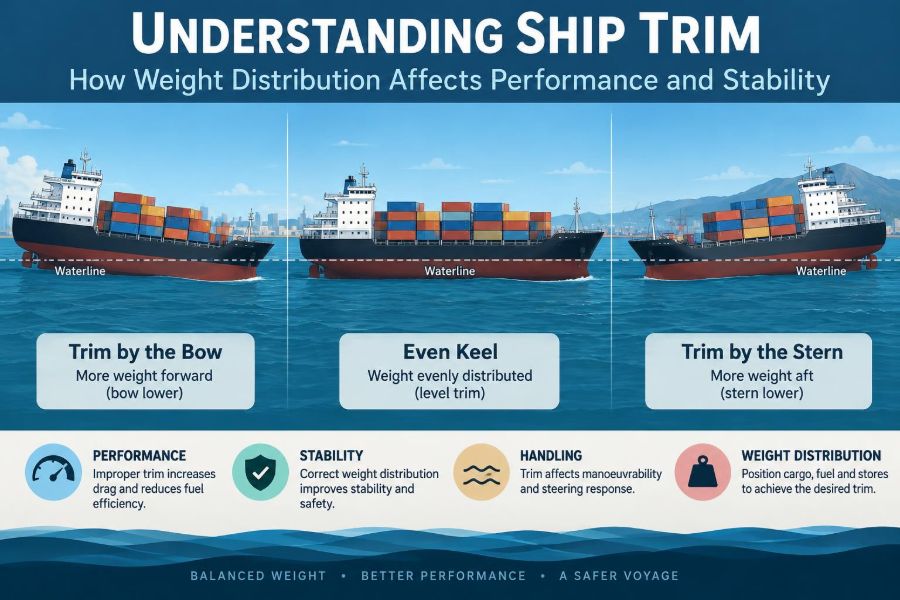

A ship can be fully loaded, upright at the quay, and still be poorly prepared for sea. If her stern sits too deep, the propeller may work in a different inflow; if her bow is too deep, she may pound into waves and ship water on deck. Neither condition necessarily looks dramatic from shore.
For the crew, trim is a daily practical question. Ballast is transferred, fuel is consumed, cargo is discharged, and freshwater tanks change level. Each of those changes moves the vessel’s overall weight and alters how she floats.
For students, trim is where hydrostatics becomes visible. It connects the abstract locations of centres of gravity and buoyancy with fuel use, propeller immersion, structural loading, visibility, and stability.
The aim is not to make every vessel perfectly level. The aim is to understand the vessel’s intended operating condition, predict the effect of a weight movement, and keep the ship within approved limits.
⚓ What Ship Trim Means
Trim is the difference between a ship’s draught forward and her draught aft. Draught is the vertical distance from the keel reference to the waterline, read at marked positions on the hull.
A ship is trimmed by the stern when the aft draught exceeds the forward draught. She is trimmed by the head when the forward draught is greater. Equal forward and aft draughts are commonly called even keel, although local draught marks and hull form still need careful interpretation.
📏 Reading Forward, Aft, and Mean Draughts
Draught marks are normally provided at the bow, stern, and often near midships. The forward and aft readings establish trim; the mean draught gives a useful first indication of displacement and immersion.
In practice, officers use corrected draughts rather than relying only on a visual average. Mark locations may not sit exactly at the forward and aft perpendiculars used in hydrostatic data, and water density, hogging or sagging, and observation error can influence a calculated mean draught.
🧭 The Direction of Trim
The phrase “trim by the stern” describes direction, not whether the condition is acceptable. A modest stern trim may be normal or desirable for one ship, while the same value could be unsuitable for another loading condition.
Always state the condition clearly: for example, “0.6 m by the stern,” rather than simply “the ship has trim.” This prevents a frequent communication error during cargo planning and ballast operations.
🪨 Why a Ship Changes Trim
Trim changes when the ship’s longitudinal centre of gravity, usually abbreviated LCG, moves forward or aft. Adding weight forward, removing weight aft, or shifting cargo toward the bow tends to create trim by the head. The reverse actions tend to produce trim by the stern.
The effect depends on both the amount of weight and the distance it moves. A relatively small mass shifted a long distance can matter more than a large mass shifted between nearby holds.
📍 The Longitudinal Centre of Gravity
LCG is the fore-and-aft position through which the ship’s total weight can be considered to act. It is a calculated result of every item aboard: hull, machinery, cargo, ballast, fuel, stores, crew effects, and liquids in tanks.
Think of a seesaw. Moving a person farther from its pivot creates a larger turning effect. On a ship, that fore-and-aft turning effect is called a trimming moment.
🔄 Trimming Moment and Weight Shift
A trimming moment is found conceptually by multiplying a weight by the longitudinal distance through which it moves. If a ballast transfer moves water from a forward tank to an aft tank, the resulting moment acts to lower the stern and raise the bow.
The final change in trim cannot be guessed from moment alone. It also depends on the ship’s displacement, waterplane shape, and hydrostatic properties at that draught. Approved stability information converts the moment into a predicted trim change.
📐 MCT 1 cm: A Useful Hydrostatic Tool
MCT 1 cm means moment to change trim by one centimetre. It is usually supplied in the vessel’s hydrostatic tables or stability booklet for a range of displacements.
Dividing the applied trimming moment by the relevant MCT 1 cm gives the approximate total change in trim in centimetres. This is a planning calculation, not a substitute for checking the actual draughts after an operation, particularly where density or loading assumptions are uncertain.
🌊 Buoyancy Must Move Too
A floating ship displaces water equal in weight to her own weight. When the ship trims, the underwater shape changes: one end immerses more deeply and the other rises. The distribution of buoyant force shifts until it balances the distribution of weight.
This is why trim is an equilibrium condition, not simply a hull angle. The ship settles at the attitude where weight and buoyancy produce no remaining unbalanced longitudinal turning moment.
🧮 LCF and the Pivot Misconception
The longitudinal centre of flotation, or LCF, is the centroid of the waterplane area. For small changes of trim at a given displacement, it is the reference about which the waterline is treated as rotating.
LCF is not a physical hinge hidden in the hull. It changes with draught and waterplane shape. Yet it is essential because it tells the navigator or loading officer how a calculated trim change divides between the forward and aft draughts.
📊 How a Trim Change Reaches Each End
If LCF lies aft of midships, a given change of trim generally produces a larger draught change at the bow because the bow is farther from the LCF. The opposite may occur on a vessel whose LCF lies farther forward.
Loading manuals provide the required distances and sign conventions. A common mistake is to calculate total trim correctly but apply the forward and aft corrections in the wrong direction. Sketching the intended rotation before entering numbers is a simple safeguard.
⚖️ Trim, List, and Heel Are Different
Trim is a fore-and-aft inclination. List is a permanent port or starboard inclination caused by an off-centre distribution of weight or buoyancy. Heel is usually a temporary transverse inclination caused by wind, turning, lifting, or a shifting load.
They can occur together. A ship may be trimmed by the stern and listed to port after uneven cargo discharge. Correcting only the visible list does not automatically correct the longitudinal condition.
| Condition | Primary direction | Typical cause |
|---|---|---|
| Trim | Fore and aft | Weight moved between forward and aft spaces |
| List | Port and starboard | Uneven loading or flooding |
| Heel | Port and starboard, often temporary | Wind, turning, or lifting operation |
🧱 Weight Distribution Is More Than Cargo Location
Deck cargo and holds receive attention because they are visible, but many trim changes originate in tanks. Fuel oil, ballast water, freshwater, lubricating oil, and liquid cargo can shift LCG significantly as their quantities change.
The lightship itself also matters. Machinery, superstructure, accommodation, cranes, ramps, and fixed equipment establish a baseline LCG before any voyage cargo is loaded.
🛢️ The Operational Effect of Consuming Fuel
Fuel consumption is rarely uniform along the ship. A vessel using mainly aft bunker tanks becomes lighter aft over time, tending to move LCG forward and reduce stern trim or create head trim.
Engineers and deck officers therefore need a shared picture of the tank plan. A voyage can begin with acceptable propeller immersion and end with a less favourable condition if consumption and ballast management are not considered together.
💧 Free Surface: The Related Tank Hazard
A partly filled tank has a free surface: liquid can move across the tank as the ship rolls or heels. This mainly reduces effective transverse stability by raising the virtual centre of gravity; it is not itself a direct trim effect.
However, slack tanks often complicate trim management because they may be used for transfer operations. Their free-surface corrections must be included in stability calculations, even when the planned transfer is intended only to alter fore-and-aft draught.
🚢 Propeller Immersion and Stern Trim
Aft trim commonly improves propeller immersion, which may reduce the risk of the propeller drawing air in rough conditions. Adequate immersion helps the propeller develop thrust consistently and can reduce racing, where engine speed rises as the propeller loses load.
Too much stern trim is not automatically better. It can increase aft draught, alter hull resistance, worsen steering characteristics on some designs, or exceed draught limits. The acceptable range comes from vessel-specific operating guidance.
🌬️ Bow Trim, Slamming, and Green Water
Excessive trim by the head drives the bow deeper into the sea. In waves, this can increase the likelihood of slamming, the repeated impact of the forward bottom against water after emerging from a wave trough.
A low bow may also ship more green water—solid water moving onto deck rather than spray. Hull form, speed, weather, freeboard, and heading all matter, so trim is only one part of the risk assessment.
🏃 Resistance and Fuel Performance
Trim changes the wetted surface and the way water flows around the hull. That can change resistance and, consequently, the power needed to maintain a given speed. The most economical trim is not universal; it varies with hull form, displacement, speed, sea state, and propeller arrangement.
For that reason, a trim that works well in calm water may not be the best practical condition in heavy weather. Safe draught, propulsion reliability, manoeuvring, and structural limits remain higher priorities than a narrow efficiency target.
🛞 Steering and Manoeuvring Effects
Trim alters the underwater lateral area at the bow and stern, influencing how a ship answers the helm. A deeply immersed stern may provide a different rudder environment, while a deeply immersed bow can change directional behaviour.
These effects are vessel-specific and are especially relevant during restricted-water manoeuvres. Pilots and masters rely on experience, but the loading condition should never be treated as separate from anticipated turning, stopping, or berthing requirements.
👀 Bridge Visibility and Forward Draught
A bow-down condition reduces the height of the bridge relative to the sea and can restrict the view immediately ahead of the vessel. Navigation requirements and operating procedures may specify a maximum blind sector or a corrective method such as additional lookout arrangements.
Visibility should be checked as a real operational issue, not only as a calculation on a loading form. Container stacks, deck cargo, weather, and night conditions can add further limitations.
🏗️ Longitudinal Strength: The Hidden Constraint
A ship is a long beam supported by buoyancy and loaded by weight. If the weight and buoyancy distributions differ significantly along the hull, they create shear forces and bending moments.
Hogging describes a condition in which the middle tends to rise relative to the ends; sagging describes the middle tending to droop. Trim does not by itself define either condition, but the cargo and ballast pattern used to create trim can seriously affect longitudinal strength.
📚 Loading Computers and Stability Booklets
Approved loading instruments combine ship-specific hydrostatic and structural data to assess draughts, trim, stability, shear force, and bending moment. Their value depends entirely on reliable input: correct weights, tank soundings, densities, cargo positions, and loading sequence.
A stability booklet remains essential because it states the approved assumptions, limiting conditions, and procedures. A loading computer is a decision-support tool, not permission to operate outside the vessel’s documented limits.
🧭 A Practical Trim-Planning Sequence
Before transferring ballast or loading a major parcel, establish the present condition and the intended final condition. Then assess the consequences rather than correcting one draught mark in isolation.
- Verify draught readings, tank quantities, cargo weights, and water density.
- Identify the required draught, trim, stability, visibility, and strength limits.
- Use approved data to model the proposed cargo or ballast movement.
- Check free-surface effects, propeller immersion, air draught, and local port restrictions where relevant.
- Carry out the operation in a controlled sequence and compare actual draughts with predictions.
- Recalculate if observed results differ materially from the plan.
🔁 Ballast Transfers Need Control
Ballasting can correct trim efficiently, but a transfer may temporarily create an unacceptable intermediate condition. Pumping out one tank before filling another can affect stability, list, strength, or draught at a restricted berth.
Clear communication between deck and engine departments is essential. Confirm tank identity, valve alignment, expected transfer quantity, pumping rate, sounding method, and stop point before the operation begins.
📦 Cargo Loading Sequence Matters
The final cargo plan may be safe while the loading sequence is not. Loading several heavy units forward before aft holds are filled can create excessive head trim or local structural loading during cargo work.
Bulk carriers, general cargo ships, container vessels, and Ro-Ro ships all manage different cargo patterns, but the principle is the same: evaluate each stage, not only departure condition. Terminal constraints may also limit maximum or minimum draught at particular locations.
⚠️ Common Errors in Trim Calculations
Most errors arise from incomplete information or inconsistent references, rather than difficult mathematics. Small mistakes can accumulate when several tank transfers and cargo movements occur during a busy port call.
- Using the wrong water density or failing to apply density correction.
- Confusing a tank’s total capacity with its actual mass of liquid.
- Applying an LCG or LCF position from the wrong displacement.
- Mixing sign conventions for forward and aft positions.
- Ignoring slack-tank free-surface corrections.
- Checking final trim but overlooking shear force and bending moment.
🧾 Draught Surveys Need Careful Observation
Draught readings may be affected by swell, wake, fouling around marks, poor lighting, inaccessible locations, and differences between port and starboard readings. Observers should take repeated readings when conditions permit and record the circumstances.
Where draught surveys support cargo quantity calculations, established procedures include corrections beyond simple trim, such as density and hull-deflection considerations. The exact method should follow the vessel, terminal, and survey requirements rather than informal estimation.
🌦️ Weather Changes the Best Operating Condition
Sea state can make an otherwise efficient trim undesirable. A condition selected for calm-water resistance may lead to uncomfortable or unsafe motions when meeting waves at speed, while a different trim may improve propeller immersion or reduce bow emergence.
There is no single “best trim” independent of route and weather. Masters must balance operational guidance with actual conditions, speed decisions, forecast uncertainty, and the ship’s observed behaviour.
🛠️ Design Features That Influence Trim Sensitivity
Fine-bowed ships, wide transoms, long flat waterplanes, bulbous bows, and different machinery arrangements respond differently to weight movement. A ship with a large waterplane area generally resists small changes in trim more than one with a smaller area at the same scale, but geometry is complex.
This is why rules learned from another vessel should be treated cautiously. The hydrostatic tables and approved operating instructions for the ship in front of you are the governing reference.
🎓 A Simple Hypothetical Example
Imagine a vessel that transfers ballast from a forward peak tank to an aft peak tank. The same water is retained onboard, so total displacement changes little, but its position moves a long distance aft. The ship will tend to gain stern trim.
If the aft draught approaches a port limit, the correct response is not necessarily to abandon all ballast correction. The team might choose a smaller transfer, use a more central aft tank, redistribute another weight, or revise the target condition after checking stability and strength.
🤝 Communication Makes Trim Management Safer
Trim decisions cross departmental boundaries. The chief officer may manage cargo and ballast, the chief engineer may track fuel use and pumping capability, and the master must integrate navigation, weather, port limits, and overall safety.
Useful handovers state the actual draughts, present trim, critical tank levels, planned consumption, ballast restrictions, and any limit that could be approached before the next watch. A shared plan prevents one routine action from undoing another department’s careful adjustment.
✅ Core Principle: Balance the Whole Ship
Trim is not a cosmetic feature of a ship’s waterline. It is the visible result of longitudinal weight distribution and a condition that influences propulsion, handling, visibility, seakeeping, and sometimes structural loading.
The sound approach is to calculate with approved ship-specific data, observe the real condition, and assess trim alongside stability and longitudinal strength. A favourable number at one draught mark is never enough if it creates a problem elsewhere.
Good trim management means placing and moving weight so the entire ship—not just the bow or stern—remains fit for the voyage and the operation ahead. That discipline turns hydrostatic theory into safer, more efficient shiphandling. ⚓🌊🚢