
A container arriving at a port may look much the same as it did a decade ago: steel boxes, cranes, tugboats, and a ship’s bridge high above the water. Yet below deck and inside shore-control rooms, the technology behind that journey is changing quickly.
Shipowners must move cargo reliably while facing tighter emissions rules, uncertain fuel availability, and pressure to improve safety. Engineers are being asked to make practical decisions now, even though several of the most promising solutions are still developing.
That makes this a real-world engineering problem rather than a simple choice between “old” and “new.” A fuel affects tanks, piping, engines, training, and port operations. Automation affects sensors, communications, maintenance, liability, and the people responsible when a system fails.
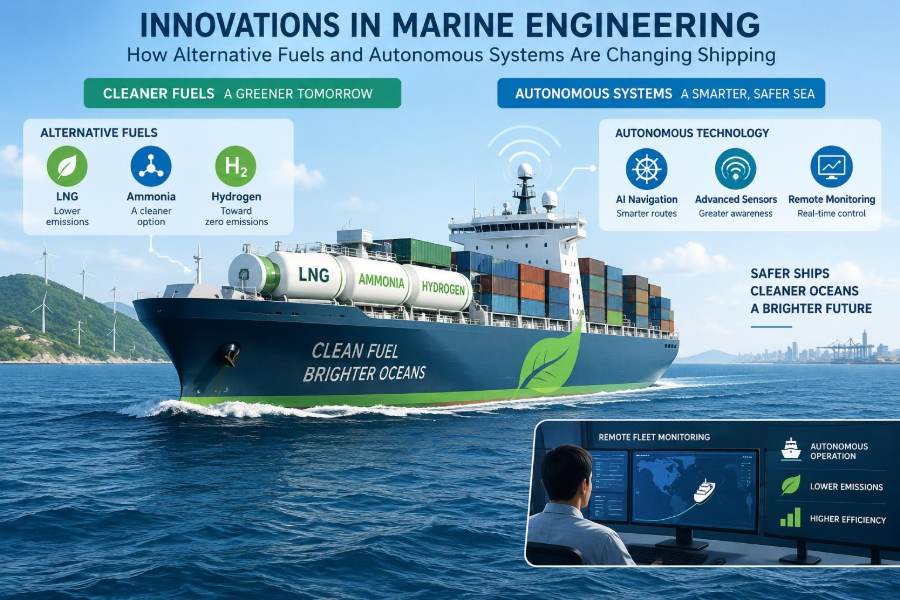
Alternative fuels and autonomous systems are therefore reshaping shipping together. Understanding their limits as well as their potential is essential for anyone preparing to work in marine engineering.
🌍 Why Shipping Is Under Pressure to Change
International shipping carries a large share of world trade, but most vessels have historically relied on fossil marine fuels. Combustion produces carbon dioxide, while certain fuel components and operating conditions can also contribute to sulfur oxides, nitrogen oxides, and particulate matter.
Environmental regulation, customer expectations, and fuel-price uncertainty are pushing fleets toward lower-emission operation. At the same time, ships cannot simply stop operating while technology matures. They must meet schedules, cross long distances, and retain safe propulsion in difficult weather.
The result is a transition based on risk management and engineering trade-offs, not a single universal replacement for conventional fuel.
⚙️ The Meaning of Alternative Fuel
An alternative marine fuel is any energy carrier used to reduce dependence on conventional petroleum-based bunker fuel. It may reduce certain emissions at the ship’s funnel, but that does not automatically mean it has low environmental impact across its full production and delivery chain.
Engineers commonly distinguish between tank-to-wake emissions, produced during operation on board, and well-to-wake emissions, which include making, transporting, and supplying the fuel. This distinction prevents an apparently clean onboard solution from being judged without considering how its energy was produced.
Fuel selection therefore begins with the intended route, vessel type, available infrastructure, and lifecycle objective.
🧭 Why There Is No Single Winning Fuel
A short-sea ferry with frequent calls can use a different energy system from an ocean-going bulk carrier that may sail for weeks between bunkering ports. Energy density, tank volume, fuel cost, engine readiness, and safety requirements all vary.
Some fuels are commercially available now but may offer limited lifecycle carbon benefits depending on their source. Others have promising long-term potential but need new supply chains, equipment standards, and crew competence.
| Fuel or energy option | Key engineering attraction | Major practical challenge |
|---|---|---|
| LNG | Established engine and handling technology | Methane slip and fossil origin |
| Methanol | Liquid handling and easier storage than cryogenic fuels | Lower energy density and toxicity |
| Ammonia | No carbon in the molecule | High toxicity and immature onboard practice |
| Hydrogen | Can be used in fuel cells | Low volumetric energy density |
| Battery power | Efficient, quiet local operation | Range and charging constraints |
🔥 LNG: A Transitional Fuel With Trade-Offs
Liquefied natural gas, or LNG, is natural gas cooled into a liquid so it can be stored compactly enough for transport. It can reduce sulfur oxides and particulates substantially compared with traditional high-sulfur residual fuels, and it can reduce some carbon dioxide emissions at the point of use.
Its climate case depends heavily on controlling methane slip: unburned methane released from engines or fuel systems. Methane is a potent greenhouse gas, so leaks and incomplete combustion matter.
LNG also requires insulated cryogenic tanks, specialized bunkering procedures, and careful ventilation. It is a mature option in some trades, but not necessarily a final decarbonization destination.
🧪 Methanol and the Appeal of Liquid Handling
Methanol is a liquid at ordinary ambient conditions, making it easier to store and transfer than fuels requiring extremely low temperatures. Existing liquid-fuel experience can be adapted, although methanol needs dedicated materials, seals, piping arrangements, and safety procedures.
It has lower energy density than conventional fuel, so a vessel needs more tank volume for equivalent range. That can affect cargo capacity or ship layout, particularly on long voyages.
The lifecycle outcome depends on production. Methanol made from fossil feedstocks differs significantly from methanol produced using low-carbon energy and suitable carbon sources. The label alone does not describe its full climate performance.
☣️ Ammonia’s Promise and Safety Challenge
Ammonia contains no carbon, so its use does not create carbon dioxide from the fuel molecule itself. That makes it attractive for deep-sea shipping, where batteries are generally too heavy and bulky to provide all voyage energy.
However, ammonia is toxic and corrosive to some materials. A release can endanger crew, port personnel, and nearby communities. Ships require robust containment, leak detection, ventilation, emergency shutdown arrangements, and trained people who can respond calmly and correctly.
Combustion can also create nitrogen-containing emissions, including nitrous oxide under some conditions. Engine design and exhaust treatment must therefore be assessed as a complete system, not merely as a fuel change.
💨 Hydrogen and Fuel-Cell Propulsion
Hydrogen can be used in internal-combustion engines or electrochemical fuel cells. In a fuel cell, hydrogen reacts with oxygen to produce electricity, water, and heat without combustion at the cell itself.
Its principal marine difficulty is storage. Compressed hydrogen occupies considerable volume, while liquid hydrogen requires very low temperatures and highly insulated tanks. Both approaches change ship arrangement and require strict control of ignition sources, ventilation, and gas accumulation.
Hydrogen is often most plausible first in shorter routes, specialized vessels, or as part of a hybrid system. Its environmental value depends on how the hydrogen is manufactured.
🔋 Batteries and Hybrid Power Systems
Batteries are already useful where vessels have predictable, relatively short routes and time to charge. Ferries, harbor craft, offshore support vessels, and ships using battery power for port maneuvering can reduce local noise and exhaust emissions.
Marine batteries need thermal management, fire detection, electrical protection, and physical segregation. A battery room is not simply a larger version of a consumer-device battery compartment; fault propagation and firefighting arrangements require dedicated design.
Hybrid systems combine batteries with engines, generators, fuel cells, or shore charging. They can smooth rapid load changes, allow generators to run closer to efficient operating points, and provide redundancy when designed properly.
🌱 Biofuels and Drop-In Compatibility
Some biofuels can be blended with or substituted for conventional marine fuels with relatively modest changes to machinery. This makes them attractive for fleets that need an immediate operational pathway without replacing engines or building entirely new bunkering systems.
Compatibility still needs testing. Fuel stability, water contamination, microbial growth, filter blockage, cold-flow behavior, and seal compatibility can affect reliability. A fuel that is chemically acceptable on paper may create maintenance issues in a specific vessel’s storage and treatment system.
The sustainability question is equally important: feedstock origin and land-use effects influence lifecycle results.
🏭 Fuel Production Is Part of Ship Design
Marine engineers cannot treat fuel supply as someone else’s problem. A vessel designed for a low-carbon fuel may spend decades in service, while production capacity and port distribution can develop unevenly.
Before selecting a fuel, project teams should ask where it will be bunkered, what quality specification will apply, who will operate the transfer equipment, and how disruptions will be managed. Fuel flexibility can be valuable when supply conditions remain uncertain.
A dual-fuel engine may reduce transition risk, but it also adds equipment, controls, maintenance needs, and possible operating compromises. Flexibility is useful only when the crew can operate it safely.
🛢️ Tanks, Piping, and Ship Arrangement
Fuel selection affects more than the engine room. Tank placement can influence stability, cargo space, fire boundaries, collision protection, and access for inspection. Cryogenic fuels need insulation and controlled boil-off management; toxic fuels need containment and detection; low-flashpoint fuels need carefully classified electrical areas.
Piping systems must account for temperature, pressure, chemical compatibility, drainage, purging, and isolation. A good layout makes normal operation simple and abnormal operation controllable.
Design reviews should consider maintenance access from the beginning. A valve that is difficult to inspect in calm conditions becomes much harder to troubleshoot during a voyage.
🧯 Bunkering Is a High-Risk Interface
Bunkering connects ship, terminal or bunker vessel, crew, hoses or transfer arms, and sometimes public port areas. This is where incompatible procedures or unclear communication can turn a routine transfer into an emergency.
Effective bunkering plans define responsibilities, communication channels, transfer limits, emergency stop signals, exclusion zones, and spill or release response. Checklists remain valuable because they force teams to confirm the basics before fuel begins to flow.
Automation can assist with monitoring pressure and level, but it does not remove the need for an alert human team. A sensor can identify an abnormal reading; people must understand what action it requires.
👷 Crew Competence Is a Design Requirement
New fuels introduce hazards that may be unfamiliar even to experienced seafarers. Training must explain the physical behavior of the fuel, the purpose of protective systems, and the actions required during leakage, fire, loss of ventilation, or fuel-transfer failure.
Competence is more than attending a course. Crews need drills, clear operating procedures, and opportunities to practice decisions under realistic conditions. A procedure that cannot be followed while wearing protective equipment, communicating over noise, and managing time pressure needs redesign.
Engineers should involve operators early. Their experience often reveals access, labeling, and maintainability problems missed in drawings.
🧠 What Maritime Autonomy Actually Means
Autonomous shipping is often imagined as an empty ship navigating itself across an ocean. In practice, autonomy exists on a spectrum. Many ships already use automated machinery controls, route optimization, dynamic positioning, and decision-support systems while retaining full human command.
A more autonomous vessel may perform certain tasks independently under defined conditions, such as holding station, avoiding charted hazards, or following a planned route. Remote operators may supervise and intervene from ashore.
Autonomy is not the absence of people. It is a different allocation of human and machine responsibilities.
📡 The Sensor Suite: A Ship’s Digital Senses
Autonomous functions depend on sensors that build a usable picture of the vessel and its surroundings. Typical inputs include radar, cameras, satellite navigation, gyrocompasses, speed logs, automatic identification system data, depth information, and machinery sensors.
No sensor is perfect. Cameras struggle with glare, fog, darkness, and spray. Radar interpretation can be difficult in clutter. Satellite positioning can be degraded or intentionally interfered with. Sensor fusion combines multiple inputs so that one weak signal does not control the entire decision.
Good autonomy starts with good data quality, calibration, redundancy, and fault detection.
🗺️ Navigation Decisions in a Messy Sea
A navigation algorithm must do more than follow a line on a chart. It needs to account for traffic, currents, shallow water, weather, vessel maneuverability, navigation rules, and the uncertainty of other vessels’ intentions.
Close-quarters situations are especially challenging because human mariners use radio calls, visual cues, local practice, and judgment. A technically legal maneuver may still be confusing or unsafe if another vessel does not expect it.
Autonomous navigation must therefore be conservative where uncertainty is high. Safe behavior often means slowing down, creating margin, and calling for human review rather than pursuing maximum schedule efficiency.
⚓ Machinery Automation Below Deck
Autonomy is not limited to the bridge. Engine-room automation can monitor temperatures, vibration, lubrication condition, electrical load, and fuel-system performance. It can start standby equipment, balance generators, and issue alarms before a parameter becomes critical.
Condition monitoring supports predictive maintenance: maintenance based on observed equipment condition rather than only calendar intervals. Rising bearing vibration, for example, may justify inspection before a failure damages surrounding machinery.
But data trends need engineering interpretation. A sensor drift, a changed operating profile, or a poor baseline can create a misleading warning.
🖥️ Remote Operations and Shore Control
Shore control centers can support vessels by monitoring voyages, machinery health, weather, and energy use. They may provide specialist assistance that is impractical to carry on every ship, especially for small or highly automated vessels.
Communication links, however, have latency, coverage gaps, and cyber risks. A remote operator cannot always react as quickly as a person standing on the bridge, and a vessel must retain safe local behavior if the link fails.
Clear authority is essential. During a developing emergency, teams must know whether the master, onboard crew, shore operator, or automated system has decision authority.
🛡️ Cybersecurity Is a Safety System
Connected navigation and machinery systems expand the ship’s attack surface. A cyber incident can affect business data, but it can also disrupt propulsion controls, sensor feeds, cargo systems, or communications.
Basic protections include network segmentation, controlled software updates, access management, secure backup arrangements, and procedures for operating safely when a digital system is unavailable. Crew awareness matters because phishing, removable media, and weak passwords can bypass sophisticated equipment.
Cyber resilience means designing for recovery. The safest digital ship is not one assumed to be invulnerable, but one able to continue safely after a system is compromised or lost.
⚠️ Failure Modes Must Be Designed In
Engineering teams should ask, “What happens when this fails?” for every sensor, controller, fuel valve, communication link, and power supply. The answer should not be “the ship stops thinking.”
Fail-safe design moves equipment toward a safer condition when a fault occurs. Redundancy provides alternate paths, while graceful degradation allows reduced but controlled operation rather than abrupt loss of capability.
For example, loss of a camera should not automatically make a vessel blind if radar and other verified inputs remain available. Conversely, conflicting sensor data may require the system to reduce speed and request human intervention.
⚖️ Rules, Liability, and Accountability
Maritime law and operating rules developed around vessels with masters and crews on board. As remote and autonomous functions expand, questions arise about watchkeeping, collision responsibility, inspection, and evidence after an incident.
Technology can advance faster than regulations and common practice. Operators should not assume that a technically capable feature is authorized for every route or operating mode.
Robust logs are important. They should show sensor status, control actions, alerts, operator interventions, and system configuration. These records support troubleshooting, incident investigation, and continuous improvement.
🔗 The Connection Between Fuel and Autonomy
Alternative fuels and autonomy are often discussed separately, but they meet in the vessel’s energy-management system. A hybrid ship must balance propulsion demand, battery state, generator loading, fuel availability, and safety limits in real time.
Automation can optimize this balance, such as using battery power during maneuvering and scheduling generator operation efficiently at sea. It can also monitor fuel-system pressures, gas detection, and temperature trends continuously.
Yet added integration creates additional complexity. A software error should never be able to override essential fuel safety protections or conceal a hazardous alarm.
📈 Data Can Reduce Waste, Not Replace Judgment
Voyage data can reveal excessive hull resistance, inefficient trim, generator underloading, or recurring auxiliary-equipment problems. Weather routing and speed management may reduce fuel consumption when applied within safe operating limits.
The quality of a recommendation depends on the inputs and assumptions behind it. A route optimized only for fuel use may be unsuitable if it increases exposure to heavy weather, delays arrival outside a berth window, or conflicts with crew-rest requirements.
Use data as a decision aid. Experienced engineers and navigators remain responsible for recognizing when a model does not match conditions at sea.
🔧 Maintenance in a More Digital Fleet
Marine maintenance is shifting from isolated manual checks toward a blend of inspections, laboratory analysis, sensor data, and software-supported planning. New fuels may require specialized components, while autonomous systems add computers, networks, and calibration tasks.
A practical maintenance strategy identifies critical spares, verifies software versions, tests emergency modes, and protects the fundamentals: clean fuel, sound electrical connections, cooling capacity, lubrication, and watertight integrity.
One common mistake is treating digital equipment as maintenance-free. Sensors foul, connectors corrode, and configuration changes can create faults as surely as worn mechanical parts.
🏗️ Ports Must Evolve With Ships
A ship cannot adopt a new fuel or a higher level of automation alone. Ports need compatible bunkering arrangements, trained emergency responders, electrical charging capacity where relevant, data connections, and procedures for interacting with remotely supported vessels.
Port calls are complex because they involve pilots, tugs, terminals, traffic services, customs processes, and local weather. This makes them a demanding environment for autonomous functions, even when open-water navigation is reliable.
Successful innovation depends on shared operating concepts. Ship and shore systems must be designed as one coordinated ecosystem.
💰 Evaluating Cost Beyond Fuel Price
Comparing fuels by price per tonne is misleading because fuels have different energy content, storage requirements, and infrastructure needs. Capital cost, lost cargo volume, maintenance, training, insurance, port charges, and downtime can all affect the lifecycle business case.
Similarly, automation may reduce some repetitive workload but require investment in sensors, communications, cybersecurity, and shore support. Its value may be highest where it improves reliability, safety margins, or operational consistency rather than simply reducing crew numbers.
A sound evaluation states its assumptions openly and tests how the result changes when fuel supply, utilization, or regulation changes.
🧩 A Practical Selection Framework
For students and working professionals, the most useful habit is to turn broad claims into engineering questions. Start with the mission: route length, power demand, port time, cargo constraints, weather exposure, and expected service life.
- Assess lifecycle emissions and local air-quality effects.
- Map fuel availability and port infrastructure on the actual trading pattern.
- Identify hazards, credible failures, and emergency response needs.
- Check space, weight, stability, and maintainability implications.
- Define the human role during normal operation, faults, and emergencies.
- Evaluate regulations and classification requirements for the intended service.
This approach does not guarantee a perfect choice, but it exposes weak assumptions before they become expensive modifications.
🚧 Common Mistakes During Technology Adoption
One mistake is selecting technology from a brochure rather than from an operating profile. A promising fuel may be impractical where bunkering is uncertain; an advanced autonomous feature may be unsuitable where communications or port coordination are limited.
Another is underestimating transition work: procedures, drills, spare parts, manuals, and interfaces often determine whether a system performs well after delivery. Treating safety training as a final commissioning task is particularly risky.
Finally, avoid framing a project as either fully automated or not automated. Incremental, well-verified functions can deliver meaningful gains while preserving clear human oversight.
🎓 Skills Marine Engineers Need Next
Future marine engineers will still need strong foundations in thermodynamics, fluid mechanics, electrical systems, machinery, stability, and safety. Those principles are becoming more valuable, not less, because they help engineers question unfamiliar technology intelligently.
Additional useful skills include control systems, data interpretation, cybersecurity awareness, hazard analysis, and communication across ship-shore teams. Engineers do not need to become software specialists to work effectively with autonomy, but they should understand system boundaries and failure behavior.
The strongest professionals can connect a digital dashboard reading to the physical machinery and operating condition behind it.
🌊 A Realistic Path for the Next Decade
Change will likely be uneven. Different vessel classes and regions will adopt different combinations of fuels, batteries, automation, and efficiency measures according to their routes and infrastructure.
Near-term progress may come from hybridization, better energy management, improved hull and propeller performance, low-carbon fuel blends, and decision-support tools. More radical fuels and higher autonomy can expand as standards, supply chains, and operational experience mature.
This is not a sign of failure. In an industry with long vessel lives and demanding safety requirements, staged adoption is often the responsible engineering path.
🧭 The Core Principle: Design the Whole System
The central lesson is that neither a new fuel nor an autonomous control system succeeds in isolation. Performance depends on the complete chain: production, storage, transfer, machinery, sensors, software, crew competence, port support, maintenance, and emergency response.
A vessel is safe and efficient when these parts work together under ordinary conditions and remain manageable when conditions become abnormal. Engineers should be skeptical of simple claims and instead seek evidence from realistic operating scenarios.
Innovation in shipping is most valuable when it delivers measurable operational improvement without moving hidden risks from the funnel or bridge to another part of the system.
Marine engineering’s future will be built by combining lower-carbon energy with resilient automation, while keeping safety, human judgment, and whole-system design at the center of every decision. 🚢⚙️🌍