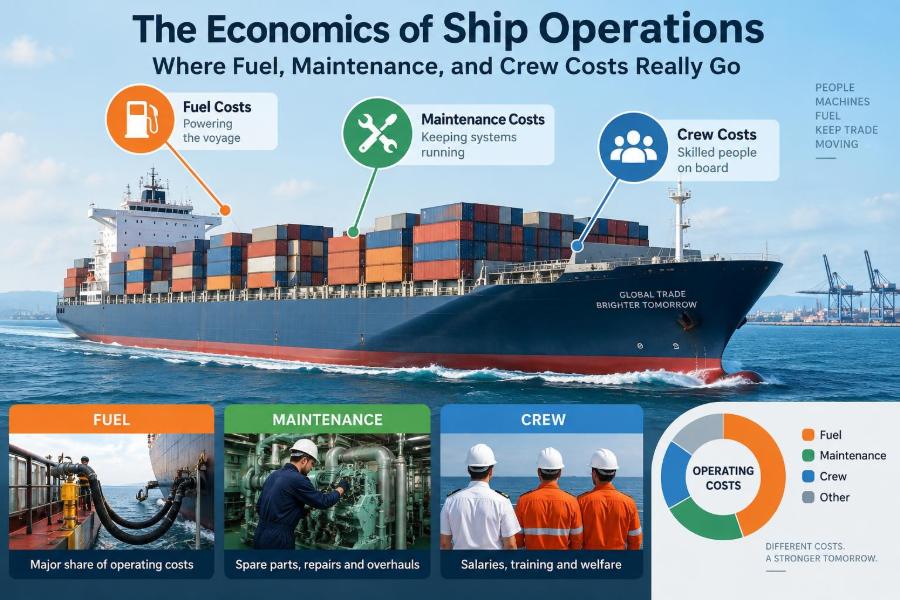

A vessel can appear to be earning well while its operating margin quietly disappears below deck. The charter rate may look attractive, cargo may be booked, and the engine may be running reliably—yet a small change in fuel price, port delay, or machinery condition can transform the financial result of a voyage.
For a chief engineer, superintendent, officer, or maritime student, this is more than an accounting topic. Operating costs shape maintenance decisions, voyage planning, crewing patterns, spare-parts strategy, and the pressure felt during every off-hire event.
Ship operation is often described as a balance between safety, reliability, and commercial performance. Economics does not replace those priorities. Instead, it explains why disciplined technical management matters: safe, compliant vessels that use energy efficiently and avoid breakdowns are generally less expensive to operate over time.
Understanding where money actually goes helps crews see the wider consequence of everyday decisions—from cleaning a heat exchanger to reporting a developing vibration before it becomes a costly casualty.
🧭 Start With the Operating-Cost Picture
Ship costs are commonly divided into three broad groups: capital costs, operating expenses, and voyage expenses. Capital costs relate to owning or financing the ship, while operating expenses keep it crewed, maintained, insured, supplied, and compliant.
Voyage expenses vary with where and how the vessel trades. Fuel, port charges, canal transits, cargo-related expenses, and some agency services belong here in many commercial arrangements. The exact allocation depends on the charter party, so the same invoice may be paid by a different party under a different contract.
The useful question is not simply, “What does the ship cost?” It is “Which cost changes when we alter speed, route, maintenance timing, or time in port?”
📜 Know Who Pays Under the Charter
A shipowner, technical manager, commercial manager, and charterer may all influence expenditure without all paying the same bills. Under a time charter, the charterer commonly directs the vessel’s commercial employment and usually bears voyage costs such as bunkers, while the owner remains responsible for the vessel’s technical condition, crew, and many operating costs.
Under a voyage charter, the owner more often carries both the operating burden and the voyage-cost exposure. Bareboat arrangements shift much more responsibility to the charterer.
This distinction matters when evaluating performance. A fuel-saving modification may benefit the party buying fuel most directly, but poor maintenance can still create off-hire, claims, reputational damage, and lost future employment for several parties.
⛽ Why Fuel Usually Dominates the Conversation
Fuel is highly visible because consumption responds quickly to operational choices. Main-engine load, auxiliary-generator demand, speed, weather, hull condition, cargo operations, and time spent waiting all affect the bunker bill.
A ship does not consume fuel only while sailing. Generators supply hotel load, pumps, ventilation, cargo systems, deck machinery, and accommodation services. Tankers, gas carriers, reefers, passenger vessels, and offshore vessels can have especially distinctive auxiliary loads.
Fuel cost also combines two variables: quantity consumed and price paid. Even excellent consumption control cannot eliminate exposure to changing bunker prices, but it can reduce the number of tonnes purchased and improve predictability.
📈 Understand the Speed–Power Relationship
Resistance rises as a vessel moves faster through water, and required propulsive power tends to rise much faster than speed. The precise relationship differs by hull form, loading condition, sea state, propeller condition, and machinery configuration, but the operational lesson is consistent: modest speed reductions can yield meaningful fuel savings.
That does not mean “slower is always cheaper.” A slower vessel may need another day at sea, consume more auxiliary fuel, miss a berth window, breach a delivery commitment, or reduce annual cargo capacity. The best speed is a commercial and technical decision, not a slogan.
Weather routing and realistic passage plans help avoid the opposite mistake: demanding an uneconomic speed after losing time earlier in the voyage.
🌊 Hull and Propeller Condition Spend Fuel Quietly
Marine growth and roughness increase frictional resistance. A fouled hull or damaged propeller can require more shaft power to maintain the same speed, even when the engine itself is functioning normally.
Hull cleaning and coating choices therefore belong in an economic discussion, but they must be assessed over a full operating cycle. Cleaning has cost, availability constraints, environmental restrictions, and safety requirements. A premium coating may reduce roughness growth, yet its value depends on trading pattern, idle periods, water temperature, and dry-docking interval.
Trend monitoring is more useful than relying on a single day’s performance. Compare corrected speed-power data across similar drafts, weather conditions, and engine settings.
🧪 Fuel Quality Is Also a Reliability Cost
The cheapest fuel offer is not automatically the least expensive fuel in service. Compatibility problems, contamination, poor stability, or unsuitable handling can create separator overload, filter blockage, injector wear, loss of propulsion, or costly disposal issues.
Bunkering procedures are therefore financial controls as well as safety procedures. Representative sampling, correct labelling, custody records, segregation planning, and review of supplier documentation help protect the vessel if a quality dispute arises.
On board, treatment settings must suit the fuel and machinery maker’s guidance. Reducing separator performance merely to save a little electrical power can be a false economy when it allows abrasive or catalytic particles to reach precision components.
⚙️ Engine Efficiency Is a System Outcome
Specific fuel consumption is often discussed as an engine number, but real ship efficiency comes from the complete system. Air-cooler fouling, turbocharger condition, exhaust back pressure, injection performance, scavenging, jacket-water temperatures, and cylinder lubrication all influence how efficiently power is produced.
Engine-room teams use logs, performance software, inspections, and laboratory results to identify deviation. A trend is more informative than a single reading: rising exhaust temperature spread, falling charge-air pressure, or abnormal fuel-rack position can signal a developing loss.
The objective is not to chase perfect readings in isolation. It is to identify a meaningful change, confirm the cause safely, and correct it before excess consumption becomes damage or downtime.
🔌 Auxiliary Loads Are Not “Small” Loads
Auxiliary machinery is sometimes overlooked because it does not directly turn the propeller. Yet generator fuel use can become substantial during port stays, cargo operations, maneuvering, refrigeration demand, or periods of high accommodation load.
Good energy management means matching running generators to demand without operating too close to overload or leaving lightly loaded sets running inefficiently for long periods. Frequent unnecessary starts and stops also create maintenance consequences.
Practical opportunities include managing compressed-air leaks, optimizing pump operation, maintaining heat exchangers, reviewing lighting and HVAC loads, and avoiding simultaneous operation of redundant equipment unless the operating condition requires it.
🏗️ Maintenance Is an Investment, Not a Single Bill
Maintenance spending includes planned tasks, condition monitoring, spare parts, lubricants, riding-squad support, workshop services, class-related repairs, and the administration needed to schedule them. It is tempting to treat all of it as a cost to be minimized.
That approach overlooks the purpose of maintenance: preserving function, safety, and availability. A delayed overhaul may improve this month’s budget but increase the likelihood of failure during the next loaded passage.
The better comparison is between the cost of timely work and the total consequence of failure, including off-hire, towage, cargo disruption, port penalties, emergency procurement, and potential safety exposure.
🛠️ Planned Maintenance Creates Predictability
A planned maintenance system organizes routine work around running hours, calendar intervals, maker recommendations, statutory requirements, and vessel experience. Its greatest economic benefit is often predictability: work can be prepared, parts can be ordered in time, and jobs can be coordinated with port stays or dry dock.
However, fixed intervals are not infallible. Equipment operating under unusually light load, harsh fuel conditions, high ambient temperatures, or frequent starts may not behave like the generic maintenance schedule assumes.
Records should explain what was found, not merely state that a task was closed. Useful feedback allows superintendents and crews to refine maintenance intervals without compromising regulatory or maker requirements.
📡 Condition Monitoring Avoids Unnecessary Work
Condition-based maintenance uses evidence from vibration readings, oil analysis, thermography, ultrasonic testing, performance trends, and inspections to judge equipment health. It can reveal deterioration before a functional failure occurs.
For example, a bearing may show a developing vibration signature while still operating. Planned intervention can then be arranged before secondary damage affects shafts, housings, or connected machinery.
Condition monitoring has limits. A poor measurement route, inconsistent sampling, or an incorrect interpretation can create false confidence. It works best when readings are taken consistently, alarms are investigated, and the data is combined with physical inspection and operating history.
🔩 Spare Parts Tie Up Cash for Good Reasons
Every spare part in a store represents money tied up in inventory, but a vessel cannot wait weeks for a critical component when it is far from a supply hub. The challenge is to stock enough of the right parts without filling stores with obsolete, duplicated, or poorly preserved inventory.
Criticality analysis helps. A component deserves greater attention when its failure could stop propulsion, disable safety equipment, breach a statutory requirement, damage cargo, or cause prolonged off-hire.
Storage condition matters as much as quantity. Moisture, poor labelling, expired rubber items, missing certificates, and inaccessible bins can turn an apparently available spare into an unusable one.
🚨 Breakdowns Cost More Than Repairs
When machinery fails, the repair invoice is only one layer of cost. The ship may lose time, require tugs, miss a berth, consume fuel while drifting or maneuvering, incur survey costs, or need urgent delivery of parts and specialists.
Commercial contracts may also define off-hire, performance claims, or liability differently depending on the cause and circumstances. These outcomes are contract-specific, so technical staff should avoid assuming that every delay has the same financial result.
A well-written failure report supports learning and claim handling. It should record facts, alarms, operating conditions, actions taken, damaged parts, and likely contributing factors—not assign blame before evidence is available.
👥 Crew Costs Are Broader Than Wages
Crew expenditure includes wages, overtime or leave arrangements where applicable, travel, visas, training, medical examinations, insurance-related costs, recruitment, communications, victualling, personal protective equipment, and administrative support ashore.
Manning decisions should never be reduced to headcount alone. A vessel needs competent personnel who can operate safely, maintain equipment, manage emergencies, complete essential records, and comply with rest-hour requirements.
High turnover can create hidden costs through familiarization gaps, repeated travel, weaker team coordination, and lost vessel-specific knowledge. Retaining capable seafarers is not simply a welfare objective; it can improve operational continuity.
🧠 Competence Prevents Expensive Errors
Many costly events begin with a small missed signal: an incorrect valve lineup, a bypass left open, a cooling-water trend ignored, an incomplete handover, or an alarm normalized because it has appeared before. Training and a questioning culture reduce these vulnerabilities.
Competence includes practical judgment, not only certificates. A junior engineer who understands why a purifier interface must be controlled is better able to recognize abnormal operation than someone who has memorized a procedure without context.
Drills, toolbox talks, mentoring, and realistic handovers are relatively modest investments compared with the disruption caused by an avoidable operational error.
🛌 Fatigue Has a Financial and Safety Price
Fatigue affects attention, decision-making, communication, and the ability to respond to alarms. On a ship, it can be worsened by port intensity, repeated night work, administrative workload, noise, heat, and insufficient recovery time.
Trying to reduce crew cost by stretching a small team can therefore backfire. The apparent saving may be overtaken by errors, poor maintenance quality, injuries, non-compliance, or deteriorating morale.
Work and rest arrangements must meet applicable requirements, but compliance on paper is not the same as a sustainable workload. Managers should examine whether schedules, task planning, and port-call demands make genuine rest realistically possible.
🍽️ Victualling and Welfare Support Performance
Food, freshwater quality, accommodation condition, connectivity, recreation, and access to medical support are sometimes categorized as minor operating expenses. Their practical effect can be much larger because they influence health, retention, concentration, and life on board.
Cost control is appropriate: stores should be planned, waste monitored, and provisions protected from spoilage. But cutting standards until meals, hygiene, or communications become inadequate is not sound management.
A ship is both a workplace and a home for its crew. Welfare spending should be assessed against its role in sustaining a capable team during long periods away from shore.
🧾 Compliance Is Part of the Operating Model
Classification surveys, flag-state requirements, port-state inspections, environmental rules, certification, safety management, and security arrangements create direct costs in audits, equipment, documentation, and training. They also create scheduling constraints that affect maintenance planning.
Compliance should not be treated as an external interruption to “real” operations. A vessel that cannot demonstrate required condition or documentation may face delay, detention, restricted trading, or unplanned corrective work.
The efficient approach is to embed compliance in daily routines. Test records, calibration status, maintenance evidence, and crew familiarity are easier to maintain continuously than reconstruct under inspection pressure.
🌱 Environmental Controls Change Cost Drivers
Emissions rules and carbon-related commercial measures have increased attention on fuel selection, fuel consumption, voyage efficiency, data quality, and technical upgrades. Their exact impact varies by ship type, trade, flag, charter arrangement, and applicable regime.
Compliance options can involve lower-sulphur fuels, exhaust-gas cleaning systems, alternative fuels, energy-efficiency devices, shore power where available, or operational measures such as speed and trim optimization. No option is universally suitable.
Each choice carries trade-offs in capital cost, operational complexity, fuel availability, maintenance needs, space, safety procedures, and future uncertainty. Sound decisions use a vessel-specific lifecycle assessment rather than a fashionable technology label.
🧭 Route, Weather, and Port Time Shape the Budget
A route is not merely a line between two ports. It includes weather exposure, currents, traffic separation schemes, piracy or security considerations, canal options, draft limits, expected congestion, and the reliability of berth windows.
Waiting outside port can consume fuel and crew time while disrupting maintenance opportunities and departure plans. Arriving too early at high speed may be less efficient than a coordinated just-in-time arrival, provided safety, charter obligations, and port readiness allow it.
Weather routing similarly requires balance. A longer route may use less fuel or reduce the risk of heavy-weather damage, while a shorter route may be appropriate under different conditions.
⚓ Port Calls Generate More Than Port Charges
Port expenses can include pilotage, tugs, linesmen, agency, berth fees, freshwater, waste services, launches, inspections, and cargo-related support. The invoice structure varies widely by port and contract.
The indirect costs are often just as important. Rapid turnarounds can compress maintenance, increase fatigue, and create more opportunities for damage during maneuvering or cargo operations. Delays may keep generators, pumps, or cargo systems running longer than planned.
Good port-call planning connects the deck, engine, cargo, commercial, and shore teams. Clear timing for bunkering, stores, repairs, surveys, and crew changes reduces conflict between tasks competing for the same short window.
📊 Measure Costs With the Right Performance Data
Useful management relies on consistent data: fuel consumed by consumer, distance sailed, speed, shaft power where available, generator hours, lube-oil use, maintenance backlog, spare-parts consumption, port days, and off-hire events.
Numbers need context. Comparing daily fuel use between a laden voyage in heavy weather and a ballast voyage in calm water tells little unless draft, speed, sea state, current, and operational mode are considered.
A practical dashboard should highlight deviation and prompt questions. It should not encourage crews to manipulate records or operate unsafely merely to make a monthly figure look better.
🧮 Use Total Cost, Not the Cheapest Invoice
Procurement decisions often fail when they focus only on purchase price. A cheaper pump may have poorer efficiency, limited service support, a shorter overhaul interval, or difficult spare-parts availability. Its lifetime cost can exceed that of a more expensive alternative.
Total cost of ownership includes acquisition, installation, energy use, consumables, maintenance, downtime risk, training, disposal, and expected service life. Not every factor can be calculated precisely, but identifying them improves decisions.
This perspective also applies to service contracts, coatings, lubricants, and digital systems. Ask what the product changes in the vessel’s actual operating pattern, not simply what it costs at purchase.
🔄 Dry Docking Concentrates Years of Decisions
Dry dock is a major planned expenditure because inspection, steelwork, coating renewal, propeller work, valve overhauls, class items, and modifications compete for limited time. Poor preparation can turn a controlled project into a sequence of expensive variations.
Effective preparation starts well before arrival: inspect early, define scope, obtain maker input, identify long-lead parts, review class due items, and decide which optional efficiency upgrades genuinely fit the ship’s remaining trading life.
There is also a risk in trying to do everything. Extra work may extend the docking period, create interface problems, or exceed the value returned. Scope discipline is as important as ambition.
🧯 Insurance Does Not Remove Operational Risk
Insurance transfers some financial consequences of casualties, but it does not erase disruption. Deductibles, exclusions, delays, evidence requirements, reputational effects, and uninsured losses can remain significant.
Good loss prevention is therefore an operating-cost strategy. Fire safety, navigation discipline, machinery reliability, cargo care, cyber hygiene, and emergency preparedness reduce the chance that a routine voyage turns into a major interruption.
After an incident, timely factual reporting and preservation of records are essential. Commercial and legal implications can be complex, so companies should follow their reporting procedures and seek appropriate specialist advice rather than improvise conclusions.
🤖 Digital Tools Help Only When the Inputs Are Trusted
Fuel-monitoring platforms, planned-maintenance systems, electronic logs, remote diagnostics, and voyage-optimization tools can reveal patterns that paper records may hide. They can also improve handovers between ship and shore.
Yet a dashboard is only as reliable as its sensors, configuration, and human inputs. Flow-meter drift, incorrect timestamps, inconsistent noon reports, or unverified assumptions can produce polished but misleading conclusions.
Digitalization works best when crews understand what is being measured, can challenge anomalies, and receive useful feedback. Data collection that only creates extra reporting burden will rarely improve the vessel’s economics.
⚖️ Avoid Cost Cutting That Transfers the Problem
Some reductions are genuine efficiencies: eliminating energy waste, combining planned jobs, improving inventory accuracy, or negotiating better logistics. Others simply move cost into the future or onto another department.
- Deferring a critical repair may become an emergency breakdown.
- Reducing crew support may increase turnover and fatigue.
- Buying non-equivalent parts may raise failure risk.
- Skipping inspection may conceal corrosion or wear until repair scope expands.
Before approving a saving, ask what function is being reduced, what failure it could allow, who carries the resulting risk, and how the outcome will be monitored.
🗣️ Connect Shipboard Decisions to Shore Management
Economic performance improves when shipboard observations reach people able to act on them. A crew can report a recurring alarm, fuel-handling difficulty, or spare shortage, but the report must lead to technical review, purchasing action, or a clear operational decision.
Likewise, shore teams should explain the purpose behind targets and reporting requests. Crews are more likely to provide accurate data when they understand that it will support maintenance planning or safer operation, rather than be used as a simplistic scorecard.
Regular, evidence-based dialogue turns cost control into a shared operational discipline rather than pressure imposed from ashore.
🧩 A Hypothetical Voyage Shows the Interactions
Consider a hypothetical bulk carrier facing a delayed berth. If it continues at a high speed to arrive early, it may burn additional fuel and then wait at anchor with generators running. If it slows safely under an agreed arrival plan, it may reduce fuel use—but only if the revised timing does not create a contractual or navigational problem.
Now add a marginal auxiliary generator with a cooling issue. Deferring attention might seem convenient during the voyage, but a failure during the port stay could force inefficient generator use, delay cargo work, and require urgent service.
The lesson is not that one answer always wins. It is that fuel, maintenance, schedule, crew workload, and commercial commitments are connected decisions.
🎯 Build a Practical Cost-Control Routine
An effective routine is repetitive, transparent, and focused on controllable causes. It does not require every seafarer to become an accountant.
- Review fuel and machinery trends against comparable operating conditions.
- Prioritize defects by safety, availability, and consequence of delay.
- Keep critical-spares records accurate and preservation standards visible.
- Plan port work early, including permits, access, deliveries, and manpower.
- Investigate repeated alarms and recurring consumable use.
- Discuss lessons from delays and near misses without turning review into blame.
Small routines create reliable information. Reliable information allows better decisions before a cost becomes urgent.
🏁 The Core Principle: Reliable Operation Protects Margin
The economics of ship operations cannot be reduced to a fuel target or a monthly maintenance budget. Fuel, machinery condition, crew capability, compliance, port time, and commercial planning interact continuously.
The strongest operating strategy protects safety and reliability first, then removes waste through sound data, competent people, timely maintenance, and realistic voyage decisions. It recognizes that an apparently cheap choice can be costly when it increases risk, delay, or fuel use elsewhere.
For marine professionals, this is the central connection: technical discipline is not separate from commercial performance. It is one of the mechanisms that makes dependable commercial performance possible.
The most sustainable savings come from running a safe, well-maintained, well-crewed vessel with fewer surprises—not from spending less on the systems that keep it dependable. 🚢⚙️🌊