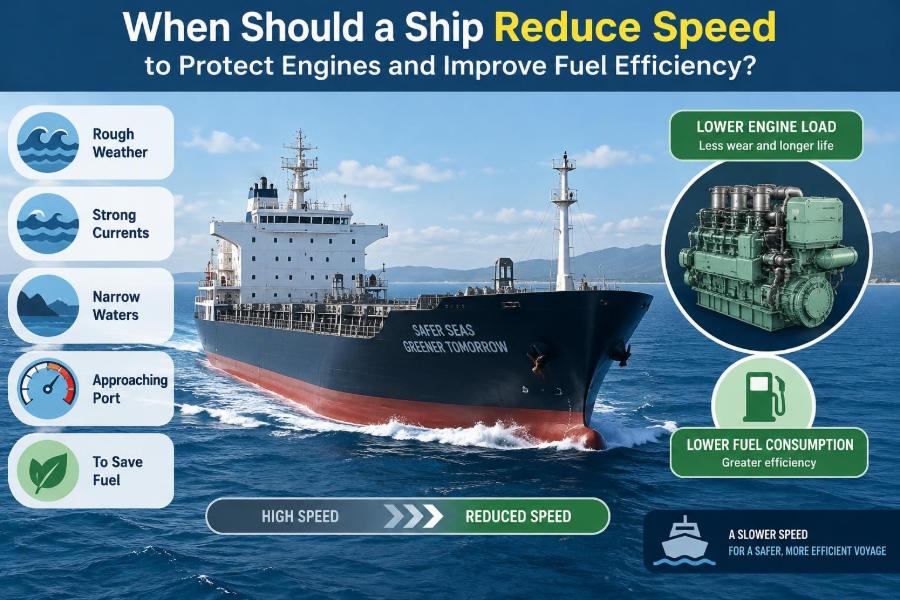

A vessel is making good time on a long passage when the weather forecast changes. Head seas are building, exhaust temperatures begin to spread between cylinders, and the bridge asks whether the engine can hold schedule speed. The answer is rarely just “yes” or “no.”
Reducing speed may look like lost productivity, but continuing at the requested revolutions can turn rough weather, poor hull condition, or machinery imbalance into excess fuel use and avoidable engine stress. A small reduction made early is often easier to justify than a large reduction forced by an alarm later.
For engineers, speed management is therefore not simply an operational decision made on the bridge. It is a practical link between propulsion loading, machinery condition, weather, fuel consumption, emissions, safety, and the commercial plan.
The useful question is not whether slow steaming is always good. It is: when does the operating condition make a lower speed the safer and more efficient choice?
⚙️ Speed Is Really a Propulsion Load Decision
A ship’s speed is produced by propeller thrust, and that thrust requires power from the main engine. When the bridge orders more speed, the engine must normally deliver more torque and power through the shaft.
For a fixed-pitch propeller, power demand rises very sharply as revolutions increase. The exact relationship depends on hull, propeller, draft, weather, and other variables, but the practical lesson is clear: the last few knots can require disproportionately more fuel.
This is why reducing speed is often effective. It removes load from the engine and reduces the resistance-related power needed to move the hull through water.
📈 The Propeller Law Explains the Fuel Penalty
Under broadly comparable conditions, propeller power is often approximated as varying with the cube of shaft speed. This is an engineering rule of thumb, not a promise that every voyage will follow an exact equation.
If shaft revolutions rise, required power can rise much faster. Fuel consumption per hour generally follows power demand, so a modest reduction in rpm can produce a meaningful hourly fuel reduction.
However, a slower passage takes longer. The relevant commercial measure is often fuel per mile, voyage fuel, arrival window, and charter requirements—not fuel per hour alone.
🧭 Distinguish Speed Through Water From Speed Over Ground
The engine and propeller respond mainly to speed through water and resistance. The schedule, meanwhile, is often judged by speed over ground, which is affected by current.
A favourable current may let a ship lower rpm while maintaining planned arrival time. An adverse current can tempt operators to increase power, even though the extra fuel may produce little useful gain.
Bridge and engine teams should compare shaft rpm, engine load, speed through water, speed over ground, current, and estimated time of arrival together. Looking only at GPS speed can lead to poor loading decisions.
🌊 Reduce Early in Heavy Seas
Heavy head seas increase added resistance. The ship may slow naturally, while the propeller and main engine experience an uneven, changing load as the hull pitches and heaves.
Maintaining the original calm-water rpm in these conditions can demand high torque, increase thermal loading, and produce unstable propeller immersion. A planned speed reduction gives the machinery a more manageable operating margin.
It can also improve comfort and reduce structural slamming, green water exposure, and cargo movement risks. The safe speed is determined by the whole vessel response, not just the main engine’s available power.
🌬️ Treat Strong Wind and Swell as Added Resistance
Wind force on accommodation blocks, deck cargo, containers, cranes, and exposed hull surfaces can be substantial. Swell arriving from a different direction than local waves may further complicate motion and steering.
A vessel on a loaded ballast passage may be especially sensitive to windage. If the ship must use unusually high power merely to maintain a modest speed, reducing speed and adjusting route or heading may be more rational than continuously loading the engine near its limit.
Weather routing is valuable because it helps identify where a reduction should occur before conditions become severe.
🛞 Avoid Propeller Racing and Repeated Load Surges
In rough seas, the stern may rise enough for the propeller to lose part of its immersion. The propeller then races: shaft rpm rises quickly because resistance on the propeller suddenly falls.
When the propeller re-enters water, load returns abruptly. Repeated racing and reloading can stress the propulsion train and cause governor action that makes engine operation less stable.
Reducing rpm and, where operationally appropriate, altering course can lessen the severity of these cycles. Engineers should follow the vessel’s operating guidance and report the observed behaviour clearly to the bridge.
🌡️ Watch Exhaust Temperatures, Not Only Engine Load
Main-engine load percentage is useful, but it is not a complete health indicator. A cylinder can show abnormal combustion or injection performance before overall load looks alarming.
A widening exhaust-temperature spread, persistent high temperature on one unit, abnormal scavenge temperatures, or unusual turbocharger response deserves investigation. Holding high speed while such symptoms develop can add heat to an already imperfect condition.
Reducing load may be a prudent temporary protective action, but it does not cure the fault. The cause still needs systematic assessment under the manufacturer’s instructions and the ship’s safety procedures.
🔥 Reduce Load When Cooling Margins Are Shrinking
Jacket-water, piston-cooling, lubricating-oil, and charge-air temperatures reveal whether the cooling system can carry the current heat load. High ambient seawater temperature, fouled coolers, restricted flow, or a control-valve problem can reduce that margin.
When temperatures trend upward at a steady power setting, increasing speed is particularly unwise. A controlled reduction can stabilize conditions while engineers verify pumps, filters, cooler performance, levels, and automatic controls.
Never treat lower load as permission to ignore an overheating trend. It is a risk-control measure while the defect is identified.
💨 Respect Turbocharger and Scavenge-Air Limits
Large two-stroke and medium-speed four-stroke engines depend on adequate air delivery for efficient combustion. Turbocharger fouling, air-filter restriction, charge-air cooler fouling, or turbine-side deposits can reduce available air.
At high fuel index with insufficient air, combustion quality may deteriorate and exhaust temperatures may rise. Black smoke, poor acceleration, and abnormal temperature patterns are practical warning signs, though each has several possible causes.
Reducing speed lowers fuel demand and can restore a safer air-to-fuel balance. The permanent response may involve cleaning, inspection, tuning, or repair—not simply operating slower indefinitely.
🧱 Consider Hull Fouling Before Demanding More Power
Marine growth and roughness on the underwater hull increase frictional resistance. Even a ship that looks normal from the bridge may need substantially more power than expected to make the same speed through water.
If the required rpm or fuel rate has gradually risen over a voyage or since dry dock, hull condition is a plausible contributor. Forcing the vessel to meet historical speed at a much higher load wastes fuel and adds machinery stress.
Performance monitoring helps separate a short-term weather effect from a persistent hull-performance problem. Cleaning or planned underwater maintenance may offer a better long-term solution.
🌀 Do Not Forget Propeller Damage and Roughness
A bent blade, damaged edge, rope entanglement, cavitation erosion, or heavy surface roughness can reduce propeller efficiency. The engine may still reach requested rpm, but the ship gains less speed for the fuel burned.
Vibration, unusual shafting behaviour, a sudden change in slip, or poor speed-power performance after an incident should prompt investigation. Continuing at high load may magnify vibration-related risks.
Speed reduction is sensible when abnormal propulsion behaviour is suspected, especially until the bridge, engine department, and company can establish operating limits.
⚖️ Keep Within the Engine’s Approved Operating Envelope
Every propulsion plant has maker-defined limits for continuous rating, overload use, thermal condition, torsional vibration zones, and operating modes. These limits take priority over a general preference for speed or fuel economy.
Some engines have barred speed ranges, where continuous operation is prohibited because of torsional vibration concerns. Passing through such a range may be permitted according to instructions, but remaining there is not.
The correct response to a schedule request is therefore based on the approved load diagram and current machinery condition. “The engine did it last voyage” is not an engineering limit.
🎛️ Understand the Difference Between RPM, Torque, and Power
Power is the product of torque and rotational speed. A ship can therefore face a demanding engine condition even when rpm does not look exceptional, particularly if propeller load has increased.
On controllable-pitch propeller systems, pitch and rpm can be adjusted in different combinations. A poor combination may create rapid load changes, inefficient running, or undesirable engine response.
Engineers should use the indicators available on their vessel—such as shaft power, torque, fuel index, pitch, and exhaust temperatures—rather than treating rpm as the sole measure of demand.
🚦 Use Slow Steaming Deliberately, Not as a Casual Setting
Slow steaming is a planned reduction in service speed, commonly used to reduce fuel consumption and emissions and to match a voyage schedule. It can be highly effective, but very low load may introduce separate machinery concerns.
At prolonged low load, combustion can be less clean, exhaust-side deposits may accumulate, and some engines may need specific maintenance or periodic higher-load operation. The acceptable range and procedures are manufacturer- and vessel-specific.
A good slow-steaming plan includes an agreed rpm or power target, monitoring routine, fuel and lubrication considerations, arrival planning, and clear communication with the bridge.
🧪 Low Load Can Also Create Operational Problems
Reducing speed is not automatically protective if it places the engine below its suitable continuous operating range. Low cylinder temperatures and incomplete combustion can contribute to fouling, deposits, and unstable running on some machinery.
Auxiliary systems also matter. A lower main-engine load may change waste-heat availability, electrical demand patterns, boiler requirements, and machinery-room workload.
The goal is not the lowest possible rpm. It is the lowest safe and efficient operating point that remains compatible with engine guidance and voyage needs.
🛢️ Match Fuel Changes to the New Load
Fuel viscosity, temperature, injection condition, and changeover management affect combustion at every load. When a vessel changes speed substantially, engineers should confirm that fuel-system settings and temperatures remain within the applicable operating requirements.
With residual fuels, inadequate heating can impair viscosity control; excessive heating can also create handling issues. Distillate operation has different concerns, including lubricity and temperature management where relevant.
Fuel quality problems may become more visible under changing load. If abnormal combustion begins after a fuel change or speed change, avoid assuming one caused the other without checking the evidence.
🛢️ Maintain Cylinder Lubrication Discipline
For slow-speed two-stroke engines, cylinder-oil feed must follow the maker’s guidance for load, fuel sulphur regime, and condition monitoring. Cutting feed simply because speed is lower can expose liners and rings to wear or corrosion risk.
Conversely, excessive lubrication can contribute to deposits and waste. The right setting comes from approved operating instructions, inspection findings, scrape-down oil trends where used, and engineering judgement.
Speed reduction changes the thermal environment of the cylinder, so lubrication should be reviewed as part of a controlled operating change, not treated as an isolated cost-saving adjustment.
🧭 Reduce Speed for Restricted Visibility and Navigational Risk
Machinery protection is not the only reason to slow down. In fog, heavy rain, congested waters, ice-prone areas, narrow channels, or areas with fishing craft, a safe speed may be far below the engine’s economical point.
Lower speed provides more time to assess targets, communicate, manoeuvre, and stop or turn if necessary. It may also avoid rapid engine movements that create thermal and mechanical transients.
Navigation rules, master’s judgement, pilotage requirements, and local instructions govern these decisions. Engineers support them by ensuring the propulsion plant is ready for manoeuvring and frequent speed changes.
🧊 Account for Ice, Slush, and Debris
Ice navigation can create highly variable propeller and hull loads. Slush, brash ice, and floating debris may affect cooling-water intakes, steering, and propulsion in addition to increasing resistance.
Reducing speed limits impact energy and gives crews more reaction time. It also helps avoid aggressive power changes that may be unsuitable for the hull, propeller, shafting, or ice-class operating guidance.
No generic speed rule is adequate here. Follow the vessel’s ice limitations, class requirements, master’s plan, and any escort or local authority instructions.
🏗️ Light Draft and Ballast Condition Change the Picture
A lightly loaded vessel may have less propeller immersion and can pitch more readily in waves. It may also have greater windage, making weather effects more pronounced than on a loaded passage.
Ballast condition affects trim, resistance, and propeller efficiency. A poor trim can increase fuel use and make the stern more vulnerable to emergence in rough seas.
Before demanding more power, consider whether ballast, trim, and route choices can improve the operating condition. Within stability and structural limits, trim optimization can be a useful efficiency tool.
📊 Trend Data Is Better Than a Single Reading
One high exhaust temperature or one low speed observation may be caused by a passing wave set, manoeuvre, sensor issue, or changing current. Trends help distinguish temporary variation from a developing fault.
Useful data to record and compare include:
- shaft rpm, power or torque, and fuel consumption;
- speed through water, speed over ground, draft, trim, wind, and sea state;
- exhaust, scavenge, cooling-water, and lubricating-oil temperatures;
- turbocharger speed or pressure where available; and
- vibration, smoke, alarms, and unusual governor behaviour.
Consistent records make discussions with the master, superintendent, and manufacturer more evidence-based.
🗣️ Make Bridge–Engine Communication Specific
“Engine is not happy” is less useful than a concise operational message: requested rpm requires unusually high power; number three exhaust temperature is rising; propeller racing is frequent; or cooling-water margin is limited.
The bridge needs to understand the consequence, the recommended action, and whether the condition is a precaution, a limitation, or an emergency. The engine room needs weather, route, ETA, and manoeuvring intentions.
A practical message might state that a certain power reduction is recommended pending checks, while avoiding false certainty about the underlying cause. Clear logs protect safety and help later analysis.
🧑✈️ Balance the Master’s Authority and Engineering Advice
The master has overall responsibility for the safety of the ship, while the chief engineer is responsible for safe machinery operation within the vessel’s management structure. Effective speed decisions rely on timely professional advice between both departments.
Engineers should communicate limitations early rather than waiting until a protective trip or alarm forces the issue. Masters should avoid treating machinery advice as merely a challenge to schedule performance.
Commercial pressure is real, but it does not remove the need to operate within safe limits. A documented, technically grounded reduction is sound seamanship and sound engineering.
📅 Use Arrival Windows to Avoid Wasteful Speed Changes
A ship that races toward a berth and then waits at anchor has often burned fuel for no operational benefit. When an arrival window is known, speed can be optimized over the whole passage.
Just-in-time arrival depends on reliable communication with charterers, terminals, agents, and traffic services. It is not simply “go slow”; it is matching propulsion effort to a realistic arrival requirement.
Stable speed is often kinder to machinery than repeated periods of maximum power, slowdown, and renewed acceleration. It can also simplify fuel planning and reduce workload.
🧮 Compare Fuel per Day With Fuel per Voyage
At lower speed, daily fuel consumption normally decreases because required power decreases. Yet the voyage length increases, so total fuel depends on the balance between lower daily use and more days at sea.
Consider a hypothetical voyage where reducing speed avoids a period of very high resistance in forecast head seas. Even if the passage becomes longer, the ship may avoid operating inefficiently at high load and may arrive with less total fuel consumed.
By contrast, reducing speed on a calm voyage with a fixed, tight arrival deadline may require later acceleration that erases much of the earlier saving. Voyage planning must examine the whole profile.
🧾 Know the Difference Between Precautionary and Mandatory Slowdown
A precautionary slowdown is chosen to preserve operating margin: rising temperatures, rough seas, or unusual fuel demand may justify it before limits are reached. A mandatory slowdown occurs when approved limits, alarms, defects, navigation requirements, or emergency instructions require action.
This distinction matters for reporting and decision-making. A precautionary measure should still be logged with observations and rationale; a mandatory limitation may require notification, defect reporting, and additional risk controls.
Do not wait for a mandatory situation when evidence indicates the margin is steadily disappearing.
🧰 Avoid Common Speed-Management Mistakes
- Chasing speed with rpm alone: this ignores power, torque, weather, and propeller condition.
- Assuming low load is harmless: prolonged operation below recommended limits can create combustion and deposit problems.
- Ignoring gradual performance loss: hull, propeller, air-path, or fuel-system issues often develop slowly.
- Using one sensor as proof: validate suspicious readings against trends and other indicators.
- Reducing speed without an operational plan: the bridge still needs a safe ETA, weather strategy, and manoeuvring readiness.
Good decisions come from combining data with observation, not from relying on a single rule.
✅ A Practical Decision Sequence
When load or operating conditions become questionable, a structured response prevents both overreaction and delay.
- Confirm the symptoms: check instruments, alarms, weather, draft, speed, and recent operating changes.
- Assess immediate risk: look for temperatures, pressure, vibration, smoke, racing, or limits that require prompt reduction.
- Inform the bridge with a clear recommendation and operational reason.
- Reduce load in a controlled manner when needed, following vessel procedures.
- Investigate likely causes and monitor whether the condition stabilizes.
- Record readings, actions, and communications for trend analysis and follow-up.
This sequence supports safe judgement without pretending that every abnormal condition has one simple cause.
🔍 The Core Principle: Operate for Margin, Not Maximum
A ship should reduce speed when the extra power needed to maintain pace creates disproportionate fuel use, erodes machinery margin, increases propulsion instability, or compromises navigational and structural safety.
Weather, hull and propeller condition, engine temperatures, air supply, cooling capacity, draft, currents, and schedule all change the correct answer. The most efficient speed is therefore a moving target, not a number painted on a performance curve.
Well-managed speed reduction is neither a sign of weak machinery nor an automatic cure for defects. It is a controlled operational tool that buys time, protects equipment, and helps the vessel use energy where it produces genuine value.
Reduce speed early when evidence shows that forcing the ship onward is consuming operating margin faster than it is creating useful progress. That decision protects the engine, supports safe navigation, and often improves the economics of the entire voyage. 🚢⚙️🌊