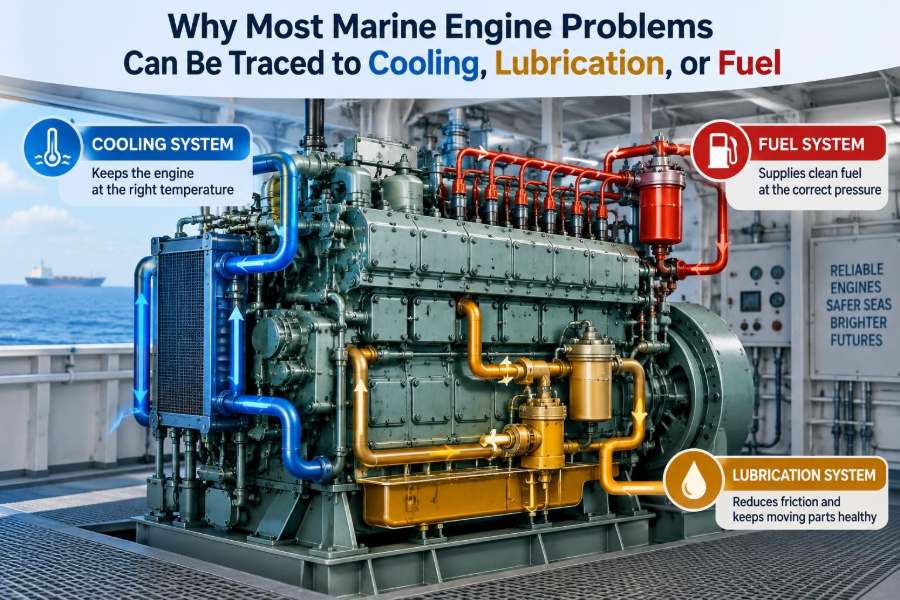

A main engine that loses power halfway through a passage rarely begins with a dramatic mechanical failure. More often, someone first notices a high jacket-water temperature, a falling lube-oil pressure, uneven exhaust temperatures, or a filter that suddenly needs attention.
These signs can look unrelated because they appear on different gauges and in different spaces. Yet they often lead back to three systems that keep every combustion engine alive: cooling, lubrication, and fuel supply.
For marine engineers, this is useful because troubleshooting is not just about finding a failed part. It is about understanding the conditions that allowed that part to fail. A damaged bearing, seized piston, cracked liner, or loss of propulsion may be the final event—not the original fault.
Learning to trace symptoms through these three systems turns engine-room alarms into a logical investigation. It also makes routine rounds, trend monitoring, and planned maintenance far more effective.
⚙️ The Engine Depends on Three Continuous Services
A diesel engine converts fuel energy into useful shaft power, but combustion alone cannot sustain it. Heat must be removed at a controlled rate, moving surfaces must be separated by an oil film, and fuel must arrive clean, correctly pressurized, and properly prepared.
Cooling, lubrication, and fuel systems are therefore not secondary support equipment. They are continuous life-support systems for the engine. A defect in any one of them can quickly affect combustion, clearances, wear rates, and reliability.
🔗 Why Different Failures Often Have the Same Root Cause
Marine engines are tightly connected systems. Low cooling flow can raise component temperature; higher temperature reduces oil viscosity; thinner oil weakens the lubricating film; then bearing or liner damage becomes more likely.
The reverse is also possible. Poor fuel atomization can cause late or incomplete combustion, increasing exhaust temperature and thermal loading. The observed symptom may be “high temperature,” but the origin is in fuel treatment or injection.
This is why engineers should distinguish between the failed component and the initiating condition. Replacing an injector, pump, or bearing without correcting that condition invites a repeat failure.
🧭 Start With the Engine’s Normal Operating Pattern
A fault is easiest to recognize when normal values and normal relationships are understood. During steady load, temperatures, pressures, and exhaust readings should remain reasonably stable and should agree with the engine maker’s operating guidance.
One reading outside expectation matters, but a changing pattern often matters more. For example, a gradual rise in scavenge-air temperature, a widening exhaust-temperature spread, and increasing cooling-water demand may reveal deterioration before an alarm activates.
Good watchkeeping means recording values consistently enough to identify direction, not merely confirming that an alarm has not yet sounded.
🌡️ Cooling Is About Control, Not Maximum Cold
The cooling system removes heat from cylinder liners, cylinder heads, exhaust valves, turbochargers, and sometimes charge-air coolers. Its purpose is not to make components as cold as possible. It must keep metal temperatures within a range that protects strength, clearances, oil behavior, and combustion efficiency.
Overcooling has consequences too. Low temperatures can encourage poor combustion, condensation, corrosive deposits, and reduced thermal efficiency. The aim is stable, specified temperature control, not simply the highest available flow.
💧 The Freshwater and Seawater Sides Have Different Jobs
Many vessels use a closed freshwater circuit around the engine and a seawater circuit through central coolers or dedicated heat exchangers. Freshwater is treated to limit internal corrosion and deposits, while seawater carries rejected heat overboard.
This arrangement protects engine passages from direct seawater exposure. But it also creates two potential fault zones: restricted freshwater circulation inside the engine, and reduced heat transfer across the cooler because of fouling, blockage, or low seawater flow.
| Observation | Possible cooling-system direction |
|---|---|
| High engine outlet temperature with normal seawater discharge | Investigate freshwater circulation, thermostat control, air pockets, or internal restrictions |
| High engine and cooler temperatures together | Check seawater inlet, strainers, pump performance, cooler fouling, and seawater temperature |
| One cylinder hotter than others | Consider local jacket-water passage restriction, sensor error, combustion issue, or component damage |
🚰 Low Cooling Flow Is Not Always a Pump Failure
When temperature rises, the cooling pump is often blamed first. A worn impeller, damaged mechanical seal, slipping drive, or poor suction can certainly reduce delivery, but the same symptom can result from a partially closed valve, blocked strainer, trapped air, or an incorrectly positioned bypass.
Check the whole flow path. Pump discharge pressure alone does not prove adequate flow through the heat exchanger and engine. Compare differential pressures where available, inspect strainers safely, and verify valve line-up against the system diagram.
🫧 Air Pockets Create Local Hot Spots
Air trapped in a freshwater cooling circuit can interrupt circulation through high points such as cylinder-head passages. The temperature sensor may not always sit at the hottest location, so a seemingly modest system-temperature change can conceal severe local overheating.
Air may enter after maintenance, poor venting, low expansion-tank level, or a small leak on the suction side. Repeated loss of water or frequent need for venting deserves investigation; adding water repeatedly treats a symptom, not the cause.
🧂 Fouling Turns a Cooler Into an Insulator
Heat exchangers work by transferring heat through metal surfaces. Scale, biological growth, mud, oil contamination, and corrosion products add thermal resistance, much like wrapping insulation around a radiator.
Seawater-side fouling is common where organisms and suspended solids are present. Freshwater-side deposits may point to poor water treatment or incompatible chemical additions. Cleaning must follow the cooler maker’s procedure because aggressive methods can damage tubes, plates, or protective coatings.
🧪 Cooling-Water Chemistry Protects Hidden Surfaces
Closed cooling water is not just water. It is normally maintained with treatment chemicals selected to reduce corrosion, scale formation, and cavitation-related damage. The correct treatment depends on the engine, materials, and maker’s recommendations.
Ignoring test results can allow corrosion products to circulate until they block narrow passages or erode pump components. Excessive or incompatible treatment can also create problems, so dosing should be controlled rather than guessed.
A sample result is most valuable when it prompts action: investigate contamination, correct concentration, or increase monitoring after maintenance or water addition.
🔥 Overheating Changes Clearances and Material Behavior
Metal expands when heated. Engine designers allow for this, but excessive temperature changes clearances beyond their intended range. Pistons can scuff against liners, valves can lose seating quality, and cylinder heads may distort or crack under severe thermal stress.
Lubricating oil exposed to hotter surfaces also oxidizes faster and may lose the viscosity needed to carry load. That is why an overheat alarm should never be treated as an inconvenience to be silenced. Reducing load or stopping, when operating instructions require it, may prevent much greater damage.
🛢️ Lubrication Does More Than Make Parts Slippery
Lubricating oil forms a separating film between bearings, journals, cam followers, gears, and other moving surfaces. It also carries heat away, suspends contaminants for filtration, helps seal some interfaces, and protects surfaces from corrosion.
In a healthy hydrodynamic bearing, shaft rotation draws oil into a wedge-shaped clearance and generates a pressurized film that supports the load. If that film collapses, metal contact can occur rapidly.
📉 Low Oil Pressure Is a Symptom, Not a Diagnosis
A low-pressure alarm may result from low sump level, blocked suction strainers, pump wear, a stuck relief valve, excessive bearing clearance, oil that has become too hot, or an inaccurate sensor. The correct response depends on the engine and situation, but continued operation with genuinely inadequate pressure can be destructive.
First establish whether the reading is real. Compare independent instruments if fitted, inspect the local gauge, and consider oil temperature and load. Then investigate the system methodically rather than adjusting a relief valve to make the alarm disappear.
🌡️ Viscosity Connects Oil Temperature to Protection
Viscosity describes an oil’s resistance to flow. If oil becomes excessively hot, it generally becomes thinner. Thin oil may still reach the bearings, but its film may not have enough strength for the load and clearance conditions.
Oil that is too cold can be a problem as well, especially at starting or after long standby periods. It flows poorly, increases pumping losses, and may not reach distant points promptly. Correct oil temperature is therefore a controlled operating requirement, not a convenience.
🔍 Contamination Gives Early Warnings
Water, fuel, soot, coolant chemicals, and abrasive particles can all degrade lubricating oil. Water can reduce film strength and promote corrosion. Fuel dilution reduces viscosity. Hard particles act like cutting compound in bearings, pumps, and hydraulic components.
Routine oil analysis can identify trends in contamination, additive depletion, viscosity change, and wear metals. It does not diagnose every fault by itself, and sample quality matters, but it can direct attention toward a leaking cooler, poor combustion, ingress path, or abnormal wear process.
🧲 Filters Remove Debris but Cannot Fix Its Source
A rising filter differential pressure shows that the filter is collecting material, which is useful information. Switching to a clean standby filter may restore flow, but the collected debris should be examined when safe and practical.
Soft sludge may suggest oxidation or contamination. Metallic particles may require more urgent investigation. Repeated filter blockage is not a maintenance nuisance; it is evidence that contamination is entering or being generated somewhere in the system.
⚖️ Matching Oil to the Engine and Duty Matters
Marine engines use lubricants chosen for their viscosity grade, additive package, fuel type, design, and operating profile. Slow-speed crosshead engines, trunk-piston engines, auxiliary diesels, and gear systems have different lubrication needs.
Using an unapproved oil, mixing incompatible products, or making a large unplanned top-up can affect detergency, alkalinity reserve, water separation, and deposit control. Product selection and changeover should follow the engine and lubricant supplier guidance rather than assumptions based on appearance alone.
⛽ Fuel Quality Begins Before the Service Tank
Fuel-related engine trouble often originates before fuel reaches the engine. Delivered fuel may contain water, sediments, catalytic fines, or incompatible blend components. Storage conditions can add further contamination through tank bottoms, condensation, and disturbed sludge.
Fuel handling is therefore a chain: receiving, sampling, storage, settling, heating, purification, service-tank management, filtration, pressurization, and injection. A weakness at any stage can surface later as unstable running or accelerated wear.
🧱 Cat Fines Can Damage Precision Components
Catalytic fines, commonly hard aluminum- and silicon-containing particles associated with some residual fuels, are especially harmful if they reach the engine. They can accelerate wear in fuel pumps, injectors, piston rings, and cylinder liners.
Effective settling, correct purifier operation, suitable fuel temperature, clean tanks, and properly maintained filters reduce the risk. A filter may catch some particles, but relying on the final filter alone places too much burden on the last barrier.
💧 Water in Fuel Causes More Than Poor Combustion
Water can cause corrosion, loss of lubricity in fuel-system components, unstable combustion, and microbial growth in some distillate storage conditions. Free water also occupies separator capacity and can upset fuel preparation.
Tank draining should be routine and deliberate, especially after bunkering, rough weather, or prolonged storage. If water keeps appearing, investigate possible sources such as leaking heating coils, condensation, contaminated transfer arrangements, or ingress through tank openings.
🌡️ Fuel Temperature Determines Its Handling Behavior
For heavier fuels, temperature affects viscosity and therefore pumping, purification, filtration, and injection. Fuel that is too cold may be difficult to move and atomize. Fuel that is overheated can create excessive vapor formation, reduce viscosity too far, and stress seals or equipment.
Setpoints should be based on the fuel’s actual properties and the equipment maker’s guidance. Heating by habit—rather than by measured viscosity or operating need—can produce its own faults.
💉 Injection Quality Shapes Combustion
An injector must deliver fuel at the right time, in the right quantity, and as a fine spray that mixes effectively with compressed air. Worn nozzles, deposits, poor opening behavior, leakage, incorrect timing, or pump defects can disturb this process.
Possible indications include uneven exhaust temperatures, rough running, smoke, elevated fuel consumption, cylinder-pressure abnormalities, or local piston and exhaust-valve distress. No single indication proves an injector fault, so compare several measurements before removing equipment.
💨 Air Supply Belongs in the Fuel-Combustion Investigation
Combustion depends on fuel and air. A dirty air filter, fouled charge-air cooler, turbocharger problem, scavenge leak, or restricted exhaust path can leave a cylinder short of oxygen even when the fuel system is healthy.
This is a useful diagnostic boundary: high exhaust temperature may be caused by excess fuel, poor atomization, late combustion, or insufficient air. Treating every high-temperature cylinder as a fuel-injector problem can waste time and miss the true restriction.
📊 Read Symptoms as Relationships, Not Isolated Numbers
Engine diagnosis improves when readings are compared across cylinders, across time, and against load. An individual exhaust temperature may be acceptable, but a growing spread between cylinders at the same load deserves attention.
Similarly, oil pressure should be interpreted with oil temperature and engine speed, while cooling performance should be interpreted with seawater temperature, cooler differential pressure, and load. The system tells a clearer story when related values are read together.
🧰 A Practical First Response to Abnormal Readings
When conditions permit, begin with controlled observation rather than rushed adjustment. Protect people and machinery first, follow vessel procedures, and reduce load or stop equipment when alarm instructions or judgment require it.
- Confirm the indication using available local and remote instruments.
- Compare current values with recent trends and with other cylinders or parallel equipment.
- Check simple external causes: valve positions, tank levels, filter differential pressures, leaks, and pump status.
- Identify which system could create the full pattern of symptoms.
- Correct the cause, then monitor whether the trend returns to normal.
This sequence helps prevent the common error of changing several settings at once and losing the evidence needed to find the original fault.
🧯 Know When Troubleshooting Must Become Protection
Some abnormalities allow careful monitoring; others demand immediate protective action. Rapidly falling lube-oil pressure, severe overheating, crankcase mist alarms, abnormal bearing temperature, major fuel leakage, or signs of fire should be handled according to the vessel’s emergency and operating procedures.
Engineers should never bypass trips, defeat alarms, or continue operation solely to reach a convenient maintenance window. The exact limits and response actions vary by engine design and company procedures, which must take priority over general guidance.
📝 Trend Records Turn Routine Rounds Into Diagnosis
A logbook or digital trend is valuable only when readings are taken under comparable conditions and reviewed. Record load, ambient or seawater conditions where relevant, temperatures, pressures, purifier condition, filter changes, and unusual operating events.
For example, a gradual increase in jacket-water outlet temperature after a particular port stay may direct attention to seawater fouling. A viscosity decline after a fuel-system issue may suggest dilution. Context makes data useful.
🧹 Planned Maintenance Must Include System Cleanliness
Changing filters and renewing parts on schedule is necessary, but reliable operation also depends on clean tanks, effective strainers, correct cooler maintenance, calibrated sensors, sound insulation, and controlled fluid quality.
Maintenance should ask two questions: “What is due?” and “What is changing?” The second question catches emerging defects that a calendar-based task list may not reveal.
👥 Communication Prevents Repeat Defects
Watchkeepers, engineers, electricians, and shore support may each see a different part of the same problem. A sensor discrepancy, unusual purifier discharge, changed bunker quality, or recently opened cooling circuit can be highly relevant to a later engine symptom.
Clear handovers should include trends, temporary measures, alarms received, components isolated, samples sent, and checks still required. Good faultfinding is collaborative because no single person observes the entire operating history.
🧠 Avoid the Most Common Diagnostic Shortcuts
Several shortcuts repeatedly lead engineers away from root cause:
- Assuming an alarm transmitter is wrong without verifying it.
- Replacing the visibly damaged part but not investigating why it was damaged.
- Changing multiple variables simultaneously.
- Judging a system only at no-load or during a brief test.
- Ignoring a slow trend because the value remains inside an alarm limit.
The better alternative is disciplined evidence gathering. This may feel slower initially, but it reduces repeat work and protects machinery from an avoidable escalation.
🔄 Remember That One Fault Can Cross System Boundaries
A leaking fuel injector can wash lubricant from a cylinder liner and increase thermal loading. A failed cooler can allow water into lubricating oil. An overheating engine can degrade oil, while poor oil cooling can itself be caused by restricted seawater flow.
These interactions explain why apparently separate defects often occur together. When a fault is found, inspect adjacent systems for consequences as well as causes. Repairing the first failure may not remove contamination or damage already introduced elsewhere.
✅ The Core Principle: Protect Heat, Film, and Combustion
Most marine diesel problems become easier to organize when three basic questions are asked. Is heat being removed at the correct rate? Is an adequate clean oil film reaching loaded surfaces? Is clean, correctly prepared fuel being injected into sufficient air?
These questions do not replace maker manuals, alarm matrices, inspections, or professional judgment. They provide a reliable framework for deciding where to look first and for connecting symptoms that otherwise seem unrelated.
The strongest engine-room diagnosis follows the path from abnormal condition to root cause, and cooling, lubrication, and fuel are usually the first paths worth tracing.
When these systems are monitored as a connected whole, many serious failures can be recognized while they are still developing rather than after they have become repairs. 🚢🛢️🌡️