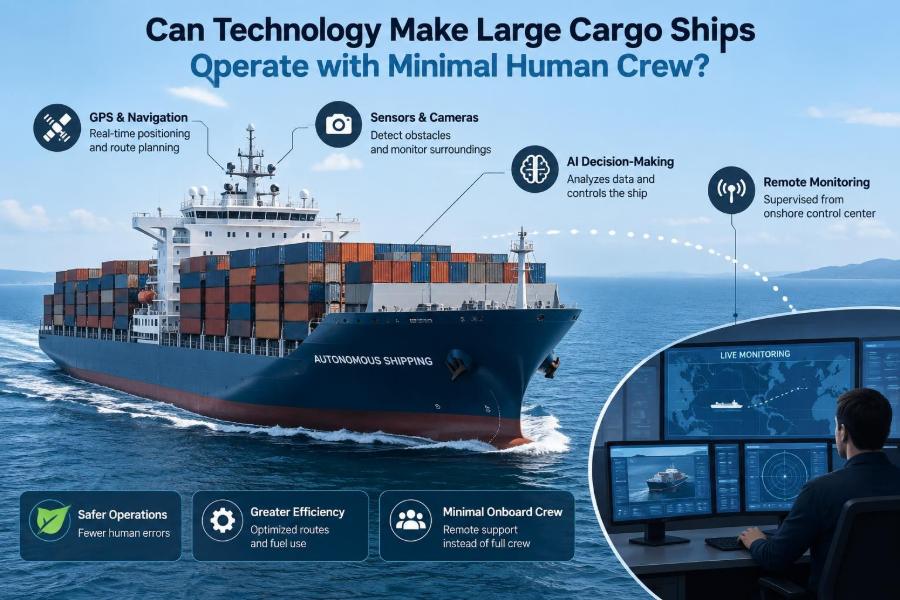

At 2 a.m., a container ship may be hundreds of miles from land, moving through traffic, weather systems, and changing sea states. On the bridge, watchkeepers interpret radar echoes, assess another vessel’s intentions, and decide whether a small course change now will prevent a close-quarters situation later.
Below deck, engineers monitor propulsion, electrical power, cooling water, fuel treatment, alarms, and machinery temperatures. Much of this work is already assisted by automation. Yet assistance is not the same thing as operating safely without people.
The idea of a large cargo ship sailing with only a handful of crew—or no crew aboard—can sound like the next obvious step after autonomous cars and automated warehouses. For marine engineering students and professionals, the more useful question is not whether technology is impressive enough, but whether the complete ship-and-shore system can manage normal operations, failures, and accountability.
Minimal crewing is therefore a design, operations, safety, maintenance, and regulatory challenge at the same time. Technology can reduce workload and change job roles, but it must also preserve the ability to detect problems, make sound decisions, and recover when conditions stop being predictable.
⚓ What “Minimal Crew” Actually Means
Minimal crew does not have one universal definition. It may describe a conventionally crewed ship with fewer people because machinery is highly automated, a vessel supervised from a shore control centre, or a ship capable of operating with no seafarers aboard for part of a voyage.
These models should not be confused. A ship with a small crew can still have immediate human intervention in the engine room and on the bridge. A remotely supervised ship may have people ashore, but communication delay, limited sensor views, and reduced physical access change what those people can realistically do.
In practice, the transition is likely to be gradual. Many vessels will first adopt more decision support and condition monitoring before they become genuinely remote or autonomous in limited operating areas.
🧭 Why Large Cargo Ships Are a Difficult Test Case
Large cargo ships carry substantial momentum, often have restricted visibility close to the hull, and require careful handling in confined waters. Their voyages also cross very different environments: open ocean, dense traffic schemes, narrow approaches, pilotage waters, berths, and anchorages.
A ship may perform reliably for days at sea, then face its highest workload during a few hours entering port. This matters because autonomy must be judged by the difficult phases, not only by a calm passage across open water.
Cargo ships also operate as commercial assets with tight port schedules, complex cargo documentation, security obligations, and inspections. Safe navigation is only one part of the operational picture.
🤖 Automation Is Already Aboard
Marine automation is not new. Modern ships commonly use integrated bridge systems, autopilots, automatic steering control, engine monitoring, alarm systems, power-management systems, electronic charts, and machinery automation.
For example, an unmanned machinery space arrangement can allow engineers to leave the engine room during defined periods while alarms are monitored elsewhere. That arrangement still depends on trained people who can investigate an alarm, isolate equipment, and repair faults.
The key distinction is simple: automation performs programmed functions; autonomy manages goals and changing conditions with limited direct intervention. A vessel can be highly automated without being autonomous.
🧠 The Four Building Blocks of Ship Autonomy
A minimally crewed vessel needs more than an autopilot. It needs a linked system that can perceive its surroundings, understand the situation, choose an action, and carry out that action through reliable machinery and controls.
- Perception: collecting information from radar, cameras, AIS, GNSS, gyrocompasses, depth sensors, machinery sensors, and weather inputs.
- Situation assessment: deciding what those signals mean, such as identifying a crossing vessel, fishing gear, a navigation buoy, or a sensor fault.
- Decision and control: selecting a safe manoeuvre and sending commands to steering, propulsion, thrusters, or machinery systems.
- Assurance: checking that the action occurred as intended and switching to a safe state if it did not.
A weakness in any one layer can undermine the entire chain. Accurate radar is of limited value if the decision logic misclassifies a target or if a steering actuator cannot respond.
📡 Sensors Create Awareness, Not Certainty
Radar remains valuable because it can detect objects beyond visual range and in darkness, although sea clutter, rain, target size, and antenna placement affect its performance. Cameras add visual context but can be degraded by fog, spray, glare, dirt, darkness, or ice on a lens.
AIS, the Automatic Identification System, provides identity and voyage information transmitted by equipped vessels. It is helpful but should not be treated as ground truth: not every object transmits AIS, and transmitted data can be absent, wrong, or outdated.
Robust designs use sensor fusion, combining several sensor types so that one source can check another. Fusion improves resilience, but it does not eliminate ambiguity. A floating container, small craft, or partially obscured aid to navigation can remain a challenging detection problem.
🗺️ Navigation Needs More Than a Planned Route
Electronic charts and voyage-planning tools can create an efficient route while considering charted depths, route restrictions, weather forecasts, and fuel use. But a voyage plan is an intention, not a guarantee that conditions will remain suitable.
Safe navigation requires continuous comparison between plan and reality. Current, wind, traffic behaviour, updated notices, reduced visibility, equipment limitations, and a master’s or operator’s risk assessment can all justify changing the plan.
A useful analogy is a railway timetable versus driving in city traffic. A timetable provides structure; it cannot predict every pedestrian, road closure, or emergency vehicle. Ships need the equivalent ability to adapt without losing their safety margins.
🚦 Collision Avoidance Is a Judgment Problem
The International Regulations for Preventing Collisions at Sea, commonly called COLREGs, set out rules for avoiding collisions. They include obligations to keep a proper lookout, proceed at a safe speed, assess risk, and take effective action.
Some parts are readily expressed in logic, such as calculating closest point of approach. Other parts demand contextual judgment: whether another vessel is actually maintaining course, whether a fishing vessel is restricted by its gear, or whether an early alteration could confuse traffic.
Autonomous systems must interpret both vessel movement and human behaviour. A technically legal manoeuvre may still be poor seamanship if it is late, hard for others to understand, or places the ship in a more dangerous position minutes later.
👀 The Proper Lookout Problem
A human lookout uses sight, hearing, radar, local knowledge, and communication to build a mental picture. A camera may see an object, but it does not automatically understand a shouted warning, an unusual light pattern, debris, or a crew member signalling from a small boat.
This is one reason remote operation cannot simply be treated as watching video from shore. Camera placement creates blind zones, bandwidth can be constrained, and a remote operator may lack the physical cues available on the bridge.
Technology can extend lookout capability, especially with thermal cameras and radar tracking. The challenge is demonstrating that the combined system is at least as dependable as the level of lookout required for the operating conditions.
🏗️ Ports Are Less Predictable Than Open Water
Port approaches concentrate complexity. Tugboats, pilots, line handlers, terminal personnel, dredging activity, recreational craft, currents, traffic control instructions, and berth availability can all affect the manoeuvre.
Berthing is also highly ship-specific. Windage area, loading condition, rudder response, propeller effects, thruster capacity, and local bathymetry influence how a vessel behaves. A digital model can help, but its assumptions must remain valid as conditions change.
For this reason, early minimal-crew operations are more plausible on controlled, repeatable routes than on unrestricted global trades involving varied ports and weather conditions.
⚙️ The Engine Room Cannot Be Treated as a Black Box
Main propulsion plants and auxiliary systems are made of components that wear, leak, foul, vibrate, overheat, and occasionally fail in combinations. A temperature trend may indicate a developing bearing issue, while a sudden pressure loss may demand immediate isolation and response.
Engine automation can start standby pumps, regulate generator load sharing, and initiate protective shutdowns. Those functions are essential, but a shutdown that protects machinery can also leave a ship without propulsion in a dangerous location.
Minimal-crewing designs therefore need to consider fault consequences, not merely whether an alarm exists. Can the fault be diagnosed? Is there redundancy? Can equipment be restarted safely? Who can physically intervene if a valve sticks or a filter blocks?
🔧 Predictive Maintenance Helps, but Does Not Repair Equipment
Condition monitoring uses signals such as vibration, temperature, lubricating-oil condition, electrical current, and operating hours to identify abnormal trends. It can help operators plan maintenance before a failure becomes serious.
Its strength is early warning, not magic prediction. A sensor may fail, a trend may be misinterpreted, and some failures develop rapidly without a clear prior signature. Data quality matters as much as the analytical model.
A minimally crewed ship may require more maintenance preparation ashore: reliable spare-parts planning, port-service arrangements, remote technical support, and equipment designed for inspection and replacement with fewer hands aboard.
🔋 Electrical Power Is the Ship’s Nervous System
Navigation, steering control, communication, pumps, cooling, alarms, and cargo systems often depend on electrical power. A power-management system balances generator output and demand, starts additional generators, and may shed non-essential loads to protect the network.
A blackout is not simply an electrical inconvenience. Depending on design and circumstances, it can affect propulsion, steering availability, navigation equipment, and fire-fighting capability. Recovery procedures must be dependable even when sensors or communications are impaired.
More automation can increase electrical and software dependence. Good design therefore includes separation, redundancy, emergency power, tested restoration procedures, and clear limits on what functions may share a common point of failure.
🛟 Fire, Flooding, and Abandonment Change the Equation
Fire and flooding are among the clearest limits on unattended operation. Automatic detection can identify smoke, heat, water level, or gas concentration, and fixed suppression systems can act quickly in some protected spaces.
But incidents often require physical work: closing boundaries, checking adjacent compartments, fighting a fire with the correct medium, dewatering, shoring damage, accounting for people, and deciding whether conditions are escalating.
An uncrewed ship cannot evacuate itself, and a small crew may be stretched by simultaneous tasks. Any safety case for reduced manning must show how emergency duties remain achievable with the people actually aboard, not with an idealized full emergency team.
🧯 Cargo Risks Do Not Disappear at Sea
Containers and bulk cargoes can create hazards through misdeclaration, shifting, self-heating, leakage, water ingress, or interaction with weather. Tankers and gas carriers add their own process-safety demands, while refrigerated cargo needs reliable power and temperature control.
Remote sensing can monitor selected spaces and cargo parameters, but not every cargo condition is directly measurable from a central screen. Crew also carry out inspections, respond to visible damage, secure loose equipment, and coordinate with shore authorities when cargo problems occur.
Reduced crewing may be easier for cargoes and ship types with stable, closely monitored operating conditions than for operations requiring frequent inspections or complex emergency response.
🌊 Weather Is a Systems Challenge
Weather routing can reduce exposure to severe conditions and improve fuel efficiency. Forecasts, wave models, and vessel performance data give operators far better planning tools than were available in earlier eras.
However, a forecast does not remove uncertainty. A ship must still respond to unexpected squalls, changing wave direction, heavy rolling, green water on deck, or cargo-related motion limits. Sensor reliability can also decline exactly when conditions become harsh.
Autonomy must therefore include conservative operating envelopes: clear thresholds for slowing down, changing route, requesting human support, or entering a safe mode. The best decision may be commercial delay rather than forcing a schedule.
📶 Shore Control Centres Extend, Not Replace, Capability
A shore control centre can bring together navigators, engineers, data analysts, and fleet managers. It may supervise multiple vessels, compare live machinery trends across a fleet, and provide specialists who would not be carried on every ship.
Its limits are practical. Satellite links have finite bandwidth and can be interrupted; video may be delayed; and a shore operator cannot tighten a leaking connection, clear a blocked strainer, or walk to the bridge wing for a better view.
Remote control also raises workload questions. One operator may monitor several quiet vessels, but an unusual event can demand full attention immediately. Designing sensible handover rules and operator-to-vessel ratios is as important as building the control room.
🔐 Cybersecurity Becomes a Navigational Safety Issue
Connected navigation and machinery systems create new paths for support and efficiency, but also for unauthorized access, malware, data manipulation, and loss of availability. A cyber incident can become a safety problem if it affects charts, communications, sensors, or control networks.
Defence involves more than passwords. It includes network segmentation, controlled remote access, software update management, backups, logging, user training, and the ability to operate essential functions in a degraded mode.
A common mistake is assuming that isolated equipment will remain isolated forever. Service laptops, removable media, vendor access, and poorly managed interfaces can reconnect systems in unexpected ways.
🛰️ Positioning and Communication Need Backup Paths
Satellite navigation is fundamental to modern maritime operations, but position information can be degraded or unavailable. Ships should maintain independent methods for checking position, including radar comparison, visual navigation where possible, inertial systems, and sound navigation practices.
Likewise, remote operation needs communications designed around loss, delay, and interruption. The vessel must know what to do if it cannot contact shore: continue under stated limits, reduce speed, hold position where safe, seek a safe area, or transfer to a preplanned fallback mode.
Loss of link must be an expected design condition, not an exceptional surprise. The safest fallback will depend on location, traffic, propulsion condition, and environmental constraints.
⚖️ Rules, Liability, and Certification Must Catch Up
International and national maritime rules were largely developed around ships with masters and crews aboard. Questions arise when a remote operator makes a manoeuvring decision: who is the person in command, where are they legally located, and how are watchkeeping responsibilities fulfilled?
Classification societies, flag administrations, port authorities, insurers, and cargo interests each have legitimate concerns. Approval is likely to depend on the particular vessel, operating area, degree of automation, emergency arrangements, and demonstrated reliability rather than on a single label such as “autonomous.”
Technology may move faster than regulation, but commercial operation requires both. A capable prototype is not automatically a legally accepted trading ship.
📋 A Safety Case Is More Useful Than a Sales Claim
A safety case is a structured argument, supported by evidence, that a system can operate safely in a defined context. For minimal-crewing concepts, it should identify hazards, controls, assumptions, residual risks, and responsibilities.
The boundaries matter. A system shown to work on a sheltered, fixed route in daytime may not be suitable for night operation, severe weather, mixed traffic, or ocean crossings. Expanding the operating domain requires new evidence, not optimism.
Hazard analysis should include technical failure, human error, software faults, poor sensor data, cyber events, maintenance shortcomings, and organizational decisions such as pressure to maintain schedule.
🧪 Testing Must Include Bad Days
Sea trials in favourable conditions can demonstrate basic functionality, but they do not reveal every operational weakness. Testing should include realistic abnormal scenarios: sensor disagreement, loss of GNSS, communication interruption, machinery alarms, dense traffic, reduced visibility, and conflicting operator priorities.
Simulation is particularly useful because rare and hazardous cases can be repeated safely. Hardware-in-the-loop testing, where real control equipment interacts with a simulated vessel or environment, can expose interface and timing issues before deployment.
No test programme can prove that every future event is covered. Its purpose is to uncover failure paths, validate fallback actions, and establish credible limits for operation.
👩✈️ Human Factors Still Matter—Even Ashore
Automation changes human work from continuous hands-on control toward monitoring, intervention, and exception management. This can create the out-of-the-loop problem: an operator may become less able to respond quickly because the system normally performs the task without them.
Control displays must show not only what the vessel is doing but why it is doing it, what information is uncertain, and what actions are available. An operator who sees “collision risk resolved” needs enough detail to challenge that conclusion when it does not fit the wider situation.
Fatigue, alarm overload, poor handovers, and misplaced trust affect shore staff as well as seafarers. Moving people ashore does not remove human factors; it relocates them.
🎓 Seafarers Will Need Different Skills, Not Fewer Skills
Future shipboard and shore roles may place more emphasis on digital systems, data interpretation, cyber awareness, remote diagnostics, and automated-control limitations. At the same time, core seamanship, machinery knowledge, emergency response, and practical judgment remain essential.
A technician who understands both a fuel-system fault and the logic controlling the standby pump is more valuable than someone trained only to acknowledge alarms. Training should therefore connect software behaviour to physical equipment and real operational consequences.
For students, this is a reason to build breadth: understand thermodynamics, electrical systems, control engineering, navigation principles, risk assessment, and communication. Minimal crewing increases the need for people who can think across disciplines.
💰 The Economic Case Is Broader Than Wage Cost
Reducing crew numbers may lower some onboard accommodation, victualling, travel, and personnel costs. But that potential saving must be weighed against sensors, redundancy, communications, shore centres, software assurance, cyber protection, training, maintenance, insurance, and certification.
There is also a cost of reduced onboard repair capacity. A fault that an experienced engineer could resolve at sea may become a delay, towage issue, or port-service requirement if no one is available to intervene.
The financial case will differ sharply by ship type and trade. Regular short-sea routes with standardized port calls may have a different balance from deep-sea ships operating far from technical support.
🌱 Efficiency and Emissions Can Improve—With Conditions
Automation can support fuel-efficient routing, optimized trim, machinery performance monitoring, and steadier control of propulsion demand. These tools can reduce waste when their recommendations are accurate and when operators understand their limits.
However, a minimal-crew concept is not automatically an environmental solution. Extra computing, sensors, communications, redundancy, and shore infrastructure also consume resources, while a major casualty can carry serious environmental consequences.
The most credible environmental benefit comes from using digital systems to improve operational decisions while keeping safety margins intact. Fuel optimisation should never override weather limits, collision avoidance, or machinery protection.
🧩 Where Minimal Crewing Is Most Plausible First
Initial applications are likely to favour bounded operations: short routes, predictable traffic patterns, well-mapped waters, strong communications, frequent port access, and vessels with comparatively repeatable duties. These conditions make failure response and shore support more manageable.
Even then, “minimal” may mean a small onboard team rather than zero crew. People can provide local inspection, emergency response, mooring support, and practical troubleshooting while automated systems reduce routine workload.
| Operating context | Why it may suit higher automation | Key remaining challenge |
|---|---|---|
| Fixed short-sea route | Repeatable geography and accessible shore support | Port manoeuvring and mixed local traffic |
| Coastal feeder service | Frequent communications and shorter recovery distance | Weather variation and busy approaches |
| Deep-sea container trade | Long open-water periods may support automation | Self-sufficiency during distant emergencies |
| Complex hazardous cargo service | Process monitoring can be highly instrumented | Specialized emergency and cargo response |
🚧 Common Mistakes in the Autonomy Debate
One mistake is comparing a ship only with a self-driving car. Ships move more slowly, but they operate in an environment with weaker lane structure, variable communications, major weather exposure, and limited opportunities to pull over safely.
Another mistake is treating average performance as sufficient. Safety-critical systems must be assessed for unusual combinations: a sensor failure during heavy rain, a machinery alarm near a traffic separation scheme, or a cyber problem during port approach.
Finally, it is misleading to frame the choice as fully crewed versus fully uncrewed. Many useful improvements lie between those extremes, including better decision support, targeted remote assistance, and equipment designed for safer unattended periods.
🛠️ Designing Ships for Graceful Degradation
Graceful degradation means that when part of a system fails, the vessel loses capability in a controlled way rather than failing suddenly and completely. A degraded sensor suite might trigger lower speed and a request for human confirmation; a communications loss might activate a conservative navigation plan.
This philosophy affects physical layout as well as software. Redundant steering arrangements, separated power supplies, manual local controls, accessible valves, clear alarm priorities, and maintainable machinery all make recovery more realistic.
The question engineers should ask is not only “What happens when this works?” but “What does the ship become when this fails, and is that state still safe enough for its location?”
📈 A Practical Road Map for Operators
Operators considering reduced crewing should begin with a narrow operational problem, such as remote machinery support or supervised transit in a defined area. The objective should be measurable in safety and workload terms, not simply described as “more autonomous.”
- Map tasks currently performed by crew, including routine, abnormal, and emergency duties.
- Identify which tasks can be automated, remotely supported, or eliminated through better design.
- Analyse failure modes and define conservative fallback actions.
- Train crew and shore staff together using realistic scenarios.
- Introduce the capability in phases and review operational evidence before expanding its use.
This approach keeps technology connected to real work. It also reveals tasks that are invisible in routine logs but decisive during disruptions.
🔭 What the Near Future Is Likely to Look Like
The next phase of maritime autonomy is likely to be uneven rather than revolutionary. Some ships will gain advanced route optimisation, remote diagnostics, automated machinery functions, and better shore support while retaining conventional crews.
Other vessels on tightly controlled routes may demonstrate more ambitious remote or autonomous functions. Their experience will be valuable, but it should not automatically be generalized to every ship class, voyage, or regulatory environment.
The industry’s most durable progress will come from proving specific capabilities under stated conditions, learning from near misses and failures, and resisting the temptation to promise universal autonomy too early.
✅ The Core Principle: Technology Must Strengthen Recovery
Large cargo ships can certainly operate with progressively smaller onboard teams in some circumstances, and existing automation already makes that possible in limited ways. But the central engineering question is not whether a computer can keep a ship on track during normal conditions.
It is whether the vessel, shore team, and supporting infrastructure can recognize uncertainty, handle degraded equipment, manage emergencies, and recover safely when normal conditions disappear. A credible minimal-crew system must be designed around those difficult moments.
That is why the future role of people is likely to become more selective and more technical, rather than simply vanish. Human judgment, physical intervention, and accountable command remain valuable precisely where automated systems encounter ambiguity.
Technology can make large cargo ships operate with fewer people, but safe minimal crewing depends on resilient systems, realistic limits, and people who are ready to take over when resilience is tested. 🚢⚙️🌊