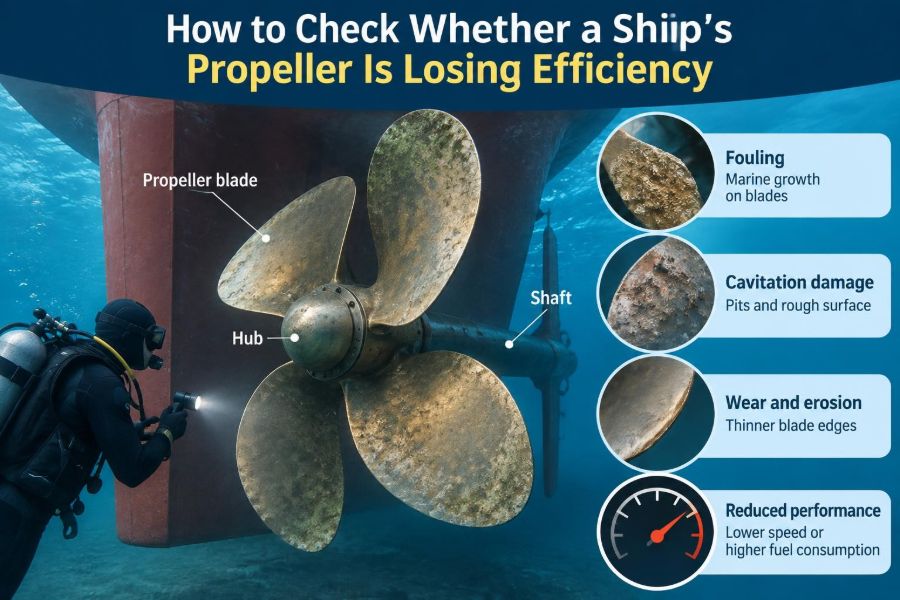

A chief engineer notices that the vessel is using more fuel than usual to maintain its normal service speed. The main engine appears healthy, the weather has settled, and no alarm points to an obvious machinery fault. Attention soon turns to the component that converts shaft power into thrust: the propeller.
Propeller efficiency rarely disappears all at once. More often, it is lost gradually through fouling, surface damage, incorrect operating conditions, hull resistance, or a change in the relationship between engine, shaft, and water. That gradual decline can be easy to overlook when voyage conditions vary from day to day.
For operators, lower propeller efficiency means higher fuel consumption, reduced speed margin, vibration, and potentially more wear on propulsion equipment. For students, it is a useful example of how hydrodynamics, machinery performance, maintenance, and voyage data connect in a real shipboard problem.
The key is not to judge the propeller from one speed reading or one fuel figure. A reliable diagnosis compares like with like, checks the whole propulsion system, and separates genuine propeller loss from other causes of poor vessel performance.
⚙️ What Propeller Efficiency Actually Means
A propeller receives torque and rotational power from the shaft, then accelerates water astern to create thrust. Its efficiency describes how effectively the delivered shaft power becomes useful propulsive power moving the ship ahead.
Some energy is inevitably lost to slip, swirling flow, friction, cavitation, and turbulence. The practical concern is a change from the vessel’s normal condition: needing more power or fuel to achieve the same speed under comparable conditions.
Propeller performance is never independent of the hull. Water reaching the propeller has already been disturbed by the ship’s wake, so a good assessment considers the complete hull–propeller–engine system.
📈 The Most Useful Early Warning: Speed–Power Drift
The clearest operational sign is often a drift in the speed–power relationship. If the ship once made a given speed at a particular shaft power but now needs materially more power in similar draft, trim, weather, and current, resistance or propulsion efficiency has changed.
For example, a speed reduction during a loaded passage may be entirely normal if head seas have increased. It becomes meaningful when repeated observations in calm or corrected conditions show the same unfavorable trend.
Do not treat this as proof of propeller damage. It is a trigger for investigation, because hull fouling, added displacement, engine limitations, and environmental effects can produce the same symptom.
🧭 Start With a Fair Baseline
Performance data only become valuable when compared against an appropriate baseline. This may be sea-trial data, post-drydock results, a verified historical performance curve, or a carefully selected period when the hull and propeller were known to be clean.
Record the conditions surrounding the reference data: draft, displacement, trim, water depth, sea state, wind, current, engine condition, fuel type, and shaft configuration. A light ballast condition should not be compared casually with a deeply loaded voyage.
A baseline is not a single “perfect” number. It is a range of expected behavior for defined operating conditions.
🗂️ Build a Consistent Voyage Data Set
Daily noon reports are useful, but higher-frequency logged data are often better because short intervals make it easier to identify changes in weather, maneuvering, or machinery load. The purpose is to find a persistent pattern rather than react to ordinary operational noise.
- Speed through water and speed over ground
- Shaft revolutions, torque, and calculated shaft power where available
- Main-engine load, fuel index or fuel consumption, and exhaust temperatures
- Draft, displacement, trim, and ballast condition
- Wind, waves, swell, current, and water depth
- Date of hull and propeller cleaning, damage, or drydock work
Data quality matters. A defective speed log, inconsistent weather estimate, or misread fuel figure can create a performance problem that exists only on paper.
🌊 Separate Speed Through Water From Speed Over Ground
Speed over ground is what a GPS reports; it includes the effect of current. Speed through water is more relevant when assessing how much thrust is required to drive the hull through surrounding water.
A favorable current can hide a deteriorating propulsion condition, while an adverse current can make a healthy ship appear inefficient. When only speed over ground is available, current information and reciprocal runs can help, but uncertainty remains.
In practice, comparing many runs on broadly similar routes and correcting for known current is more dependable than drawing a conclusion from one passage.
🏗️ Check Hull Fouling Before Blaming the Propeller
Hull fouling is one of the most common reasons for increased power demand. Slime, algae, shell growth, and roughened coatings raise skin-friction resistance over a very large wetted area.
A fouled hull changes the wake entering the propeller as well as the resistance the propeller must overcome. The propeller may be operating less favorably even when its own blades are clean.
Review the time since last cleaning, trading pattern, port stays, water temperatures, and antifouling coating condition. A vessel spending long periods idle in biologically active waters deserves particular scrutiny.
🦪 Inspect for Propeller Biofouling
Marine growth on the propeller directly changes blade surface roughness and profile. Even a thin slime layer can disturb the smooth water flow needed for efficient lift generation on each blade; heavier growth creates much larger losses and can promote vibration.
Divers or remotely operated vehicles can inspect an immersed propeller, subject to local rules, safe operating conditions, and the vessel’s procedures. Video should cover blade faces, backs, leading edges, trailing edges, hub, and the area around the boss.
Cleaning can restore performance, but the method must suit the propeller material and coating system. Aggressive tools can leave damage that offsets some of the benefit.
🔍 Look Closely at Blade Surface Condition
A polished-looking propeller is not automatically efficient, but a rough or damaged one warrants attention. Examine for pitting, corrosion, coating loss, deposits, scoring, and localized roughness, especially near leading edges and blade tips.
Small defects matter because propeller blades operate at high relative water velocity. Roughness increases friction and can disturb the pressure distribution that produces thrust.
Document location and extent with photographs or video. This allows engineers to distinguish old, stable imperfections from newly developed defects after a grounding, debris strike, or cleaning operation.
🪨 Identify Mechanical Damage to Blades
Contact with debris, ice, floating timber, nets, quay structures, or the seabed can bend or nick a blade. Damage may be obvious, but a small leading-edge deformation can also cause measurable vibration or uneven loading without being visible from the surface.
Warning signs include a sudden change in shaft vibration, unusual noise, altered engine loading at a familiar rpm, or a deterioration that starts immediately after a suspected contact event.
Any significant damage should be assessed by qualified personnel. Grinding or reshaping a blade without engineering control can alter pitch, balance, strength, and class compliance.
🌀 Understand Cavitation as a Symptom and a Cause
Cavitation occurs when local pressure falls low enough for vapor-filled cavities to form in the water. As these cavities collapse, they can produce noise, vibration, and in severe cases, surface erosion.
Some cavitation can be expected in certain operating regimes. The concern is abnormal or increasing cavitation, especially when it accompanies loss of thrust, blade pitting, or structural vibration.
Causes may include excessive loading, damaged blade geometry, poor inflow from the hull, ventilation near the surface, or operation outside the propeller’s intended range. It should be investigated as a system issue, not merely a blade issue.
📐 Verify Pitch and Blade Geometry
Propeller pitch is the theoretical forward distance a blade would travel in one revolution through a solid material, much like the advance of a screw. Actual advance in water is lower because water flows around the blades.
For a controllable-pitch propeller, an incorrect pitch setting, feedback error, or hydraulic problem can make the engine and propeller appear mismatched. For a fixed-pitch propeller, distortion from damage or an improper repair can change effective pitch locally.
Specialist measurement methods can check pitch distribution, blade profile, and blade-to-blade consistency. These checks are more revealing than a simple visual inspection when performance loss is persistent.
⚖️ Consider Static and Hydrodynamic Balance
Propeller balance is not only about equal blade weight. Blades must also present comparable hydrodynamic characteristics in operation. Uneven repairs, erosion, and deformation can create unequal thrust between blades.
The result may be cyclic shaft loading and vibration transmitted into bearings, the stern tube, and the hull. A vessel can still make speed while operating inefficiently and imposing unnecessary stress on equipment.
Vibration analysis helps identify whether the frequency is linked to shaft rotation or blade passing. It does not by itself diagnose the exact defect, but it narrows the inspection focus.
🎛️ Compare Shaft Power, RPM, and Fuel Rate
A proper propulsion review compares several variables together. Higher fuel consumption alone may reflect fuel quality, engine tuning, auxiliary loads, or operating practice. Higher shaft power at the same rpm and speed points more directly toward increased hydrodynamic demand.
Where torque measurement is available, shaft power can be estimated from torque and rotational speed. That is usually more informative than engine rpm alone, particularly on engines operating under electronic control or variable load conditions.
| Observed pattern | Possible interpretation | Useful next check |
|---|---|---|
| Same rpm, lower speed | Higher resistance or weaker thrust | Hull/propeller condition and weather correction |
| Same speed, higher shaft power | Resistance increase or propulsive loss | Trend against clean baseline |
| New vibration with performance loss | Blade damage, cavitation, or shaft-line issue | Vibration review and underwater inspection |
| Normal shaft power, high fuel use | Possible engine-side issue | Engine performance assessment |
🔥 Rule Out Main-Engine Performance Problems
An engine that cannot develop power efficiently may look like a propulsion problem. Uneven cylinder exhaust temperatures, turbocharger fouling, poor combustion, fuel-system faults, air-side restrictions, and control limitations can all affect fuel use and available power.
Compare engine indicators with the manufacturer’s limits and established onboard trends. Cylinder pressure analysis, exhaust temperature patterns, scavenge condition, and turbocharger performance may be relevant depending on the engine type.
It is possible for both engine and hull conditions to deteriorate at the same time. A structured review prevents one issue from masking the other.
🔩 Do Not Ignore Shaft-Line and Bearing Condition
Misalignment, bearing wear, stern-tube problems, or abnormal friction can consume power and change vibration behavior. These faults may not reduce propeller hydrodynamic efficiency directly, but they reduce the efficiency of the propulsion train overall.
Monitor bearing temperatures, lubricating-oil condition, stern-tube leakage trends, shaft vibration, and alignment evidence from maintenance records. Sudden changes deserve more urgent attention than slow, explainable seasonal trends.
Never use propulsion trials to “test” a suspected shaft-line fault beyond approved operating limits. Damage can escalate quickly if a bearing is distressed.
🚢 Assess Wake, Trim, and Draft Effects
The propeller works in the wake field behind the hull, not in still, uniform water. Draft and trim change that wake field, alter hull resistance, and affect propeller immersion.
A stern-down trim may improve or worsen performance depending on hull form and loading condition. Excessive trim can increase resistance, while a lightly immersed propeller can suffer from ventilation or unsteady inflow.
Compare performance only at similar draft and trim, or use the vessel’s approved loading and performance guidance to account for the difference. Operational trim optimization can produce useful savings, but it is not a substitute for repairing damage or removing fouling.
🌬️ Correct for Weather and Sea State
Wind and waves add resistance and can cause propeller emergence, racing, and variable loading. Swell direction matters too: a following sea may improve speed over ground while still producing uncomfortable variations in propeller loading.
Weather correction is inherently uncertain because sea conditions are difficult to describe perfectly. The solution is not false precision; it is to use long-term trends, comparable conditions, and clearly stated assumptions.
When evaluating performance, calm-water periods are especially valuable. They reduce the number of explanations competing with a suspected efficiency loss.
🏞️ Account for Shallow Water and Restricted Channels
In shallow water, the flow around the hull and propeller is constrained by the seabed. Resistance and squat can increase, and the propeller may work in a different inflow condition than it does in deep water.
Canals, narrow channels, and dredged approaches add bank effects, current variations, maneuvering demand, and frequent changes in speed. Data from these areas should not be used as a direct equivalent to open-water service performance.
A ship may appear “slow” on a regular port approach while its offshore propulsion condition is entirely normal.
🧪 Use Sea Trials and Performance Tests Carefully
A formal speed trial can provide a controlled comparison, but it requires defined procedures, suitable environmental conditions, calibrated instruments, and professional analysis. It is not simply a high-speed run with GPS screenshots.
Reciprocal runs help reduce the effect of current and wind. Repeated runs at selected power settings provide a curve rather than a single point, making abnormal deviations easier to recognize.
For many vessels, routine operational monitoring gives earlier warning than occasional trials. The strongest approach combines both when circumstances justify it.
📹 Plan an Underwater Inspection Properly
An underwater inspection should have a clear question: Is there fouling? Has damage occurred? Is the coating intact? Are there signs of cavitation erosion or fishing gear around the hub?
Brief the inspection team on the vessel’s propeller type, recent events, previous images, and the areas needing close coverage. Good lighting, stable video, scale reference, and blade identification make the findings far more useful.
- Confirm the engine cannot be started and follow isolation procedures.
- Ensure divers or remotely operated equipment operate under the vessel’s safety plan.
- Record each blade consistently, including tip, leading edge, trailing edge, face, and back.
- Compare findings with earlier inspection images where possible.
Video is evidence, not automatically a repair specification. Significant findings should be evaluated by the appropriate technical authority.
🧹 Decide When Propeller Cleaning Is Justified
Cleaning is justified when fouling is confirmed and the expected operational gain outweighs cost, downtime, environmental constraints, and the risk of surface damage. It is most convincing when inspection evidence aligns with a gradual adverse performance trend.
A clean propeller cannot compensate for a heavily fouled hull, a defective engine, or unsuitable trim. Likewise, cleaning based only on a single poor voyage can waste money and leave the real problem unresolved.
After cleaning, compare new data against pre-cleaning data under similar conditions. This closes the loop and improves future maintenance decisions.
🛠️ Know When Repair Is More Appropriate Than Cleaning
Cleaning removes deposits; it does not correct bent edges, cracks, serious cavitation erosion, missing material, or geometry errors. Repairs may involve controlled blending, welding, machining, pitch correction, or replacement, depending on material and defect severity.
Propeller repair must preserve strength and balance. A repair that looks smooth underwater may still be unacceptable if it changes blade thickness, pitch distribution, or fatigue resistance beyond approved limits.
Report suspected impact damage promptly. Continuing at high power with a compromised propeller can increase vibration and potentially damage connected equipment.
🧮 Watch for Controllable-Pitch Propeller Faults
On a controllable-pitch propeller, blade angle is adjusted while shaft speed may remain relatively constant. This creates additional failure modes: incorrect pitch feedback, hydraulic leakage, servo faults, hub mechanism wear, or a mismatch between command and actual pitch.
A useful clue is an unexpected engine-load response to a pitch command, especially if it differs from known behavior at similar rpm and draft. Control-system alarms may not appear if the feedback remains plausible but inaccurate.
Testing should follow maker procedures. Unplanned pitch movements can create dangerous thrust changes and should never be improvised during normal operation.
🚫 Avoid Common Diagnostic Shortcuts
Several shortcuts lead to poor conclusions. The most common is declaring the propeller inefficient because fuel consumption rose on one rough voyage. Another is assuming all speed loss is hull fouling without checking current, engine condition, and draft.
- Comparing loaded and ballast voyages without correction
- Using speed over ground as the only performance measure
- Ignoring sensor calibration and data-entry errors
- Inspecting only the visible blade face and not the back or hub
- Ordering cleaning before confirming the cause of loss
- Ignoring new vibration because speed remains acceptable
Good troubleshooting is slower at the beginning but faster overall because it prevents repeated, ineffective interventions.
🧾 Create a Practical Investigation Sequence
A sensible sequence starts with desk review before underwater work. Trend speed, power, fuel, rpm, draft, and weather; identify when the change began; then compare that date with drydock, cleaning, machinery work, idle periods, or reported contact events.
- Validate the data and establish comparable operating points.
- Check engine, shaft-line, and control-system trends.
- Assess likely hull resistance changes.
- Inspect the propeller when evidence or risk justifies it.
- Choose cleaning, repair, further testing, or monitoring based on findings.
- Verify results after corrective action.
This sequence avoids treating the propeller as an isolated component while still ensuring it receives timely attention.
📊 Turn Monitoring Into Preventive Maintenance
Performance monitoring is most useful when it supports planned maintenance rather than emergency response. A simple monthly review can flag gradual speed–power deterioration before it becomes operationally expensive or develops into a vibration concern.
Keep records of hull and propeller condition alongside performance data. Over several maintenance cycles, the vessel develops its own evidence about fouling rate, cleaning effectiveness, coating behavior, and optimal inspection intervals.
Digital tools can help organize trends, but they do not remove the need for engineering judgment. A model is only as dependable as its sensors, assumptions, and input data.
👥 Coordinate Deck, Engine, and Shore Teams
Deck personnel observe weather, trim, route, and speed behavior. Engine-room teams see load, fuel consumption, temperatures, vibrations, and machinery condition. Shore staff may hold hull-performance models, drydock records, and repair history.
Efficiency losses are diagnosed best when these observations are combined. A concise report should state what changed, when it changed, the operating conditions, supporting measurements, and any suspected initiating event.
This shared approach also prevents a narrow conclusion such as “the engine is at fault” or “the propeller is fouled” before evidence supports it.
🛡️ Keep Safety and Operating Limits First
Propulsion performance work must not compromise safe navigation or machinery limits. Avoid extended high-load testing in confined waters, poor weather, heavy traffic, or when vibration, bearing temperature, or shaft behavior is abnormal.
Follow the vessel’s safety management system, manufacturer guidance, class requirements, and local restrictions for diving, cleaning, and repairs. The exact requirements vary by vessel, flag, port, and equipment arrangement.
Efficiency is valuable, but a controlled, well-documented investigation is more valuable than forcing the machinery to produce a conclusive answer.
✅ The Core Principle: Compare Like With Like
A ship’s propeller may be losing efficiency when comparable data show that more shaft power or fuel is required for the same speed through water, particularly when inspection reveals fouling, damage, roughness, cavitation erosion, or pitch-related faults.
But this conclusion must survive alternative explanations. Hull fouling, weather, current, draft, trim, shallow water, engine health, shaft-line condition, and instrument error can all influence the same headline numbers.
The most reliable method is therefore a chain of evidence: accurate trends, fair corrections, system checks, focused inspection, corrective action, and post-action verification.
Propeller efficiency is best assessed not by one alarming voyage figure, but by disciplined comparison of the whole propulsion system under genuinely similar conditions. 🚢⚙️🌊