
Even a well-maintained ship cannot remain completely dry inside.
Small amounts of water can enter or accumulate from shaft seals, machinery leaks, condensation, cleaning operations, rainwater, pipe joints, cooling systems, and other everyday sources. Because water naturally flows downward under gravity, it eventually collects in the lowest internal spaces of the vessel, known as the bilges. 💧⚙️
If this water were allowed to accumulate unchecked, it could create serious problems. It might corrode structures, damage electrical equipment, contaminate lubricants, interfere with machinery, create stability concerns, or indicate a much more serious leak.
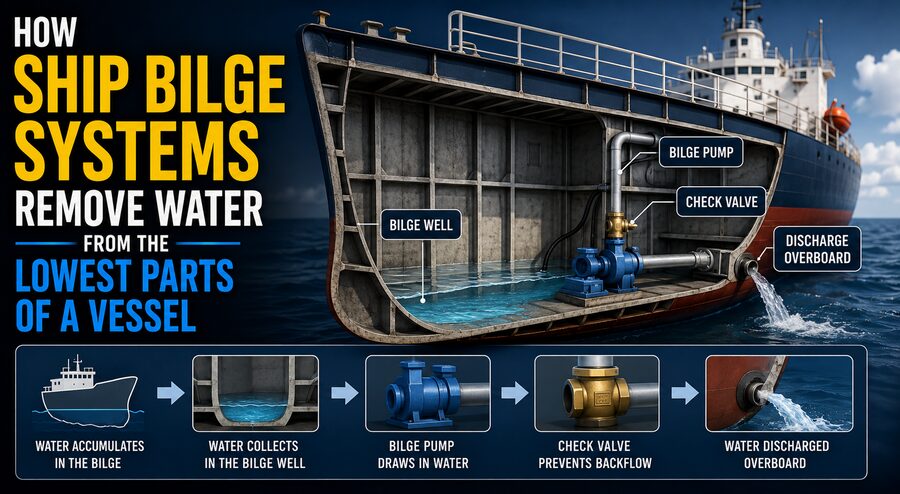
Ships therefore use a dedicated bilge system to collect, monitor, and remove unwanted water.
A typical bilge system combines:
- Bilge wells
- Suction pipes
- Strainers
- Pumps
- Valves
- Manifolds
- High-level alarms
- Non-return devices
- Oil-water handling equipment
Together, these components allow crews to remove water from the lowest parts of machinery spaces, cargo areas, void spaces, and other compartments while maintaining control over where that liquid is ultimately discharged.
The basic principle is simple:
Let gravity collect water at low points, then use controlled suction to move it somewhere safe. 🚢💧
🧱 1. What Exactly Is a Bilge?
The term bilge refers to the lower internal region of a ship where unwanted liquid tends to collect.
In an engine room, the bilge is usually located below machinery and floor plates.
In other compartments, dedicated depressions called bilge wells may be built into low points of the structure.
Water flows toward these areas because of gravity.
Bilge liquid may contain more than clean water. Depending on location, it can include:
- Seawater
- Fresh water
- Lubricating oil
- Fuel traces
- Cleaning chemicals
- Dirt
- Rust particles
- Condensate
This mixture is why bilge handling is not simply a matter of pumping water directly overboard.
Environmental controls are an important part of modern bilge-system operation. 🌊
💧 2. Where Does Bilge Water Come From?
Bilge water can accumulate from many sources.
In machinery spaces, common contributors include:
- Small pump-seal leaks
- Valve-stem leakage
- Cooling-water drips
- Condensation
- Pipe-flange seepage
- Machinery maintenance
- Deck washing
- Drainage from equipment
Some amount of bilge water is normal.
However, an unusually rapid rise can indicate something more serious, such as a failed pipe, damaged seal, hull leak, or flooding condition.
For this reason, bilge systems are not only drainage systems.
They are also part of the ship’s damage detection and safety infrastructure. ⚠️
🕳️ 3. Bilge Wells Collect Water at Strategic Low Points
Ships are divided into many compartments, and each compartment may have its own drainage arrangements.
Rather than allowing water to spread across a large floor area, designers provide bilge wells at selected low points.
These wells act like small collection pits.
Water drains naturally toward them through:
- Deck slopes
- Drain channels
- Limber holes
- Local piping
Once water enters the well, a suction pipe can remove it.
Bilge wells make pumping more effective because they concentrate water into a smaller area.
Without them, a pump might lose suction while a shallow layer of water still remained spread across the compartment.
🔍 4. Strainers Keep Debris Out of the Bilge Piping
Bilge water is often dirty.
It may contain:
- Rags
- Paint chips
- Rust flakes
- Metal fragments
- Packaging debris
- Dirt
If this material entered a pump or narrow suction line, it could cause blockage or mechanical damage.
Bilge suctions therefore commonly include strum boxes, strainers, or similar debris-catching devices.
These devices allow liquid to pass while preventing larger objects from entering the system.
However, strainers themselves can become clogged.
Regular inspection and cleaning are therefore essential. 🛠️
A blocked bilge strainer can make a perfectly functional pump appear to have failed.
🔧 5. Suction Pipes Carry Bilge Water Toward the Pumps
Each bilge well is connected to a suction line.
The arrangement varies by vessel, but multiple compartment suctions may connect to a central bilge manifold.
The manifold allows engineers to select which compartment the pump will drain.
For example, valves may allow suction from:
- Port engine-room bilge
- Starboard engine-room bilge
- Shaft tunnel
- Cargo-space bilge
- Auxiliary machinery space
Operators open the correct suction valve and close unrelated paths.
This selective arrangement helps prevent unintended communication between compartments.
It also allows one pump to serve several locations. 🔀
⚙️ 6. Bilge Pumps Provide the Suction
A bilge pump creates the pressure difference needed to draw liquid from the bilge well and move it through the piping.
Depending on the vessel, bilge duty may be performed by dedicated pumps or by multi-purpose pumps designed for several services.
Common pump types can include:
- Centrifugal pumps
- Reciprocating pumps
- Positive-displacement pumps
- Eductors or ejectors in certain arrangements
The exact machinery depends on vessel size, classification requirements, and system design.
Bilge systems are generally designed with redundancy because drainage capability remains important even if one pump is unavailable. 🛡️
🌪️ 7. Eductors Can Move Bilge Water Without a Conventional Pump
Some ships use eductors, also called ejectors, for drainage in particular spaces.
An eductor has no conventional rotating impeller.
Instead, a high-speed motive fluid passes through a nozzle, creating a low-pressure region.
This suction draws bilge water into the eductor.
The two flows then combine and discharge together.
Eductors are attractive because they contain few moving parts.
However, they require a supply of motive fluid and must be designed carefully for the intended service.
They are especially useful where simple, rugged drainage is desirable.
🚪 8. Non-Return Valves Prevent Water From Flowing Backward
Bilge piping must not allow water to flow backward into a compartment.
Imagine pumping water from one space while pressure in the discharge line accidentally forces liquid into another bilge well.
That could spread flooding rather than remove it.
For this reason, bilge systems may include non-return valves or other arrangements that permit flow in one direction while restricting reverse flow.
This is especially important where several spaces share common pipework.
Correct valve configuration is critical to safe operation. 🔒
📢 9. Bilge-Level Alarms Warn the Crew
Bilge wells often contain level sensors.
If water rises above a predetermined level, the sensor activates a high-bilge alarm.
The alarm alerts the crew that:
- Water is accumulating unusually quickly
- A pump may not be operating
- A drain may be blocked
- A pipe may be leaking
- Flooding may be occurring
In machinery spaces, these alarms can be monitored from the engine-control room or integrated automation system.
Some unattended machinery spaces rely heavily on automatic alarms because engineers may not be physically present beside the bilge at all times. 🚨
🤖 10. Some Bilge Pumping Can Be Automated
On some vessels, bilge drainage may be partly automated.
A level switch can command a pump to start when water reaches a certain point and stop when the level falls.
However, automation is handled cautiously because bilge liquid may be oily or contaminated.
A system should not automatically discharge polluted water overboard without satisfying applicable treatment and monitoring requirements.
Therefore, automatic bilge pumping often focuses on movement to a holding tank or controlled internal destination rather than unrestricted discharge to sea.
🛢️ 11. Engine-Room Bilge Water Often Contains Oil
Machinery-space bilges are particularly important because leaked lubricating oil or fuel can mix with water.
Even a relatively small amount of oil can create an environmentally harmful discharge.
For this reason, oily bilge water is often pumped to a bilge holding tank or processing system.
It may then pass through an oily-water separator.
The goal is to separate oil from water before any permitted discharge is considered.
This environmental function is a major part of modern marine engineering. 🌊🛢️
🧪 12. Oily-Water Separators Treat Bilge Mixtures
An oily-water separator uses physical separation principles to remove oil from contaminated water.
Depending on system design, it may use combinations of:
- Gravity separation
- Coalescing elements
- Filters
- Multiple separation stages
Oil droplets are encouraged to combine into larger droplets that can be removed more easily.
The treated water is monitored before discharge.
International maritime pollution rules place strict requirements on oily-water disposal.
Ships therefore use monitoring, control, recordkeeping, and alarm systems to help ensure compliance. 📋
🌍 13. Environmental Regulations Strongly Influence Bilge Operation
Bilge discharge is regulated under international and national pollution-control rules.
A key international framework is MARPOL, particularly provisions dealing with oil pollution from ships.
Machinery-space bilge water containing oil cannot simply be pumped overboard whenever convenient.
Depending on vessel type, location, equipment, and operating conditions, approved treatment and monitoring requirements apply.
Ships may also retain bilge mixtures onboard for later disposal to shore reception facilities.
This means the bilge system is simultaneously:
- A safety system
- A drainage system
- A pollution-control system
🔥 14. Bilge Water Can Create Fire Hazards
Oil floating on bilge water is not merely an environmental issue.
It can also increase fire risk.
Machinery spaces contain:
- Hot surfaces
- Electrical equipment
- Fuel systems
- Exhaust components
Allowing oily residues to accumulate below machinery is poor housekeeping and can contribute to hazardous conditions.
Regular bilge cleaning therefore improves both pollution prevention and fire safety.
A clean bilge also makes new leaks easier to detect. 🔥
🧭 15. Separate Compartments Need Separate Drainage Paths
Large vessels are subdivided by watertight bulkheads.
This subdivision helps contain flooding.
The bilge system must preserve that safety philosophy.
Piping passing through watertight boundaries is carefully arranged so that one flooded space cannot easily spread water into another through the bilge system.
Valves, non-return arrangements, and remote closures may be used depending on the vessel and regulatory requirements.
Maintaining watertight integrity is one reason bilge piping design is more complicated than ordinary building drainage.
🚢 16. Cargo Holds May Have Their Own Bilge Arrangements
Cargo spaces can also collect water.
Sources may include:
- Condensation
- Rain during cargo operations
- Minor seawater ingress
- Cargo moisture
- Cleaning operations
Bilge wells in cargo holds allow this water to be removed.
However, the design must prevent cargo from blocking the suction.
Strum boxes and protective gratings may be used.
Certain cargoes also require special drainage considerations because contaminated water may need to be retained or handled differently.
🌧️ 17. Deck Drainage and Bilge Drainage Are Not Always the Same
Water on exposed weather decks is often removed through scuppers and drains that discharge directly overboard or into dedicated drainage systems.
Bilge systems generally deal with water that has entered enclosed internal spaces.
Keeping these drainage functions distinct helps avoid unnecessary load on the bilge system.
It also reduces the chance that large amounts of ordinary rainwater contaminate machinery-space bilges.
Good ship design tries to keep clean drainage and oily drainage separated whenever practical.
📉 18. Pumps Must Maintain Suction as Water Level Falls
Pumping from a bilge can be difficult near the end of the operation.
As the level drops, air may begin entering the suction pipe.
Many centrifugal pumps do not handle large amounts of air well.
If the suction loses prime, the pump may stop moving water effectively.
Bilge-well geometry, suction placement, and pump selection are therefore designed to allow as much water as practical to be removed.
Some systems use self-priming arrangements or positive-displacement pumps where appropriate.
⚠️ 19. Emergency Bilge Suction Provides Another Line of Defense
Machinery spaces may include an emergency bilge suction arrangement.
The purpose is to provide an additional means of removing large quantities of water if normal bilge arrangements are insufficient or unavailable.
Depending on the ship’s approved design, a large-capacity pump used for another service may be connectable to the machinery-space bilge during an emergency.
Because incorrect use could affect other vital systems or create flooding paths, emergency bilge suction is controlled by specific procedures and regulatory design requirements.
It is not simply another everyday drain. 🚨
🌊 20. Bilge Systems Become Critical During Flooding
Under normal conditions, bilge pumps may handle small leaks and routine drainage.
During hull damage or major pipe failure, inflow can become much larger.
At that point, the bilge system may help control flooding, but its capacity is finite.
Damage-control efforts may also require:
- Closing watertight doors
- Isolating damaged pipes
- Using portable pumps
- Counter-flooding only where specifically planned
- Deploying emergency drainage equipment
The most important objective is often to stop or reduce the source of incoming water.
A pump cannot save a compartment indefinitely if water enters faster than the system can remove it.
⚖️ 21. Excess Bilge Water Can Affect Ship Stability
Water inside a vessel adds weight.
More importantly, if water can move freely across a wide compartment, it can create a free-surface effect.
As the ship rolls, the water shifts toward the lower side.
This movement can reduce effective stability.
For this reason, large amounts of flooding inside a vessel are particularly dangerous.
Bilge systems help remove unwanted liquid before it accumulates to levels that can worsen operational safety.
In a serious casualty, stability analysis becomes a major part of damage control. ⚓
🔍 22. Bilge Monitoring Helps Detect Hidden Leaks
A rising bilge level can reveal leaks that are otherwise difficult to see.
Suppose a cooling-water pipe develops a small crack behind machinery.
The leak may not be obvious immediately.
But water steadily reaches the bilge well.
Repeated high-level alarms or unusually frequent pumping tell engineers that something has changed.
Crews can then investigate the source.
In this way, the bilge system acts somewhat like an early-warning network for internal leakage.
🧰 23. Maintenance Is Essential for Reliability
Bilge systems may sit idle for long periods and then be urgently needed.
That makes preventive maintenance critical.
Crews may inspect:
- Strainers
- Valve operation
- Pump seals
- Pipework
- Level switches
- Alarm circuits
- Non-return valves
- Holding tanks
- Separator equipment
Sediment and oil sludge can accumulate in bilge wells and suction lines.
Routine cleaning helps ensure pumps can move water when needed.
Testing alarms is particularly important because a silent failed sensor could allow flooding to progress unnoticed.
🧯 24. Bilge Systems Must Be Operated Carefully Around Fuel and Oil
Because bilge spaces can contain flammable residues, housekeeping procedures matter.
Fuel leaks should be repaired quickly rather than simply allowed to drain into the bilge.
Oil-soaked rags and debris should be removed appropriately.
Drains from certain hazardous systems may be segregated rather than connected directly to ordinary bilges.
The goal is to prevent the bilge from becoming a collection point for unnecessary combustible material.
🏗️ 25. Ship Designers Plan Bilge Systems During Compartment Layout
Bilge design begins long before a ship enters service.
Naval architects and marine engineers determine:
- Where water will naturally collect
- How many bilge wells are needed
- Which pump serves each space
- Required pipe diameters
- Valve locations
- Redundancy
- Emergency drainage paths
- Pollution-control arrangements
The placement of structural members, tanks, machinery foundations, and bulkheads all affects drainage.
A bilge well is most effective when the compartment’s shape naturally directs water toward it.
Poor placement can leave pockets of standing water.
📊 26. Pump Capacity Must Match the Vessel’s Requirements
Bilge pumps must provide sufficient capacity for the ship’s size and arrangement.
Classification societies and maritime regulations prescribe design requirements for many vessel types.
Engineers consider:
- Compartment volume
- Pipe resistance
- Suction lift
- Required flow
- Redundancy
- Emergency duties
A larger pump is not automatically better.
Oversized pumps can create suction problems, waste energy, or complicate control.
The system must be designed as a complete hydraulic network.
🔄 27. A Typical Bilge-Water Journey
A routine machinery-space bilge flow might look like this:
1. Water leaks or drains into the engine-room bilge. 💧
2. Gravity carries it toward a bilge well.
3. A strainer blocks large debris.
4. A selected suction valve connects the well to a pump.
5. The pump transfers the mixture to a bilge holding tank.
6. Oily water is processed through approved separation equipment or retained for shore disposal.
7. Monitoring and control systems ensure discharge is handled according to applicable rules.
Not every vessel follows exactly this arrangement, but the basic logic is common.
🧠 28. Why Bilge Systems Are More Important Than They Look
A bilge system is easy to overlook because most of it consists of pipes, valves, wells, and pumps hidden below deck plates.
Yet it performs several crucial functions.
It helps maintain:
- Dry machinery spaces
- Equipment reliability
- Corrosion control
- Flood detection
- Fire safety
- Pollution prevention
- Damage-control capability
A small amount of water may seem harmless.
But inside a ship, uncontrolled water accumulation can quickly become a serious engineering problem.
🏁 Conclusion
Ship bilge systems remove unwanted water by taking advantage of a simple fact: water always seeks the lowest point.
The ship’s internal structure directs drainage toward bilge wells, where suction lines can collect it. Pumps or eductors then move the liquid through controlled piping systems.
Strainers keep debris away from pumps. Valves select which spaces are being drained. Non-return devices help prevent reverse flooding. High-level alarms warn crews when water rises unexpectedly. 🚨
In machinery spaces, oily bilge water requires special treatment. Rather than being discharged freely, it may be transferred to holding tanks, processed through oily-water separation equipment, or sent to approved shore facilities in accordance with environmental regulations. 🌊🛢️
During normal operation, the bilge system quietly handles condensation, minor leaks, and routine drainage.
During abnormal conditions, it becomes an important part of damage control and can provide early warning that something is wrong.
The engineering principle is straightforward, but the system around it is carefully designed:
collect water at low points, keep debris out, provide reliable suction, control the discharge, and maintain enough redundancy to keep the vessel safe.
That is how a network hidden beneath decks and machinery helps keep one of the world’s largest moving structures dry, stable, and operational. 🚢⚙️💧