
A fuel spray reaches a hot exhaust surface in the engine room. Within seconds, the small flame can become a fast-growing fire fed by fuel oil, lubricating oil, airflow, and the heat stored in machinery.
In this situation, crew response matters enormously, but portable extinguishers alone may not be enough. Access can become dangerous, visibility can disappear, and the fire may be located behind equipment or below deck plates.
This is why ships use fixed firefighting systems: permanently installed arrangements designed to deliver extinguishing media throughout a protected machinery space. They are a central part of the ship’s layered fire-safety strategy.
Understanding how these systems work helps engineers make better decisions during maintenance, testing, emergency response, and post-fire recovery. More importantly, it explains why preventing a release is just as important as making one happen. 🧯
🔥 1. Why Engine Rooms Need Special Protection
Engine rooms combine many of the conditions required for a serious fire. They contain ignition sources, combustible liquids, electrical equipment, pressurised systems, and machinery that may continue operating until it is deliberately stopped.
A fire in an enclosed machinery space can spread through oil contamination, cable runs, ventilation paths, and radiant heat. Fixed systems are intended to control or extinguish the fire when manual attack is unsafe or ineffective.
⚓ 2. The Fire Triangle Is Only the Beginning
Fire needs fuel, oxygen, and heat. Engine-room fire protection focuses on removing or controlling one or more of these elements.
Fixed systems commonly work by reducing oxygen, cooling burning surfaces, interrupting combustion, or covering fuel with foam. Their effectiveness depends on the fire type and on whether the protected space can be properly isolated.
- Fuel: fuel oil, diesel oil, lubricating oil, hydraulic oil, insulation, and cable materials.
- Heat: exhaust manifolds, turbochargers, boilers, electrical faults, friction, and welding work.
- Oxygen: air supplied through ventilation fans, dampers, doors, and other openings.
🛢️ 3. Common Causes of Machinery-Space Fires
Many engine-room fires begin with a relatively small loss of containment. A leaking pipe, loose fitting, cracked flexible hose, or failed gasket can release atomised oil onto a surface hot enough to ignite it.
Good design, cleanliness, insulation, shielding, and routine inspection reduce this risk. A fixed system is essential backup protection, not a substitute for controlling leaks and ignition sources.
Typical initiating events
- Fuel or lubricating oil spraying from a pressurised line.
- Oil-soaked lagging contacting hot exhaust components.
- Electrical arcing or overheating in switchboards and motors.
- Overheated bearings, seized machinery, or frictional heating.
- Hot work performed without effective preparation and fire watch.
🧱 4. Fixed Systems Are Part of a Layered Defence
Shipboard fire safety is built in layers. The first layers aim to prevent ignition; later layers detect, contain, suppress, and support evacuation.
A fixed system operates most effectively when the earlier layers have done their job. Detection provides warning, fire boundaries slow spread, and shutdowns remove fuel and air before extinguishing agent is released.
- Prevention through maintenance and safe working practices.
- Detection through alarms, patrols, and monitoring.
- Containment through divisions, closures, and ventilation control.
- Suppression through fixed and portable firefighting equipment.
- Recovery through cooling, monitoring, ventilation, and investigation.
📜 5. Rules Define the Objective, Not a Single Layout
International requirements for machinery-space fire protection are primarily found in the SOLAS fire-safety framework, while flag administrations, classification societies, and company procedures add practical requirements. The exact arrangement depends on the ship type, machinery-space size, installed system, and approval basis.
Engineers should therefore avoid assuming that every vessel has identical release stations, alarms, or shutdown sequences. The approved fire-control plan, operating manual, and onboard instructions are the authoritative references for a particular ship.
🌫️ 6. Carbon Dioxide: A Widely Used Total-Flooding Agent
Carbon dioxide, usually called CO₂, is widely used in fixed engine-room systems because it can flood an enclosed space and reduce oxygen concentration enough to stop combustion. It does not leave water or powder residue on machinery.
Its major hazard is equally important: CO₂ can render the atmosphere incapable of supporting life. No person may remain in, enter, or re-enter a space that may contain a lethal concentration of CO₂ without strict emergency procedures and suitable breathing protection.
🧪 7. How CO₂ Extinguishes a Fire
When released in the required quantity, CO₂ fills the protected volume and displaces air. The oxygen level falls below that needed for most ordinary combustion to continue.
It also has some cooling effect as it expands, but its main mechanism is oxygen reduction. This is why doors, dampers, vents, and other openings must be closed as far as practicable before release.
If air continues entering the space, the extinguishing concentration can be diluted. If the fire boundary is not maintained after release, a smouldering or hot fuel source may reignite once oxygen returns.
🗄️ 8. The CO₂ Storage Bank and Its Components
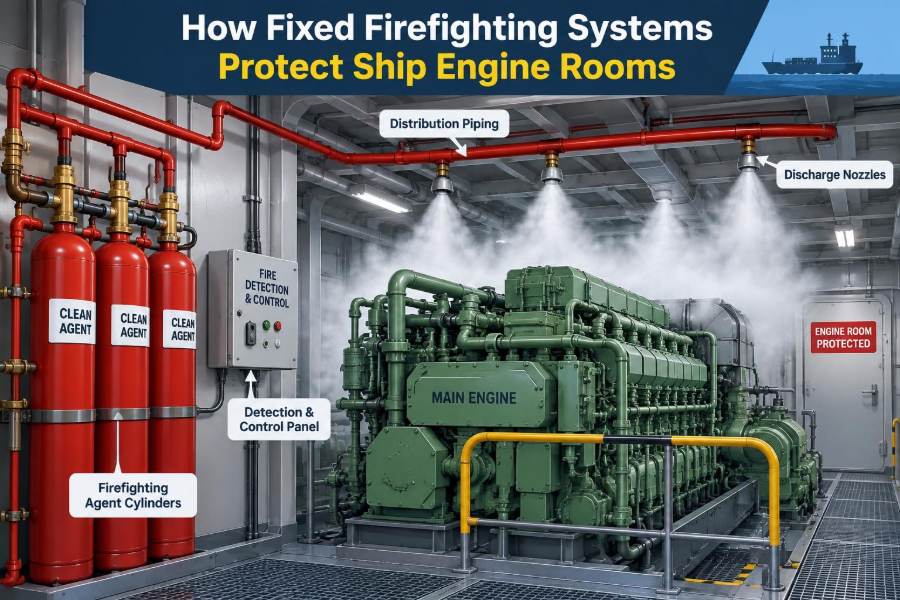
A typical CO₂ installation stores liquid CO₂ in high-pressure cylinders grouped in a dedicated station outside the protected machinery space. The station is arranged so the system can be operated without entering the fire area.
Components may include cylinders, manifold piping, pilot cylinders or actuation devices, control heads, distribution valves, discharge nozzles, warning alarms, and manual release controls. The exact design varies, but every component must function as one coordinated system.
🔐 9. Why Release Controls Are Deliberately Difficult
Accidental discharge of CO₂ could kill anyone inside the protected space. For this reason, fixed CO₂ systems use safeguards such as enclosed release cabinets, sequential actions, safety pins, instructions, alarms, and arrangements that require deliberate operation.
The goal is not to make emergency action confusing. It is to ensure that an operator has time to confirm evacuation, isolate the space, and understand that release is irreversible until the cylinders have discharged.
🚨 10. The Alarm Before Agent Release
Before a total-flooding system discharges, an audible warning is normally given in the protected space. This warning tells anyone who may be inside to leave immediately by the nearest safe route.
The alarm is not a guarantee that the space is empty. Personnel accountability remains essential, especially during maintenance, cleaning, inspections, or work in bilges, workshops, and enclosed recesses.
Everyone working in machinery spaces should know the sound and meaning of the pre-discharge warning. Treat it as an evacuation order, not as a signal to investigate the fire. ⚠️
🧭 11. The Essential Sequence Before Release
The exact checklist must follow the ship’s approved procedure and the master’s command structure. However, the general logic is consistent: raise the alarm, account for people, isolate the fire, then release the agent.
- Sound the general alarm and report the emergency.
- Stop or secure machinery as directed and stop fuel supply where possible.
- Stop ventilation and close dampers, doors, skylights, and other openings.
- Evacuate the space and verify personnel accountability.
- Operate the fixed system from the designated safe location.
- Maintain the boundary and monitor conditions after discharge.
Releasing agent before evacuation and closure can create a life-threatening atmosphere while also reducing suppression effectiveness.
🛑 12. Fuel Shutoffs Help Remove the Fire’s Food
Quick-closing valves, remote fuel pump stops, and emergency shutdowns are designed to limit the continued supply of combustible liquid. Their purpose is especially important where a fire involves a ruptured fuel line or a pump seal.
These controls do not remove oil already burning or spilled in the bilge. They reduce the chance that the fire continues to receive fresh fuel after the initial release.
Engineers must know which tanks, pumps, transfer systems, purifiers, and boilers are affected by each remote control. Labels and drills should turn this knowledge into a reliable response.
💨 13. Ventilation Shutdown Is Not Optional
Ventilation supplies oxygen and can carry heat, smoke, and flames beyond the immediate fire location. Stopping fans and closing fire dampers protects the extinguishing concentration inside the machinery space.
It also limits smoke movement into accommodation areas, control spaces, or adjacent compartments. A single open vent can undermine a total-flooding operation.
After a fire, ventilation must be restarted only under controlled conditions. Introducing fresh air too early can support reignition from hot metal, trapped vapours, or smouldering material.
💧 14. Water Mist Provides Cooling and Local Suppression
Water-mist systems discharge very fine droplets at high pressure or through specially designed nozzles. The small droplets absorb heat efficiently and can produce steam near the fire, helping to reduce local oxygen availability.
Unlike a conventional sprinkler installation, water mist is engineered around nozzle type, droplet behaviour, pressure, spacing, and the protected hazard. It may be designed as a total-compartment, zoned, or local-application system.
Water mist can be valuable where rapid cooling and reduced water damage are desired. It still requires correct operation, adequate water supply, clear nozzles, and a system design approved for the particular machinery-space risk.
🚿 15. Water Mist and CO₂ Solve Different Problems
| Feature | CO₂ total flooding | Water mist |
|---|---|---|
| Main action | Reduces oxygen in an enclosed space | Cools fire and surrounding surfaces with fine droplets |
| Personnel hazard | Atmosphere becomes immediately dangerous to life | Less asphyxiation risk, but heat, steam, electricity, and access remain hazards |
| Space condition | Requires effective enclosure and closure | Can be arranged for local or broader protection, depending on design |
| Post-discharge concern | Maintain concentration and control re-entry | Check for hidden fire, water accumulation, and damaged equipment |
Neither system is universally “better.” The right choice depends on vessel design, protected equipment, regulatory approval, and the operating philosophy of the ship.
🫧 16. Foam Systems Tackle Flammable-Liquid Surfaces
Foam works by forming a blanket over a flammable-liquid surface. This blanket separates fuel vapour from air and can help suppress vapour release from a pool of oil.
On ships, foam may be used for particular machinery-space hazards, fuel-handling areas, or other spaces where liquid fuel fires are a concern. The foam concentrate, mixing arrangement, discharge device, and application rate must be compatible with the intended hazard.
Foam is not simply “soapy water.” Its performance depends on using the correct concentrate and delivering it in the way the system was designed to apply it.
⚡ 17. Clean-Agent Systems and Their Role
Some ships and specialised spaces use gaseous clean agents as fixed extinguishing media. These systems may suppress fire through a combination of heat absorption and chemical interference with combustion, depending on the agent.
They are often considered where equipment damage, residue, or space constraints are important. Like any gaseous system, they require approved design concentration, warning arrangements, enclosure integrity, and procedures for evacuation and re-entry.
Do not assume that “clean” means harmless to people. Every extinguishing agent has operational limitations and safety precautions that must be understood before use.
📍 18. Local-Application Systems Protect High-Risk Equipment
A local-application system directs extinguishing agent at a defined hazard rather than flooding the entire engine room. Typical targets may include main-engine fuel pumps, diesel generators, purifiers, boilers, incinerators, and thermal-oil equipment.
This approach can control a fire early while allowing the wider space to remain accessible, provided conditions are safe. It is particularly useful for equipment with known fuel-spray and hot-surface risks.
Local protection does not eliminate the need for a total-flooding system where required. A local system may stop a small equipment fire; a larger or spreading fire may demand full-space isolation and suppression.
🧯 19. Portable Extinguishers Still Matter
Fixed systems are not the first answer to every fire. A trained crew member may safely extinguish a very small, incipient fire using the correct portable extinguisher, while another person raises the alarm and communicates with the bridge.
However, portable firefighting should stop when conditions become unsafe. Dense smoke, spreading flames, a pressurised oil spray, loss of escape route, or uncertainty about the fire’s location are clear reasons to withdraw and escalate the response.
The priority is never to save machinery by sacrificing people. A fixed system exists for the moment when direct attack cannot be justified.
🧠 20. Detection Gives the Crew Time to Decide
Heat detectors, smoke detectors, flame detectors, and machinery alarms can provide early warning. No detector type is perfect for every location, so systems are selected and positioned according to the expected hazard and environmental conditions.
Early detection allows the crew to investigate, stop equipment, isolate fuel, and attack a small fire before it develops. It also supports a faster decision to evacuate and release fixed suppression if the situation is already beyond local control.
🧰 21. Maintenance Keeps a System Ready, Not Merely Installed
A fixed system may remain unused for years, yet it must operate correctly on the day it is needed. Maintenance therefore includes visual inspection, checking access and signage, verifying cylinder condition, examining hoses and piping, and testing alarms and controls as permitted by the maintenance plan.
Only competent persons should perform servicing that could affect system integrity or cause accidental discharge. Records matter because they show what was checked, what was found, and whether defects were corrected.
Practical checks for watchkeepers
- Keep release stations accessible, legible, and free from stored items.
- Report missing seals, damaged pins, corrosion, leaks, or unreadable instructions.
- Keep nozzles unobstructed and avoid painting over them.
- Confirm that remote closures and shutdowns can be reached quickly.
- Protect distribution piping from mechanical damage during repairs.
🔧 22. Isolation Valves and Changeovers Need Control
During maintenance, a section of a system may be isolated or placed in a special condition. This can create an unnoticed impairment if the configuration is not controlled and restored.
A formal permit, tag, or impairment process helps ensure that the bridge, engine department, and relevant crew know what protection is unavailable. Temporary risk controls may include fire patrols, restricted hot work, or postponing non-essential operations.
When work is complete, restoration should include an independent check that valves, controls, alarms, and protective covers are back in their correct condition.
👥 23. Drills Turn Equipment Into Capability
Crew members do not need to practise actual agent release to conduct meaningful drills. They can rehearse reporting, communication, boundary cooling, evacuation, personnel accounting, ventilation shutdown, remote fuel isolation, and simulated release procedures.
Drills should test real decisions, such as what happens if a person is unaccounted for, a damper fails to close, or the fire involves a running generator. These scenarios reveal gaps that a simple walk-through may hide.
Clear roles reduce confusion: who commands, who checks the space, who shuts ventilation, who operates fuel stops, who guards access, and who records events.
🚪 24. Re-Entry Is One of the Most Dangerous Stages
After total flooding, the absence of visible flame does not prove the fire is out. Hot surfaces, smouldering insulation, trapped fuel vapours, and damaged electrical equipment can all create renewed danger.
Re-entry must follow the ship’s emergency procedures and the incident commander’s assessment. For a CO₂-protected space, the atmosphere must be treated as hazardous until it has been properly ventilated, assessed, and declared safe for the intended entry.
Personnel may need breathing apparatus, communication, a standby team, gas monitoring where applicable, and a planned escape route. Rushing in can turn a contained machinery fire into a multiple-casualty emergency.
🌡️ 25. Cooling, Monitoring, and Preventing Reignition
After suppression, crews may cool external boundaries and monitor temperatures, smoke, pressure indications, and signs of continued combustion. The correct approach depends on the agent used, the location of the fire, and the ship’s procedures.
Opening the space too soon can introduce oxygen and trigger reignition. Keeping it sealed too long without assessment can complicate recovery, so the decision requires disciplined command and careful information gathering.
Once conditions permit, the source of fuel must be isolated and the damaged area inspected before machinery is returned to service.
🧹 26. Housekeeping Supports Every Fixed System
Clean engine rooms are safer engine rooms. Oil leaks should be repaired, drip trays emptied, contaminated lagging renewed, and oily rags managed in approved containers.
Housekeeping also preserves access to escape routes, firefighting stations, remote stops, dampers, and release controls. In an emergency, a blocked walkway or hidden valve can cost critical time.
A good standard of cleanliness makes leak detection easier and reduces the combustible load that a fixed system may have to overcome.
📋 27. Fire Plans and System Instructions Must Be Readable
Fire-control plans identify firefighting equipment, boundaries, ventilation arrangements, and emergency controls. Operating instructions near release stations provide the immediate sequence for a particular installation.
These documents are useful only when they are current, protected from damage, and understood by the crew. New joiners should be shown the physical location of the protected spaces, release controls, shutdowns, and escape routes.
During a casualty, people rely on familiar layouts and practiced actions. Documentation supports that familiarity; it cannot replace it.
🧑🏫 28. The Core Principle: Isolate, Evacuate, Suppress, Verify
Fixed firefighting systems protect engine rooms by combining engineering with disciplined human action. The extinguishing agent is powerful, but it works properly only when the space is isolated, people are safe, and fuel and ventilation have been controlled.
The central sequence is simple to remember: isolate the fire, evacuate the space, release the correct system, and verify that conditions remain safe before recovery begins. Every drill, inspection, and maintenance task should reinforce this principle.
A fixed firefighting system is not a button to press; it is a carefully managed emergency process that protects lives first and machinery second. 🧯⚓🚨