
A large ship engine can produce enormous amounts of power—and enormous amounts of heat. Marine diesel engines may operate continuously for days or weeks while pushing cargo ships, tankers, cruise vessels, ferries, and naval ships across thousands of kilometers of ocean.
If that heat were allowed to build up, engine components could expand excessively, lubricating oil could degrade, cylinder liners could become damaged, and the engine might eventually seize or fail.
Yet ships cannot simply stop in the middle of the ocean every few hours to let their engines cool.
Instead, marine engineers use sophisticated cooling systems that continuously remove heat from the engine and transfer it into the surrounding seawater. 🌊❄️
These systems rely on a combination of freshwater cooling circuits, seawater heat exchangers, pumps, thermostatic valves, lubrication systems, sensors, alarms, and redundancy.
The result is a carefully controlled thermal-management system that allows some of the world’s largest engines to operate reliably for extremely long periods.
🔥 Why Ship Engines Produce So Much Heat
Marine engines convert the chemical energy stored in fuel into mechanical power.
Fuel burns inside the cylinders, creating extremely hot combustion gases.
These gases push the pistons downward, turning the crankshaft and ultimately driving the propeller or electrical generator.
However, only part of the fuel’s energy becomes useful mechanical work.
A significant portion becomes heat.
Heat enters:
- Cylinder liners
- Cylinder heads
- Pistons
- Exhaust components
- Lubricating oil
- Turbochargers
Without cooling, metal temperatures would quickly rise beyond safe operating limits.
🌡️ Why Engines Cannot Simply Run Hotter
Engine components are designed to operate within specific temperature ranges.
If temperatures become excessive, several problems can occur.
🛢️ Lubricating Oil Can Break Down
Engine oil forms a protective film between moving surfaces.
At excessive temperatures, oil can lose viscosity or chemically degrade.
This reduces lubrication and increases wear.
🔩 Metal Components Expand
Metal expands when heated.
Excessive expansion can reduce clearances between moving components.
A piston or bearing operating with insufficient clearance could suffer serious damage.
💥 Thermal Stress Can Develop
Different parts of the engine heat and cool at different rates.
Uneven temperatures create mechanical stress that can lead to cracking or distortion.
⚠️ Combustion Can Be Affected
Excessive engine temperatures can influence combustion quality and increase the risk of abnormal operating conditions.
Cooling is therefore essential not only for comfort but for engine survival.
💧 Why Ships Use Freshwater Inside the Engine
It might seem logical to pump seawater directly through the engine.
After all, the ship is surrounded by an almost unlimited supply of cooling water.
In many modern systems, however, seawater is not circulated directly through the most sensitive internal engine cooling passages.
Instead, the engine is cooled using treated freshwater in a closed circuit.
Why?
Seawater contains:
- Salt
- Minerals
- Marine organisms
- Suspended particles
If seawater circulated through the engine directly, it could encourage:
- Corrosion
- Scale formation
- Deposits
- Blockages
Freshwater is therefore used inside the engine because its chemistry can be controlled much more carefully.
🔄 The Closed Freshwater Cooling Loop
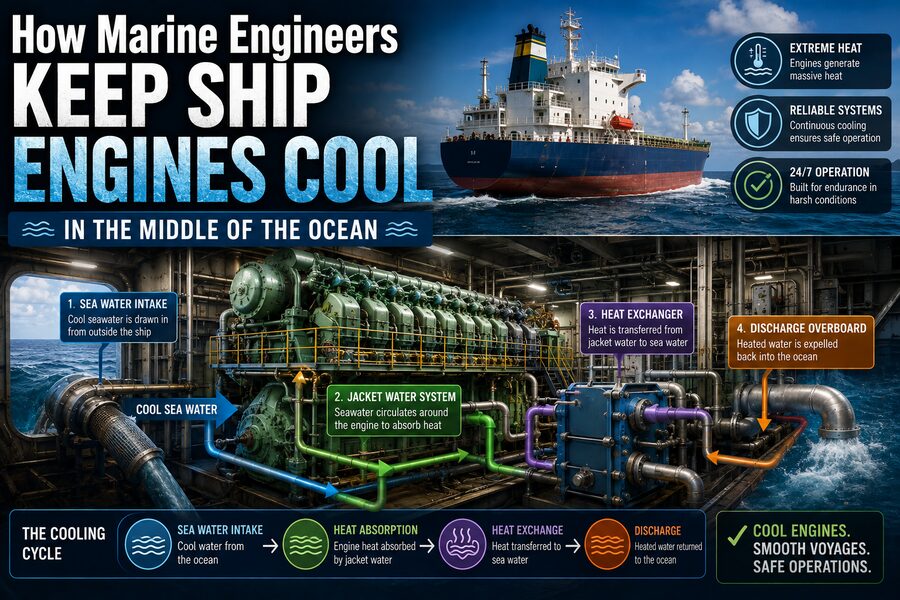
A typical marine engine cooling system works as a closed loop.
Freshwater absorbs heat from the engine.
A pump circulates that heated freshwater toward a heat exchanger.
Inside the heat exchanger, the engine freshwater transfers its heat to seawater.
The cooled freshwater then returns to the engine.
The cycle repeats continuously.
In simplified form:
Engine → Hot Freshwater → Heat Exchanger → Cooled Freshwater → Engine
Meanwhile:
Ocean → Seawater Pump → Heat Exchanger → Warmer Seawater → Back to Ocean
The two water streams usually remain physically separated.
Only heat passes between them.
🌊 Seawater Is the Final Heat Sink
The ocean acts as the ship’s ultimate heat sink.
Seawater enters the vessel through openings called sea chests.
These are engineered intake structures located in the hull below the waterline.
From there, pumps move seawater through:
- Strainers
- Heat exchangers
- Coolers
After absorbing heat, the seawater is discharged overboard.
Because the ship is surrounded by a vast body of water, it has access to a continuously renewed cooling source.
🧺 Why Seawater Strainers Are Important
Ocean water contains much more than salt.
A seawater intake may encounter:
- Seaweed
- Shell fragments
- Sand
- Plastic debris
- Marine organisms
If this material reached pumps or heat exchangers, it could block cooling passages.
Ships therefore use strainers.
These devices capture larger debris before seawater enters important equipment.
Marine engineers inspect and clean strainers regularly.
A blocked strainer can reduce seawater flow enough to cause cooling problems.
🧊 Heat Exchangers Transfer Heat Without Mixing Fluids
The heat exchanger is one of the most important pieces of equipment in a marine cooling system.
Its purpose is to allow heat to move from hot freshwater into cooler seawater without mixing them.
Two common designs are:
- Shell-and-tube heat exchangers
- Plate heat exchangers
🔧 Shell-and-Tube Heat Exchangers
A shell-and-tube heat exchanger contains many small tubes inside a larger outer shell.
One fluid flows through the tubes.
The other flows around them.
Heat passes through the tube walls.
For example, seawater may flow through the tubes while engine freshwater flows around them.
Because the two fluids remain separated, saltwater does not enter the engine’s cooling passages.
📚 Plate Heat Exchangers
A plate heat exchanger contains many thin metal plates stacked closely together.
Freshwater and seawater flow through alternating channels.
The thin plates provide a large surface area for heat transfer.
Plate heat exchangers can be compact and highly efficient.
However, they require proper maintenance because narrow passages can become fouled.
🌡️ High-Temperature and Low-Temperature Cooling Circuits
Large marine engines may use more than one freshwater cooling circuit.
A common arrangement includes:
- High-temperature circuit
- Low-temperature circuit
The high-temperature circuit may cool components such as cylinder liners and cylinder heads.
The low-temperature circuit may cool:
- Lubricating oil
- Charge air
- Auxiliary machinery
This allows different parts of the ship’s machinery to operate at their preferred temperatures.
🔥 Why Engines Are Not Cooled as Much as Possible
It might seem safest to make an engine as cold as possible.
That is not actually desirable.
An engine operating too cold can suffer from:
- Poor combustion
- Increased fuel consumption
- Deposits
- Condensation
- Corrosion
- Excessive wear
Marine cooling systems therefore do not aim for the lowest possible temperature.
They aim for the correct operating temperature.
Thermostatic control systems help maintain this range.
🎛️ Thermostatic Valves Control Temperature
A thermostatic valve regulates how much cooling water passes through a cooler.
When the engine is cold, some coolant may bypass the heat exchanger.
This allows the engine to warm up quickly.
As temperature rises, the valve directs more coolant through the cooler.
This creates automatic temperature regulation.
Modern ships may use electronically controlled valves and centralized automation systems for even more precise control.
🌬️ Charge-Air Cooling
Marine diesel engines often use turbochargers.
Turbochargers compress incoming air before it enters the cylinders.
Compressed air becomes hot.
Hot air is less dense than cooler air.
Therefore, after compression, the air is usually passed through a charge-air cooler.
Cooling the air increases its density.
Denser air contains more oxygen per unit volume.
This improves combustion and engine efficiency.
The charge-air cooler may use the ship’s low-temperature freshwater cooling circuit.
🛢️ Lubricating Oil Must Also Be Cooled
Engine oil absorbs significant heat from:
- Bearings
- Pistons
- Crankshaft components
- Other moving surfaces
If the oil becomes too hot, its viscosity may decrease.
The oil could then become too thin to maintain adequate lubrication.
Ships therefore use lubricating-oil coolers.
Hot oil transfers heat to cooling water through a heat exchanger before returning to the engine.
Maintaining oil temperature is critical for bearing life and overall engine reliability.
🌀 Turbochargers Also Face Extreme Temperatures
Turbochargers operate in one of the hottest parts of the engine system.
Exhaust gases flowing through the turbine can reach very high temperatures.
Some turbocharger components may use cooling water or carefully controlled lubrication to manage heat.
Cooling and lubrication help protect:
- Bearings
- Casings
- Shafts
Turbocharger failure can significantly reduce engine power, so temperature control is essential.
🚢 Central Cooling Systems
Older ship designs may use several individual seawater coolers for different pieces of machinery.
Many modern vessels instead use a central cooling system.
In this arrangement, seawater is concentrated mainly in one central heat exchanger.
Freshwater is then distributed throughout the ship to cool different systems.
Advantages include:
- Less seawater piping
- Reduced corrosion
- Easier maintenance
- Better temperature control
Because seawater is highly corrosive, limiting where it circulates can improve reliability.
🧪 Why Water Chemistry Matters
Freshwater cooling systems are not simply filled with ordinary tap water.
The coolant is often chemically treated.
Treatment can help prevent:
- Corrosion
- Scale
- Biological growth
Engineers monitor characteristics such as:
- pH
- Chloride concentration
- Treatment chemical levels
Poor coolant chemistry can slowly damage engine passages even if temperatures appear normal.
⚙️ Pumps Keep Cooling Water Moving
Cooling systems depend on pumps.
A circulation pump forces freshwater through the engine.
A seawater pump moves ocean water through the external cooling system.
Large ships may have multiple pumps, including standby units.
If one pump fails, another may be started.
This redundancy is extremely important at sea.
A cooling pump failure could otherwise force the main engine to reduce power or stop entirely.
🔁 Redundancy Makes Marine Systems Safer
Ships operate far from repair facilities.
Critical systems are therefore often designed with redundancy.
A vessel may have:
- Multiple seawater pumps
- Multiple freshwater pumps
- Duplicate strainers
- Backup coolers
- Emergency power supplies
Redundancy allows maintenance or failure of one component without immediately losing propulsion.
🚨 Temperature Sensors and Alarms
Modern marine engines are covered with sensors.
Engineers monitor temperatures such as:
- Jacket cooling water temperature
- Lubricating oil temperature
- Exhaust gas temperature
- Bearing temperature
- Charge-air temperature
If a temperature becomes abnormal, the automation system generates an alarm.
The crew can then investigate before serious damage occurs.
📉 What Happens If Cooling Begins to Fail?
Suppose seawater flow decreases because a strainer becomes blocked.
The heat exchanger removes less heat.
Freshwater temperature begins rising.
Sensors detect the change.
The control system may:
- Trigger an alarm.
- Start a standby pump.
- Adjust valves.
- Reduce engine load.
- Shut down equipment if temperature becomes dangerous.
This layered protection helps prevent catastrophic damage.
🧠 Engineers Watch Trends, Not Just Alarms
Experienced marine engineers do not wait for an alarm before taking action.
They monitor trends.
For example, a slowly rising freshwater outlet temperature might indicate:
- Heat-exchanger fouling
- Reduced seawater flow
- Pump degradation
- Incorrect valve operation
Detecting gradual changes allows maintenance to be performed before a serious failure occurs.
🧼 Heat Exchangers Become Fouled
Over time, heat-exchanger surfaces can become coated with deposits.
Seawater-side fouling may include:
- Scale
- Sediment
- Biological growth
Oil-side coolers can also accumulate contamination.
Deposits reduce heat transfer because they create an insulating layer between the two fluids.
Engineers therefore clean heat exchangers periodically.
🐚 Marine Growth Can Reduce Cooling
Warm seawater systems can attract marine organisms.
Barnacles, mussels, and other growth can restrict seawater piping.
Ships may use anti-fouling systems to reduce this problem.
Methods can include controlled chemical treatment or specialized electrochemical systems.
Maintenance teams also inspect seawater passages when possible.
🧯 Emergency Cooling Considerations
Loss of cooling is one of the most serious machinery problems a ship can face.
Emergency procedures may include:
- Starting standby pumps
- Reducing engine speed
- Isolating a damaged cooler
- Switching to another cooling path
- Stopping nonessential machinery
The exact response depends on ship design and operating conditions.
The goal is to prevent overheating while maintaining enough propulsion for safe navigation if possible.
🧊 Cooling at Different Ocean Temperatures
Seawater temperature changes depending on geography and season.
A ship operating in cold northern waters may have extremely effective cooling.
In tropical regions, seawater may be much warmer.
Warmer seawater reduces the temperature difference available for heat transfer.
Cooling systems are therefore designed for challenging conditions, not just average ocean temperatures.
🧮 The Importance of Temperature Difference
Heat transfer depends strongly on temperature difference.
If engine coolant is hot and seawater is cool, heat moves efficiently.
If seawater becomes warmer, the temperature difference becomes smaller.
The heat exchanger may need:
- More seawater flow
- Greater surface area
- Cleaner heat-transfer surfaces
Engineers account for these conditions when designing the system.
🌊 What About Ships in Harbors or Polluted Water?
Cooling can be more difficult in shallow harbors.
Water may contain more:
- Mud
- Debris
- Marine growth
- Industrial contamination
Sea chests and strainers can become blocked more easily.
Ships may have both high and low sea chests located at different hull levels.
This provides flexibility depending on water depth and operating conditions.
⚓ Cooling When the Main Engine Is Stopped
Even when the main propulsion engine is not running, other machinery still needs cooling.
Examples include:
- Auxiliary generators
- Air-conditioning systems
- Refrigeration
- Electrical equipment
Separate pumps or auxiliary cooling systems maintain circulation while the ship is in port.
⚡ Diesel-Electric Ships Use Similar Principles
Some vessels do not connect the main diesel engine directly to the propeller.
Instead, diesel engines drive electrical generators.
Electric motors then turn the propellers.
Cruise ships and specialized vessels may use this arrangement.
Although propulsion architecture differs, the diesel generators still produce large amounts of heat.
They require the same fundamental cooling methods:
freshwater circuits + heat exchangers + seawater heat rejection.
🔋 Battery-Electric and Hybrid Ships Also Need Cooling
Even vessels with large battery packs require thermal management.
Batteries, inverters, electric motors, and power electronics generate heat.
These systems may use liquid cooling loops connected to seawater heat exchangers.
So even as marine propulsion becomes more electrified, ocean water will likely remain an important final heat sink.
🏭 Waste Heat Can Sometimes Be Reused
Not all engine heat has to be thrown away.
Large ships can recover some waste heat.
Hot exhaust gases may produce steam in an exhaust gas boiler.
Heat can then be used for:
- Fuel heating
- Accommodation heating
- Hot water
- Auxiliary processes
Some advanced ships use waste-heat recovery systems to generate additional electricity.
This improves overall fuel efficiency.
♻️ Why Heat Recovery Matters
A large marine engine contains enormous thermal energy flows.
Recovering even a small portion of otherwise wasted heat can reduce fuel consumption.
This helps lower:
- Operating cost
- Fuel use
- Emissions
Marine engineers therefore consider cooling and heat recovery together as parts of overall energy management.
👨🔧 The Role of Marine Engineers
Keeping ship engines cool is not an entirely automatic process.
Marine engineers regularly inspect:
- Pump pressure
- Water temperature
- Tank levels
- Heat exchanger performance
- Strainers
- Valves
- Coolant chemistry
They also perform maintenance and respond to alarms.
On large ships, machinery control rooms display many of these measurements continuously.
🔧 Preventive Maintenance Is Essential
Cooling-system failure often develops gradually.
Preventive maintenance includes:
- Cleaning seawater strainers
- Inspecting pumps
- Testing thermostatic valves
- Cleaning heat exchangers
- Checking for leaks
- Analyzing coolant chemistry
- Testing alarms
Keeping the system clean and functional is much safer than waiting for overheating to occur.
🧱 Materials Must Resist Corrosion
Seawater is highly corrosive.
Cooling-system components may therefore use materials selected for marine environments.
Examples can include:
- Copper alloys
- Stainless steels
- Titanium
- Specialized coatings
Material selection depends on cost, temperature, pressure, and seawater conditions.
Titanium is especially resistant to seawater corrosion and is used in some high-performance heat exchangers.
🌊 Why Ships Have an Advantage Over Land Systems
A land-based power plant may require:
- Cooling towers
- Large radiators
- Rivers
- Cooling ponds
A ship already sits inside an enormous body of water.
This makes seawater an extremely convenient heat sink.
The challenge is not finding cooling water.
The challenge is using it without allowing salt, corrosion, biological growth, and debris to damage the machinery.
That is why the freshwater-seawater heat-exchanger arrangement is so effective.
🌟 Final Thoughts
Marine engines remain cool in the middle of the ocean because engineers do not rely on a single cooling device.
They use an integrated thermal-management system.
Freshwater circulates through the engine, absorbing heat from cylinder liners, heads, oil coolers, and other components. Pumps carry that heat to heat exchangers, where it passes into seawater. The warmed seawater is then discharged back into the ocean. 🌊
At the same time, thermostatic valves control temperature, strainers prevent debris from entering the system, chemical treatment protects freshwater circuits, and sensors constantly watch for overheating.
Critical pumps and coolers often have backups because a cooling failure thousands of kilometers from port can become a major emergency.
Marine engineers also inspect and maintain the system continuously, looking for fouling, corrosion, leaks, poor flow, and abnormal temperatures.
The ocean therefore plays an important but indirect role.
Rather than letting corrosive seawater circulate freely through the engine, engineers use it as the final destination for unwanted heat while keeping sensitive machinery protected by cleaner closed-loop cooling circuits.
From giant cargo ships to cruise vessels and diesel-electric ships, this combination of fluid mechanics, heat transfer, automation, corrosion control, and redundancy allows powerful engines to operate for long periods while surrounded by one of the world’s most abundant cooling resources. 🚢⚙️❄️