
A large ship can operate for days or weeks without returning to port. During that time, hundreds or even thousands of people may be living and working onboard, engines are running continuously, food is being prepared, machinery is being maintained, and enormous quantities of water and fuel are moving through the vessel. 🌊⚓
All of that activity creates waste.
Ships can generate:
- Sewage from toilets and medical spaces
- Wastewater from showers, laundries, and kitchens
- Food waste
- Plastics and packaging
- Used oil and oily water
- Engine-room sludge
- Exhaust emissions
- Cargo residues
- Hazardous maintenance waste
If these materials were simply dumped overboard, the environmental impact could be severe.
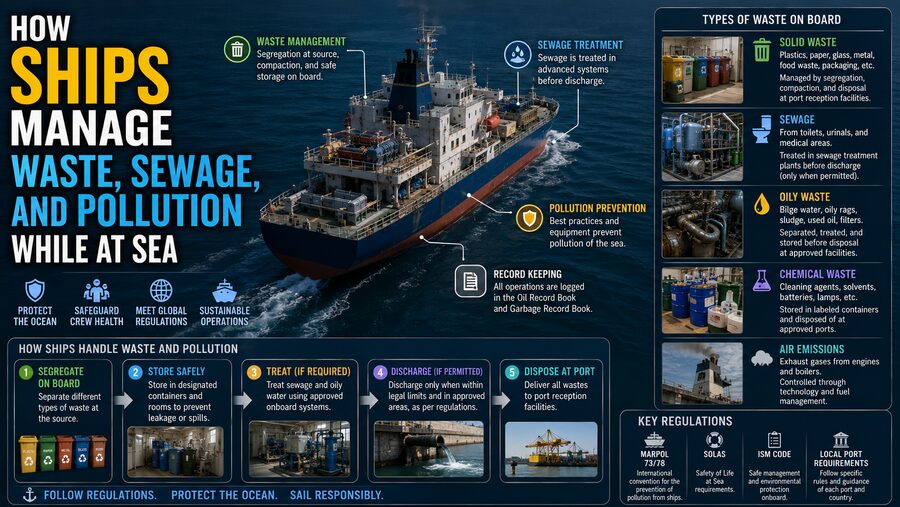
Modern commercial ships therefore use a combination of treatment equipment, storage tanks, separators, incinerators, monitoring systems, recordkeeping, and port reception facilities to manage waste.
International maritime rules—particularly those associated with the MARPOL Convention—establish major pollution-prevention requirements for ships. 🌍🛡️
The result is a surprisingly complex environmental-management system operating continuously behind the scenes.
🚽 What Happens to Sewage From Toilets?
On a ship, wastewater from toilets is commonly called blackwater.
Blackwater can contain:
- Human waste
- Toilet flushing water
- Bacteria
- Organic material
- Nutrients
Discharging untreated sewage close to populated coastlines can create serious environmental and public-health problems.
Many modern ships therefore use an onboard sewage treatment plant, or STP.
The basic goal is similar to a small municipal wastewater-treatment facility:
Collect sewage → Treat it → Reduce solids and contamination → Discharge or store according to applicable rules
The exact equipment varies by vessel.
🦠 Biological Sewage Treatment
Many marine sewage-treatment systems use microorganisms to break down organic waste.
In a simplified biological system:
1. Sewage enters a treatment tank.
2. Solids and liquids are mixed or separated.
3. Bacteria consume biodegradable organic material.
4. Air may be added to support aerobic microorganisms.
5. Treated water is separated from remaining solids.
6. A final disinfection step may be used.
The treated effluent is much cleaner than raw sewage.
Ships may discharge treated sewage only when the ship’s equipment, location, operating conditions, and applicable regulations permit it.
Otherwise, the wastewater must remain onboard until it can be handled appropriately.
🛢️ Holding Tanks Provide Another Option
Not every ship continuously discharges treated sewage.
Ships can also use holding tanks.
A holding tank temporarily stores sewage until:
- The vessel reaches an appropriate discharge area,
- the sewage treatment system can process it, or
- the waste can be transferred to a reception facility in port.
Holding capacity is especially important when ships operate in environmentally sensitive waters where discharge restrictions may be stricter.
Cruise ships and passenger vessels may require substantial wastewater-management capacity because of the number of people onboard. 🛳️
🚿 What Is Greywater?
Wastewater from:
- Showers
- Washbasins
- Laundries
- Galleys
is often referred to as greywater.
Greywater is different from sewage, but that does not mean it is harmless.
It may contain:
- Soap
- Detergents
- Grease
- Food particles
- Cleaning chemicals
- Nutrients
- Microplastics
How greywater is managed depends on vessel design and the rules applying to the ship’s operating area.
Some ships route greywater through treatment systems.
Others store it or manage it through dedicated wastewater arrangements.
Modern passenger ships may integrate blackwater and greywater treatment in highly sophisticated wastewater plants.
🧼 Advanced Wastewater Treatment on Passenger Ships
Large cruise ships can effectively operate like small floating cities.
Their wastewater systems may incorporate technologies such as:
- Biological treatment
- Membrane filtration
- Chemical treatment
- Ultraviolet disinfection
- Fine solids separation
These systems can significantly reduce contaminants before wastewater is managed according to applicable discharge rules.
Because cruise ships may operate near environmentally sensitive destinations, wastewater treatment can be an important part of their environmental systems.
🗑️ What Happens to Ordinary Garbage?
Ships generate many of the same solid wastes as homes and businesses.
Examples include:
- Cardboard
- Paper
- Glass
- Metal cans
- Packaging
- Food scraps
- Maintenance waste
But a ship cannot simply place garbage outside for collection every evening.
Instead, garbage is usually sorted onboard.
A ship might have separate waste streams for:
Plastics → Glass → Metals → Paper → Food waste → Hazardous waste
Sorting makes it easier to store, recycle, treat, or transfer materials at ports.
🚫 Plastics Are a Major Concern
Plastic pollution is particularly damaging in marine environments because plastics can persist for very long periods and harm wildlife.
International maritime pollution rules place strong restrictions on disposing of plastics into the sea.
Plastic waste is therefore generally retained onboard for recycling, processing, incineration where permitted and appropriate, or delivery to port reception facilities.
This can include:
- Plastic bottles
- Bags
- Packaging
- Synthetic ropes
- Fishing gear-related plastic material
Good shipboard waste management depends heavily on preventing prohibited materials from entering general waste streams.
🍎 How Ships Handle Food Waste
Food waste creates a different problem.
A large passenger vessel can generate substantial quantities of leftover food every day. 🍽️
Ships may use equipment such as food-waste grinders, pulpers, or dehydrators.
Depending on applicable maritime rules and where the vessel is operating, certain processed food wastes may sometimes be discharged under controlled conditions.
Other food waste must be stored for disposal ashore.
Rules can be stricter in designated environmentally sensitive areas.
Because requirements depend on location, waste type, vessel, and processing method, crews follow specific onboard garbage-management procedures rather than simply assuming organic material can go overboard.
📋 Ships Have Garbage Management Plans
Larger regulated vessels typically operate according to formal garbage-management procedures.
These specify:
- How waste is collected
- How it is separated
- Where it is stored
- Which treatment equipment may be used
- What can and cannot be discharged
- How waste is transferred ashore
Certain vessels must also maintain records documenting garbage operations.
That recordkeeping helps demonstrate compliance and gives authorities a way to investigate suspicious discharges.
🔥 Can Ships Burn Their Waste?
Some ships have onboard incinerators.
These systems can burn certain permitted waste streams, reducing their volume dramatically.
Incineration may be useful for:
- Some garbage
- Oily sludge
- Certain operational wastes
However, shipboard incineration is regulated.
Not every substance may be burned, and operating conditions matter because incomplete combustion can create harmful emissions.
Ash from incinerators must also be handled appropriately.
Modern waste management therefore treats incineration as one tool—not a universal solution.
🛢️ The Engine Room Creates Oily Waste
The machinery spaces of a large ship contain:
- Engines
- Pumps
- Fuel systems
- Lubricating-oil systems
- Pipes
- Filters
Small amounts of oil and water can accumulate in the lowest parts of the machinery space.
This mixture is known as bilge water.
Bilge water may contain:
- Water
- Fuel oil
- Lubricating oil
- Cleaning residues
- Dirt
Because oil is highly damaging to marine environments, oily bilge water cannot simply be pumped overboard whenever convenient.
Ships use specialized pollution-control equipment to manage it.
⚙️ How an Oily-Water Separator Works
An oily-water separator, or OWS, separates oil from water.
A simplified process may involve:
Bilge mixture → Separation stages → Oil removed → Water monitored → Permitted handling
Oil and water behave differently because of their density and chemical properties.
Equipment may use:
- Gravity separation
- Coalescing elements
- Filters
- Sensors
The separated oil is retained in dedicated waste-oil or sludge tanks.
The processed water is monitored before any discharge is allowed.
📡 Oil Content Monitoring Provides a Safety Barrier
Marine pollution-control systems may include instruments that measure the amount of oil remaining in processed water.
If the oil concentration exceeds the permitted threshold, the system can prevent discharge or redirect the water for further treatment.
This provides an important layer of protection.
Conceptually:
Separator → Oil monitor → Acceptable? → Discharge only if permitted
If not:
Return to holding system
This reduces the chance that heavily contaminated bilge water reaches the sea.
🛢️ What Is Sludge?
Ship engines also generate concentrated oily residues known as sludge.
Sludge can come from:
- Fuel purification
- Lubricating-oil purification
- Tank cleaning
- Machinery operations
Because sludge is highly oily, it must be carefully managed.
It may be:
- Stored onboard
- Burned in an approved onboard system where permitted
- Transferred to a port reception facility
Ships keep dedicated tanks for these waste oils.
📖 Oil Record Books Create Accountability
Certain ships must record important oil-handling operations in an Oil Record Book.
Entries may document activities such as:
- Bilge-water handling
- Sludge transfer
- Fuel operations
- Oil disposal
These records help port authorities and inspectors verify that oily waste is being managed correctly.
Deliberately bypassing pollution-control equipment or falsifying records can result in serious penalties.
⛽ Fuel Itself Can Cause Pollution
Not all ship pollution comes from waste.
Fuel-handling operations also create risk.
When bunkering—taking fuel onboard—ships use procedures to reduce spill risk.
Crews may:
- Monitor tank levels
- Check valves and pipelines
- Maintain communication between ship and supplier
- Use containment around connections
- Prepare spill-response equipment
A small mistake while transferring hundreds or thousands of tonnes of fuel could create a major pollution incident.
Careful operating procedures are therefore essential.
🌫️ Ships Also Produce Air Pollution
Pollution prevention at sea is not only about what enters the water.
Marine engines burn fuel and produce exhaust containing substances such as:
- Carbon dioxide
- Nitrogen oxides
- Sulfur oxides
- Particulate matter
International regulations place limits on certain ship emissions and fuel characteristics.
Ships may reduce emissions using technologies such as:
- Cleaner fuels
- Engine modifications
- Selective catalytic reduction
- Exhaust gas cleaning systems
- Energy-efficiency improvements
The maritime industry is also increasingly exploring lower-carbon propulsion and fuel options. 🌱⚓
🧪 What Are Exhaust Gas Scrubbers?
Some ships use exhaust gas cleaning systems, often called scrubbers.
These systems remove part of the sulfur-related pollution from engine exhaust.
A scrubber may contact the exhaust with water or another treatment medium, capturing pollutants before gases leave the funnel.
Different scrubber configurations handle the resulting washwater differently.
Because washwater itself can contain contaminants, its management is subject to technical and environmental requirements.
Some ports or coastal jurisdictions may restrict particular scrubber operating modes.
🚢 Cargo Can Create Pollution Risks Too
Tankers and bulk carriers may transport cargoes that themselves pose environmental risks.
Examples include:
- Crude oil
- Petroleum products
- Chemicals
- Dry bulk materials
After unloading, small quantities of cargo may remain inside tanks or holds.
Ships use specialized procedures for:
- Tank washing
- Cargo residue handling
- Slop storage
- Cleaning-water management
Rules depend heavily on the type of cargo.
A chemical tanker, for example, requires much more specialized waste management than an ordinary container ship.
🛢️ Oil Tankers Use Dedicated Pollution-Control Systems
Oil tankers are specifically designed to minimize oil pollution risk.
They may use features such as:
- Segregated ballast tanks
- Slop tanks
- Cargo monitoring systems
- Double hulls
- Dedicated piping arrangements
During cargo operations, oily mixtures can be collected and retained rather than freely discharged.
Oil tanker pollution prevention is one of the most extensively regulated areas of marine engineering.
🌊 Ballast Water Is a Different Kind of Environmental Problem
Ships take on ballast water to maintain stability, trim, and safe handling.
A lightly loaded ship may pump seawater into ballast tanks.
Later, it may release that water somewhere else.
Historically, this created an ecological problem because ballast water can transport:
- Tiny marine organisms
- Larvae
- Plankton
- Microorganisms
A species taken onboard in one ecosystem can potentially be released thousands of kilometers away.
Ballast-water management systems therefore treat or manage ballast water to reduce the transfer of invasive organisms.
This is pollution in a biological rather than simply chemical sense. 🦠🌊
🧪 How Ballast Water Can Be Treated
Treatment systems may combine technologies such as:
- Filtration
- Ultraviolet light
- Electrochemical treatment
- Other approved disinfection methods
The objective is to reduce viable organisms before ballast water is discharged.
Ballast-water management has become an increasingly important part of modern ship design.
🧽 Deck Washwater Must Be Managed Carefully
Ships regularly wash decks for safety and maintenance.
But deck runoff may contain:
- Oil traces
- Cargo residues
- Cleaning products
- Paint particles
Crews therefore follow procedures suited to the type of vessel and material involved.
On some vessels, contaminated water may need to be collected rather than allowed to run directly overboard.
The exact controls depend on the contamination and operating area.
🎨 Paint and Maintenance Waste Can Be Hazardous
Ships require constant maintenance because seawater is extremely corrosive.
Crews may perform:
- Painting
- Rust removal
- Machinery servicing
- Filter replacement
These activities can generate:
- Paint chips
- Solvents
- Used filters
- Oily rags
- Chemicals
- Batteries
These materials are generally segregated from ordinary garbage and managed as controlled or hazardous waste where applicable.
Dropping paint debris or maintenance residues directly into the ocean can create pollution.
🏗️ Port Reception Facilities Complete the System
A ship can store waste only for a limited time.
Eventually much of it must go ashore.
Ports therefore provide or arrange reception facilities for different waste types.
A vessel may unload:
- Sewage
- Garbage
- Waste oil
- Sludge
- Hazardous waste
- Cargo residues
The waste then enters land-based recycling, treatment, or disposal systems.
The ship and port therefore form one continuous waste-management chain.
🧾 Documentation Follows Waste Ashore
For many waste streams, ships maintain records describing what happened to the material.
Records can show:
Generated onboard → Stored → Treated or transferred → Received by authorized facility
Receipts from port reception facilities may support this documentation.
Traceability reduces the temptation to save money by illegally dumping waste at sea.
🗺️ Special Areas Can Have Stricter Rules
Not every part of the ocean is treated identically.
Certain regions receive greater environmental protection because they are particularly vulnerable due to factors such as:
- Limited water exchange
- Heavy shipping
- Sensitive ecosystems
- High ecological value
International rules can impose stricter discharge requirements in designated special areas.
Ships therefore need to know not just what waste they have, but also where they are operating.
Navigation and environmental compliance are closely connected.
🛰️ Ships Track Their Position Precisely
Modern ships know their position using satellite navigation and electronic chart systems.
This matters for pollution management because discharge restrictions can depend on geographic location and distance from land.
The crew must ensure that any permitted discharge occurs only under the correct conditions.
Some onboard systems can also record operational data that helps verify compliance.
👨✈️ The Crew Plays a Critical Role
Sophisticated equipment alone cannot prevent pollution.
Ship crews are trained to:
- Separate waste correctly
- Operate treatment systems
- Inspect equipment
- Maintain records
- Respond to spills
- Follow discharge restrictions
- Report malfunctioning systems
Poor waste segregation can make even excellent equipment ineffective.
For example, placing prohibited plastics into a food-waste stream could create a serious compliance problem.
Environmental protection therefore depends heavily on everyday crew discipline.
🚨 What Happens During an Accidental Spill?
Ships carry emergency plans for pollution incidents.
If oil or another pollutant accidentally escapes, the crew may need to:
1. Stop the source if safely possible.
2. Contain the spill onboard.
3. Protect drains and overboard openings.
4. Notify responsible authorities.
5. Deploy spill-response materials.
6. Record and investigate the incident.
Oil tankers and other vessels carrying significant pollution risks may have especially detailed emergency-response plans.
Fast containment can prevent a small leak from becoming a major marine incident.
🧱 Double Hulls Reduce Tanker Spill Risk
Modern oil tankers commonly use double-hull construction.
Instead of cargo oil tanks being separated from the sea by only one structural shell, there is an additional space between the cargo and outer hull.
If the outer hull is damaged in a collision or grounding, the inner barrier may remain intact.
Double hulls cannot prevent every oil spill, but they provide an important extra layer of protection. 🛡️
🤖 Automation Helps Monitor Environmental Systems
Modern ships increasingly automate waste and pollution-control equipment.
Sensors may monitor:
- Tank levels
- Pump operation
- Oil concentration
- Treatment-plant status
- Discharge valves
Control systems can produce alarms when conditions become abnormal.
For example:
Waste tank nearing full → Alarm
Oil content too high → Discharge prevented
Sewage-treatment fault → Crew notification
Automation reduces reliance on manual observation but does not replace qualified operators.
🧪 Ships Are Inspected for Compliance
Ships can be inspected by:
- Flag-state authorities
- Port-state control officers
- Classification organizations
- Other authorized bodies
Inspectors may examine:
- Pollution-prevention equipment
- Waste-management procedures
- Treatment systems
- Record books
- Tank arrangements
- Certificates
A ship with malfunctioning systems or suspicious records can face enforcement action.
This creates strong incentives to maintain pollution-control systems properly.
🌱 Reducing Waste at the Source Is Better Than Treating It Later
The most effective waste is often the waste that never needs to be handled.
Ships and operators can reduce waste by:
- Minimizing unnecessary packaging
- Improving food planning
- Reusing materials
- Purchasing supplies in bulk
- Recycling onboard
- Reducing single-use plastics
Passenger ships in particular have opportunities to reduce enormous quantities of disposable material.
Waste prevention reduces:
- Storage requirements
- Treatment demands
- Disposal costs
- Environmental risk
🛳️ Example: Waste Management on a Large Passenger Ship
Imagine a cruise ship carrying several thousand passengers and crew.
During one day:
🚽 Toilets generate blackwater.
🚿 Showers and laundries generate greywater.
🍽️ Restaurants create food waste.
📦 Shops and supplies generate cardboard and packaging.
⚙️ Engines generate oily residues.
The ship may respond by:
1. Sending sewage to wastewater treatment.
2. Processing appropriate greywater streams.
3. Separating recyclables.
4. Grinding, dehydrating, storing, or otherwise managing food waste.
5. Retaining plastics and controlled waste.
6. Separating oil from machinery-space bilge water.
7. Storing sludge in dedicated tanks.
8. Recording relevant waste operations.
9. Transferring retained waste to approved reception facilities at port.
The process is continuous.
A ship is essentially running its own compact environmental utility system while moving across the ocean.
⚖️ Why Ships Cannot Simply Store Everything Forever
It might seem safest to prohibit every form of discharge and require all waste to remain onboard.
But ships have limited:
- Tank space
- Storage volume
- Payload capacity
Some treated waste streams can be managed at sea under carefully regulated conditions, while more hazardous materials must be retained.
Maritime regulations therefore distinguish between different:
- Waste types
- Treatment levels
- Vessel types
- Geographic areas
- Operating conditions
This allows ships to operate for long periods while minimizing environmental harm.
🌍 The Larger Goal: Preventing Pollution at Sea
Shipboard waste management follows a broad hierarchy:
Reduce waste → Separate it → Treat it → Store hazardous material → Discharge only where permitted → Transfer remaining waste ashore
Every stage matters.
A failure in sorting can contaminate recyclables.
A malfunctioning separator can release oil.
Poor recordkeeping can make compliance difficult to verify.
A blocked wastewater plant can force operational changes.
Environmental management is therefore integrated with routine ship operations rather than treated as an occasional task.
✅ Final Thoughts
Ships may spend weeks far from land, but they cannot treat the ocean as an unlimited waste disposal system. 🚢🌊
Modern vessels use carefully engineered systems to manage sewage, garbage, oily water, machinery sludge, air emissions, cargo residues, and other pollutants.
Sewage-treatment plants process blackwater.
Holding tanks store wastewater when necessary.
Garbage-management systems separate plastics, food waste, recyclables, and controlled materials.
Oily-water separators treat machinery-space bilge water.
Sludge tanks and approved disposal systems manage concentrated oily residues.
Ballast-water treatment systems reduce the transfer of invasive marine organisms.
Emission-control technologies reduce certain pollutants released through exhaust.
And port reception facilities complete the cycle by receiving waste that should remain onboard. ⚓♻️
International pollution-prevention rules provide the framework, while engineers design the equipment and crews operate it every day.
Perhaps the most important idea is that marine pollution control does not rely on one device.
It uses layers:
Waste reduction → Separation → Treatment → Monitoring → Storage → Documentation → Port disposal → Inspection
Together, these systems allow modern shipping to transport people and goods across the world’s oceans while placing much tighter controls on what ships release into the marine environment. 🌍🛡️
The next time a large ship disappears beyond the horizon, remember that below its decks it is not only running engines and navigation systems—it is also operating a miniature network of wastewater plants, recycling areas, storage tanks, separators, sensors, and pollution-control equipment designed to protect the ocean surrounding it. 🚢♻️🌊