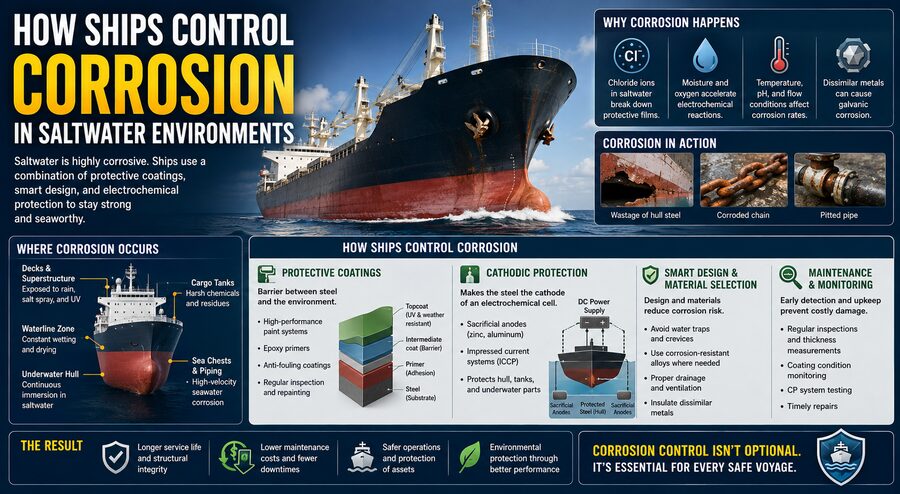

Ships spend much of their operating lives surrounded by one of the most aggressive natural environments for metal: saltwater. 🌊⚓
Seawater contains dissolved salts, oxygen, moisture, microorganisms, and other chemicals that can accelerate the deterioration of steel and other metals. Without protection, a ship’s hull, propellers, tanks, pipes, ballast systems, and offshore equipment can gradually corrode, losing strength and reliability.
Corrosion is not merely a cosmetic problem.
If severe corrosion is ignored, it can cause:
- Thinning of hull plating
- Structural weakness
- Leaking tanks or pipelines
- Damaged fasteners and welds
- Reduced equipment life
- Increased maintenance costs
- Safety risks
Modern ships therefore use several protective strategies simultaneously.
The most important include:
Protective coatings + cathodic protection + corrosion-resistant materials + drainage and environmental control + inspection and maintenance
Together, these methods dramatically slow the electrochemical reactions responsible for corrosion. 🛡️⚙️
🧪 Why Saltwater Causes Corrosion
Most large ships are constructed primarily from steel because steel is strong, relatively economical, and easy to fabricate.
However, iron in steel naturally tends to react with oxygen and water.
One simplified description of rust formation is:
Iron + oxygen + water ➡️ iron oxides
Saltwater accelerates this process because dissolved salts make the water a better electrical conductor.
Seawater contains many ions, including sodium and chloride ions.
These ions allow electrical charge to move more easily through the water, helping electrochemical corrosion reactions proceed.
In effect, seawater acts as an electrolyte.
That makes the submerged steel hull part of an electrochemical system.
⚡ Corrosion Is an Electrochemical Process
Corrosion involves small electrical reactions occurring on a metal surface.
Different areas of the same steel structure may behave as microscopic anodes and cathodes.
At an anodic region, iron atoms can lose electrons:
Fe ➡️ Fe²⁺ + 2e⁻
The iron enters the surrounding environment as ions.
The released electrons travel through the metal toward cathodic regions, where other reactions consume them.
This means corrosion resembles a tiny battery operating directly on the ship’s surface. 🔋
At the anode:
Metal is lost.
At the cathode:
A reduction reaction occurs without the same metal loss.
Ship-corrosion protection often works by controlling which parts of the structure are allowed to behave as anodes.
🎨 Protective Coatings Form the First Barrier
The most visible form of corrosion protection is paint.
Marine coatings are much more sophisticated than ordinary decorative paint.
A ship’s hull may receive several layers, each serving a specific purpose.
A typical coating system might include:
Steel surface ➡️ primer ➡️ anticorrosive coating ➡️ protective intermediate layer ➡️ finishing or antifouling coating
The goal is to prevent seawater, oxygen, and corrosive ions from directly reaching the metal.
If the steel remains physically separated from the electrolyte, electrochemical corrosion is greatly reduced.
🧹 Surface Preparation Is Critical
Even an expensive coating performs poorly if applied over rust, salt, oil, or loose material.
Before painting, shipyard workers carefully prepare the steel.
Methods can include:
- Abrasive blasting
- Grinding
- High-pressure water cleaning
- Degreasing
- Salt removal
Abrasive blasting can remove old coatings, rust, and scale while creating a rough surface that helps the new coating adhere.
Proper preparation is one of the most important factors determining how long a marine coating lasts. 🔧
A badly prepared surface may allow paint to detach, creating pathways for seawater to reach the steel underneath.
🧱 What Happens When Paint Is Damaged?
No coating remains perfect forever.
A ship’s hull can be scratched by:
- Anchors
- Floating debris
- Docking operations
- Maintenance equipment
- Ice
- Grounding or impact
Tiny defects may also form because of age or mechanical stress.
Once bare steel is exposed, seawater can contact the metal.
Corrosion can begin at the damaged location and sometimes spread beneath the surrounding coating.
This is why coatings alone are usually not considered sufficient.
Ships also rely on cathodic protection.
⚡ What Is Cathodic Protection?
Cathodic protection is an electrochemical technique that forces the protected steel structure to behave primarily as a cathode.
Remember:
Anode ➡️ metal tends to corrode
Cathode ➡️ protected from the same anodic dissolution
Engineers therefore connect the ship’s steel to another material that is willing to corrode instead.
There are two major approaches:
- Sacrificial anode cathodic protection
- Impressed current cathodic protection
Both use electrical principles to protect the hull. 🛡️
🔩 Sacrificial Anodes
A sacrificial anode is made from a metal that is more electrochemically active than the steel being protected.
Common sacrificial-anode materials in marine systems include:
- Zinc
- Aluminum alloys
- Magnesium alloys in suitable environments
The sacrificial metal is electrically connected to the ship’s steel structure.
Because it is more active, it preferentially behaves as the anode.
The protective process becomes:
Sacrificial metal corrodes ➡️ steel becomes cathodically protected
Instead of losing hull steel, the ship gradually consumes replaceable anodes. 🔄
That is why they are called sacrificial anodes.
🧩 Where Are Sacrificial Anodes Installed?
Anodes may be attached to submerged areas such as:
- Hull surfaces
- Rudders
- Sea chests
- Propeller shafts
- Ballast tanks
- Internal seawater systems
Their number, size, and placement are carefully designed.
Too few anodes may provide inadequate protection.
Poor placement can produce uneven electrical current distribution.
During dry-docking, engineers inspect the anodes and replace those that have been substantially consumed.
🔋 Impressed Current Cathodic Protection
Large ships often use a more actively controlled system called Impressed Current Cathodic Protection, commonly abbreviated as ICCP.
Instead of relying entirely on the natural electrical potential of sacrificial metals, ICCP uses an external DC power supply.
The system includes:
- Inert or slowly consumed anodes
- Reference electrodes
- Electrical control equipment
- The ship’s hull as the protected structure
The controller supplies current into the seawater through the anodes.
That current shifts the electrical potential of the hull so that corrosion reactions on the protected steel are suppressed. ⚡
🎛️ Why ICCP Can Be More Efficient
A ship’s operating environment changes constantly.
Electrical conductivity varies with:
- Water salinity
- Temperature
- Vessel speed
- Coating condition
- Depth
An ICCP system can monitor the hull potential using reference electrodes.
The controller then adjusts output current.
Conceptually:
Protection too low ➡️ increase current
Protection too high ➡️ reduce current
This makes ICCP particularly attractive for large vessels where installing and replacing huge quantities of sacrificial material may be inefficient.
⚠️ Can Cathodic Protection Be Too Strong?
Yes.
More cathodic current is not always better.
Excessive protection can create problems such as:
- Coating damage
- Hydrogen-related effects on susceptible materials
- Undesirable deposits
- Interference with nearby metallic structures
For this reason, engineers design and monitor cathodic protection within appropriate potential ranges.
The goal is controlled protection, not maximum possible electrical current.
🧲 Galvanic Corrosion Between Different Metals
Ships contain many different metals.
Examples include:
- Carbon steel
- Stainless steel
- Bronze
- Copper alloys
- Aluminum
- Nickel alloys
When two dissimilar metals are electrically connected while immersed in seawater, a galvanic cell can form.
One metal becomes more anodic and corrodes faster.
This is called galvanic corrosion.
For example, connecting a very active metal directly to a more noble metal can severely accelerate corrosion of the active material.
Engineers reduce this risk by:
- Selecting compatible materials
- Electrically isolating components
- Using insulating gaskets
- Applying suitable coatings
- Designing cathodic protection correctly
Material combinations matter greatly in marine design. ⚙️
🌀 Propellers Need Special Attention
Ship propellers are often made from corrosion-resistant copper-based alloys such as specialized bronze compositions.
The shaft may be made from another alloy.
The surrounding hull is usually steel.
Because these materials have different electrochemical potentials, engineers must carefully control galvanic interactions.
Protective systems may include:
- Cathodic protection
- Shaft grounding
- Electrical bonding
- Material selection
Proper shaft grounding can also help control electrical current that might otherwise contribute to accelerated wear or corrosion.
💧 Ballast Tanks Are Particularly Vulnerable
Ships contain ballast tanks that can be filled with seawater to adjust stability, draft, and trim.
These tanks experience extremely corrosive conditions because surfaces may repeatedly alternate between:
Wet ➡️ partially wet ➡️ humid ➡️ dry
The combination of seawater, oxygen, condensation, and inaccessible geometry can cause severe internal corrosion.
Ballast tanks therefore use specialized protective coatings.
Designers also try to minimize:
- Water traps
- Poor drainage
- Areas that are difficult to inspect
- Sharp edges where coatings are thin
Regular tank inspection is essential. 🔍
🌡️ Why the Splash Zone Can Corrode Rapidly
The area of a marine structure that repeatedly moves between wet and dry conditions is called the splash zone.
On ships and offshore structures, this region can be highly aggressive.
It experiences:
- Constant oxygen availability
- Repeated saltwater wetting
- Drying cycles
- Mechanical impact
- Sunlight and temperature changes
Fully submerged steel can sometimes corrode differently because oxygen availability may be lower.
The splash zone receives both seawater and abundant atmospheric oxygen, making protection especially important. 🌊
🦠 Microbiologically Influenced Corrosion
Not all marine corrosion is purely chemical.
Microorganisms can affect electrochemical conditions on metal surfaces.
This phenomenon is known as Microbiologically Influenced Corrosion, or MIC.
Certain bacteria can form biofilms and alter local chemistry.
Under deposits or biofilms, conditions may develop that encourage highly localized corrosion.
MIC can affect:
- Ballast tanks
- Pipelines
- Seawater cooling systems
- Storage tanks
- Offshore equipment
Engineers control it through cleaning, coatings, suitable materials, chemical treatment where appropriate, and monitoring.
🕳️ Pitting Corrosion
Sometimes corrosion does not attack the entire surface evenly.
Instead, it forms small, deep cavities called pits.
This is known as pitting corrosion.
Pitting can be especially dangerous because a surface may appear mostly intact while deep localized penetration has occurred.
Chloride-rich environments such as seawater are well known for promoting pitting in susceptible materials.
Certain stainless steels resist general corrosion extremely well but can still suffer chloride-induced pitting under unfavorable conditions.
Material grade selection is therefore critical. 🔬
🪟 Crevice Corrosion
Narrow gaps can create another localized form known as crevice corrosion.
It may occur:
- Beneath gaskets
- Under deposits
- Around fasteners
- Inside overlapping plates
- At poorly sealed joints
Water trapped inside a small crevice can develop a different chemical environment from the surrounding seawater.
Oxygen may become depleted, acidity may increase, and chloride concentration may rise.
Engineers minimize unnecessary crevices and use appropriate sealants, coatings, and materials where gaps cannot be avoided.
🧱 Corrosion Allowance Adds Extra Thickness
For some steel structures, engineers intentionally include additional material called a corrosion allowance.
Suppose calculations show that a structural plate needs a certain minimum thickness for strength.
The designer may specify extra thickness so that limited expected corrosion over the vessel’s life does not immediately reduce the plate below its structural requirement.
Conceptually:
Required structural thickness + corrosion allowance = installed thickness
This does not replace coatings or cathodic protection.
It provides an additional safety margin.
🧪 Corrosion-Resistant Alloys
In areas where ordinary carbon steel would deteriorate rapidly, ships may use more corrosion-resistant materials.
Possible materials include:
- Stainless steels
- Duplex stainless steels
- Copper-nickel alloys
- Titanium
- Specialized nickel alloys
For example, copper-nickel alloys are often valued in seawater piping because of their resistance to marine corrosion and biofouling.
Titanium offers excellent seawater resistance but is far more expensive than ordinary steel.
Material selection therefore involves balancing:
Corrosion resistance + strength + fabrication + weight + cost
Engineers typically use expensive alloys only where their advantages justify the price. 💰
🚰 Seawater Piping Requires Careful Design
Ships contain seawater systems for applications such as:
- Engine cooling
- Firefighting
- Ballast management
- Desalination
- Deck washing
These pipes are continuously exposed internally to saltwater.
Corrosion protection may involve:
- Corrosion-resistant alloys
- Internal coatings
- Cathodic protection
- Controlled flow velocity
- Replaceable pipe sections
Flow velocity matters because excessively fast water can damage protective films or cause erosion-corrosion.
Very stagnant water can create other corrosion problems.
Designers therefore seek an appropriate operating range.
🦪 Antifouling Coatings Serve Another Purpose
Ships also suffer from biofouling.
Marine organisms such as algae, barnacles, and mussels can attach to the hull.
This is not exactly the same as corrosion, but it can interact with corrosion-control systems and significantly reduce vessel efficiency.
A heavily fouled hull creates more hydrodynamic drag.
That means:
More drag ➡️ more engine power ➡️ more fuel consumption
Ships therefore use antifouling coatings on underwater surfaces.
Modern systems are designed to discourage organism attachment while complying with environmental restrictions.
Some advanced coatings use low-friction or foul-release surfaces rather than relying entirely on biocidal chemicals.
🚢 Dry-Docking Enables Major Inspection
A ship cannot remain at sea indefinitely.
At scheduled intervals it enters a dry dock, where water is removed so technicians can access the hull.
During dry-docking, crews can:
- Inspect hull plating
- Remove marine growth
- Measure steel thickness
- Repair damaged coatings
- Replace sacrificial anodes
- Inspect propellers and rudders
- Repair corrosion damage
This maintenance is essential because corrosion-control systems gradually deteriorate.
Even the best design requires inspection and renewal. 🔧
📏 Ultrasonic Thickness Testing
How do inspectors know whether a steel plate has become dangerously thin?
One common method is ultrasonic thickness measurement.
A probe sends high-frequency sound waves into the metal.
The wave reflects from the opposite surface.
By measuring travel time and knowing the speed of sound in steel, the instrument estimates plate thickness.
Conceptually:
Sound pulse ➡️ travels through steel ➡️ reflects ➡️ return time ➡️ thickness
Inspectors can compare measured thickness with original drawings and minimum allowable values.
This makes it possible to detect material loss without cutting into the hull.
🔍 Visual Inspection Still Matters
Advanced instruments are useful, but ordinary visual inspection remains essential.
Inspectors look for:
- Rust staining
- Blistered paint
- Cracking
- Pitting
- Coating delamination
- Leaks
- Deposits
- Consumed anodes
Visual patterns often reveal where water collects or where protective systems are failing.
Inspection records can also reveal whether corrosion is accelerating over time.
📊 Corrosion Monitoring and Predictive Maintenance
Modern ships increasingly use digital maintenance systems to track corrosion-related data.
Engineers may record:
- Plate thickness
- Coating condition
- Anode consumption
- Cathodic protection potential
- Inspection photographs
- Repair history
By comparing measurements over several years, maintenance teams can estimate corrosion rates.
For example:
Original plate thickness: 16 mm
Measured thickness after years of service: 14.8 mm
Engineers can determine whether the rate is acceptable or whether repair is needed.
Predictive maintenance helps ship operators intervene before corrosion becomes a structural problem. 📈
🔥 Exhaust and High-Temperature Areas Have Different Risks
Not every ship surface is exposed to seawater continuously.
Areas near exhaust systems, boilers, engines, or heated machinery may experience high temperatures.
Coatings must be selected for the specific environment.
A coating designed for a submerged hull may not survive near a hot exhaust pipe.
Marine corrosion control therefore uses many coating families, including systems designed for:
- Immersion
- Atmospheric exposure
- High temperatures
- Chemical exposure
- Cargo tanks
Selecting the correct coating for each location is essential.
⚓ Anchors and Chains Also Corrode
Anchor chains repeatedly move between seawater and air.
They experience:
- Mechanical abrasion
- Impact
- Saltwater exposure
- Oxygen exposure
Their surfaces can lose protective layers through constant contact.
Regular inspection therefore checks for:
- Corrosion
- Worn links
- Cracks
- Reduced diameter
- Deformation
A chain may need replacement when its cross-sectional loss exceeds acceptable limits.
⚠️ Stray-Current Corrosion
Unwanted electrical current can sometimes travel through a ship’s metal structure or surrounding seawater.
This is called stray-current corrosion when it causes metal loss.
Possible sources include:
- Faulty electrical systems
- Welding equipment
- Nearby cathodic protection installations
- Shore power problems
Where electrical current leaves a metallic surface and enters the electrolyte, severe localized corrosion can occur.
Correct grounding, insulation, bonding, and electrical-system maintenance help reduce this risk. ⚡
🌱 Environmental Considerations
Historically, some marine coatings contained substances that proved harmful to marine ecosystems.
Modern regulations have restricted or prohibited certain chemicals.
Ship designers therefore need corrosion and antifouling technologies that protect both:
The vessel 🚢
and
The marine environment 🌊
Research continues into:
- Low-toxicity coatings
- Foul-release surfaces
- Advanced polymers
- Smart self-healing coatings
- Environmentally safer corrosion inhibitors
Improved corrosion protection can itself support sustainability because ships and equipment last longer and require less replacement material.
🧠 Why Ships Use Multiple Protection Methods
No single method is perfect.
Paint can be scratched.
Sacrificial anodes eventually disappear.
ICCP systems can fail electrically.
Corrosion-resistant alloys are expensive.
Inspections occur only periodically.
That is why engineers use a layered defense.
For the submerged hull, for example:
High-performance coating ➡️ reduces exposed steel
Cathodic protection ➡️ protects coating defects
Corrosion allowance ➡️ provides structural reserve
Inspection ➡️ detects deterioration
Maintenance ➡️ restores protection
Each layer compensates for limitations in the others.
This approach creates much greater reliability than relying on one technique alone. 🛡️
🌍 Why Corrosion Control Has Huge Economic Value
Ships are expensive assets expected to operate for decades.
Corrosion increases:
- Fuel and maintenance costs
- Repair downtime
- Material replacement
- Inspection requirements
Severe deterioration can require steel plates, pipes, tanks, and structural members to be replaced.
Preventing corrosion is usually much cheaper than repairing advanced damage.
Good corrosion protection therefore has a direct economic benefit:
Small continuous investment in protection ➡️ fewer major repairs ➡️ longer vessel life
For a global shipping fleet, those savings can be enormous. 💰🚢
🏁 Conclusion
Ships survive decades in seawater not because steel is naturally immune to corrosion, but because engineers continuously control the electrochemical environment around it. 🌊⚙️
Saltwater accelerates corrosion because it acts as an electrically conductive electrolyte.
To fight this, ships use several complementary defenses.
Protective coatings separate steel from seawater and oxygen.
Sacrificial anodes intentionally corrode so that the hull does not.
Impressed current cathodic protection uses controlled electrical current to suppress hull corrosion.
Corrosion-resistant alloys protect especially vulnerable pipes and components.
Careful structural design reduces water traps, galvanic couples, and crevices.
Regular inspections and dry-docking detect damage before it becomes dangerous.
The essential strategy can be summarized as:
Keep seawater away from steel when possible ➡️ control electrochemical reactions when exposure occurs ➡️ inspect continuously ➡️ repair protection before major metal loss develops.
A ship’s hull may spend years immersed in an environment that naturally tries to convert its steel back into iron oxide.
Yet through coatings, electricity, materials science, structural design, and disciplined maintenance, engineers can slow that process dramatically.
That invisible battle against corrosion is one of the reasons modern ships can cross oceans safely for decades despite spending almost their entire working lives surrounded by saltwater. 🚢🛡️🌊